On this page
You are making plans with a friend and you reach the verb: do you write 友達に会う (tomodachi ni au) or 友達と会う (tomodachi to au)? Both are correct, and both mean you will see your friend. The particle is not decoration. It settles who went to meet whom: に frames you as the one going to them, or running into them, while と makes the meeting mutual, something the two of you arranged together.
Most textbooks use both forms without stopping to say why, because to a native ear the choice is obvious. It is not obvious to a learner, and the usual advice — "both are fine" — is true and useless. Here is the rule that makes the difference predictable, and the test you can run in the middle of a sentence.
に points one way; と makes it mutual
会う is a verb of reaching a person. It behaves like arriving somewhere: there is a place you get to, and the person is that place. So it takes に, the particle of destination and direction, the same に in 東京に行く (go to Tokyo) and 友達に電話する (phone a friend). 友達に会う treats your friend as the point you arrive at. You did the meeting; they were simply there to be met.
と is the particle of accompaniment. It means "with", as in 友達と行く (go with a friend). Put it on 会う and it sets you and your friend side by side: both of you came, both of you met, and it took two for the meeting to happen at all.
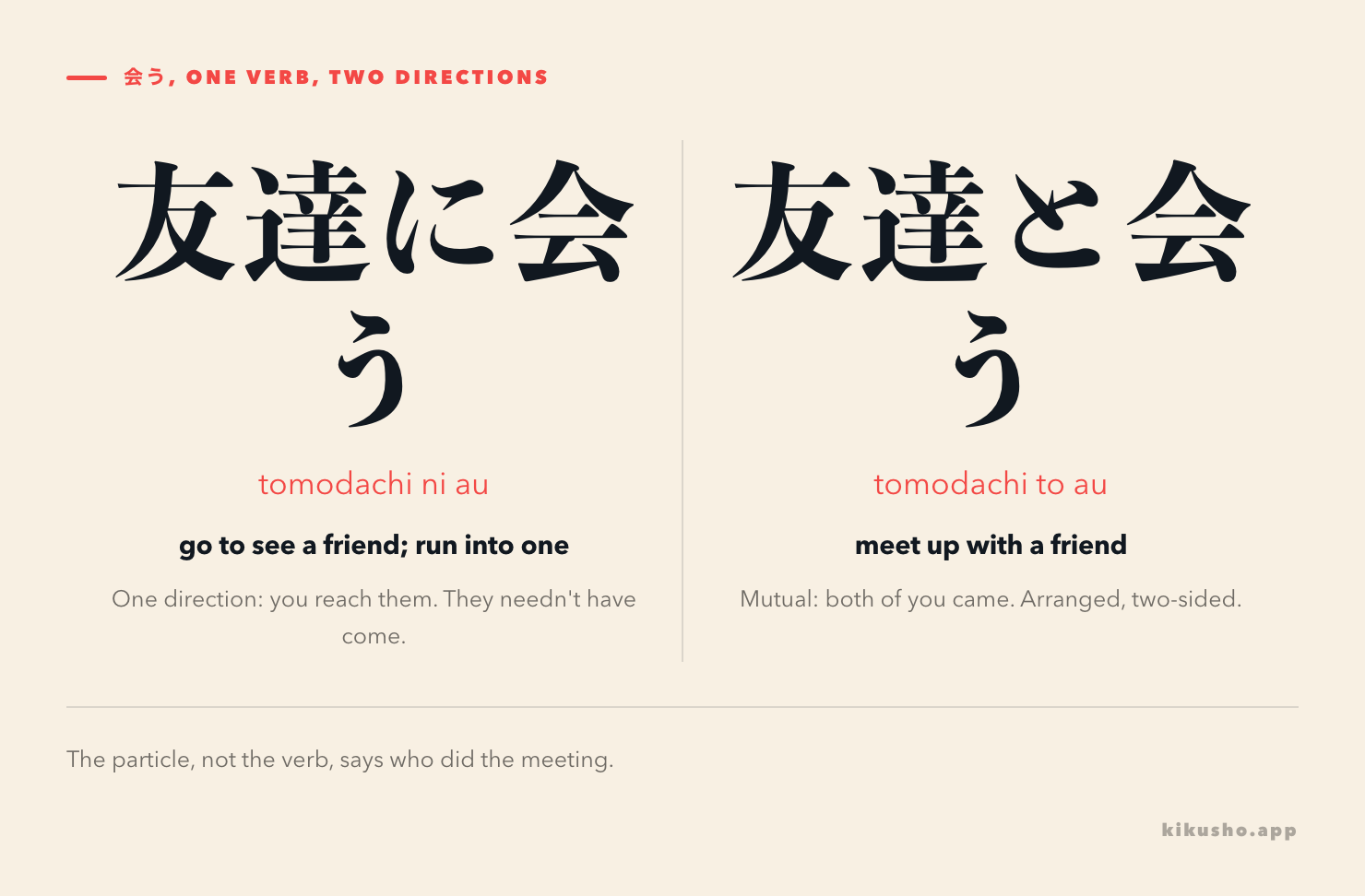
That is why neither form is more correct than the other. They answer different questions. に answers "who did you go and see?" と answers "who did you meet up with?" Pick the one whose question you are actually answering. Japanese leans on particles to carry exactly this kind of difference: は and が split a sentence by what the listener already knows, and に and と split a meeting by who came to it.
The test: could it have happened by accident?
When you are unsure, ask whether the meeting needed both people to agree to it.
If it could have happened by chance — you turned a corner and there they were — only に fits, because a chance meeting has a single active party, and that party is you. If it had to be arranged, so that both of you showed up on purpose, と is at home. A shorter version of the same test: with に, the other person could have stood still and the meeting would still have happened to them; with と, they had to come too.
That one question resolves most cases before you have to think about nuance.
Where に is at home: chance, and going to see someone
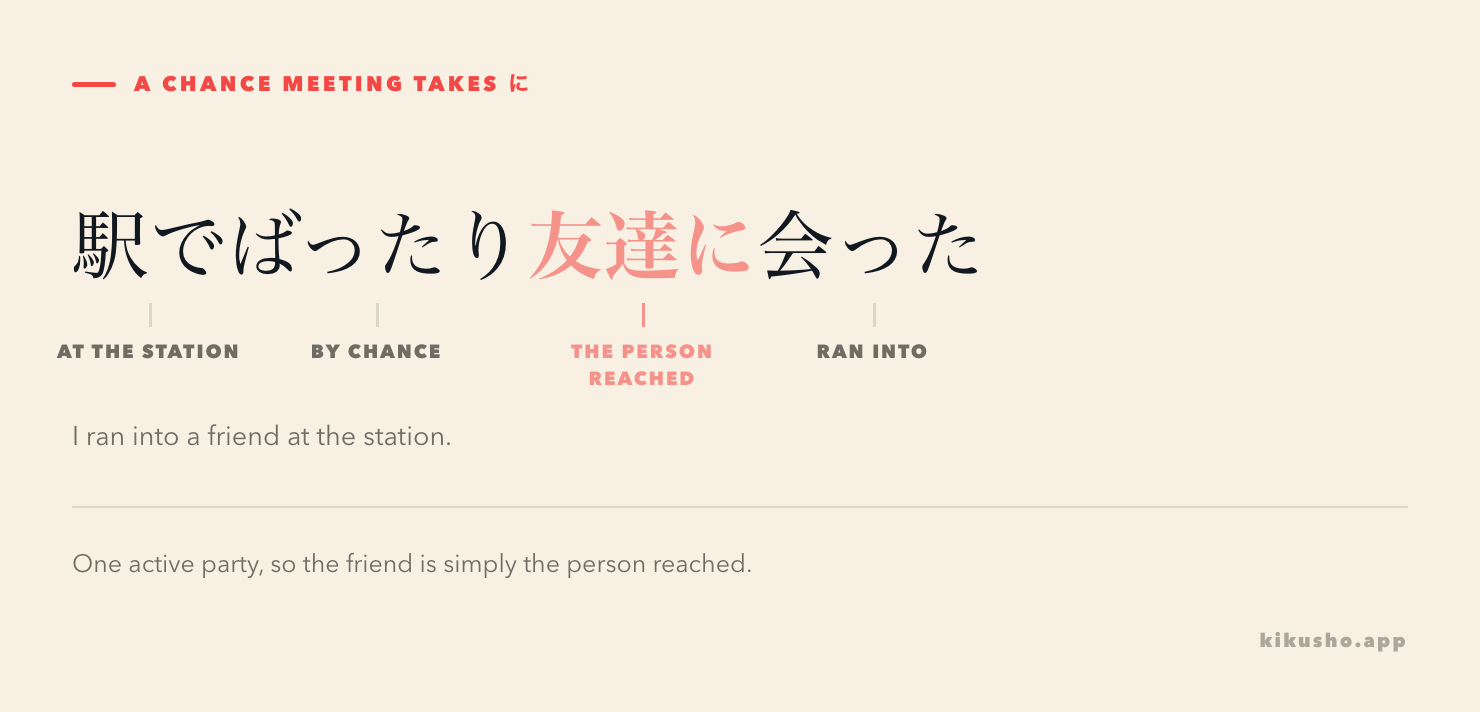
The clearest case for に is the accident. 駅でばったり友達に会った (eki de battari tomodachi ni atta) means "I ran into a friend at the station." Nobody planned it, and you are the only one who did any meeting. と here would be strange: it would imply the two of you had agreed to show up.
に is also the particle when you go to see someone on purpose, in one direction. 医者に会う is to see a doctor; 社長に会いに行く (shachō ni ai ni iku) is to go and meet the company president. The person is the destination your effort travels toward. The same logic runs under 会いたい, which takes に: 君に会いたい (kimi ni aitai), "I want to see you." Longing points one way, from you to them, so に is the natural choice.
Where と is at home: a meeting that took two
と belongs to the get-together that both of you set up. 来週、友達と会うことになっている (raishū, tomodachi to au koto ni natte iru) means "I'm due to meet up with a friend next week," and the plan is mutual by construction. と sits comfortably beside the vocabulary of arrangement: a 約束 (promise) or a 予定 (plan) is something two people hold between them.
The flip side is that と resists accident. 偶然友達と会った (gūzen tomodachi to atta) reads oddly, because 偶然 ("by chance") fights the built-in sense in と that the two of you intended it. For a genuine coincidence, a native speaker reaches for 偶然友達に会った instead. If the sentence contains the idea of chance, the particle has already been chosen for you.
The overlap: both right, aimed differently
For one and the same planned lunch, you can say either, and each tilts the picture. 友達に会う puts the spotlight on you: you went to see them. 友達と会う spreads it across both of you: we met. The sentence is not wrong either way; it foregrounds something different.
So the choice in the overlap is about emphasis. If you crossed the city to see an old friend, に captures that you were the one who made the trip. If you only want to report that the two of you got together, と. In everyday speech と is the safer default for a mutual meeting between equals, and に leans a touch more formal or one-sided — and it becomes the only option the moment chance or pure purpose enters the sentence.
The same split decides 話す, 相談する and 約束する
Here is the reason 会う is worth this much attention: the choice it forces is a single rule, and that rule runs through every verb that can take both particles. 会う only feels slippery because English "meet" hides the choice the way English rarely marks direction. Once you see it, the other verbs fall into line. に marks the person as the recipient or target, one direction. と marks them as a co-participant, both ways.
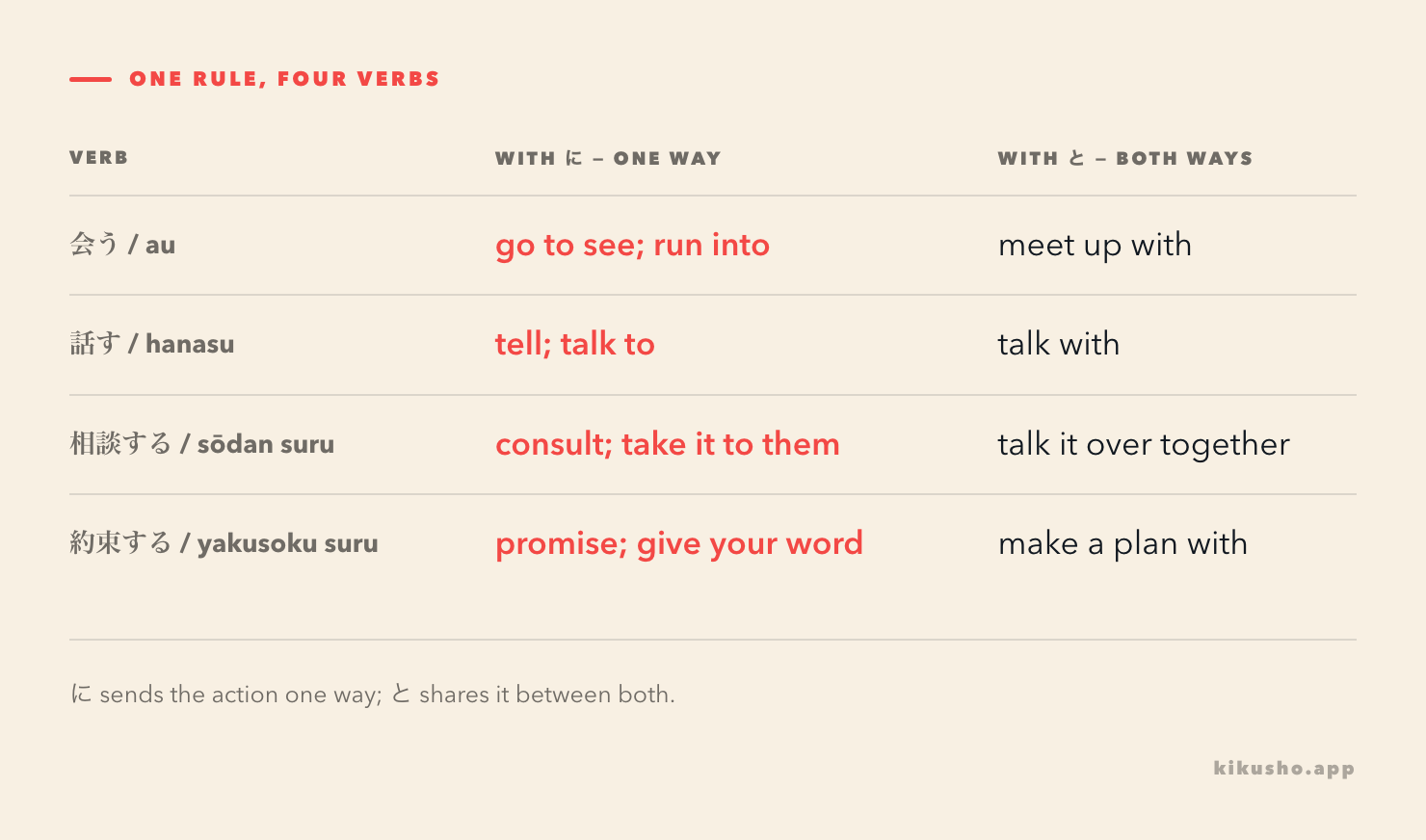
話す is the cleanest. 友達に話す is to tell a friend, to talk to them — the words travel one way, from you outward. 友達と話す is to talk with a friend, a conversation moving both ways. 先生に話す ("I'll tell the teacher") is a different act from 先生と話す ("I'll have a word with the teacher").
相談する follows the same track. 友達に相談する is to consult a friend, to bring your problem to them for advice: you hold the trouble, they are the ear. 友達と相談する is to talk it over together, to confer. 親に相談する is asking your parents' advice; チームと相談する is deciding something with the team.
約束する completes the set. 友達と約束する is to make a plan or a pact with a friend, mutual by nature. 友達に約束する is to promise something to a friend: you give your word, and it travels in one direction. 母に約束した ("I promised my mother") puts your mother on the receiving end of the promise, not alongside you making it.
The through-line is short. Once に reads as "toward" and と reads as "together", those four verbs stop being four rules to memorise and become one rule applied four times.
This is the kind of fact a bare dictionary entry drops. Look up 会う and you get "to meet"; whether it wants に or と lives in the sentence you found it in, not in the headword. It is why keeping the whole line beats keeping the word. When you meet 友達と会う in a message or 先生に相談する in a subtitle, Kikusho holds on to the sentence, its reading and the nuance a dictionary skips, so the card teaches the pairing rather than a verb floating free of its particle.
The place the choice truly bites is the accident. Tell someone 昨日友達と会った and they hear that you had plans; 昨日友達に会った can just as easily be the friend you bumped into outside the station. Japanese will often leave the subject out of the sentence altogether, which only hands the particle more of the work. The verb never moved. The particle carried the whole story.
Common questions
Is 友達に会う ever wrong?
No. 友達に会う is fully grammatical and often the more natural choice, especially for a chance meeting or when you went out of your way to see someone. It simply frames the meeting as one-directional: you reached them.
Does 偶然 (by chance) force に?
Yes. A chance encounter has only one active party, so 偶然友達に会った is the natural phrasing for bumping into someone. 偶然友達と会った sounds self-contradictory, because と carries the sense that the two of you intended to meet.
Are there verbs that take only one of these?
付き合う (to associate with, to go out with) takes only と, because the action is mutual by definition: 友達と付き合う. Verbs like 話す and 相談する take both, and the particle shifts the meaning each time.