On this page
Japanese drops the subject because the sentence usually already tells you who — not through "context" in some vague cultural sense, but through specific words that can only point one way. Learn to read those words and the missing subject stops being missing: it is carried by the topic you set three sentences ago, by which giving verb the speaker chose, by whether the sentence states a feeling or asks a question.
The advice you normally get here is that Japanese is "high-context" and you have to feel your way in. That is true and useless. The subject is not floating in the air between two people; it is encoded in the grammar, and the encoding is learnable. This is the set of cues that resolve it, in the order you should check them.
The subject isn't dropped — it's just not said twice
Once something is the topic, it stays the subject of every following clause until something new takes over. You mark it once and let it ride. This is the single biggest reason sentences look subjectless: the subject was established already, and repeating it would sound as odd as saying "Tanaka" four times in one English breath.
田中さんは電車を降りた。改札を抜けて、店に入って、コーヒーを頼んだ。 Tanaka got off the train. Went through the gate, went into the café, ordered a coffee.
Four verbs, one subject, stated once. English forces a "he" in front of each; Japanese would find that repetition strange. So the first question to ask of a subjectless sentence is never "who is this about?" but "who was the topic, and has anything replaced them?" Nine times out of ten the topic set with は a sentence or two ago is still holding, which is exactly why は marks what the listener already knows — the shared, established thing does not need re-stating.
A statement is about me, a question is about you
When nothing else is there to go on, the sentence type sets the default. A plain statement defaults to the speaker; a question defaults to the listener. This one rule resolves a huge number of short, cue-free sentences.
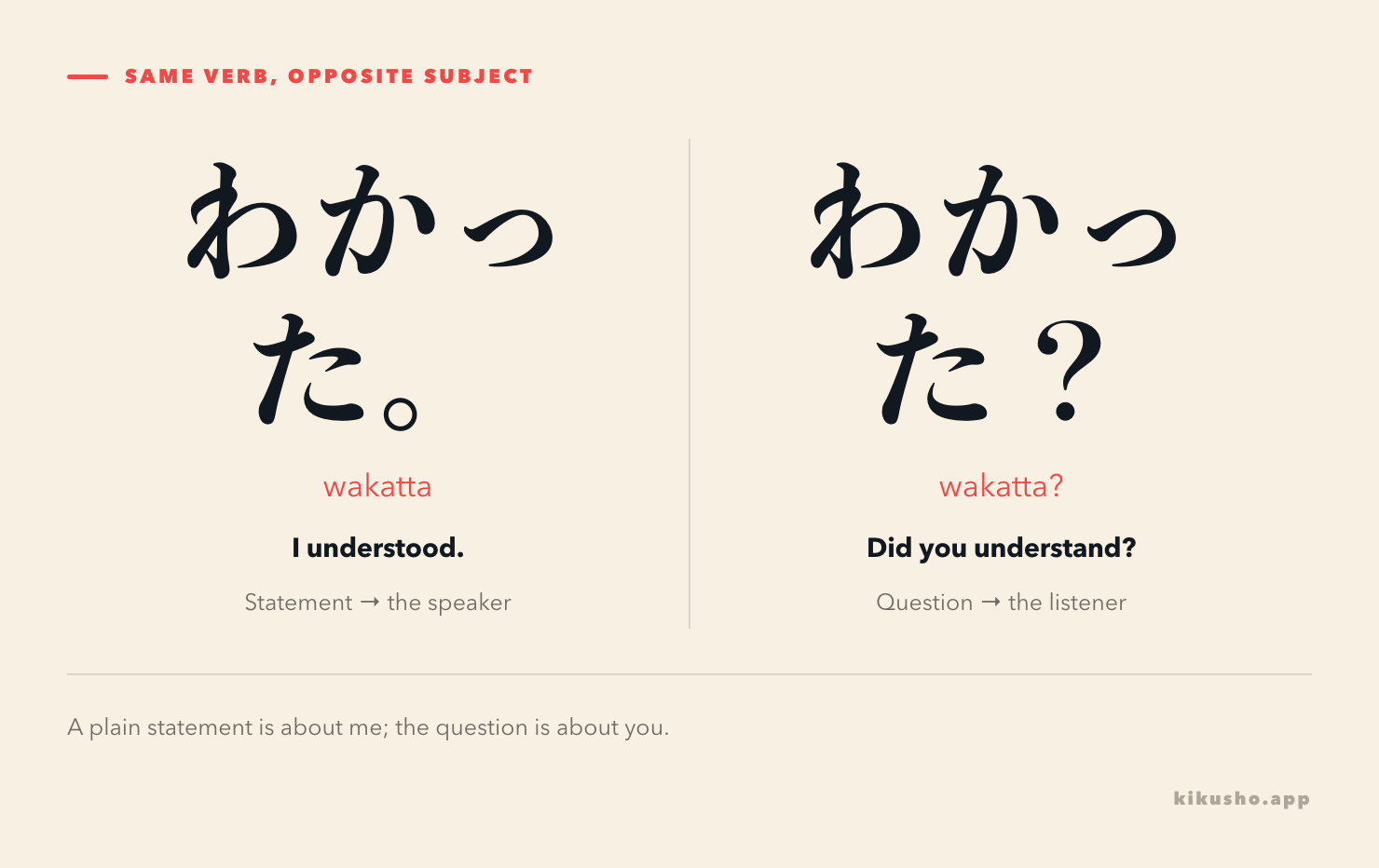
「疲れた」on its own is I'm tired. Add the rising question and 「疲れた?」is are you tired? Nobody said "I" or "you"; the fact that one is a report and the other is an enquiry did all the work. Get in the habit of registering, before anything else, whether you are being told something or asked something — the answer already narrows the subject to one of the two people in the room.
Giving and receiving verbs fix which side you're on
This is the cue learners skip past most often, and it is the most powerful. Japanese has three verbs for the single English idea "give/receive", and the one the speaker picks encodes direction — which fixes the subject without naming anyone.
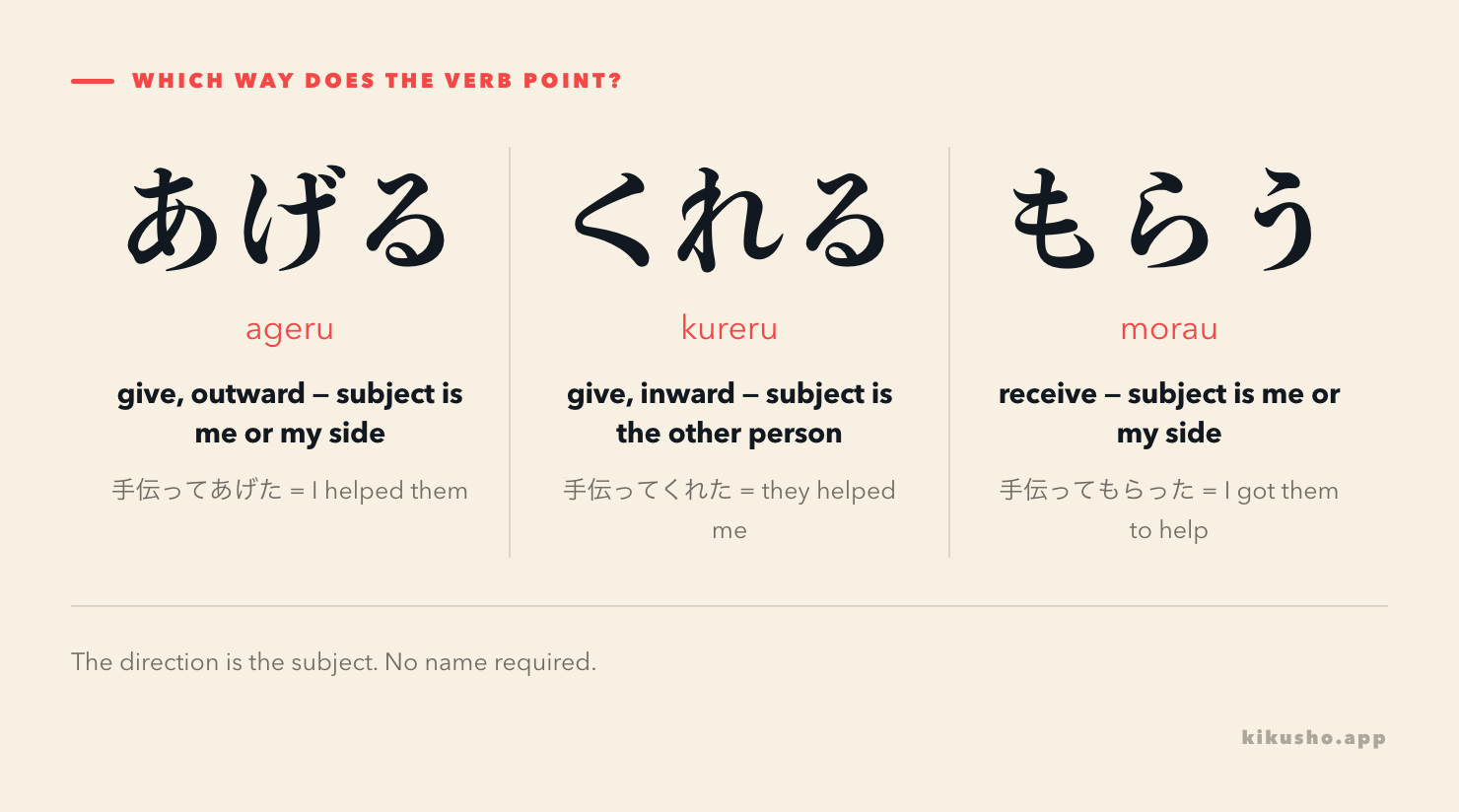
- あげる — the action goes outward, from me or my side to someone else.
- くれる — the action comes inward, from someone else to me or my side.
- もらう — I receive; the subject is me or my side, getting something from someone else.
The same three attach to other verbs as auxiliaries, and there they carry the direction into any action at all. So 「駅まで送ってくれた」has no stated subject, yet it can only mean someone drove me to the station — くれる refuses to point any way but toward the speaker. Swap it for 「駅まで送ってあげた」and, with no other change, it becomes I drove them. The verb chose the subject. This is also why leaving the person out is so often the natural choice rather than an omission — the direction word already said everything a pronoun for "I" or "you" would have.
This is also why the direction is harder to catch by ear than on the page. The giving verb lands at the very end of the clause, so a listener has to hold the whole action open — someone did something to someone — and only settle who at the last syllable. On paper you can glance ahead to that final verb; in speech you have to wait for it. Training yourself to expect the answer at the end, instead of reaching for it at the start, is most of what makes spoken Japanese click here.
Feeling words describe the one who feels — usually the speaker
Japanese draws a hard line you can lean on: in a plain statement, a private feeling or desire belongs to the speaker, because you are the only person whose inner state you can flatly assert. 「寂しい」is I'm lonely. 「新しいパソコンが欲しい」is I want a new laptop. 「食べたい」is I want to eat — the 〜たい ending is a want, and a want is yours.
The proof is in what happens when the feeling is someone else's. You cannot keep the plain form; you have to mark it. 「彼は寂しがっている」uses 〜がる, the "shows signs of" ending reserved for other people's feelings, or you hedge with 〜そう or 〜みたい. That extra marking is itself the cue: a bare feeling word is the speaker's, and the moment it is about a third person the grammar tells you so. And as with everything else, the question flips it — 「寂しい?」is are you lonely?, aimed straight at the listener.
Honorific and humble verbs point in opposite directions
Keigo is usually taught as politeness, but for reading a subjectless sentence it does something more concrete: it names the subject by whom it raises or lowers. Honorific verbs elevate someone else, so the subject is the other person. Humble verbs lower the speaker's own side, so the subject is you.
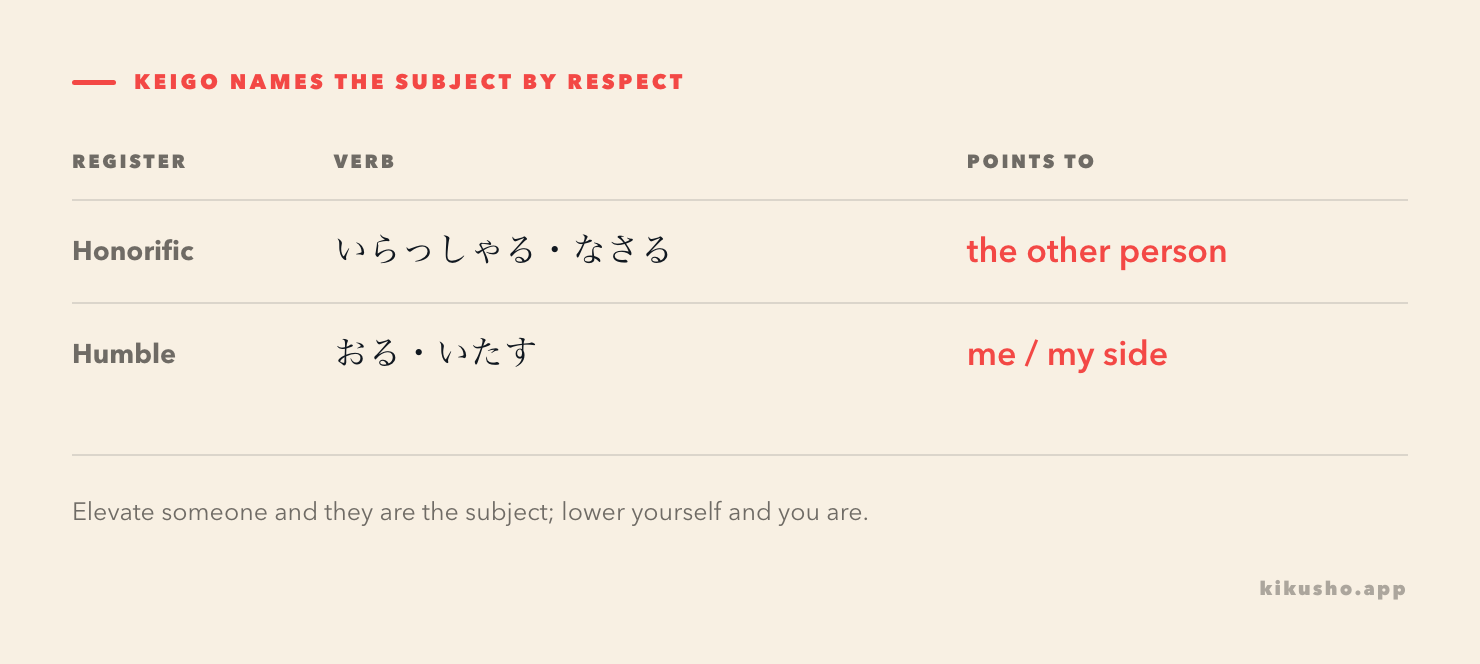
「明日はいらっしゃいますか」carries no subject word, but いらっしゃる is honorific, so it can only be asking about the listener — are you coming tomorrow? Answer 「はい、参ります」and 参る is humble, so you barely need the 私: yes, I'll come. Two sentences, no pronouns, and the register alone kept the subjects straight. If keigo still feels like a separate vocabulary to memorise, it is really just three levels and a handful of patterns — and each one quietly tells you whose action it is.
When you're the one speaking, leave it out more than feels safe
Everything above also tells you how to sound less like a textbook. Beginners state 私は at the front of every sentence because English trained them to put a subject there, and it is one of the clearest tells of a foreign speaker. Native-sounding Japanese names the subject only to introduce it or to draw a contrast, and then drops it for as long as it holds — which is usually a good while.
The rule for producing is the mirror of the rule for reading. Set the topic once. Reach for the giving verb or the keigo form that already implies who is acting. Then stop naming people until something genuinely changes. If you catch yourself about to say 私は again, ask whether anything has actually shifted since the last sentence; nearly always nothing has, and the 私は you were about to add would only have made the sentence heavier and a little childish. Leaving it out is not sloppiness you are getting away with — it is the form a fluent speaker would have picked.
When it really is ambiguous, the sentence expects you to ask
Sometimes none of these cues fire and the subject is genuinely unclear. That is not a failure of the language, and it is not your cue to panic and re-read: it is the case Japanese leaves open on purpose, because the ambiguity did not matter, or because the speaker expects to be asked. The repair is built in. When a subject does need pinning down — a new one, or a contrastive one — it gets marked with が and stated: 「私が行きます」settles who is going the instant it matters.
So the mistake is not failing to spot a hidden subject. It is hunting for one in every sentence when the running topic, the giving verb, or the keigo already answered the question three words ago. Read the cues in order — topic, sentence type, direction, feeling, register — and by the time you reach a sentence that truly has none of them, you will find it is a sentence where nobody, including a native speaker, needed one either.
Common questions
How do I know if a Japanese sentence with no subject is about me or someone else?
Read the verb and the sentence type first. A plain statement of a feeling or action defaults to the speaker; a question defaults to the listener. Then check for a giving or receiving verb (くれる points the action toward you, あげる away from you) and for honorific or humble forms, which name the subject by whom they elevate. Most sentences are resolved by one of these before you ever need a pronoun.
Does Japanese always drop the subject?
No. The subject is stated when it is new, when it is being contrasted, or when the cues would otherwise be ambiguous — and then it is usually marked with が for new information or は for the running topic. What gets dropped is the subject that is already obvious, not every subject.
Is this the same as subject-dropping in Spanish or Italian?
It solves the same problem differently. In Spanish the verb ending still agrees with the person, so "hablo" can only be "I speak". Japanese verbs do not conjugate for person at all, so the work is done by other words — giving verbs, feeling words, keigo and the running topic — rather than by the verb's ending.