On this page
You were taught that ている is the Japanese present continuous, the twin of English -ing. By that rule 結婚している should mean "is getting married". It means "is married": already, and for as long as the marriage holds. ている does not track an action in progress. It names a state that is true right now, and whether that state is an action still running or the result of a finished one is settled by the verb it sits on, not by ている itself.
What ている names is a state, not a tense
Start from what the form does, before worrying about which reading you get. ている takes the て-form of a verb and adds いる, the verb of animate existence. The whole thing says: a certain state is in effect at the moment you are speaking. The trap is that two very different states can both be "in effect".
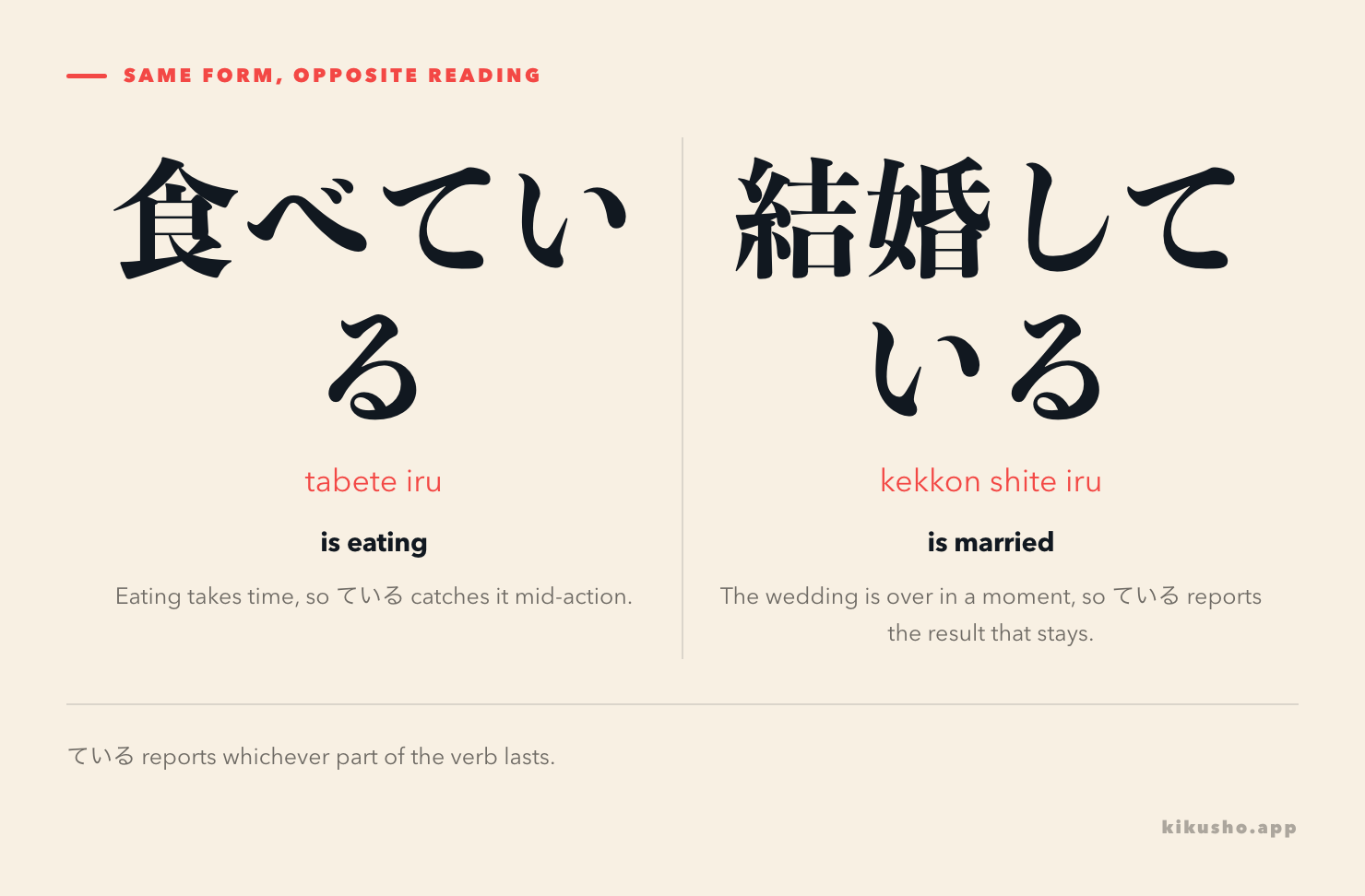
Take 食べる, to eat. 食べている is the eating still under way: "is eating". Take 結婚する, to marry. A wedding is over the instant the vows are done, so 結婚している cannot be the ceremony still running. What is still in effect is that the person is married. Same ている, opposite readings, and the verb picked which one.
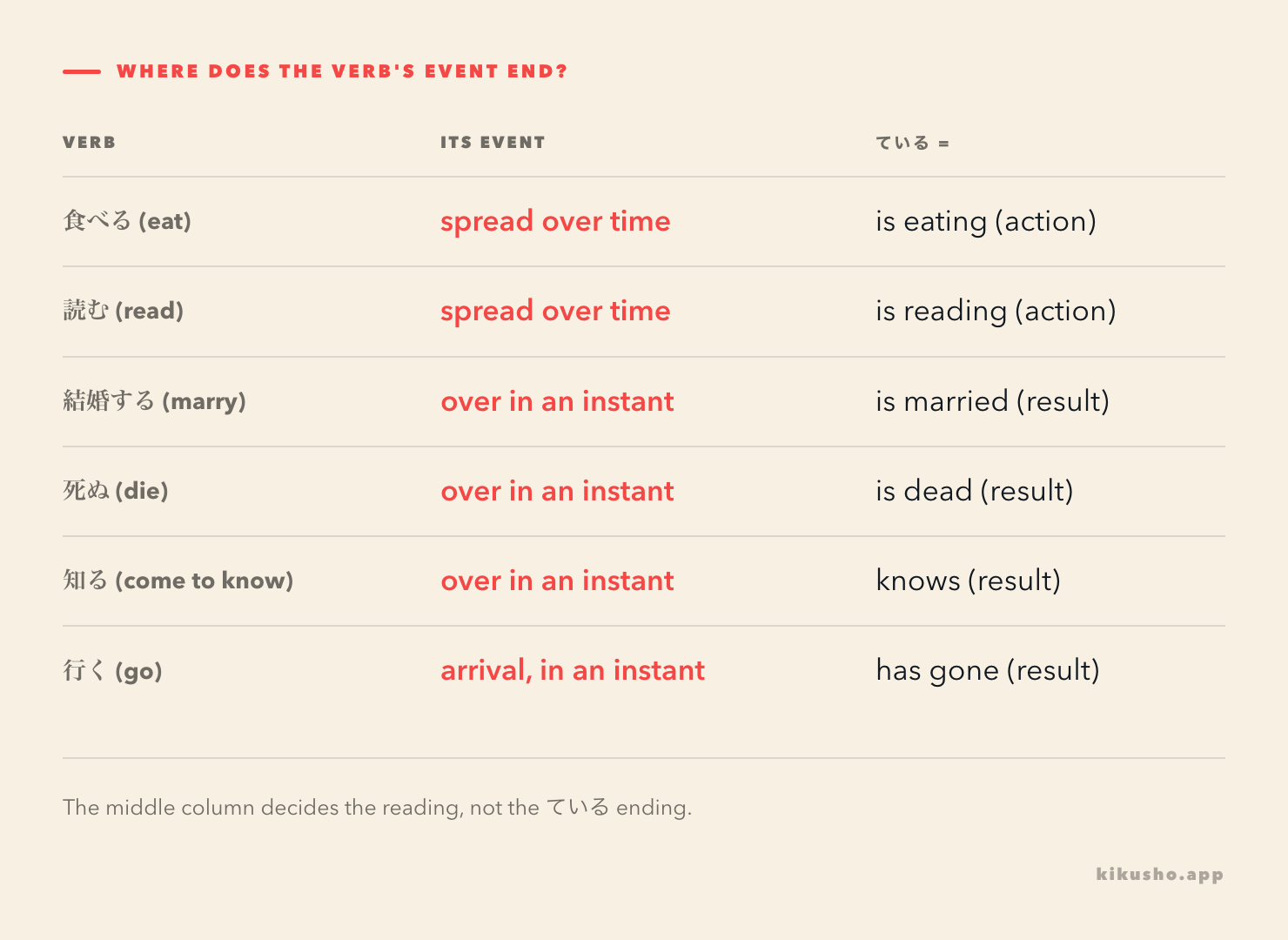
So carry one rule, not a list: ている reports whichever part of the verb has duration. When the action itself takes time, that part is the action, and the reading is "doing". When the action is over in a blink, the only thing with any duration left is its aftermath, and the reading is "the result still stands".
How it attaches: いる on the て-form
You already know the hard half. ている is just いる joined to the て-form you use to link clauses: 食べて → 食べている, 読んで → 読んでいる, して → している. いる conjugates as the regular ichidan verb it is, so everything else falls out of that: polite 食べています, past 食べていた, negative 食べていない. None of it shifts between the two readings. 結婚していた is "was married"; 食べていた is "was eating"; the ending behaves identically and the verb still does all the deciding.
The test: could someone catch you in the middle of it?
When you meet a verb you have never seen in ている, you do not have to recall which category a textbook filed it under. Ask one thing: could someone walk in and catch you in the middle of this verb? If they could, the verb holds a stretch of time you can be inside, and ている drops you inside it. 本を読んでいる (reading a book), 走っている (running), 待っている (waiting): every one is something you can be interrupted partway through.
If they could not, if the verb is a switch that flips in an instant, there is no middle to be caught in, and ている can only point at what the flip left behind. 死ぬ is instantaneous, so 死んでいる is "is dead", the state after. 落ちる is the moment of landing, so 財布が落ちている is "a wallet is lying there". 電気がつく is the click of a switch, so 電気がついている is "the light is on". The verb's event ends, and ている keeps whatever that end produced.
The negative splits the same way
Negate ている and both readings travel with it. On an action verb, 食べていない is "is not eating"; put まだ in front and it becomes "has not eaten yet": まだ食べていない. On a result verb the not-yet reading is the natural one, because the result is a thing that either has or has not arrived: まだ結婚していない is "is not married yet". That is why まだ sits in front of these negatives so often. It is marking a result still pending, not an action paused, so getting the verb's event right matters here too.
行っている means "has gone", not "is going"
The verb that trips the most learners is 行く, to go. Going somewhere feels like it should take time, so 行っている ought to be "is going". It is not. In Japanese, 行く names the arrival, the reaching of a destination, and that is a single point in time. So 行っている reports the state after arriving: being there. 彼は東京に行っている is "he has gone to Tokyo", with the plain sense that he is in Tokyo now. 来る, to come, runs the same way: 来ている is "has come, and is here".
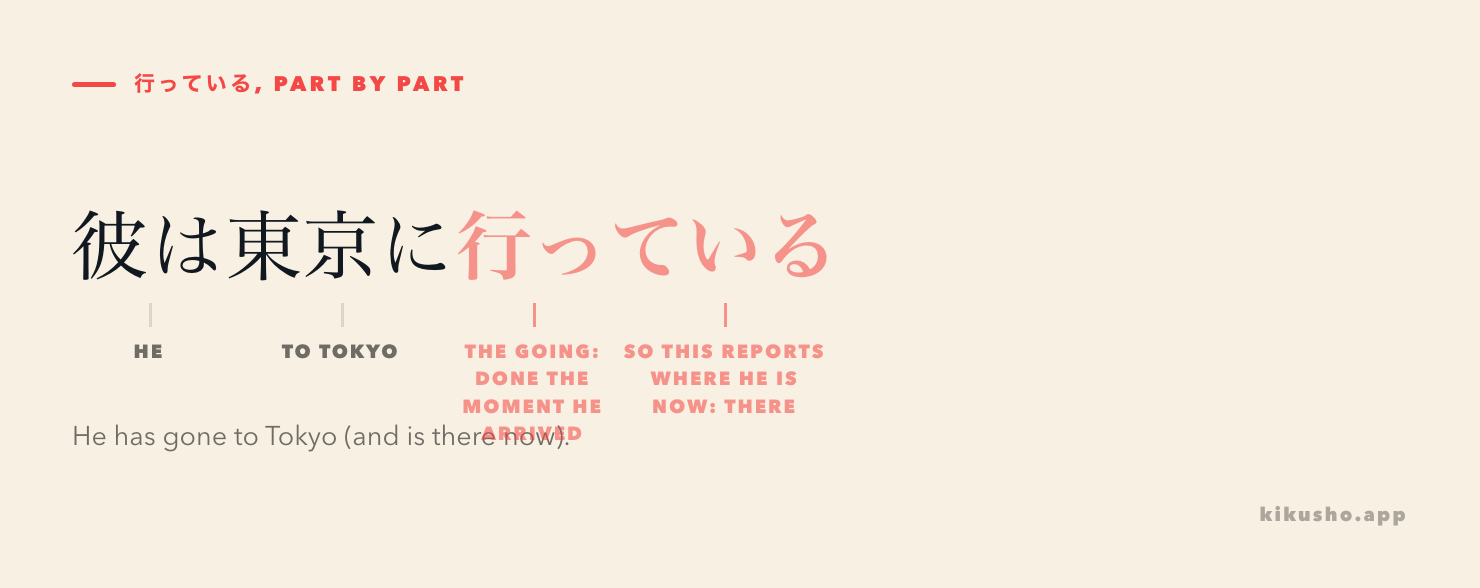
To say someone is still on the way, Japanese does not stretch 行っている to cover it; it uses 向かっている, from 向かう, to head toward, or names the route. Plain 行っている is the arrival already in the bank.
Some verbs live almost only in ている
A few verbs describe a state so completely that the plain form barely appears in the present. 知る, to come to know, is the standard case. The instant a fact reaches you is 知った, "found out"; the state of holding it from then on is 知っている, "know". There is no plain 知る that means "I know" in the here and now, and the negative is 知らない, not 知っていない. If you have met 知る and 分かる as two kinds of knowing, this is the reason one of the pair almost always turns up wearing ている.
似る, to resemble, goes further still: you will hardly ever meet it without ている. 父に似ている, "takes after his father", is a standing fact, and 似る on its own sounds wrong to most ears. 覚える, to commit to memory, works like 知る: 覚えている is "remember", the state 覚える leaves behind. 持つ, to hold, splits by sense: 持っている is "has" or "owns", the thing still in hand.
These are not rules you can derive from the verb; they are facts about particular verbs, and you collect them a sentence at a time, from wherever you met them. That is the gap Kikusho is built to close. When a ている stops you cold, a shop sign reading 閉まっている or a text saying もう帰っている, paste the line in or photograph it, and the card comes back holding the whole sentence, the verb's reading, and the sense it carried there. You review the form inside the sentence that made it clear, rather than reconstructing it from a table of verb types.
It also marks a habit and a track record
The action-or-result split covers most of what you meet, but the same form has a third job, worth knowing so it cannot ambush you. On an action verb, ている can mark a habit instead of a single event under way: 毎朝走っている is "runs every morning", not "is out running this second". It can also mark a track record, something done that still counts on the ledger: 三回結婚している is "has been married three times". A time word like 毎朝 or a count like 三回 is what tells you the reading is habit or record rather than progressive. Default to action-or-result, and let those signals override it.
The casual てる, and the verbs that never take ている
In speech the い falls out and ている becomes てる: 食べてる, 知ってる, 何してる ("what are you doing?"). The contraction touches nothing in the meaning and nothing in the action-or-result split; it is one of the endings that natural speech wears down, and you will hear てる far more than the textbook's full ている.
One group of verbs stays outside the whole system. The stative verbs ある and いる already mean "to exist", so they take no ている: there is no event to be mid-way through and none to leave a result. "There is a cat" is 猫がいる, never 猫がいている. Existence is already a state, and it needs no help to become one.
The mistake that gives you away
Two tells mark someone who has not absorbed the split. The first is reaching for 知ります to claim you know something, or 知っていない to say you do not; the forms a native uses are 知っている and 知らない. The second is subtler and costs more: reading 行っている as "is going" and so misjudging where a person actually is. If a message says 田中さんはもう帰っている, it is not saying Tanaka is in the middle of heading home. It is saying Tanaka has already left, and is home now. Read the event rather than the ending, and 行っている stops being a trap.
Common questions
Does ている just mean the English '-ing'?
Only on verbs whose action takes time, like 食べる (eat) or 読む (read), where 食べている is 'is eating'. On verbs that finish in an instant, like 結婚する, 死ぬ or 知る, ている reports the result instead, so 結婚している is 'is married', not 'is getting married'.
Why is 知っている used for 'I know' and not 知る?
知る names the instant you learn something, an event over in a moment. ている reports the state after that instant, which is the state of knowing, so 知っている is 'I know'. Its negative is 知らない, not 知っていない.
Is ている the same as てある?
Both describe a result that still holds, but てある adds that someone did it deliberately and left it that way. 窓が開いている just says the window is open; 窓が開けてある says someone opened it on purpose.
Does the casual 〜てる mean anything different from ている?
No. 〜てる is ている with the い dropped in speech, so 食べてる is 食べている. The register is more casual; the meaning and the action-or-result split are identical.