On this page
The ん in しんぶん (shinbun, newspaper) comes out as an m, and the ん in りんご (ringo, apple) comes out as an ng, even though both are written with the one kana. That happens because ん has no sound of its own. It is a single beat of nasal that takes the mouth position of whatever follows it, so the m, the n and the ng a learner hears are not three sounds to sort out. They are one sound bending to its neighbour, and the only thing you have to get right is holding it for a full beat.
Stop trying to decide, word by word, whether a given ん is an m or an n or an ng. A Japanese speaker does not decide either. The mouth is already moving toward the next sound, and ん is simply the nasal held while it moves.
The one rule: ん copies the mouth that comes next
Say しんぶん slowly and watch your lips. By the time you reach the first ん, they are already closing for the ぶ, and a nasal made with closed lips is an m. Now say りんご. For the ご, the back of your tongue rises to the soft palate, and the nasal made there is ng. You did not choose either one. The consonant after ん pulled your mouth into position, and the ん came out wearing it.
This is the whole mechanism. ん is what phonetics calls a moraic nasal: a nasal sound that fills one beat and copies the place of articulation, meaning where in the mouth the closure happens, of the consonant after it. Three places cover almost everything.
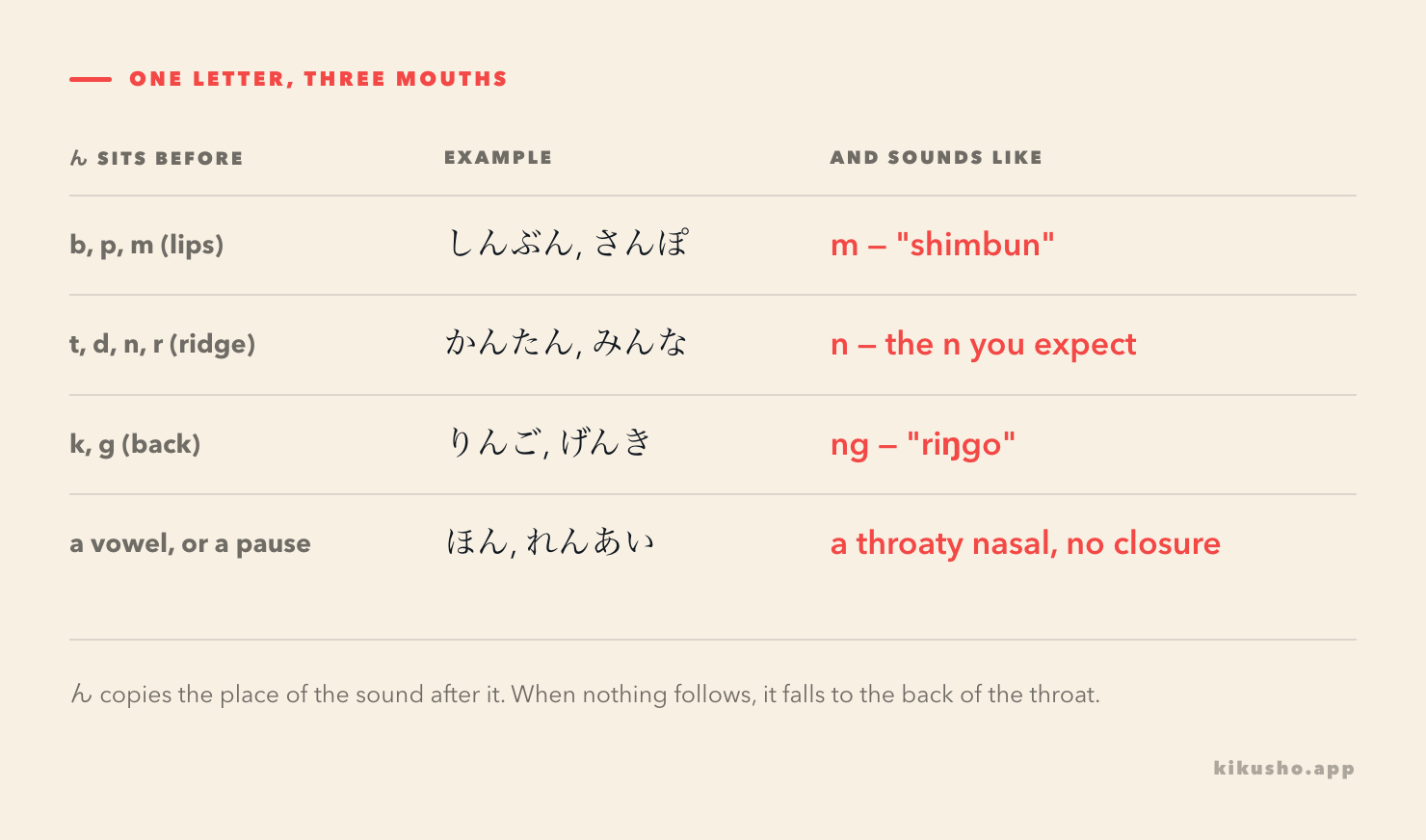
Read down the table and you can predict the next word you have never heard. A ん before any lip sound will be m. A ん before k or g will be ng. A ん before the tongue-ridge sounds is the n you already expected. You are not memorising which word gets which. You are reading the sound that follows and letting it decide.
Why m, n and ng are one sound to a Japanese ear
In English, m, n and ng are three different letters that change the word: rim, rin and ring are three words. So an English speaker hears three sounds and assumes Japanese is choosing between them too. It is not. In Japanese those three are the same unit, ん, appearing in three places, and no Japanese word is ever distinguished by swapping one for another, because the choice is never free. It is forced by the neighbour.
That is why a Japanese speaker cannot tell you which sound ん is, any more than an English speaker can say which of two different l sounds is in leaf and feel without being shown. The variation is real; it just sits below the level anyone pays attention to. For you it runs the other way. You were trained to hear the difference, and the work is to stop treating it as a decision.
しんぶん has two ん, and they are not the same
The clearest proof is a single everyday word. しんぶん contains two ん, spelled identically, and they come out as two different sounds.
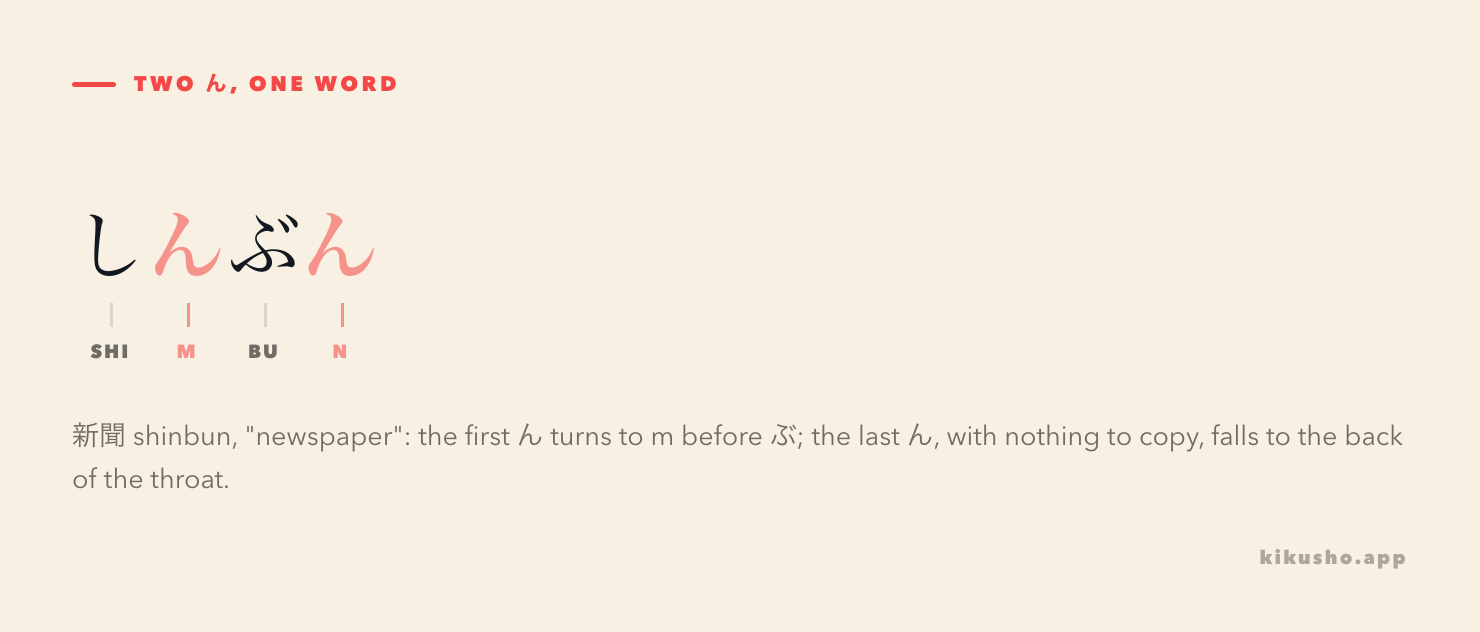
The first ん sits before ぶ, a lip sound, so it is an m: the lips close early and you hear "shimbun." The final ん has nothing after it, so there is nothing to copy. That last case is the one left to explain.
Before a vowel or a pause, ん goes to the back of the throat
When ん ends a word, or comes before a vowel, there is no following consonant to lend it a mouth position. So it settles at the back: a nasal made near the uvula, with no closure of the lips or tongue. It is the ん in ほん (hon, book), in にほん (Nihon, Japan), in ごはん (gohan, rice). English has no exact match, which is why "hon" said with a crisp English n sounds subtly off. The English n touches the ridge behind the teeth; this one touches nothing.
The vowel case is worth its own note, because it shows up in writing. In れんあい (ren'ai, romantic love) the ん comes before あ, and it stays its own full beat instead of blending into a な-row syllable. That is exactly what the apostrophe in romaji marks. しんあい (shin'ai, affection) is し・ん・あ・い, four beats, while しない (shinai, does not do) is し・な・い, three. The apostrophe is not decoration. It tells you a ん is there, holding a beat, and that the vowel after it starts fresh.
Before s, h, y and w, the same thing happens
The consonants that are not made with a full closure, the fricatives and glides, work like the end-of-word case. There is no firm lip or tongue contact for ん to copy, so it nasalises toward the back of the mouth and often colours the vowel around it. でんわ (denwa, telephone), けんさ (kensa, inspection) and ほんや (hon'ya, bookshop) all have this softer ん, closer to the throaty version than to a clean n. You do not need to drill each one. The useful thing to notice is that the crisp, tongue-tip n of English is the rarest realisation of ん in Japanese: it only appears before t, d, n and r. Everywhere else, ん is either a lip sound, a back-of-mouth sound, or no closure at all.
The beat matters more than the exact sound
Here is the part the pronunciation guides skip. If you say the ng in りんご a little too far forward, or the m in しんぶん a little too lightly, no one will misunderstand you. Those are the free variations a Japanese ear ignores. What a listener will catch is a ん that was not held long enough, because length is the thing ん carries.
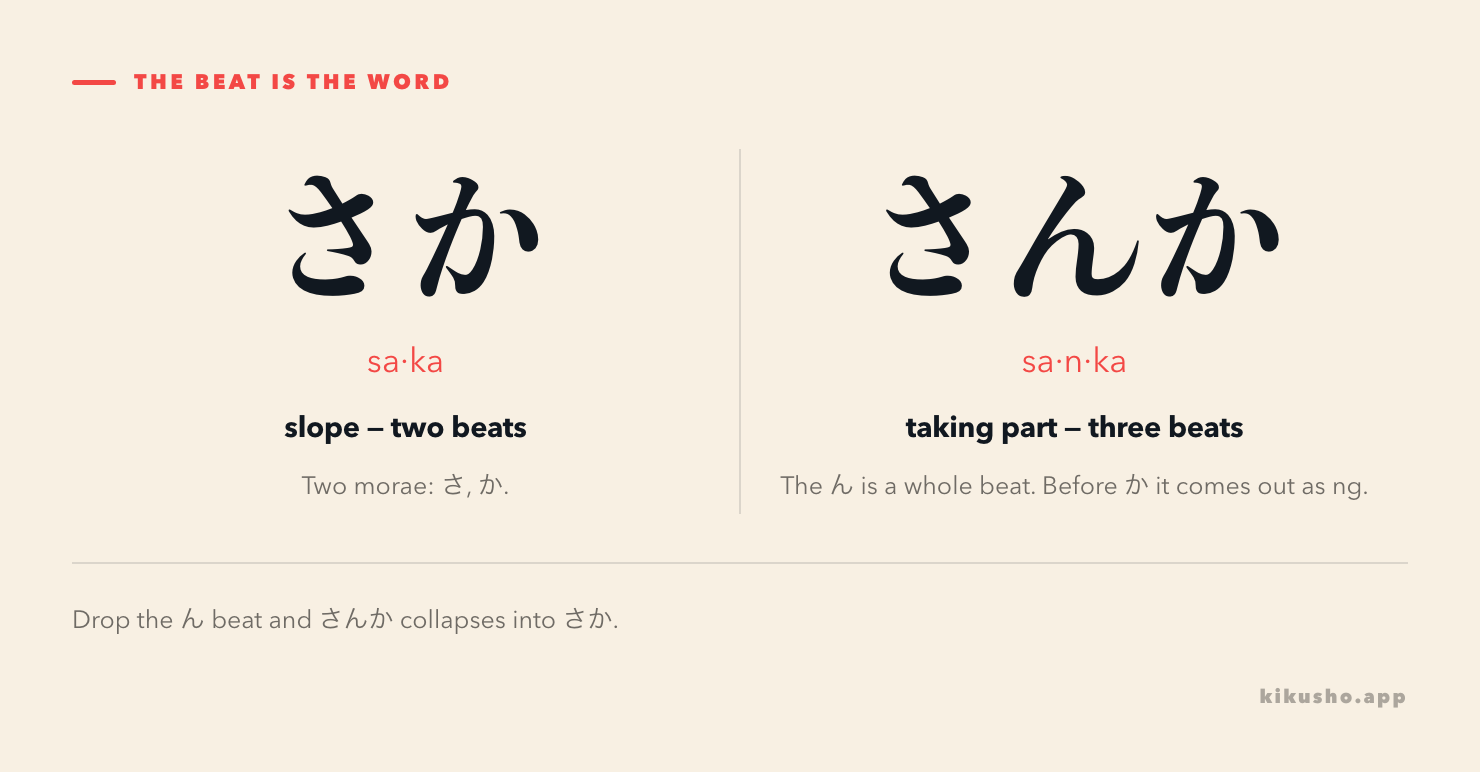
さか (saka, slope) is two beats; さんか (sanka, participation) is three, and the extra one is the ん. Rush it and the word changes. The same beat separates かど (kado, corner) from かんど (kando, sensitivity): one count of ん stands between two unrelated words. English trains you to treat a nasal as a quick consonant tacked onto a syllable, so the instinct is to shorten ん to nothing. Resisting that instinct, and giving ん the same time you give か or ほ, does more for how Japanese you sound than getting the m-versus-ng right ever will.
Hearing it: the pairs that only differ by a beat
Learning to hear ん is the same move as learning to turn a run of speech back into the words you know: you stop waiting for the sound you expected and start recognising the shape the language actually uses. Once you know ん is a full beat, the pairs that used to blur apart separate on their own: かど and かんど, さか and さんか, しない and しんあい. The difference was never a faint extra consonant you had to strain for. It was a whole beat of hum that your ear was discarding because English told it to.
Japanese has a matching habit running the other direction, sounds the spelling promises that the voice then drops. The u in です goes silent, した lands as "shta," and the same rule reshapes words all over the language. Why です sounds like "dess" is the companion to this piece: the vowels Japanese whispers, where ん is the beat it instead insists on. Between the two, a surprising amount of the distance between the spelling you read and the speech you hear turns out to be a small set of rules rather than a thousand exceptions.
The way to internalise either one is repetition on words you actually met, not a drill sheet of syllables. When a word's ん trips you, when you read しんぶん and said it with a clean n, then heard a native say "shimbun" and the two did not match, that mismatch is the thing worth keeping. In Kikusho you can say the word into the app or snap the sign it was on, and the card comes back with native audio, so the beat you misjudged is there to replay on the next review instead of fading by evening. The rule tells you what to expect; hearing the same word enough times is what moves it from something you work out to something you simply hear.
So the next time a ん sounds like an m, nothing has gone wrong with your ears or the word. The lips were closing early for the sound after it. Give the beat its full length, let the next sound shape it, and the mental list of which ん is which can go: it was never real to begin with.