On this page
In Japanese the verb for play is chosen by what your hands do to the thing you play. You press the keys of a piano with 弾く (ひく), blow a flute with 吹く (ふく), strike a drum with 叩く (たたく), and you する a sport. No single word covers all of them. The verb names the physical action rather than the idea of playing, so you decide it by asking what your body is doing to the instrument in front of you.
That one question settles nearly every case English lumps together. The instrument-by-instrument lists you find online look arbitrary while you are memorising them, but they are not a list at all. They are one rule applied five or six times.
Why there is no one word for "play"
English hands you a single verb and lets context do the sorting. You play a piano, play tennis, play a recording, play with the dog, and the word never moves. Japanese declines that economy, in the same way it splits English know into 知る and 分かる: where English keeps one word, Japanese often keeps several and makes you commit to one.
For play, the thing you commit to is the bodily action. There is no general verb meaning engage in a game or a performance; instead the language reaches for the verb that reports the motion, and a different motion takes a different verb. Pressing keys is not blowing air, and blowing air is not striking a skin, so a pianist, a flautist and a drummer each use a verb the other two never would. The verb is a description of the movement, and once you hear it that way the choice stops being a lookup.
The set: the verb is what your hands do
The whole thing fits on one screen. Read the middle column first, because the motion is what picks the verb; the instruments on the left are only examples of things that take that motion.
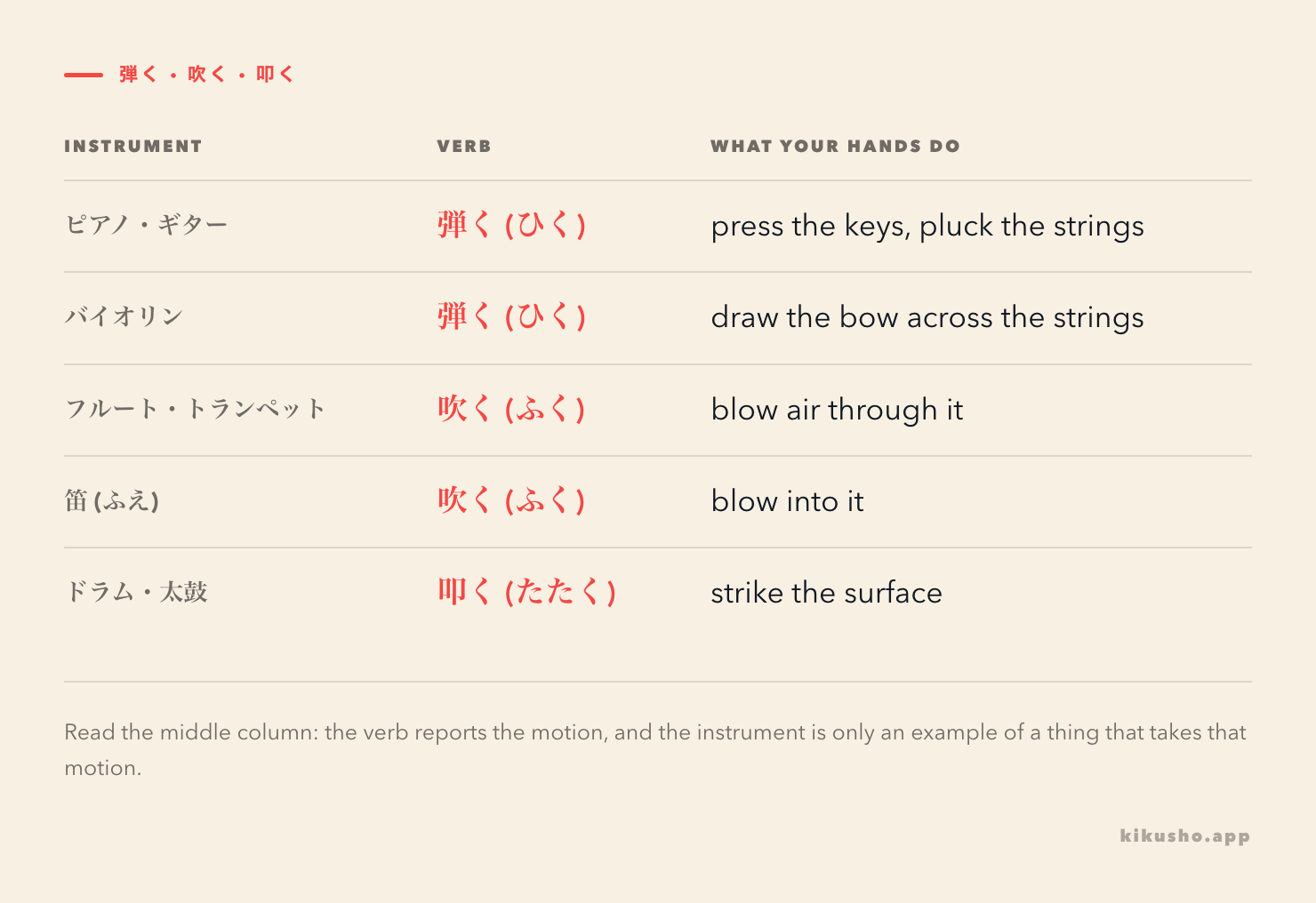
弾く is the verb of the fingers on strings and keys. ピアノを弾く, ギターを弾く, バイオリンを弾く, 琴を弾く (こと, the koto): plucked, bowed or pressed, they all count as 弾く because the hand works the strings directly. 吹く is the verb of breath. フルートを吹く, トランペットを吹く, 笛を吹く (ふえ, a flute or whistle): if you blow into it, it takes 吹く. 叩く is the verb of the strike. ドラムを叩く, 太鼓を叩く (たいこ, a taiko drum): you hit the surface, so you 叩く it. Three verbs, three motions, no exceptions inside the group.
The pattern is the motion, not the instrument
This is why learning the verbs as a vocabulary list is the slow road. A list asks you to remember that a trumpet takes 吹く as a bare fact, unconnected to anything, and bare facts are exactly what you forget. The rule connects them: a trumpet takes 吹く because you blow it, and so does a harmonica, and so does a shakuhachi you have never seen named. You are not memorising instruments. You are asking one question of each new one, and the answer is already a verb you know.
It also means you can be right about an instrument you cannot name. If you watch someone draw a bow across a cello and reach for 弾く, you are correct, because the test was never the word cello; it was the motion of the hand on the string. The rule travels to every instrument, including the ones your vocabulary has not reached yet.
Sports and games take する, and 遊ぶ needs no object
Here する earns its keep. There is no single thing your body does to "tennis" the way it does to a guitar; a sport is a whole activity, not one motion, so Japanese uses the light verb する, the all-purpose do. テニスをする, サッカーをする, 野球をする. Games work the same way: ゲームをする, トランプをする for cards. In casual speech する often becomes やる with no change in meaning, so サッカーをやる and ゲームをやる are both ordinary, and you will hear both.
遊ぶ (あそぶ) is the trap, because a dictionary offers it first under "play." But 遊ぶ is play with no object: children playing, friends spending time together, an afternoon amusing yourself. 公園で遊ぶ is playing in the park, and 友達と遊ぶ is hanging out with a friend. You cannot 遊ぶ a guitar and you cannot 遊ぶ tennis. The instant there is a specific thing being played, 遊ぶ drops out and the action verb or する takes over.
The particle shows the split cleanly. 弾く, 吹く, 叩く and する are all transitive, so the thing you play is marked with を: ピアノを弾く, サッカーをする. 遊ぶ takes no を, because nothing is being acted on; it pairs with で for where the playing happens (公園で遊ぶ) or と for who you play with (友達と遊ぶ). If you catch yourself reaching for 公園を遊ぶ, the を is the warning that you have picked the verb for objectless play and then tried to give it an object.
The games and recordings that break the rule
Two places the rule bends, and both are common enough to learn now.
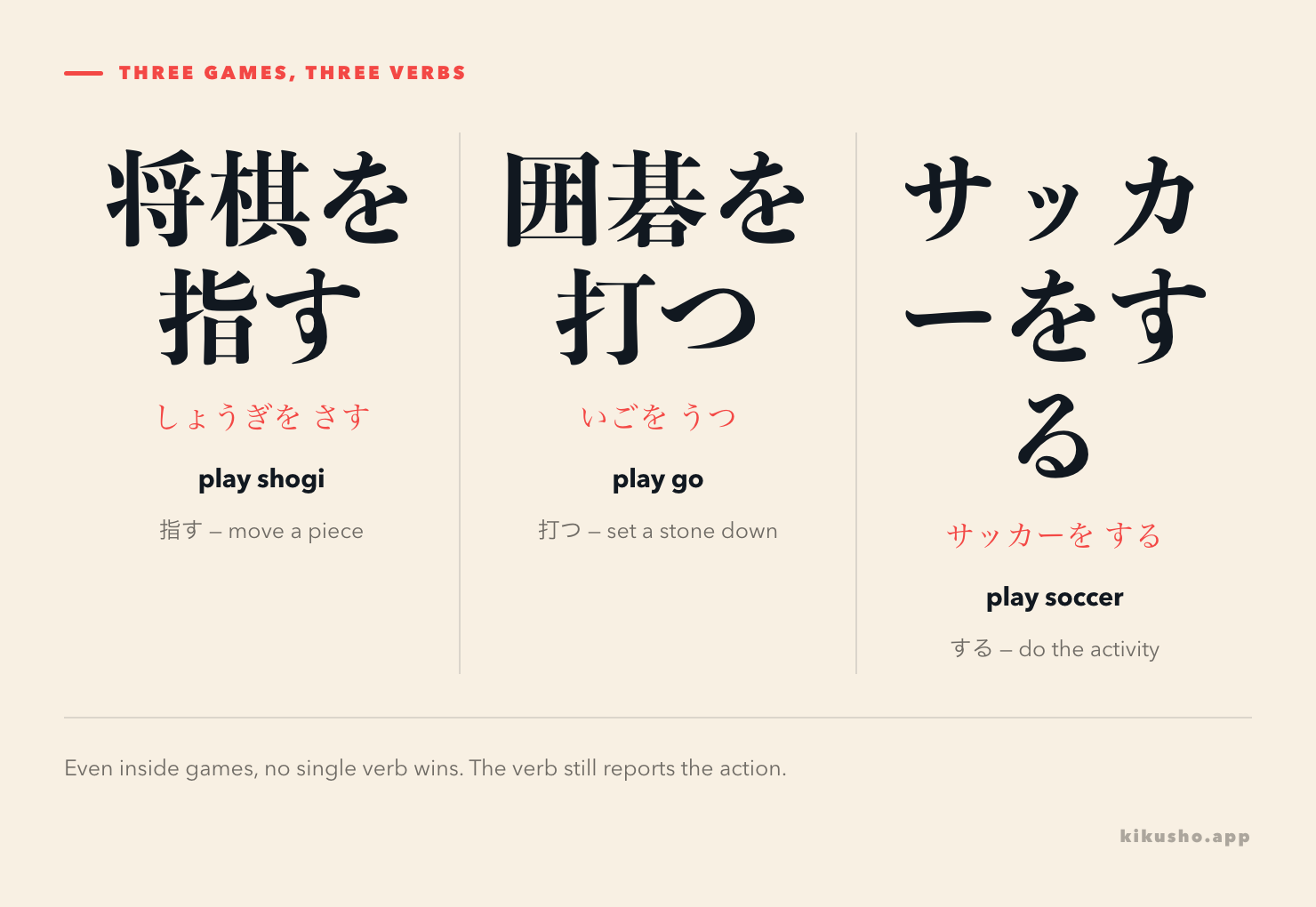
Board games kept their own verbs, older than the catch-all する. You play shogi with 指す (さす), literally to point or move a piece: 将棋を指す. You play go with 打つ (うつ), to strike, because each stone is set down with a tap: 碁を打つ, 囲碁を打つ. Neither one takes する, and a learner who says 将棋をする will be understood but marked at once as guessing.
The other bend is "play" that means starting a recording. When you play a song off your phone you are not performing it, so none of the instrument verbs fit. You かける it — 音楽をかける, 曲をかける — or 流す (ながす) it to let it run in the background, or 再生する (さいせいする) to press play on a track or a video. The verb reports the action here too: you are working a device, not moving your hands over strings.
English stretches play one step further again, to playing a part, and that sense lands somewhere else entirely. To play a role is 役を演じる (やくをえんじる), to act or portray, which is the verb of a stage rather than a game. It shares nothing with the verbs above except the English translation, so do not let play a villain drag you back toward 遊ぶ or する.
The verbs you will actually meet this month
For almost everything you will want to say, five verbs cover the ground:
- 弾く (ひく) for strings and keys: a piano, a guitar, the koto.
- 吹く (ふく) for anything you blow: a flute, a trumpet, a whistle.
- 叩く (たたく) for anything you strike: drums, taiko.
- する (casually やる) for sports and games: soccer, tennis, video games.
- かける or 再生する for playing a recording.
遊ぶ keeps its own corner for play with no object, and 演奏する (えんそうする) is the formal catch-all for "perform music" when you do not want to name the instrument — a concert programme uses it; a friend telling you they play a bit of guitar does not. If you want the instrument words themselves rather than the verbs that attach to them, the N5 music and hobbies set collects the beginner ones.
A dictionary files 弾く, 吹く and 叩く on separate pages, under play, blow and strike, and the rule that ties them together sits on none of them. You absorb it by meeting the pairings whole: ギターを弾く in a lyric, 太鼓を叩く under a festival photo, 将棋を指す in a drama subtitle. When one goes past, the phrase is worth keeping over the bare verb, because the verb only means anything against the thing it acts on. Hand the line to Kikusho, spoken or pasted, and the card it drafts keeps the object beside the verb, with the reading and an example sentence, so the motion and its noun stay joined the way the rule needs them to be. What you keep stays reviewable on the phone with no signal.
Common questions
How do you say "play a game" in Japanese?
ゲームをする, or casually ゲームをやる, for video games and most games. Card games take トランプをする or トランプで遊ぶ. Board games keep older verbs: 将棋を指す for shogi and 囲碁を打つ for go, and neither of them uses する.
What is the difference between 遊ぶ and する for "play"?
遊ぶ is play with no object — children playing, friends spending an afternoon together, 公園で遊ぶ. する needs a named activity in front of を, such as a sport or a game: サッカーをする. The moment there is a specific thing you are playing, you want する or an action verb, not 遊ぶ.
Can 弾く be used for every instrument?
No. 弾く covers strings and keyboards — the instruments you pluck, press or bow: ピアノを弾く, ギターを弾く, バイオリンを弾く. Wind instruments take 吹く (フルートを吹く) and percussion takes 叩く (太鼓を叩く). The one word that covers any instrument is the formal 演奏する.
How do you say "play a song" from a phone or speaker?
曲をかける or 音楽をかける to put a track on, 流す (ながす) to let music run in the background, or 再生する to press play on a recording or video. You are starting a device rather than performing, so the instrument verbs do not apply.