On this page
To turn something down politely in Japanese, you give a reason and then stop. You name the obstacle (you have plans, the timing is bad, you would have liked to) and let the sentence break off before the word for no ever arrives. The listener finishes it in their own head. The two words a textbook hands you for the job, いいえ and できません, are both correct, and both land harder than almost any native speaker would put it.
That gap between what you say and what you mean is the whole mechanism. Once you can see it, the stock phrases stop being a list to memorize and become one move you can make in any situation: supply the reason, withhold the refusal.
The refusal is the part you leave out
A polished Japanese refusal is, structurally, an unfinished sentence. Someone invites you out on Saturday and you answer:
土曜日はちょっと予定があって…… Doyōbi wa chotto yotei ga atte… — Saturday, I've got plans, and…
You said you have plans. You did not say so I can't come. And yet everyone heard so I can't come, because the grammar you stopped on — the て that means and, with more to follow — promised a second clause, and the only clause that fits is the refusal. You produced the reason; they produced the no. Nobody had to say it.
This is why the phrasebook lists feel arbitrary. They give you 「都合が悪くて」 and 「予定があって」 and 「ちょっと用事が」 as separate expressions to drill, when they are all the same single gesture: a reason, then a connective that leans forward into a clause that never comes. It is the same principle that runs through keigo and register more broadly — politeness in Japanese is less a special vocabulary than a set of moves layered onto the sentence you already know how to build.
Finishing the sentence is what stings
The surprise, for a lot of learners, is that いいえ and できません are not rude words. いいえ is just no; できません is just I can't. Nothing about them is slangy or aggressive. What makes them cold is that they are complete. A finished sentence states the refusal as a settled fact, and in a language where the refusal is normally left for the other person to infer, spelling it out is the blunt part.
Compare the same decline at three distances from the bare no:
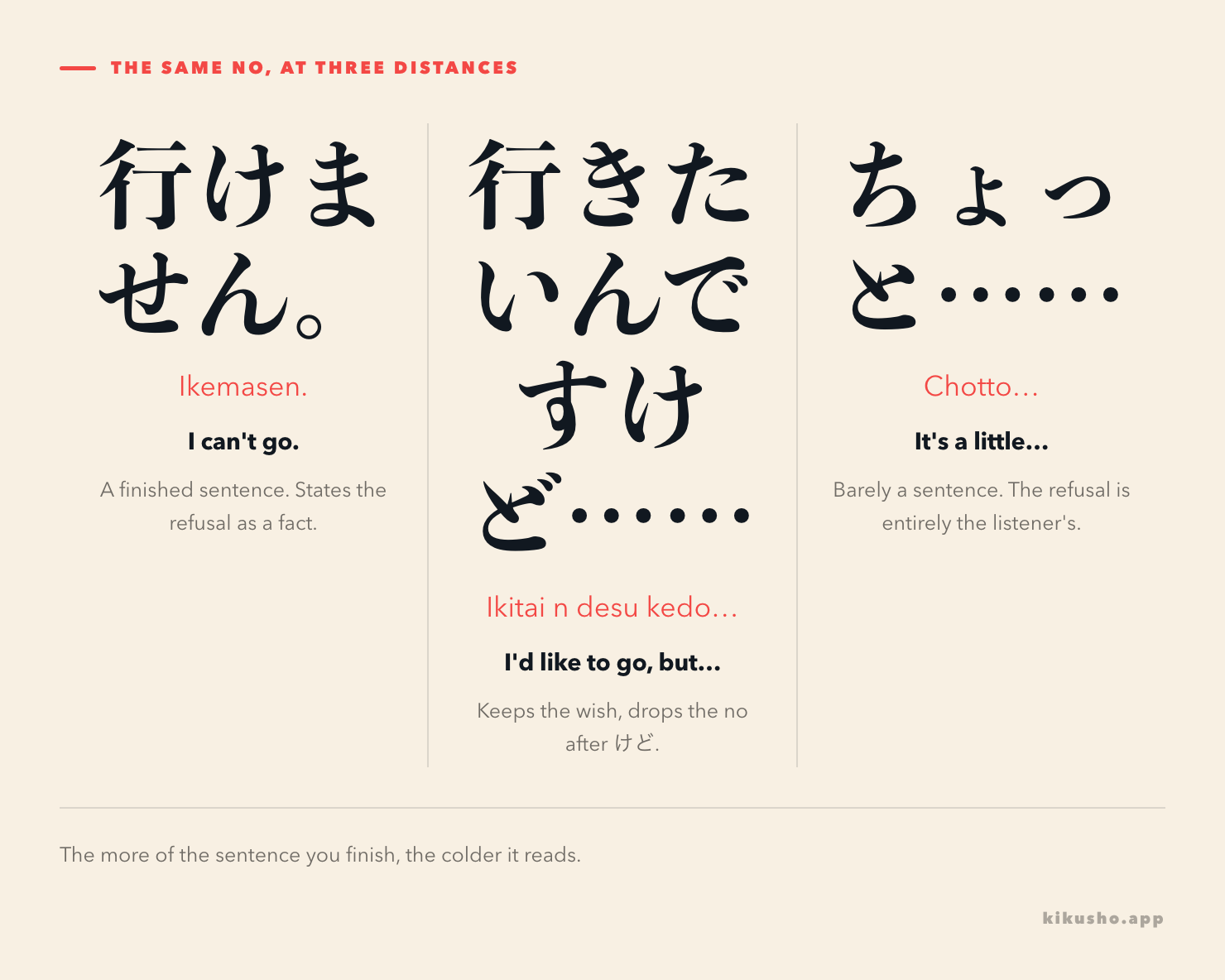
At the top, 行けません closes the matter: I can't go, and nothing follows. In the middle, 行きたいんですけど…… keeps the wish and drops the refusal, so the sentence tilts toward but and stalls there. At the bottom, ちょっと…… is barely a sentence at all, and it is the softest of the three precisely because it leaves the most unsaid. The rudeness was never in the vocabulary. It was in how much of the thought you finished.
Japanese has a way of making a correct, literal answer sound like a door shutting. It is the same effect that lets 知りません sound like a brush-off where 分かりません would not: the words are fine, and the directness is what bruises.
けど and ので carry the no without naming it
Three connectives do almost all the work of trailing off, and each attaches to the end of your reason.
けど (and its formal twin が) means but. You state what you would want, or how the situation stands, and けど promises the contrary clause: 「行きたいんですけど……」, I'd like to go, but…. The but is there; the thing after it is not.
ので (and the blunter から) means so or because. 「その日は予定がありますので……」, I have plans that day, so…. The so points at a consequence you decline to state. The two are not interchangeable in a refusal: から frames the reason as your justification and sounds a little more like you are defending your corner, while ので presents it as plain circumstance and is the softer, more deferential choice. When you are turning someone down, reach for ので.
The て-form is the loosest of the three. It means and, with the clear sense that something follows. 「都合が悪くて……」, it's inconvenient, and…. Because て commits to nothing in particular, it is the easiest to let dissolve into silence.
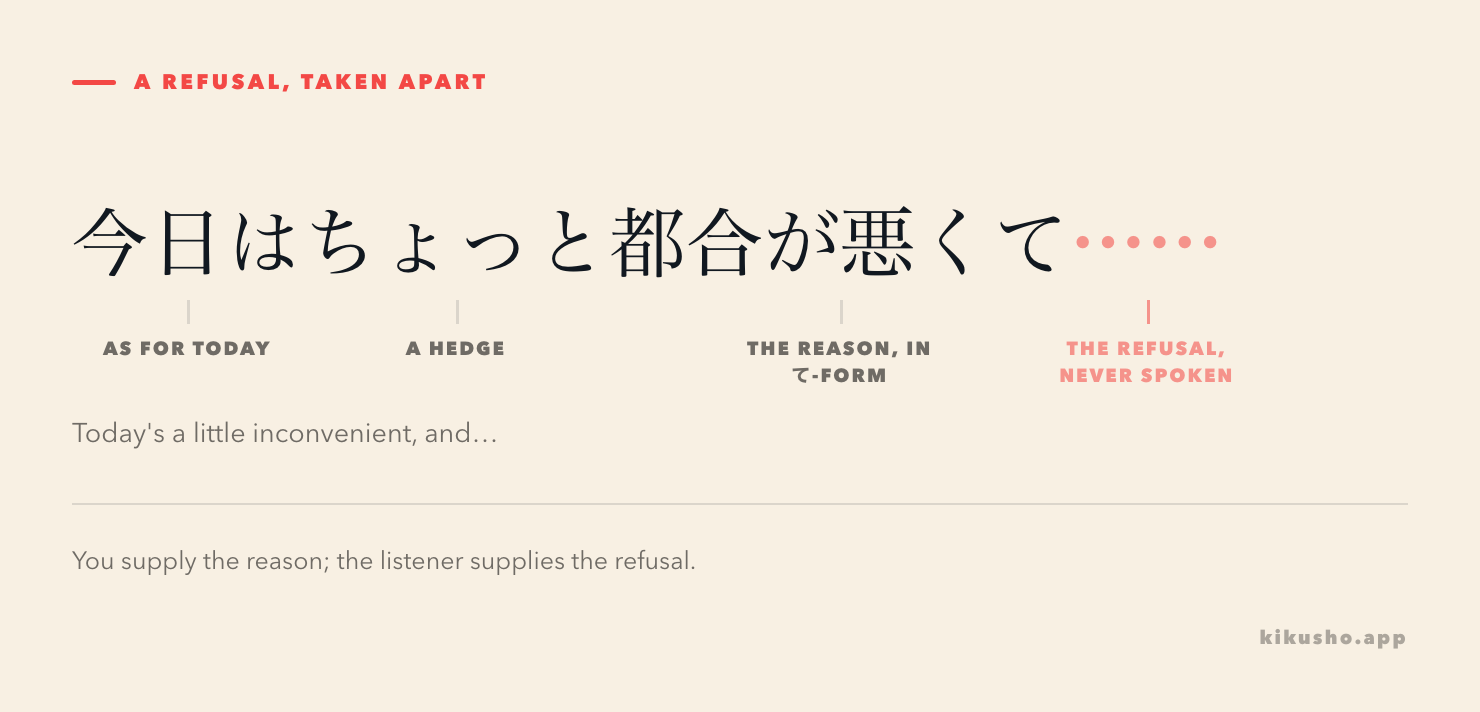
None of these is a special "refusal particle." They are the ordinary connectives you already use to join clauses. The politeness is not in the words. It is in stopping after them.
ちょっと is a whole refusal when nothing follows it
ちょっと means a little, and it is the most useful word in the language for saying no. 「明日はちょっと……」, tomorrow is a little…, is a complete, understood refusal, and you never say a little what. The hearer knows ちょっと is standing in for difficult, inconvenient, awkward, and that naming which one would only make it heavier.
Two set phrases work the same way, by pointing just past the refusal. 大丈夫です, literally I'm fine, declines an offer gently: handed a bag at the register, 大丈夫です means no thank you with no trace of rejection in it. 結構です also declines, but it is firmer, and clipped it can sound cold. It is the one to use when a no needs to be unmistakable, not the one to reach for by default.
A vague reason is more polite than a good one
The instinct carried over from English is to justify: the better your excuse, the more acceptable your no. Japanese runs the other way. 都合が悪い (circumstances are bad), 予定がある (I have plans), 用事がある (I have an errand) are deliberately, almost uselessly vague, and that vagueness is what makes them land well.
A detailed excuse — your cousin is in from Osaka, you already booked a restaurant, you promised someone months ago — sounds like a case being built, and a case invites a counter-offer. It also hints that a better invitation might flip the answer. The vague reason declines without arguing and without weighing the other person's offer against your Saturday. You are not handing them something to negotiate. You are closing the door gently and leaving it closed.
This is also where a dictionary leaves you stranded. Look up 都合が悪い and it offers inconvenient; look up 結構です and it gives fine, splendid. Neither tells you that what you just heard was someone turning you down. Kikusho is built for the phrase you meet rather than the one you go looking for: say the line back or paste it in, and the card it drafts keeps the register note that marks it as a soft decline — the part the dictionary threw away.
In formal Japanese, you cushion the reason before you give it
Step up to a request from your boss or a client and the structure does not change. It only gains a layer. Before the reason you add a cushion word, what Japanese calls クッション言葉, that signals a no is coming before any content arrives.
せっかく marks that you register the kindness of the offer: 「せっかくお誘いいただいたのですが……」, thank you for kindly inviting me, but…. あいにく means as it happens, unfortunately: 「あいにくその日は予定がございまして……」. And 申し訳ありませんが, I'm sorry, but, opens an apology before the reason has even started.
Underneath the keigo it is the same three-part move: a cushion, a reason, and a connective that leans into the clause you never say. The formal version only pads each joint. If you can hear the unfinished sentence in 「ちょっと……」, you can hear it in 「あいにく予定がございまして……」. It is the same silence, wearing a suit.
Refusing a request is not the same as denying a fact
Everything above is about declining: an invitation, an offer, a favor someone is asking of you. There is a second kind of no that works nothing like it, and confusing the two is its own mistake.
When someone is simply wrong about a fact, you say いいえ, plainly, and it is not cold at all. 「アメリカの方ですか?」, Are you American?, answered with 「いいえ、イギリスです」, No, I'm British. You are not turning the person down. You are correcting the record, and a flat いいえ is exactly right. The trailing-off softness belongs to the social act of refusing a person. The clean いいえ belongs to the factual act of setting something straight.
Get the two backwards and both misfire. Trail off when a colleague asks whether the meeting is at three and you have told them nothing at all. Answer a dinner invitation with a crisp いいえ and you have shut a door you meant only to ease closed. The phrases themselves are easy. The skill is reading which situation you are standing in — whether you are declining a person or denying a fact — and once you know that, the right words are the ones you leave out.
Common questions
Is it rude to say いいえ in Japanese?
Not in itself. いいえ is the right word for denying a fact — correcting someone who assumes you can drive, say. It only sounds cold when you use it to reject an invitation or request, where Japanese normally leaves the refusal unsaid behind a reason.
What does ちょっと mean when someone trails off with it?
It means no. Literally "a little," but 〜はちょっと followed by silence is a complete, soft refusal: the speaker signals that something makes it difficult and lets you infer the rest without stating it.
Is 結構です a polite way to refuse?
It can be, but it is firm, and said curtly it turns cold. 結構です declines plainly ("I'm fine, thank you"); for a gentler no, 大丈夫です or a reason that trails off into けど or ので is softer.
Why does できません sound harsh when it only means "I can't"?
Because it finishes the sentence. A polite Japanese refusal stops at the reason and leaves the "so I can't" for the listener to supply; stating it outright with できません names the refusal as a fact, which reads as blunt.