On this page
知る and 分かる both land in English as "know" or "understand," which is why they blur together. In Japanese the line between them is cleaner than that: 知る is information reaching you from outside, a fact you pick up and keep, and 分かる is understanding forming on the inside, a thing becoming clear to you. One is something you do to a fact; the other is something that happens to you.
That single question settles almost everything learners stumble on with this pair. Did it arrive from outside, or did it come clear inside you? The answer decides which particle each verb wants, why 分かりたい barely exists, and why answering a question with 知りません can shut a door that 分かりません leaves open.
The test is whether it reached you or came clear
When you are unsure which verb a sentence wants, ask one thing: is this a fact that reached me from outside, or is it something that became clear inside me?
If someone told you, if you read it somewhere, if you looked it up and now carry it — that is 知る. The knowing is a possession. You have the information, and you got it from a source.
If it clicked, if the pieces resolved, if you can follow it or work it out on your own — that is 分かる. The understanding is a state you are in, and nobody handed it to you.
道 (みち), the road, holds both senses at once. 道を知っている means you have the route: you have walked it, or someone described it, and the directions sit in your head. 道が分かる means you can find your way: the layout makes sense to you, so you could get there even if no one had told you. You can know a road you cannot navigate, and navigate a road nobody ever described. Keep the two senses apart and the rest of this pair falls into place.
知る is a fact arriving from outside
知る takes を, the particle that marks a thing acted on, because 知る treats its object as something taken in from elsewhere. 彼の名前を知っています means I know his name; そのニュースを知った, I heard that news. The を is the tell: an external fact is crossing into your possession.
There is a quirk here that catches nearly every beginner. The bare present 知る is rare on its own, and 知ります almost never means "I know." The state of holding information is 知っている, the knowing kept ongoing, and its negative is 知らない. So the forms you actually use are 知っている for "I know," 知らない for "I don't," and 知った for the moment you found out. If you reach for 知ります to say "I know it," it will sound off, because knowing is not an event that repeats — it is a state you entered the moment the fact first reached you.
That is also why 知りたい, "I want to find out," is one of the most natural things a learner can say. Going after a fact is an ordinary act of will: you can set out to acquire information. Hold on to that, because the other verb does not work this way at all.
分かる is understanding that forms inside you
分かる takes が, and the particle is doing something worth slowing down for. The thing marked が is not the person who understands; it is the thing that becomes clear. 日本語が分かる is not built like the English "I understand Japanese," with an I-subject acting on a Japanese-object. It is closer to "Japanese is clear," with 日本語 as the thing doing the becoming-clear and the person it is clear to left in the background, marked with は or に when named at all.
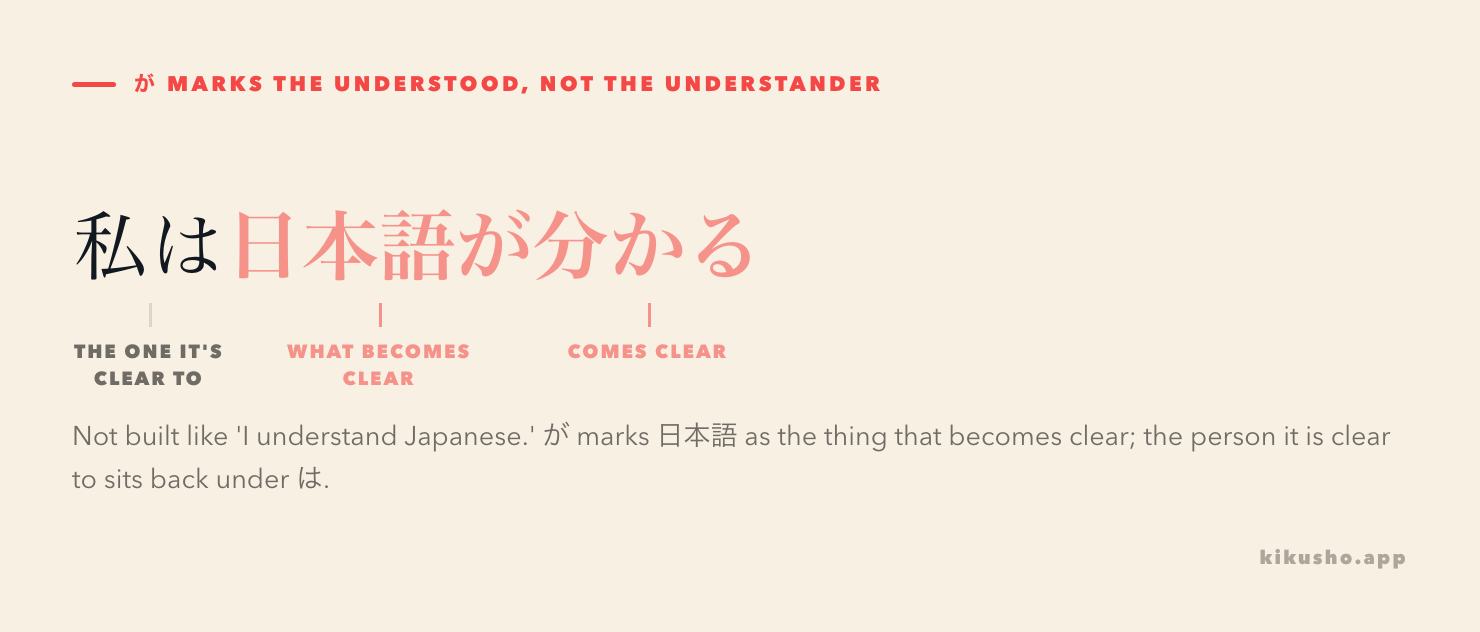
That is why 分かる already behaves like a result rather than an action. 分かった is not "I understood" as something you set out to do; it is "it came clear," which is exactly why it works as "got it" or "I see" the moment an explanation lands. The understanding arrived. You did not perform it.
And it is why 分かりたい is a form you will almost never need. You can want a fact, so 知りたい is everyday. But you cannot will understanding into appearing on command, so "I want to understand" does not map onto 分かりたい the way English leads you to expect. The wish a learner really has, I want to get to where this makes sense, comes out as 分かるようになりたい, "I want to reach the point where it's clear." That keeps 分かる in its proper place: a state you grow into, not a thing you grab.
Where both fit, and the meaning splits
Plenty of objects accept either verb, and the choice is never free: it moves the meaning. The same split runs through all of them: 知っている is holding the information, 分かる is grasping the thing itself.
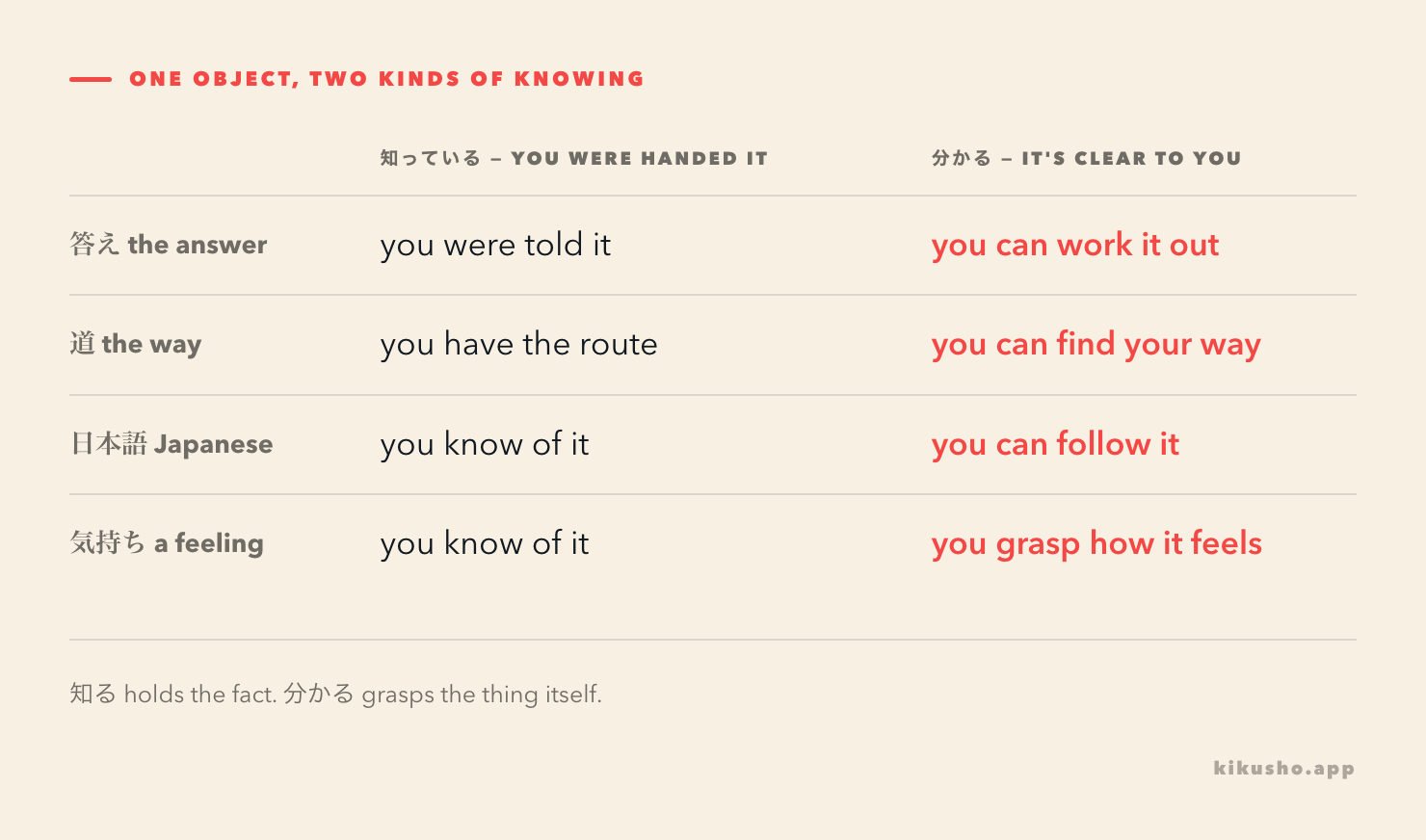
答え (こたえ), the answer, is the sharpest case. 答えを知っている means you were told the answer, or you saw it in the back of the book: you have it, but having it says nothing about whether you could reach it yourself. 答えが分かる means you can work it out, because the problem makes sense to you and the answer follows. A student who copied knows the answer; a student who studied understands it. Japanese keeps those two people in different sentences where English runs them together.
日本語 works the same way. 日本語を知っている sounds odd about your own ability, because it suggests you know of Japanese, that it is a language you are aware exists. 日本語が分かる is the natural claim: Japanese is clear to you, you can follow it. When you do want to say you know a fact about the language, that it has pitch accent, say, you reach for 知っている; when you want to say you can use it, you reach for 分かる. If you have met は and が, the instinct behind wa and ga is the same one at work here: the particle reports the role a word plays, not the dictionary meaning of the verb.
When you hear a native soften a refusal with 分かりません, or catch 知りません landing hard, that is the kind of thing a dictionary will not tell you and a rule sheet will not make stick. It is a register note tied to a specific moment someone said it. Capturing the line as you heard it, with the word, its reading, and that note about how it landed, is what turns the distinction from a fact you read once into one you can feel. Kikusho drafts that register note onto the card for you, which is the field most decks never have room for.
Why 知りません can sound like a brush-off
Here is the payoff, and the reason this pair is worth getting right even before your grammar is tidy. Both 知りません and 分かりません translate as "I don't know." To the person who asked, they do not feel remotely the same.
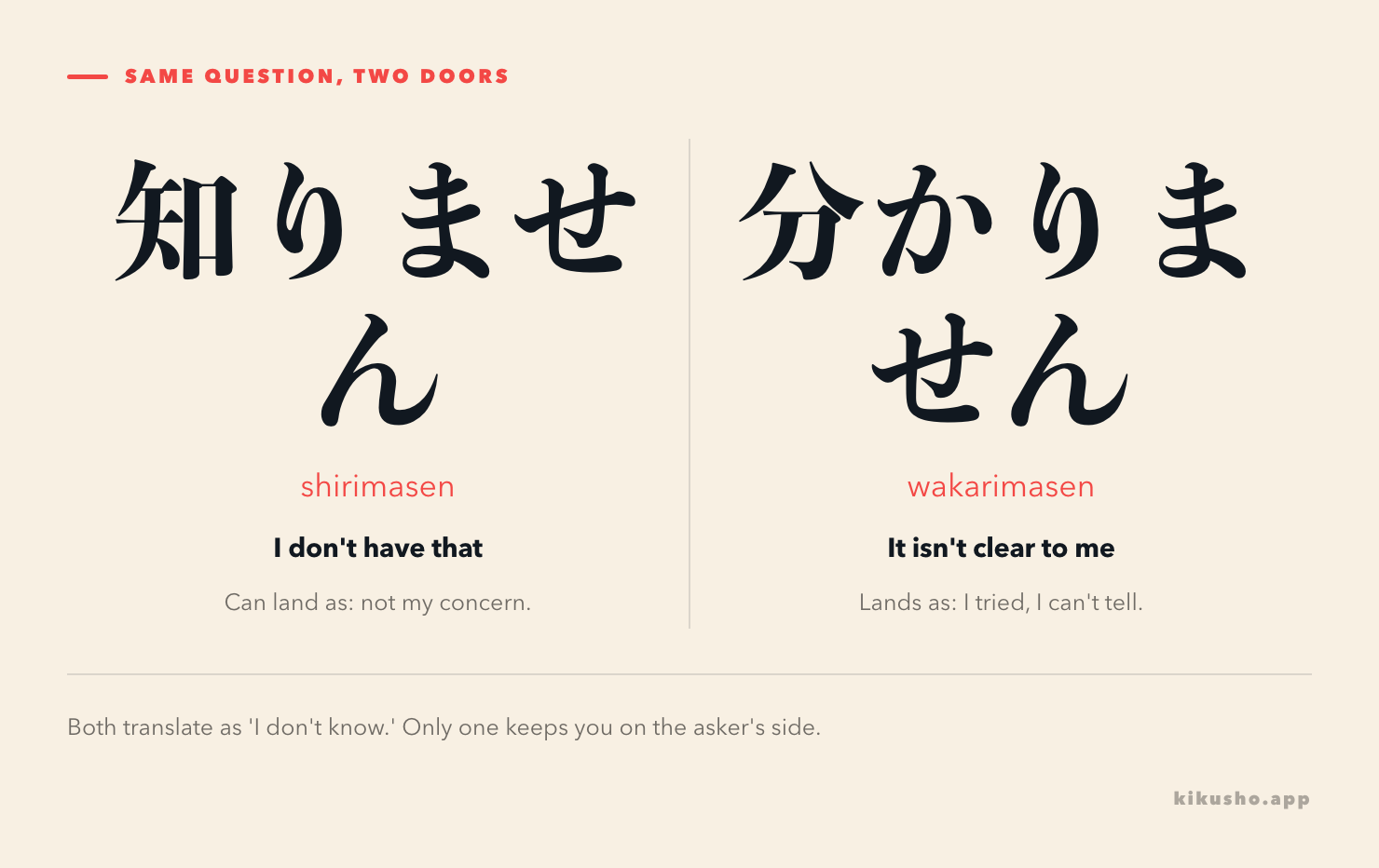
知りません says the information is not in your possession — and underneath that, that it is not connected to you. As a bare answer to someone's question, it comes out as "that is not something I hold," which slides easily into "that is not my concern." A stranger asks where the station is and you reply 知りません: you have told them, accurately, that you do not have that fact, but you have also, without meaning to, closed the door on helping find it.
分かりません says something gentler. It is not clear to me; I can't tell. It admits that you engaged with the question and came up short, which keeps you on the same side as the person asking. 駅はちょっと分かりません, "I'm not sure where the station is," leaves the two of you still working on it together. This is the same instinct that drives how Japanese politeness works: a careful speaker reaches for 分かりません, or cushions 知りません with ちょっと and a reason, almost anywhere a flat 知りません would read as a shrug.
None of this makes 知りません rude by rule. About a genuine third-party fact, whether a shop opens on Sundays or when the last train leaves, it is perfectly ordinary, because nobody expects that fact to live inside you. The sting appears only when the thing asked is something the asker hoped you would help with, and your bare 知りません tells them, in effect, that it was never yours to help with in the first place. 分かりません cannot carry that weight, because you cannot refuse involvement with something you were already trying to understand.