On this page
You already run Anki, and you keep seeing WaniKani recommended next to it. Whether it is worth adding comes down to one question: is the thing slowing you down reading the kanji in front of you, or holding on to the words you keep meeting? WaniKani is built to fix the first and cannot touch the second. If your deck is thin because the words you run into never seem to stay, a kanji course will not fill it.
The one question that decides it
Before you pay for anything, work out which wall you are hitting. There are two, and they feel similar from the inside while needing opposite tools.
The first wall is recognition. You hear a word and know it, but written down it is a shape you cannot read, and a paragraph of them is a grey block you decode one character at a time. The bottleneck is the characters: you have not met enough of them often enough to read on sight.
The second wall is retention. You meet words constantly, on signs, in subtitles, from the person across the table, and they are gone by the next morning because nothing caught them. Your reading is fine. Your deck is empty.
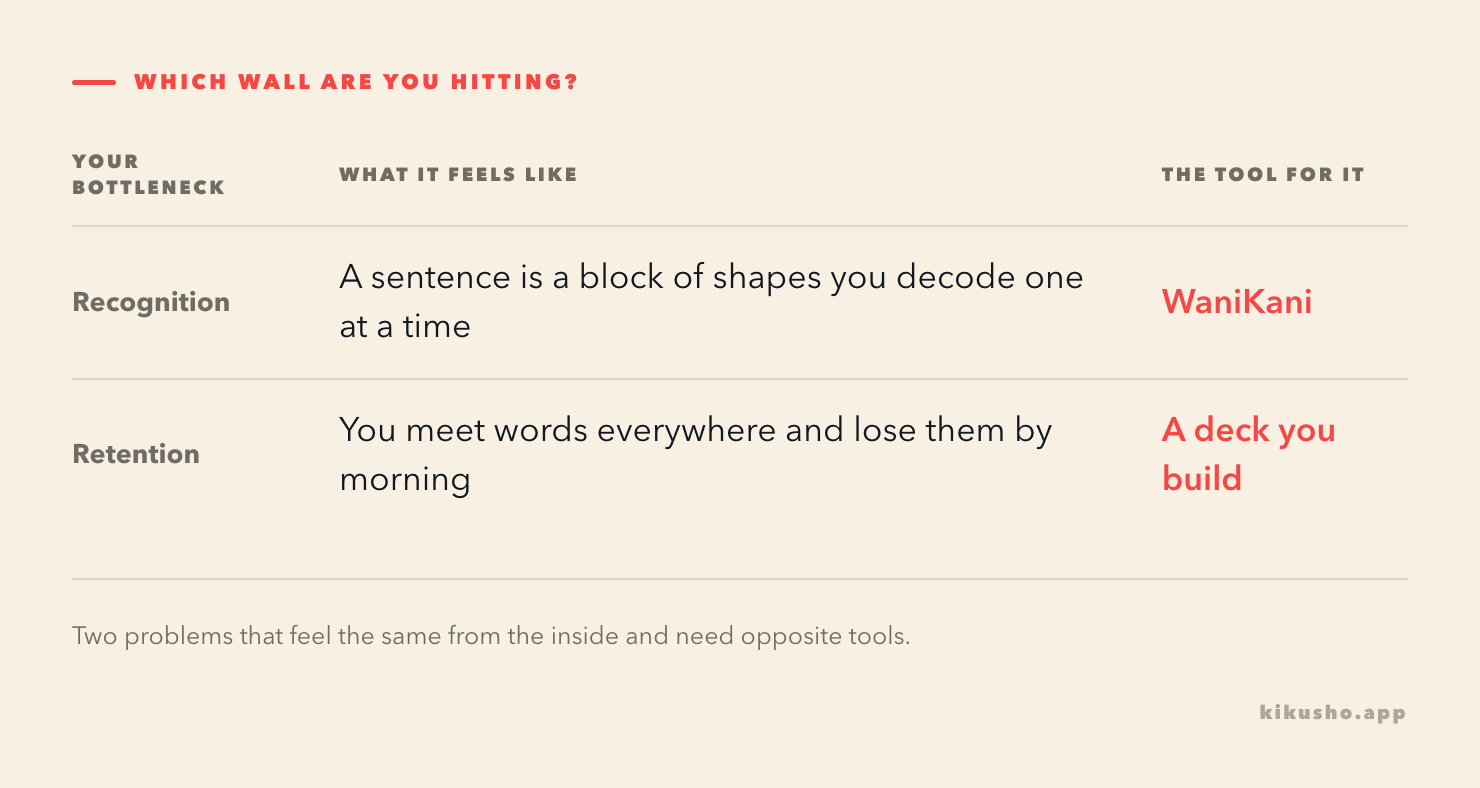
WaniKani answers the first wall. A deck you fill yourself answers the second. Most people who already use Anki and feel stuck have the second problem, which is the one WaniKani is not for.
What WaniKani does well: kanji in a fixed order
WaniKani teaches you to read roughly two thousand kanji, in a set sequence, across sixty levels, and it does not let you choose the order. You start with radicals, the parts kanji are built from, then the kanji that use those parts, then vocabulary that uses the kanji. Everything is gated: you reach the next level only once the app is satisfied you have held the last one.
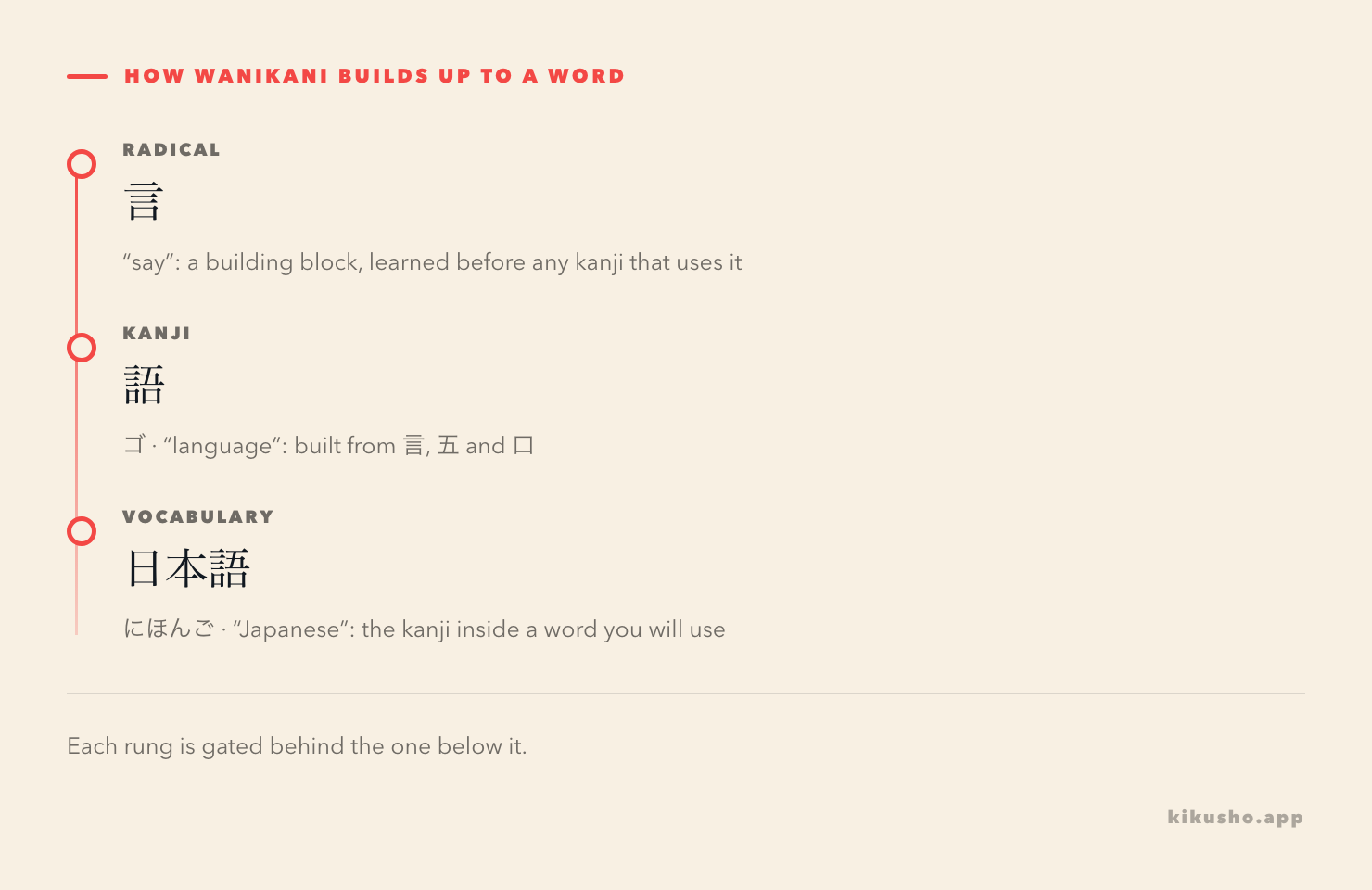
That rigidity is the point, and it is the thing a self-made deck cannot give you. Choosing your own order sounds like freedom, but with kanji it usually means learning 水 and 火 early because they are easy and stalling on the harder hundreds you actually need. WaniKani removes the choice and sequences the characters so each new one rests on parts you already know. The vocabulary stage matters here too: a character only settles once you meet it inside words rather than drilling it alone, and that is exactly what the third rung of every level is for. For the narrow job of getting a wall of text to stop being a wall, it works.
What a deck you build yourself does well: your own words
A deck you build is the opposite tool. Nothing decides what goes in it but you, which is its weakness as a kanji trainer and its whole strength as a vocabulary habit. The words in it are the ones you met and chose to keep: a sign outside a shuttered shop, a verb a colleague used twice, the line you rewound in a drama. No course contains those, because no course knows they happened to you.
This is the same reason a downloaded deck never sticks: a premade deck is somebody else's choices, and WaniKani, for all its polish, is a premade deck for kanji. It is a very good one. But the vocabulary it teaches is picked to drill the character you just learned, not because you are likely to meet it, so some of its words are ones you will recognise on a quiz and never once in the wild.
Where they look like the same tool
Both run spaced repetition. Both put Japanese on the front of a card. Both drill kanji and vocabulary. On a feature table they overlap almost completely, which is why the comparison threads go in circles. The difference is not in the features. It is in who picks the cards.
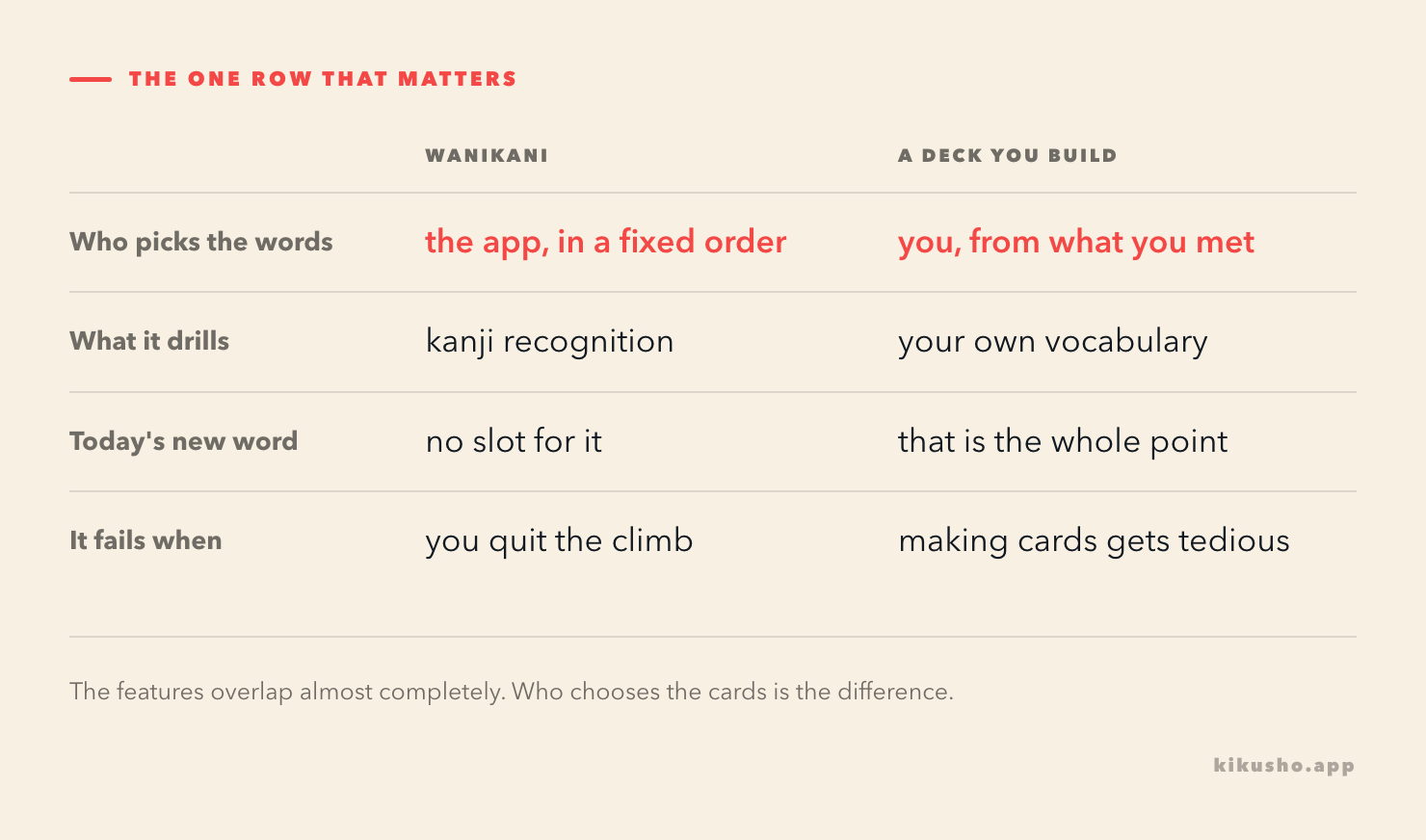
WaniKani chooses, and that is what you are paying for: a curriculum, sequenced and scheduled, so you never have to decide what to study. Your own deck chooses nothing, which means it holds exactly what you fed it and nothing you did not. One is a syllabus. The other is a record of your own week. They are not two answers to one question. They answer two.
What WaniKani can't do, and what a deck asks in return
WaniKani cannot capture the word you met an hour ago. It is sealed: its content is its content, and there is no slot for the word on today's menu. For that you need the deck you build, and here is the catch that sends people looking at WaniKani in the first place. Building that deck by hand is slow. Every word worth keeping means looking up the reading, confirming the meaning, finding a sentence, making the card. That friction is why so many self-made decks die inside a month, and why a course that does the making for you looks appealing even when it solves a different problem.
That capture step is the one worth removing, because it is the one that empties decks. WaniKani never asks it of you, since it already picked the words. The moment you keep your own, you are back to formatting a card for everything you want to save. Kikusho exists to cut that to almost nothing. The word on the menu, the phrase you only heard, the subtitle you paused on: each becomes a finished card in about the time it took to notice it, with the reading, the meaning, a register note, an example sentence and native audio already in place, reviewable with no signal. FSRS then schedules it on the same kind of curve WaniKani runs on its own content. It will not march you through two thousand kanji in order. It holds the Japanese a fixed syllabus was never going to contain.
Do you even need to read two thousand kanji?
Even if recognition is your wall, WaniKani's full climb may be more than your goal asks for. The app is built for one outcome: reading, unaided, the kind of text that assumes an adult native reader. If what you want is to follow a conversation, order with confidence, and read enough to get around a city, you reach the characters you need long before level sixty. The back third of the course drills kanji you will mostly meet in print you were not going to read anyway.
That does not make the sequencing useless. It moves the question from "is WaniKani good" to "how far up it do I need to go." Someone aiming at daily life and spoken Japanese might take the first dozen levels, where the highest-frequency characters sit, then let their own reading and their own deck carry the rest, picking up new kanji in the words that appear in front of them. Someone aiming at a novel, the news or a high-level exam has a real reason to finish. Paying for a sixty-level course and treating level ten as the finish line is a sound plan, and a cheaper one than most threads let on.
This is worth settling before you subscribe, because it changes the answer. A learner who needs recognition for reading dense text should commit to the climb. A learner who mostly needs to keep the words they meet has been handed a reading course for a retention problem, and will get more from making capture effortless than from any amount of gated kanji.
Running both without drowning
If the honest answer is both, that you cannot read well enough yet and you are losing the words you meet, the risk shows up in the first week: two review queues, and the daily load doubles until you abandon both. The fix is to treat them as one budget. Cap WaniKani at a fixed number of new radicals and kanji a day instead of clearing every lesson it offers, because its queue grows with how fast you feed it, and an eager first week becomes an unpayable pile by the third. Keep your own deck small and current: save what you meet, review what is due, and do not pad it to feel busy. Recognition from the course, lived vocabulary from your own capture, each kept deliberately short. That is the version of running both that outlasts the first month, which is longer than most people manage with either one on its own.
Common questions
Can I skip building my own deck and just use WaniKani's vocabulary?
Only if your goal is reading kanji. WaniKani's vocabulary is chosen to reinforce the characters it just taught, in its own order, so it will not contain the words you meet in your own life. It is a kanji course with vocabulary attached, not a record of the Japanese you use.
Does WaniKani teach grammar?
No. It teaches kanji and the readings and meanings of vocabulary, and nothing about how sentences are built. You need a separate grammar source alongside it, the same way you would alongside a vocabulary deck.
Can I copy WaniKani's content into Anki instead of paying?
Community decks copy the order, but they drop the thing you are paying for: the gating, the scheduling and the mnemonics working as one system. A static deck of the same words is just another premade deck, with the ordering and none of the machinery that made it work.