On this page
A downloaded Anki deck fails for a reason that has nothing to do with how the cards are built. It is thousands of words chosen by someone else, in an order set for someone else, and not one of them is attached to a moment you actually lived. That missing attachment is what makes a word stick or slide off, and a shared deck is without it by design.
You probably already suspect this. You downloaded a well-reviewed deck — a Core set, a JLPT list, whatever your textbook's forum put together — did fifty cards, and quietly stopped. The easy explanation is that you lack discipline. The more useful one is that you were reviewing someone else's vocabulary, and your memory could tell.
The problem was never the formatting
Almost all advice about premade decks is about the surface of the cards: better fields, cloze deletions, native audio, a cleaner template, an add-on that colours the pitch accent. Every bit of it can be true and none of it saves the deck, because the failure isn't in how a card looks. It's in which words are on it.
A card has one job. It brings a word back at the moment you were about to lose it. For that to be worth the seconds it costs, the word has to be one you would actually regret forgetting. A premade deck cannot know which words those are for you, so it hedges: it includes the word you need and the nine plausible ones around it, and files them all at the same priority. You inherit a stranger's guess about what matters, dressed up as a syllabus.
A word you never met has nothing to hook onto
When a word reaches you through life, it arrives wrapped in a scene. The sign you stopped to read. The phrase someone said and you had to ask them to repeat. The item on the menu you ended up pointing at. Weeks later you may not recall the reading cold, but you remember the counter, the person, the small embarrassment — and the word comes back along that thread. The scene is a second route in, and memory takes whichever route is open.
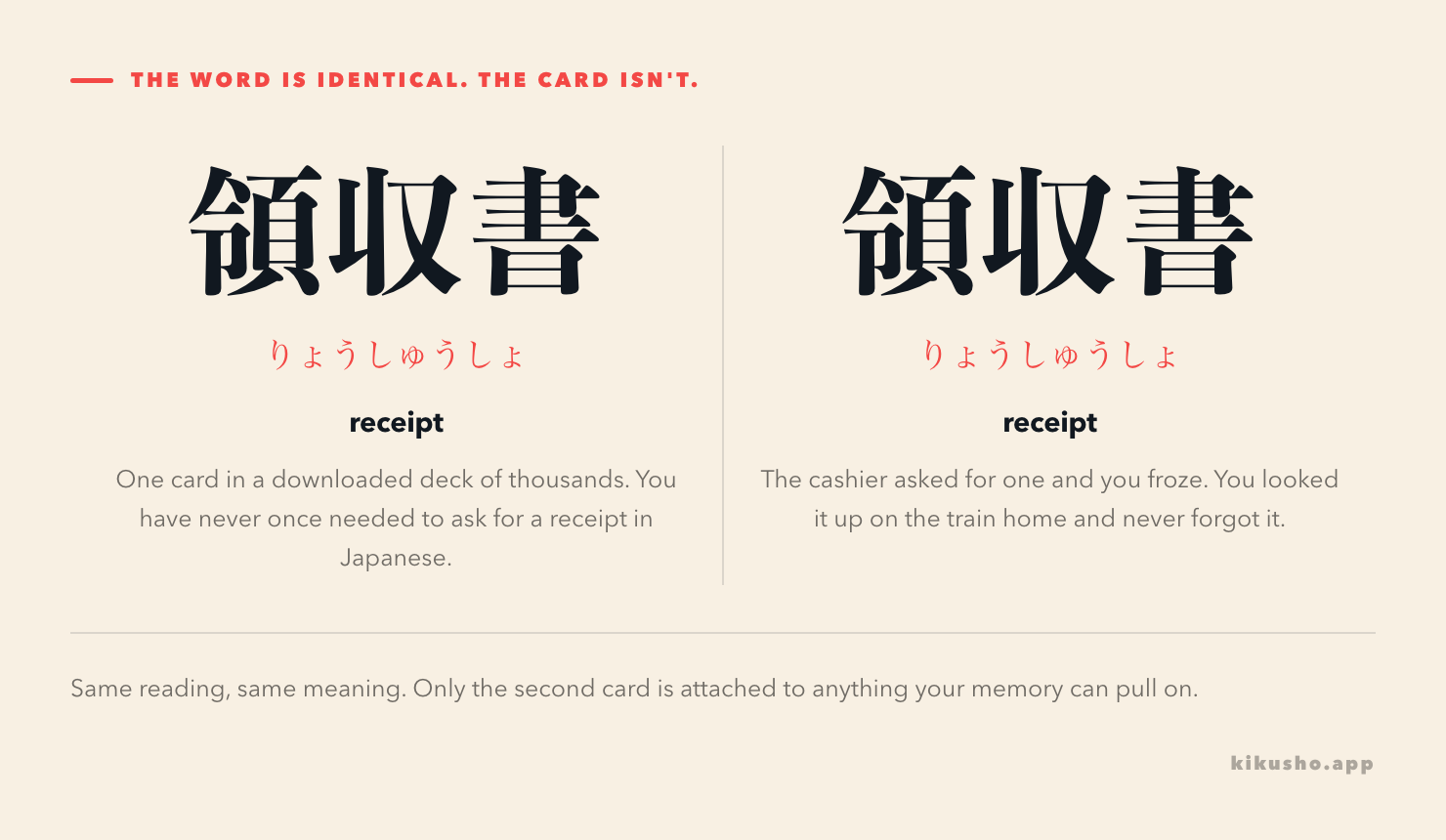
A card lifted from a shared deck has no scene. It is the word, its reading and a gloss, floating free, and the only thing holding it is raw repetition. That can work — drill anything often enough and it lodges — but it is the slowest, most fragile kind of memory, the first to go the week you skip your reviews. You are asking rote frequency to do the job that a single lived moment does almost for free.
Someone else's order is not your order
Most large decks are ordered by frequency, which sounds neutral and isn't. Frequency lists are counted from written text — newspapers, Wikipedia, novels — so they front-load the register of written text. You meet 経済 and 社会 in the first few hundred cards and 改札 hundreds of cards later, if at all. That is exactly backwards from the order a life hands them to you.
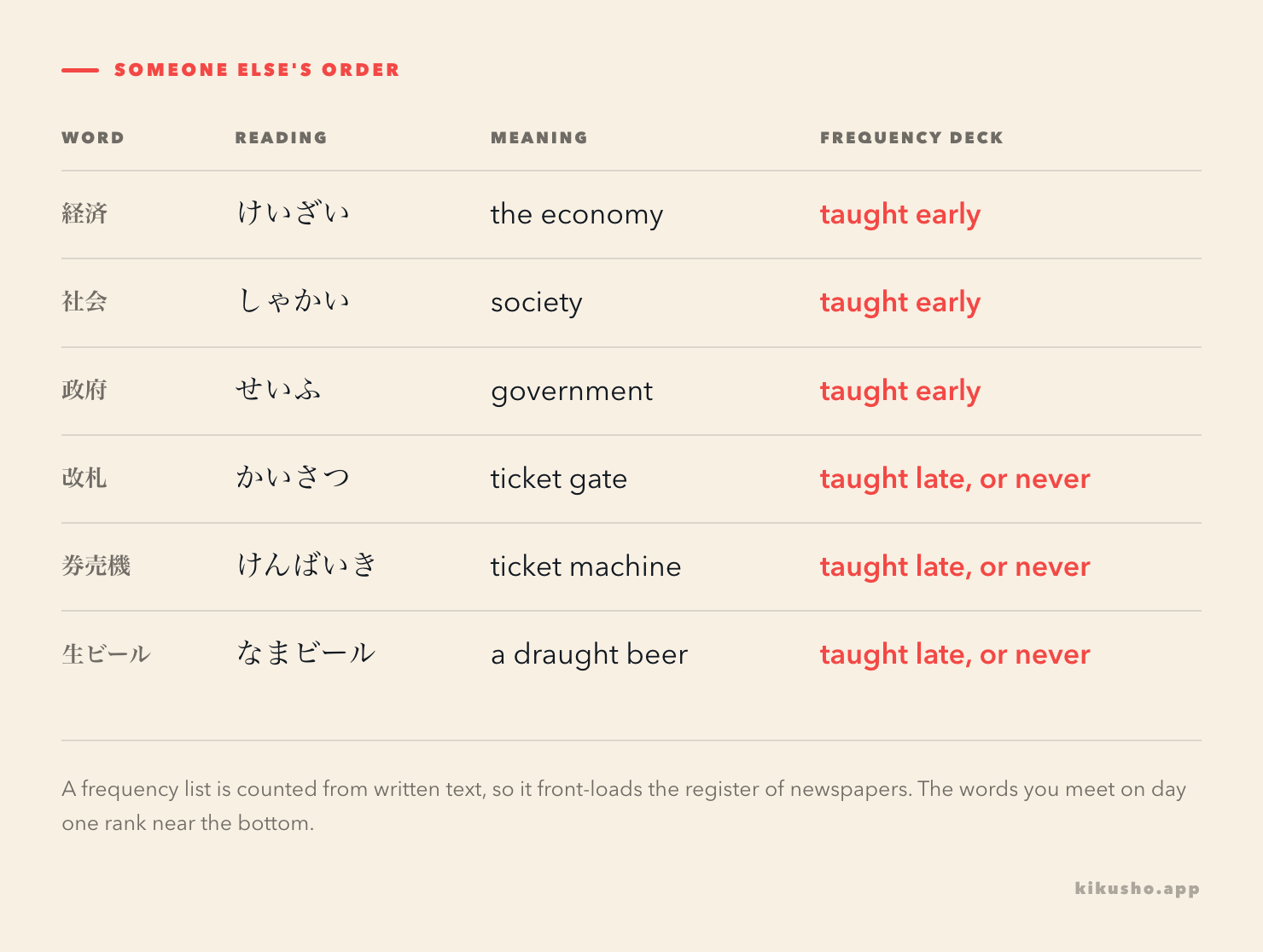
So for your first weeks the deck is quietly off-topic. You review words for things you have not yet needed to say, while the word you actually reached for this afternoon isn't in the queue at all, because a stranger's frequency count ranked it too low to reach yet. Nothing about the deck is wrong. It is simply answering a question you did not ask.
You can't honestly grade a word you don't care about
Anki's four buttons — Again, Hard, Good, Easy — are not a score for how clever you were. They are how you tell the scheduler how fast this particular memory is fading, and the whole system only works when that signal is honest. On a word you fought for and won, the grade comes naturally: you know whether it was a struggle. That is what each rating actually changes about when you see the card next.
On a word you never wanted, the signal collapses. You don't recall it and you don't much mind, so you press Good to make the card go away and keep the queue moving. Now the scheduler thinks you know a word you don't, pushes it weeks out, and the deck slowly fills with cards you have rated into a lie. A deck built from your own vocabulary barely has this failure mode, because you notice, and care, when one of your own words slips.
Nothing on a downloaded deck ever leaves
A healthy deck breathes: words come in, and words that are safely learned or turned out not to matter go out. A downloaded deck of six thousand cards can only inhale. Everything arrives; nothing is ever retired, because retiring a card means judging it not worth your time, and you have no standing to judge words you never chose. So the pile only grows, the daily count climbs, and the reviews curdle into the chore a deck becomes when nothing ever retires.
With your own words you prune without thinking. The sign you photographed once and now read without pausing leaves the deck. The word you learned for one trip and will not need again leaves too. A premade deck denies you both moves, because it was never yours to edit in the first place.
When a premade deck earns its place
This is not an argument that shared decks are useless, and it would be dishonest to pretend they never help. Two cases are real.
The first is the absolute start, when you have no words of your own yet because you have met almost no Japanese. A small, tight starter deck — the kana, a hundred survival words — gives you a floor to stand on, and its job is to make itself unnecessary within a few weeks. The failure is treating a starter deck as a spine for the next two years.
The second is a fixed external target. If you are sitting the JLPT in December, the exam's vocabulary is genuinely someone else's list, and a deck that matches it is the right tool for that narrow job. Even then it works best as a supplement running alongside the words you are collecting from real use, not as a replacement for them.
Build the deck out of what you already met
The fix is not a better download. It is to let the deck come from your day. Keep the words you actually ran into — the station sign, the line from the episode, the thing your friend said — and let those be the deck. Each one arrives with its scene attached, in the order your life happened to hand it over, and you never have to manufacture a reason to care, because you already did. This is the same reason the Japanese you see every day is the most worth keeping: it is pre-selected for relevance by the fact that you met it at all.
The catch has always been the effort. Looking a word up, checking its reading, writing the card and filing it takes long enough that you don't do it, and the word is gone by evening. That gap is the whole reason people reach for a premade deck in the first place — it is cards without the making of cards. Kikusho closes the gap from the other side: point the camera at the sign, say the phrase, or paste the text, and a complete card comes back in about three seconds — word, reading, meaning, the nuance a dictionary skips, an example sentence and native audio — for you to glance at and keep. It then schedules the review with FSRS, the same algorithm Anki uses, entirely offline. The deck is still yours, word for word. You have just stopped paying the tax that made building it feel impossible.
That is the real choice behind "should I download a deck." It was never premade cards versus nothing. It is a stranger's vocabulary you will not honestly review against your own vocabulary made as cheap to keep as someone else's — and only one of those two ever turns into a deck you actually run.
Common questions
Are premade Anki decks just badly made?
Usually the opposite — the cards are often well built, with clean fields and audio. The problem is a mismatch, not a defect: the deck teaches words someone else chose, in a frequency order set for written text, none of them tied to a moment you lived. That is what makes them slide off, not the formatting.
When is a downloaded deck actually worth using?
In two cases. At the very start, when you have no words of your own yet, a small survival deck gives you a floor to stand on and should make itself unnecessary within weeks. And when you are preparing for a fixed exam like the JLPT, whose vocabulary genuinely is a set list — though even then it works best alongside words you collect from real use, not instead of them.
Why do I abandon shared decks even though I know spaced repetition works?
Because the scheduling only pays off when you grade each review honestly, and you cannot honestly grade a word you never wanted. You press Good to clear the queue, the scheduler pushes the card weeks out, and the deck fills with cards you have rated into a lie. A deck built from your own vocabulary barely has that failure mode, because you notice when one of your own words slips.