On this page
Use ぶり or っぷり when an action, state or result gives you an observable feature to judge. 仕事ぶり is the manner someone displays while working; 食べっぷり is the striking way someone eats. If you mean a method or instruction instead, ~方 is usually the form you need.
The small っ often adds force, but it is not a switch you can flip after every verb. Japanese favours established combinations. Learn the whole noun, then notice whether the context praises, criticises or simply describes what can be seen.
The test is observation, not translation
English “the way someone does something” covers two different questions.
| Ask this | Choose | Example | What it names |
|---|---|---|---|
| How is the action done? What method works? | Vます-stem + 方 | 魚の食べ方 | how to eat the fish |
| What manner or degree did the action display? | Vます-stem + ぶり/っぷり | 彼の食べっぷり | the way he ate, as observed |
| What characteristic does this noun reveal? | N + ぶり/っぷり | 彼の仕事ぶり | the character of his work |
この魚の食べ方を教えてください。
この さかなの たべかたを おしえて ください。
Please show me how to eat this fish.
彼の豪快な食べっぷりに、みんなが驚いた。
かれの ごうかいな たべっぷりに、みんなが おどろいた。
Everyone was surprised by the hearty way he ate.
The first sentence asks for a procedure. The second turns a witnessed action into a noun and evaluates its force. Substituting 食べ方 in the second sentence would be grammatical, but it would move attention toward the form or technique of eating rather than the impression the eater created.
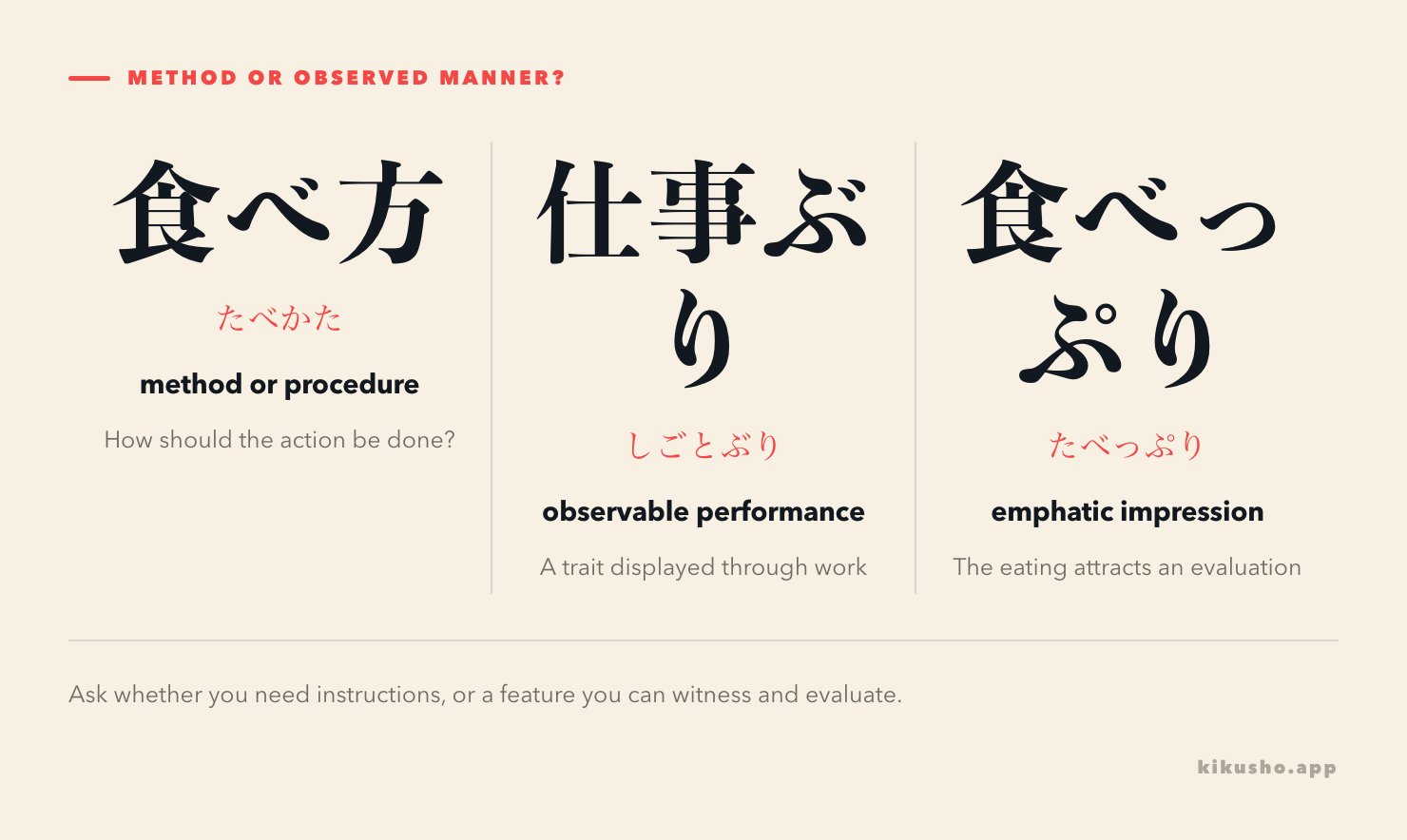
A corpus-based Osaka University study sharpens this distinction. Its analysis finds that V方 can express process, method and even the content of thought, while Vぶり is narrower: it favours manner, result state and other features directly available to observation. That is why 行き方 can mean a route or means of travel, while 行きっぷり is an evaluative description of how something advances, used especially in contexts such as racing.
Attach the suffix to a stem or a suitable noun
The basic construction is short:
| Base | Formation | Examples |
|---|---|---|
| verb | ます-stem + ぶり/っぷり | 働きぶり, 話しぶり, 飲みっぷり |
| noun | noun + ぶり/っぷり | 仕事ぶり, 活躍ぶり, 男っぷり |
The result is a noun. It can take particles, receive a modifier or modify another noun with の.
新入社員の働きぶりは、予想以上に頼もしかった。
しんにゅうしゃいんの はたらきぶりは、よそういじょうに たのもしかった。
The new employee's way of working was more dependable than expected.
彼女の落ち着いた話しぶりから、十分な準備が伝わってきた。
かのじょの おちついた はなしぶりから、じゅうぶんな じゅんびが つたわって きた。
Her calm manner of speaking conveyed thorough preparation.
選手たちは最後まで粘り強い戦いぶりを見せた。
せんしゅたちは さいごまで ねばりづよい たたかいぶりを みせた。
The players showed a tenacious style of play to the end.
The frequent ~ぶりを見せる and ~っぷりを見せる make the observational meaning explicit: a person or event displays a characteristic for someone to perceive.
JLPT Sensei's N1 reference gives both verb-stem and noun attachment, while warning that neither variant combines freely with every base. J-nihongo's independently edited lesson gives the same formation and distinguishes the stronger, more conversational evaluation often carried by っぷり.
っぷり puts more weight on the impression
Compare the sound of these established forms:
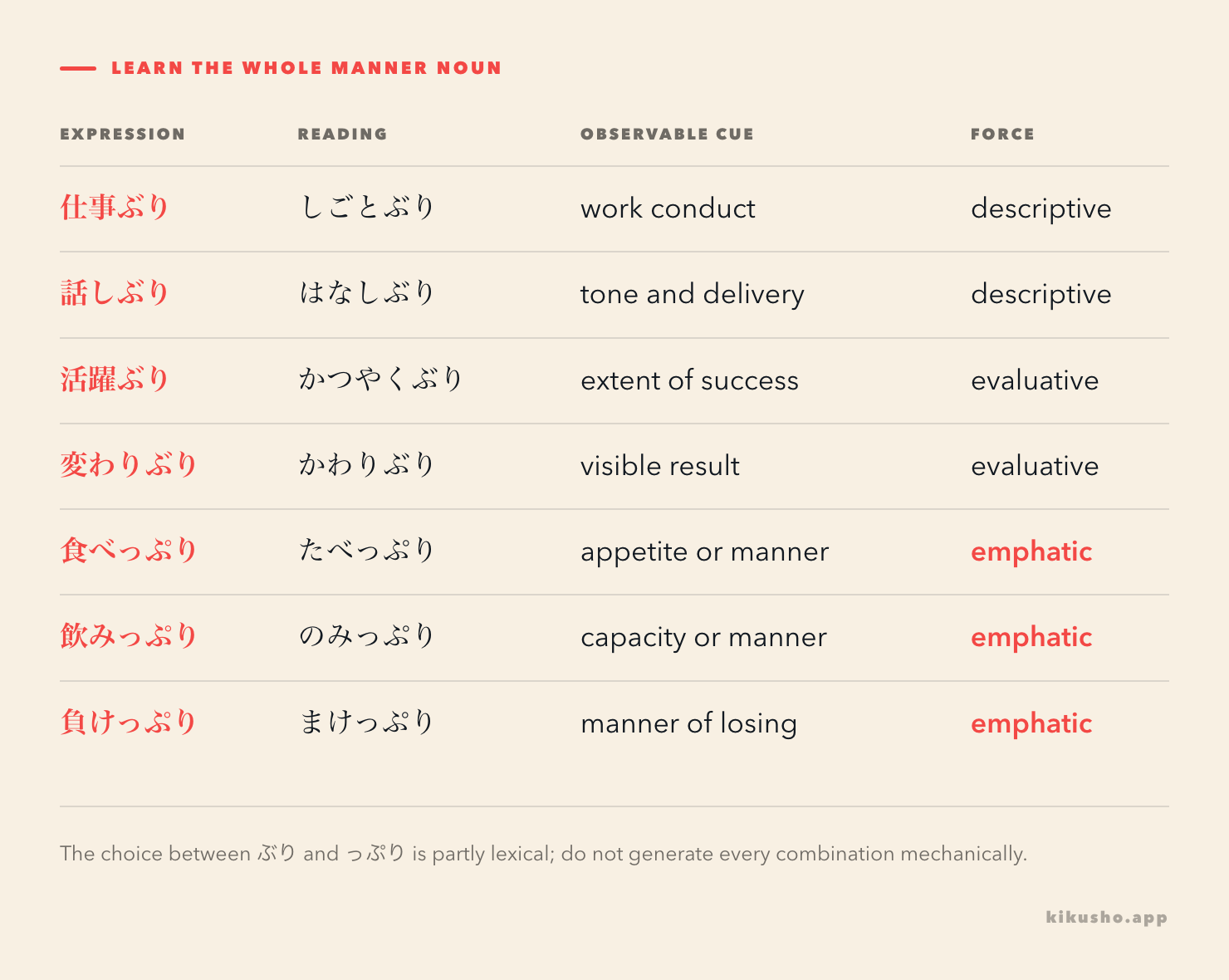
| Expression | Typical effect |
|---|---|
| 仕事ぶり | a person's work performance or conduct |
| 話しぶり | manner or tone of speaking |
| 暮らしぶり | the observable state of someone's life |
| 活躍ぶり | the extent or character of someone's success |
| 食べっぷり | an appetite or style of eating that makes an impression |
| 飲みっぷり | a conspicuous way or capacity of drinking |
| 負けっぷり | the manner in which someone loses |
子供たちの見事な食べっぷりに、料理人も笑顔になった。
こどもたちの みごとな たべっぷりに、りょうりにんも えがおに なった。
The children's splendid appetite made the cook smile too.
あの予算の使いっぷりには、さすがに驚いた。
あの よさんの つかいっぷりには、さすがに おどろいた。
Even I was shocked by the way that budget was spent.
The same suffix can support praise or criticism. っぷり makes the impression vivid; the modifier and situation decide its direction. It is therefore safer to describe it as emphatic or evaluative than as automatically positive.
The two variants sometimes coexist, as in 話しぶり/話しっぷり, but they are not always equally natural. The Osaka corpus study notes both speaker variation and a common preference for 食べっぷり over 食べぶり, even though corpus examples of the latter also exist. Treat the suffix as derivational vocabulary, not a fully productive conjugation rule.
Three lookalikes describe three different things
This manner suffix is separate from the time expression in ぶりに and 中. Compare:
| Form | Example | Meaning |
|---|---|---|
| duration + ぶり | 三年ぶりに会った | met again after a three-year gap |
| action or noun + ぶり | 仕事ぶりを見た | observed how someone worked |
| plain clause + ふり | 知らないふりをした | pretended not to know |
Voicing and spelling matter. The pretence noun is ふり, while manner ぶり is voiced inside a compound. Neither is the suffixal verb ぶる, “to put on airs,” taught with びる and じみた.
One more trap is 変わりぶり. It does not mean “after a gap.” It turns the result of changing into something observable.
十年ぶりに訪れて、町の変わりぶりに驚いた。
じゅうねんぶりに おとずれて、まちの かわりぶりに おどろいた。
I visited for the first time in ten years and was surprised by how much the town had changed.
The first ぶり measures elapsed time. The second evaluates the extent of visible change. A single sentence can contain both without giving them the same grammatical job.
Preserve the feature that made the form worth using
A card containing only 食べっぷり = way of eating loses the observed scene and the evaluation. Keep the modifier or reaction: 豪快な食べっぷり, 食べっぷりに驚いた. Those words show why the speaker chose this noun instead of neutral 食べ方.
When you capture the sentence in Kikusho, leave the complete compound in the word field and put the judgment in the editable nuance field. The useful memory is not that buri can mean “way.” It is that the form turns visible behaviour, a result or a condition into a characteristic someone can comment on.
Practice
Work through the seven items in order. Open the explanation block only after Question 7.
Question 1. A guest asks for instructions on how to eat a whole grilled fish. Choose the natural phrase.
- ア. 魚の食べっぷりを教えてください。
- イ. 魚の食べ方を教えてください。
- ウ. 魚の食べぶりに教えてください。
- エ. 魚の食べっぷり方を教えてください。
Question 2. You watched a child eat a large meal enthusiastically and want to praise the impressive sight. Complete the sentence: あの子の見事な__に驚いた。
- ア. 食べっぷり
- イ. 食べ方に
- ウ. 食べぶる
- エ. 食べふり
Question 3. Form the manner noun from 働きます and complete: 彼の__は同僚から高く評価されている。
Question 4. Which sentence uses the time-gap meaning rather than the manner suffix?
- ア. 彼の話しぶりは落ち着いている。
- イ. 選手の活躍ぶりが報道された。
- ウ. 五年ぶりに恩師と会った。
- エ. 町の変わりぶりに驚いた。
Question 5. Use all four chunks once to say “The team showed a tenacious style of play to the end.”
- チームは
- 最後まで
- 粘り強い戦いぶりを
- 見せた
Question 6. Explain the difference between 食べ方 and 食べっぷり. Which one could appear in instructions, and which one evaluates a scene you witnessed?
Question 7. Read the context and choose the best completion.
十年ぶりに故郷へ帰った。駅前には高層ビルが並び、古い商店街は公園になっていた。その__に言葉を失った。
- ア. 変わりぶり
- イ. 変わり方の方法
- ウ. 変わるふり
- エ. 十年っぷり
Answers and explanations
Answer 1. イ. 魚の食べ方を教えてください. The guest wants a method, so 方 is appropriate. 食べっぷり would evaluate someone's observed eating, not request instructions. The other choices do not form natural constructions.
Answer 2. ア. 食べっぷり. 見事な and 驚いた frame the eating as an impressive observable manner. 食べ方 could name a technique, while ウ and エ confuse this suffix with unrelated forms.
Answer 3. 働きぶり. Remove ます from 働きます and attach ぶり: 彼の働きぶりは同僚から高く評価されている. The result is a noun describing the characteristic manner or performance visible in his work.
Answer 4. ウ. 五年ぶりに恩師と会った. A duration immediately before ぶり marks the interval since the previous meeting. The other three sentences attach ぶり to an action or noun and evaluate an observable manner, achievement or result.
Answer 5. チームは最後まで粘り強い戦いぶりを見せた. 戦いぶり is the manner noun, 粘り強い evaluates it, and を見せた presents that characteristic as something the team displayed.
Answer 6. 食べ方 can describe a method and belongs naturally in instructions such as 魚の食べ方. 食べっぷり comments on the manner, force or degree apparent in an act of eating, so it suits a witnessed scene. The contrast is procedure versus observable impression.
Answer 7. ア. 変わりぶり. The buildings and vanished shopping street make the extent of change directly observable. 十年ぶり earlier in the passage marks the gap since the visit; it does not license 十年っぷり.
Placement and reviewed scope
JLPT Sensei and J-nihongo place manner ぶり/っぷり at N1. Other teaching resources place the same surface form at N3 or outside a fixed JLPT list, so the study boundary is disputed. The JLPT publishes no exhaustive official grammar inventory. Kikusho retains the source inventory's N1 placement and treats verb stems, noun formation with 方, and the time-gap ぶり as prerequisites.
The reviewed item is the manner or state suffix ぶり/っぷり. It covers observable action, degree and result, the stronger conversational tendency of っぷり, and the lexical restrictions on attachment. Duration + ぶり, pretence ふり, and suffixal verb ぶる remain separate constructions.
An ordinary method can exist before anyone performs it. ぶり begins where there is something in the performance worth seeing.
Common questions
What do ぶり and っぷり mean after a verb or noun?
They make a noun meaning the observable manner, state or degree shown in an action or condition. 仕事ぶり is how someone works, while 飲みっぷり is the striking way someone drinks.
What is the difference between ぶり and っぷり?
Both can describe an observable manner. っぷり often sounds more conversational and emphatic, and it readily conveys admiration, surprise or criticism. Natural choice also depends on the established combination, so learn expressions such as 仕事ぶり and 食べっぷり as units.
How are ぶり and 方 different?
方 can describe a method, procedure or way to perform an action. ぶり and っぷり present a visible or otherwise perceptible manner as a feature to evaluate. 食べ方 can teach how to eat something; 食べっぷり comments on the eating you witnessed.
Is this ぶり the same as 三年ぶり?
No. 三年ぶり marks the interval since an event last occurred. Manner ぶり follows an action stem or suitable noun, as in 働きぶり and 仕事ぶり, and describes what that action or state looks like.