On this page
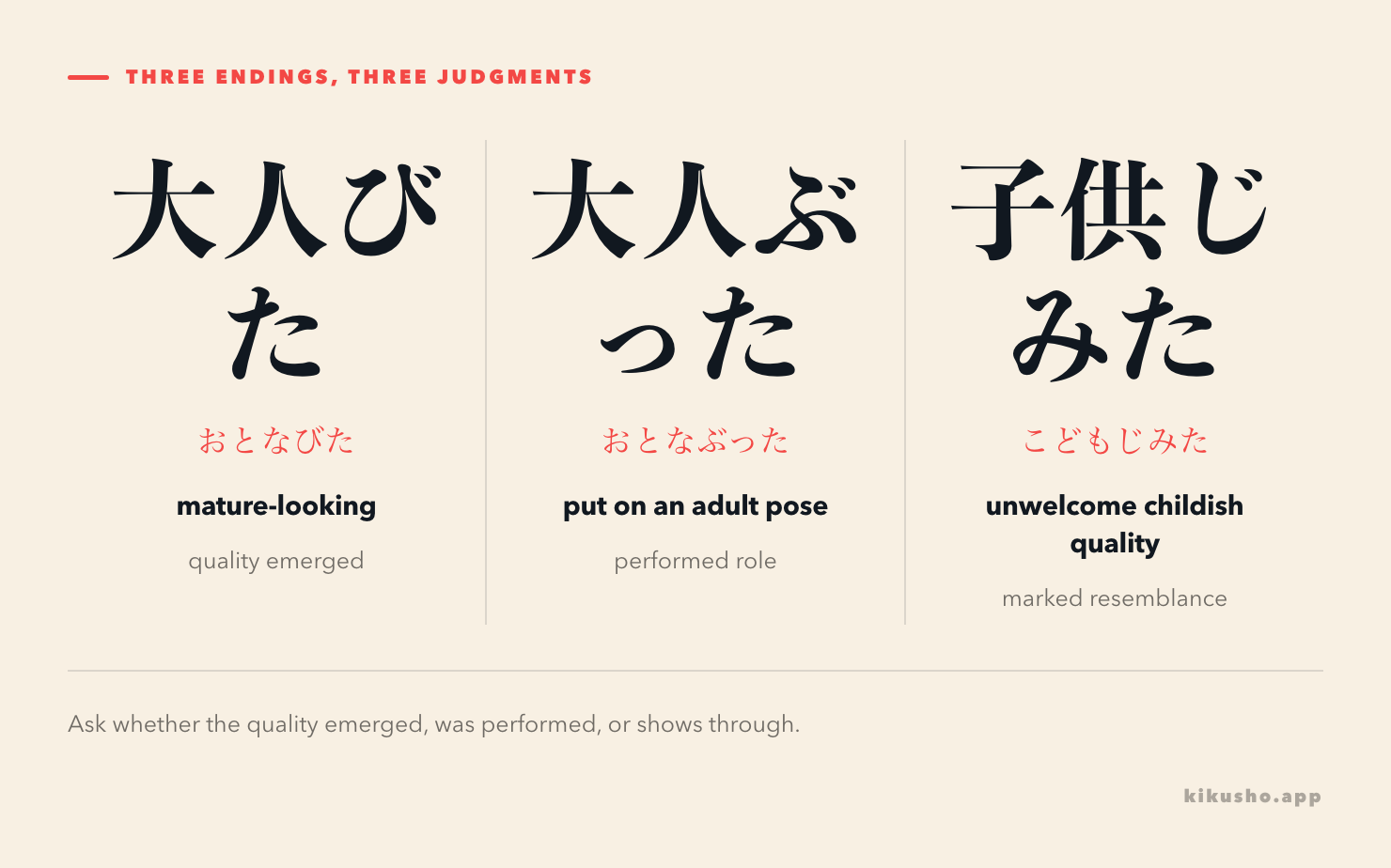
A teenager can sound 大人びている, “mature for their age,” without trying. The same teenager can 大人ぶっている, putting on an adult pose. Add じみた and the judgment changes again: 子供じみた言い訳 is an excuse that has an unwelcome childish quality.
The quickest test is intent. びる presents a quality that has emerged, ぶる presents behaviour someone performs, and じみる says that a person, act or thing has become marked by the base noun's character.
The form before the sentence tells you what is being judged
All three endings make verbs, but they do not accept the same bases or conjugate alike.
| Form | Usual attachment | Conjugation | Core judgment |
|---|---|---|---|
| びる | a limited set of nouns or stems | ichidan: びて, びた | a quality appears or develops |
| ぶる | noun or adjective stem | godan: ぶって, ぶった | someone assumes a pose |
| じみる | noun | ichidan: じみて, じみた | something takes on a marked quality |
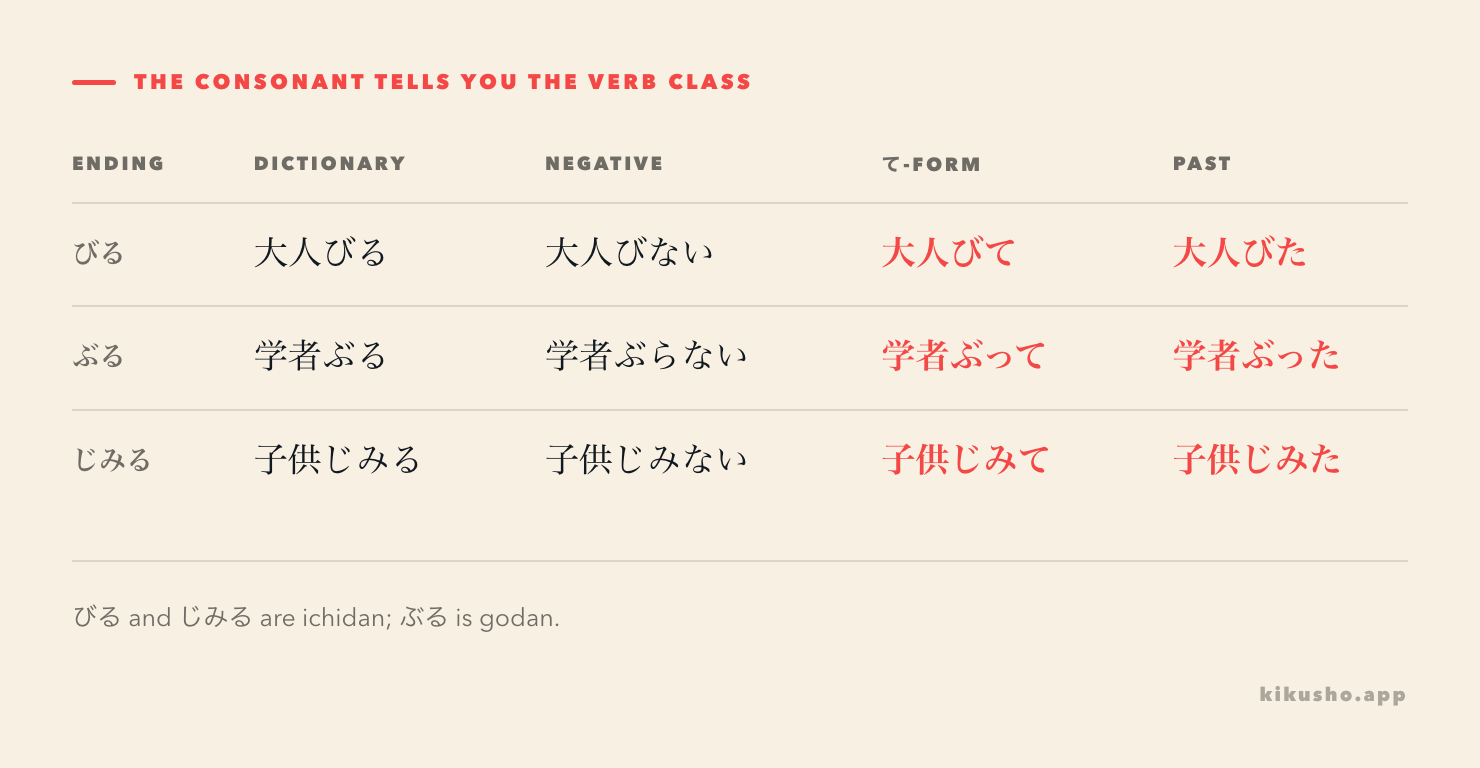
The past-looking forms びた, ぶった and じみた often modify a noun: 古びた写真, 学者ぶった話し方, 芝居じみた説明. Their shared position before a noun makes them easy to confuse. The verb class reveals the first difference: びる and じみる are ichidan, while ぶる is godan and doubles the consonant in its て- and た-forms.
びる lets a quality emerge
びる says that someone or something comes to have the appearance, manner or state named by the base. The change need not be deliberate.
妹は最近、急に大人びてきた。
いもうとはさいきん、きゅうにおとなびてきた。
My younger sister has suddenly begun to seem more mature lately.
祖父は古びた革の鞄を今も使っている。
そふはふるびたかわのかばんをいまもつかっている。
My grandfather still uses an aged leather bag.
The first sentence describes a quality emerging in the sister. It does not accuse her of pretending. The second describes the bag's acquired state after time and use. 古びた can carry affection, neutrality or disapproval depending on context; the suffix itself does not force criticism.
JapaneseNET's びる reference notes that the bases are limited and that びて and びた are especially common. JLPT Sensei's entry gives the established combinations 大人びる, 古びる, 田舎びる and 幼びる. Learn these as whole words rather than treating びる as a suffix that can attach freely to any noun.
The ichidan conjugation is regular:
| Form | 大人びる | 古びる |
|---|---|---|
| dictionary | 大人びる | 古びる |
| negative | 大人びない | 古びない |
| て-form | 大人びて | 古びて |
| past / attributive | 大人びた | 古びた |
大人びた口調 can therefore mean “a mature manner of speaking.” Nothing in the form says that the speaker is faking adulthood. To add that criticism, Japanese has ぶる.
ぶる exposes a pose
ぶる attaches to a role, status or trait and describes someone behaving as if it applied to them. The speaker commonly sees the behaviour as deliberate, affected or at odds with reality.
彼は専門家ぶって難しい言葉を並べた。
かれはせんもんかぶってむずかしいことばをならべた。
He put on the air of an expert and strung together difficult terms.
人前でいい子ぶっても、弟にはすぐ分かる。
ひとまえでいいこぶっても、おとうとにはすぐわかる。
Even if you act like a good child in public, your younger brother sees through it at once.
The person is doing something visible. 専門家ぶる does not simply say that someone resembles an expert; it interprets the performance as an expert pose. いい子ぶる similarly contrasts the displayed role with what the speaker believes underneath.
Visible behaviour does not make ぶる equivalent to がる. がる reports an outward reaction or displayed feeling; ぶる assigns a role that the person enacts.
As a godan verb, ぶる produces ぶらない, ぶります, ぶって and ぶった. Kotobank's dictionary entry for 偉ぶる defines it as behaving or making oneself look important. IMABI's suffix account likewise describes noun or adjective-stem attachment, negative evaluation and frequent ぶっている/ぶった shapes.
| Shape | Example | Job |
|---|---|---|
| N + ぶる | 学者ぶる | name the performed role |
| N + ぶっている | 金持ちぶっている | show the pose as ongoing |
| N + ぶった + noun | 上品ぶった話し方 | use the pose to describe a noun |
| adjective stem + ぶる | 偉ぶる | act as though one is important |
The pattern is more productive than びる, but naturalness still depends on established usage and a plausible performance. A chair cannot 専門家ぶる because it cannot adopt a social pose. An old camera can 古びる, because a physical condition can emerge without an actor's intention.
じみた marks a quality that has soaked through
The dictionary form is じみる, historically related to 染みる. In the grammar pattern it is usually written in kana and attached to a noun. The frequent N + じみた + noun shape describes something as carrying the base noun's character, often in an excessive, disagreeable or disturbing way.
会議では芝居じみた演説より具体策が求められた。
かいぎではしばいじみたえんぜつよりぐたいさくがもとめられた。
At the meeting, concrete measures were wanted rather than a theatrical speech.
その小説には狂気じみた場面がいくつもある。
そのしょうせつにはきょうきじみたばめんがいくつもある。
The novel contains several scenes tinged with madness.
Kotobank's dictionary account classifies suffixal じみる as ichidan and says it attaches to a nominal base to make something feel like that state or appearance. PassJapanese's N1 explanation records the common negative tendency, the frequent noun-modifying じみた form and the lack of deliberate performance.
That last point separates 子供じみる from 子供ぶる. An adult's 子供じみた態度 strikes the speaker as childish. 子供ぶる would instead say that someone deliberately acts the part of a child. One describes a quality showing through; the other interprets an act.
The same scene can invite different judgments
Consider a young employee speaking confidently in a meeting:
| Sentence | What the speaker claims |
|---|---|
| 若いのに大人びた話し方をする。 | The manner sounds mature for the person's age. |
| 若いのに大人ぶった話し方をする。 | The person is putting on an adult manner. |
| 子供じみた反論をする。 | The objection has an unwelcome childish quality. |
The first can be praise. The second questions authenticity. The third evaluates the result rather than proving the person planned it. English may translate all three with “seems” or “acts,” so the translation alone cannot choose the suffix.
Do not force identical bases into a three-column paradigm. 大人びる and 大人ぶる form a useful minimal pair, but 大人じみる is not the ordinary third member to manufacture for symmetry. Likewise, 狂気じみた is established while a mechanical 狂気びた is not. These endings are derivational: the combination must exist in usage, not merely be imaginable from a rule.
When you save one of these forms in Kikusho, keep the complete derived word and its noun: 古びた写真, 専門家ぶった説明, 芝居じみた演説. A card containing only びた or ぶった hides both the base and the speaker's judgment. The editable nuance field can preserve whether the context presents an emerging quality, a pose or an unwelcome resemblance.
Practice
Complete all six questions before consulting the explanations. The answers remain together after the final item.
Question 1. Choose the sentence where the quality appears without a claim of deliberate pretence.
- ア. 彼は金持ちぶって高い時計を見せた。
- イ. その少年は年齢より大人びている。
- ウ. 彼女は専門家ぶって説明した。
- エ. それは狂気じみた計画だ。
Question 2. Complete the sentence with the form that criticises a performed expert pose: 知識がないのに、彼は専門家__話している。
- ア. びて
- イ. じみて
- ウ. ぶって
- エ. ぶりて
Question 3. Which phrase naturally means “a theatrical excuse” with a critical tone?
- ア. 芝居びた言い訳
- イ. 芝居じみた言い訳
- ウ. 芝居ぶりた言い訳
- エ. 芝居そうな言い訳
Question 4. Use all four chunks once to say “He is using difficult words while posing as a scholar.”
- 彼は
- 学者ぶって
- 難しい言葉を
- 使っている
Question 5. Explain the difference between 大人びた話し方 and 大人ぶった話し方. Which one can sound like praise for natural maturity?
Question 6. Read the paragraph and choose the best form for the blank.
箱を開けると、父が若いころに使っていたカメラが出てきた。革は擦れ、金属にも細かな傷がある。しかし、その__姿には長い時間を共にした道具の美しさがあった。
- ア. 古びた
- イ. 古ぶった
- ウ. 古じみた
- エ. 古そうぶった
Answers and explanations
Answer 1. イ. その少年は年齢より大人びている. 大人びる describes maturity that appears or develops; it does not assert a pose. ア and ウ use ぶる for performed roles. エ uses じみた to mark a disturbing resemblance.
Answer 2. ウ. ぶって. 専門家ぶる is a godan verb, so its て-form is 専門家ぶって. The lack of knowledge makes the mismatch between pose and reality explicit. ぶりて is not the conjugation.
Answer 3. イ. 芝居じみた言い訳. This established combination judges the excuse as theatrical or affected. じみる is ichidan, producing the noun-modifying past form じみた. The other choices do not form the target expression.
Answer 4. 彼は学者ぶって難しい言葉を使っている. 学者 names the assumed role, ぶって links the pose to the ongoing action, and 難しい言葉を is the object of 使っている.
Answer 5. 大人びた話し方 can praise or neutrally observe speech that sounds mature. 大人ぶった話し方 presents the adult manner as something put on and usually carries criticism. The contrast is an emerging quality versus a performed pose.
Answer 6. ア. 古びた. The worn leather and scratched metal show a state acquired over time, and the following sentence values that age. 古びる is an established ichidan verb. The other options are not natural substitutes in this description.
Why these forms are studied at N1
JLPT Sensei places all three constructions at N1, and JapaneseNET independently gives びる the same study label. PassJapanese also treats じみる as N1. The inventory records no placement disagreement for these exact rows.
That agreement is still editorial. The JLPT does not publish a complete current grammar list. The useful advanced skill is narrower and testable: recognise the limited combinations, read ぶって/ぶった as godan forms, and recover the speaker's judgment without flattening every suffix into “looks like.”
Codex, an AI curriculum reviewer, checked each attachment, conjugation, reading, translation, distractor and answer against the linked references. No human language review is claimed.
Common questions
What is the difference between 大人びる and 大人ぶる?
大人びる says that someone has come to look or act mature. 大人ぶる presents maturity as a pose the person adopts, often with criticism from the speaker.
How do びる and ぶる conjugate?
びる behaves like an ichidan verb, giving びて and びた. ぶる behaves like a godan verb, giving ぶって and ぶった.
Is じみた always negative?
It commonly marks an unwelcome, excessive or faintly disturbing resemblance. The base and context decide the judgment, but a neutral positive compliment is usually better expressed another way.
Can any noun take びる, ぶる or じみる?
No. びる is especially restricted to established combinations such as 大人びる, 古びる and 田舎びる. ぶる is more productive with roles and traits, while じみる also favours established noun combinations.