On this page
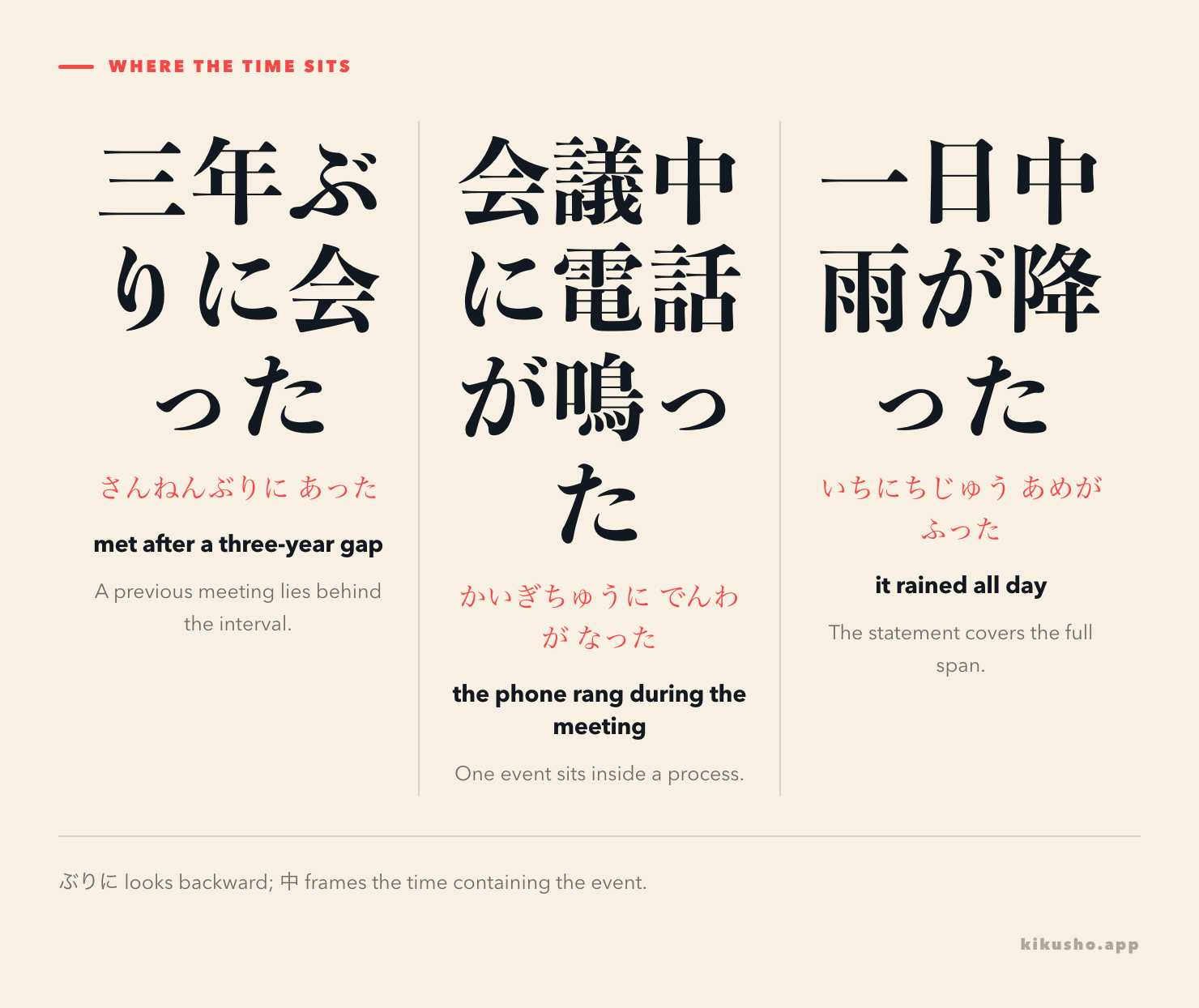
Use a duration + ぶりに when an event happens again after that gap; use noun + 中 when an event is in progress, inside a time window, or spread across it. In 三年ぶりに友達に会った, three years separate two meetings. In 会議中に友達から電話が来た, the call occurs inside the meeting.
The particle に appears in both expressions, but it does different work. With ぶり, it connects the completed gap to the returning event. With 中, it can locate another event within a period or turn a period into a deadline.
Ask whether the time is behind the event or around it
The quickest test is to draw the time in your head.
| Form | Time relation | Example | Meaning |
|---|---|---|---|
| duration + ぶりに | the interval since the previous occurrence | 三年ぶりに会った | met for the first time in three years |
| process noun + 中(ちゅう)に | one event inside an ongoing process | 会議中に電話が鳴った | the phone rang during the meeting |
| span + 中(じゅう) | the whole span or area | 一日中雨が降った | it rained all day |
| period + 中に | no later than the end of the period | 今日中に送る | send it by the end of today |
ぶりに needs an earlier occurrence to look back to, even when the sentence leaves it unstated. 中 does not. It frames the period that contains an event, state, deadline, or full-span reading.
五年ぶりにこの町へ帰ってきた。
ごねんぶりに この まちへ かえって きた。
I came back to this town for the first time in five years.
出張中にこの町へ来た。
しゅっちょうちゅうに この まちへ きた。
I came to this town during a business trip.
The first sentence compares this return with the last one. The second only places the visit inside a business trip.
ぶりに turns a duration into a completed gap
Put a duration noun before ぶり. Then choose the ending that fits the rest of the sentence.
| Shape | Job | Example |
|---|---|---|
| duration + ぶりに + event | modifies the returning event | 二週間ぶりに走った |
| event + のは + duration + ぶりだ | makes the gap the predicate | 海で泳ぐのは三年ぶりだ |
| duration + ぶりの + noun | modifies a following noun | 一か月ぶりの休み |
一か月ぶりに母と話した。
いっかげつぶりに ははと はなした。
I spoke with my mother for the first time in a month.
外で食べるのは久しぶりです。
そとで たべるのは ひさしぶりです。
It has been a while since I ate out.
久しぶり(ひさしぶり) is the useful fixed expression when you do not name the interval. Whether the duration is “long” depends on the event and the speaker. Ten hours without trains after a shutdown may be newsworthy; ten hours between ordinary meals is not usually presented as a remarkable return.
Bunpro's ぶりに reference gives ぶりだ, ぶりに, and ぶりの as the three central shapes and notes that very short intervals can sound unnatural when they are not significant. Nihongo NET's N3 treatment likewise describes the elapsed-time use as a return after a period the speaker experiences as long.
Do not merge this meaning with every suffix written ぶり. 生活ぶり, “way of life,” and 飲みっぷり, “the way someone drinks,” describe manner or appearance. This lesson's ぶりに follows a time expression and points back to a previous occurrence.
中(ちゅう)places you inside a process or bounded period
Attach 中 directly to a noun. Action nouns, especially those that also form する verbs, commonly take the reading ちゅう:
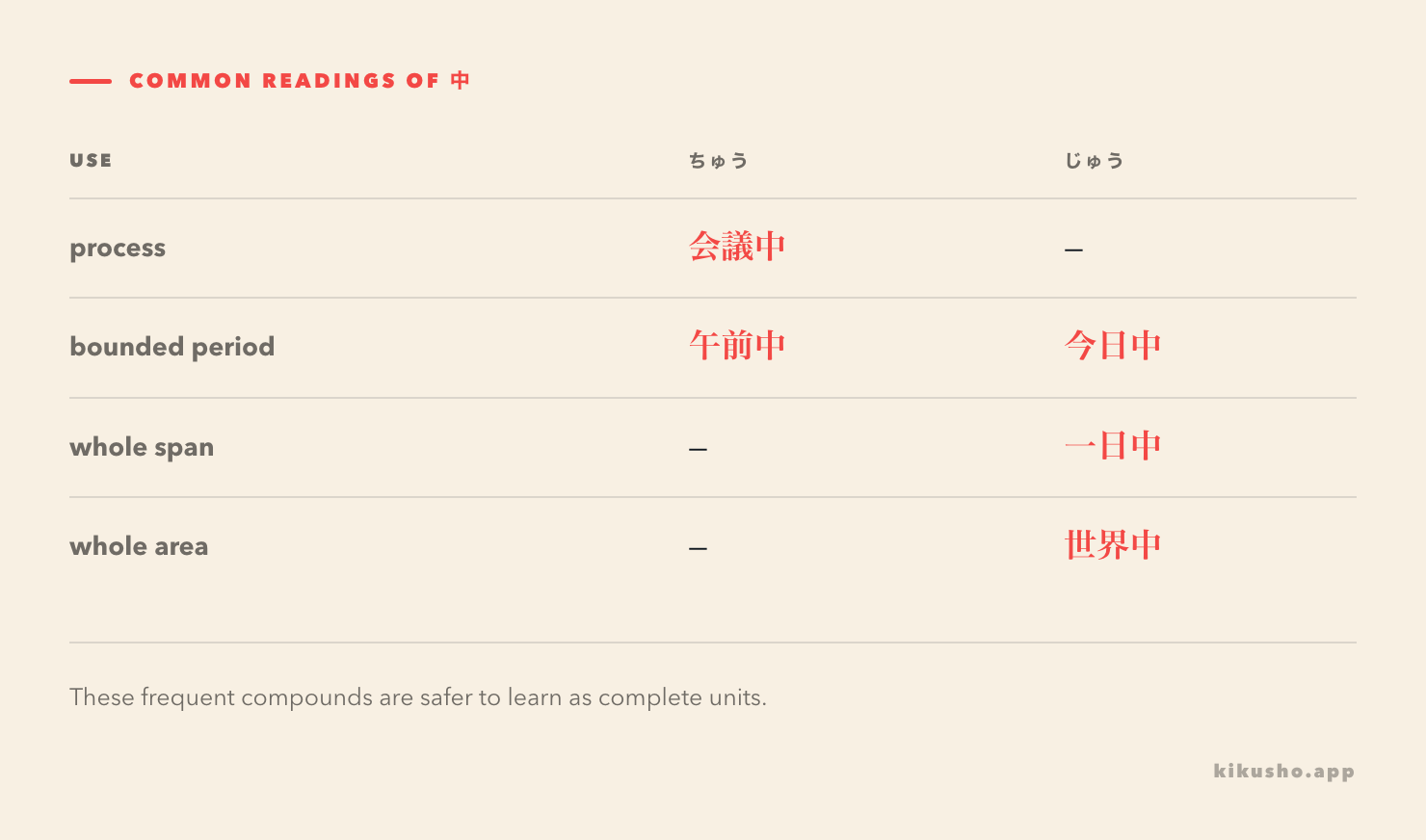
| Noun | 中 form | Use |
|---|---|---|
| 会議 | 会議中(かいぎちゅう) | in a meeting |
| 勉強 | 勉強中(べんきょうちゅう) | studying / in the middle of study |
| 工事 | 工事中(こうじちゅう) | under construction |
| 留守 | 留守中(るすちゅう) | while away |
今は会議中です。
いまは かいぎちゅうです。
I am in a meeting now.
会議中に地震がありました。
かいぎちゅうに じしんが ありました。
There was an earthquake during the meeting.
The first sentence uses 会議中 as a predicate describing a current status. The second adds に because an earthquake occupies a point within that meeting.
中 attaches to a noun, not freely to any verb stem. 食事中 is standard for “in the middle of a meal”; 食べ中 is not the ordinary form. A Nagoya University paper on the suffix observes that noun-like stems such as 考え and 話し can combine with 中, while purely verbal stems such as 食べ and 聞き resist it. Learning established compounds is safer than manufacturing a new one.
中(じゅう)covers a whole span or area
The reading じゅう often presents the named time or place as a complete extent.
一晩中、風が強かった。
ひとばんじゅう、かぜが つよかった。
The wind was strong all night.
この歌は世界中で知られている。
この うたは せかいじゅうで しられて いる。
This song is known throughout the world.
Here 中 does not mean that one event occurred at a point inside the night or the world. The statement ranges over the full span or area. JLPT Sensei's 中 reference gives the same practical contrast: ちゅう identifies a particular time or an activity in progress, while じゅう commonly means “throughout.” Bunpro's N3 entry independently places both readings under the noun-suffix pattern.
That rule is a guide, not a machine that predicts every compound. 午前中(ごぜんちゅう) is read ちゅう although it can refer to the whole morning. 今日中(きょうじゅう) and 今年中(ことしじゅう) conventionally use じゅう. The Nagoya study found further variation with expressions such as 明日中 and 来年中. Store the common expression with its reading rather than choosing a sound from the translation alone.
中に can set a deadline at the edge of the window
When a bounded period + 中 takes に, the sentence can mean that something must occur at some point before the period ends.
今日中に返事をしてください。
きょうじゅうに へんじを して ください。
Please reply by the end of today.
今月中に引っ越す予定です。
こんげつちゅうに ひっこす よていです。
I plan to move before the end of this month.
This resembles a deadline with までに, but the shape is different. The までに lesson names the final limit directly. 今日中に first packages “today” as the available window, then locates the event somewhere inside it.
Compare that with ぶりに:
一年ぶりに報告書を書いた。
いちねんぶりに ほうこくしょを かいた。
I wrote a report for the first time in a year.
一年中、報告書を書いていた。
いちねんじゅう、ほうこくしょを かいて いた。
I was writing reports all year.
今年中に報告書を書く。
ことしじゅうに ほうこくしょを かく。
I will write the report before this year ends.
One kanji and one particle create very different timelines: a completed gap, a full span, or a deadline within a span.
Context tells Kikusho which timeline to preserve
A card for 一年ぶりに会った loses its point if it keeps only ぶりに and “after one year.” The earlier meeting is part of the meaning. A card for 今日中に送る needs the deadline reading, while 一日中読んだ needs the full-span reading.
When you capture one of these sentences in Kikusho, keep the time expression and the event together. The editable reading field also matters here: ちゅう and じゅう are not interchangeable pronunciations of every 中 compound. The sentence you encountered supplies the relationship worth reviewing.
Practice
Complete all seven questions before reading the answer block.
Question 1. You saw an old friend today after not seeing her for three years. Choose the natural sentence.
- ア. 三年ぶりに友達に会った。
- イ. 三年中に友達に会った。
- ウ. 三年ちゅう友達に会った。
- エ. 三年ぶり友達中に会った。
Question 2. Choose the reading of 中 in 会議中に電話が鳴った.
- ア. なか
- イ. じゅう
- ウ. ちゅう
- エ. うち
Question 3. Complete “It snowed all day.”
- ア. 一日ぶりに雪が降った。
- イ. 一日中、雪が降った。
- ウ. 一日中に雪が降った。
- エ. 一日ちゅうに雪が降った。
Question 4. Arrange the fragments into “Please send this document by the end of today.”
- 送ってください
- 今日中に
- この書類を
Question 5. Which sentence says that one event happened at some point during summer vacation?
- ア. 夏休みぶりに祖父母を訪ねた。
- イ. 夏休み中に祖父母を訪ねた。
- ウ. 夏休み中、毎日祖父母を訪ねた。
- エ. 夏休みのぶりに祖父母を訪ねた。
Question 6. Choose the standard expression for “I am eating now, so please wait.”
- ア. 今、食べ中ですから、待ってください。
- イ. 今、食事中ですから、待ってください。
- ウ. 今、食事ぶりですから、待ってください。
- エ. 今、食べぶりにですから、待ってください。
Question 7. Choose the pair that completes the short text.
二年(甲)日本へ帰った。滞在(乙)、大学時代の先生にも会えた。
- ア. 甲: ぶりに/乙: 中に
- イ. 甲: 中に/乙: ぶりに
- ウ. 甲: ぶりだ/乙: じゅう
- エ. 甲: ちゅう/乙: ぶりだ
Answers and explanations
Answer 1. ア. 三年ぶりに友達に会った. 三年 is the completed gap since the previous meeting. 中 would place an event within a named period, and the other choices do not form either pattern.
Answer 2. ウ. ちゅう. 会議中 is the established process expression かいぎちゅう. に then places the phone call within the meeting.
Answer 3. イ. 一日中、雪が降った. 一日中(いちにちじゅう)covers the whole day. 一日ぶりに would mean the snow returned after one day; 中に would favour a point or deadline inside the day rather than the full-span reading required here.
Answer 4. 今日中にこの書類を送ってください. 今日中(きょうじゅう)sets today as the available window, and に locates the act of sending before that window closes.
Answer 5. イ. 夏休み中に祖父母を訪ねた. 中に locates one visit inside summer vacation. ウ instead says the visiting continued every day through the vacation, while the ぶり choices do not name a duration since a previous visit.
Answer 6. イ. 今、食事中ですから、待ってください. 食事 is a noun and combines naturally with 中. 食べ is a verb stem and does not freely form the standard expression 食べ中.
Answer 7. ア. 甲: ぶりに/乙: 中に. 二年ぶりに marks the return to Japan after a two-year gap. 滞在中に places the meeting with the teacher inside that stay.
N3 placement and checked scope
JLPT Sensei places ぶりに at N3, and Nihongo NET independently uses the same level. Bunpro places the elapsed-time use at N2, so the boundary is disputed. Kikusho retains the inventory's N3 placement while recording the disagreement. JLPT Sensei and Bunpro both place the noun-suffix uses of 中 at N3.
The prerequisites are duration expressions, noun modification with の, and the temporal particle に. No exhaustive official JLPT grammar list fixes the level boundary. The two reviewed items are the elapsed-time ぶりに and the temporal or spatial suffix 中(ちゅう/じゅう). Manner suffixes such as 生活ぶり, lexical uses of 中 meaning “inside,” and the separate pattern 最中 are outside this lesson.
Two expressions can both point to a period without describing the same timeline. One asks when the event last happened. The other asks what the named period contains.
Common questions
What is the difference between ぶりに and 中?
A duration followed by ぶりに marks the return of an event after that gap, as in 三年ぶりに会った. 中 places something inside a period or process, throughout a span, or before a period ends, as in 会議中に, 一日中, and 今日中に.
When is 中 read ちゅう and when is it read じゅう?
ちゅう commonly marks a process or bounded interval, as in 会議中 and 午前中. じゅう commonly covers a whole span or area, as in 一日中 and 世界中. Some combinations have conventional readings, so learn frequent compounds as units.
What is the difference between 会議中 and 会議中に?
会議中 describes the status “in a meeting.” 会議中に places another event at a point during that meeting, as in 会議中に電話が鳴った. The particle に marks the temporal location of the second event.
Can ぶりに be used for a short interval?
It can when the speaker treats the interval as significant, but ordinary uses favour a gap worth noticing. 五分ぶり may sound marked unless those five minutes matter in the situation.