On this page
Use がる for a feeling visible in someone's behaviour, がり for a recurring sensitivity or type of person, and たがる for signs that someone wants to act. The three forms share がる, but they answer different questions: what reaction is showing, what someone is usually like, or what action they appear to want.
The distinction matters because Japanese often marks how you know about another person's inner state. 妹は帰りたがっている does not claim direct access to her thoughts. It presents her words or behaviour as evidence that she wants to go home.
Choose the form by asking what the sentence describes
Start with the time scale and the kind of meaning you need.
| Meaning | Form | Example | Natural reading |
|---|---|---|---|
| a visible feeling or reaction | adjective stem + がる | 子どもが犬を怖がっている。 | The child is showing fear of the dog. |
| a recurring sensitivity or personal tendency | adjective stem + がり | 兄は寒がりだ。 | My older brother feels the cold easily. |
| a visible wish to perform an action | verb ます-stem + たがる | 妹が帰りたがっている。 | My younger sister seems to want to go home. |
Read 怖 as こわ, 兄 as あに, 寒 as さむ, 妹 as いもうと and 帰 as かえ.
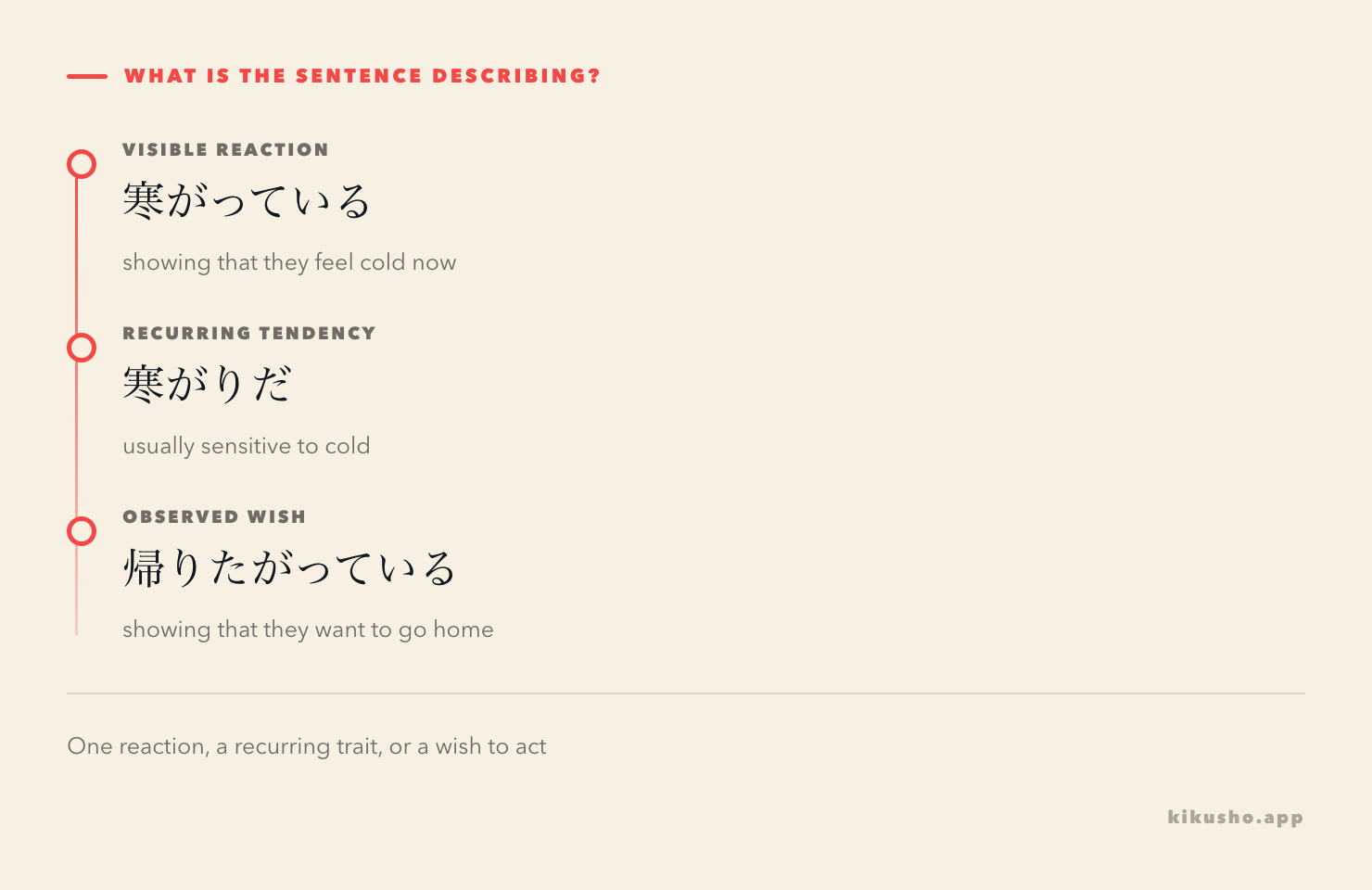
The English word “seems” is useful but incomplete. 怖がっている describes fear as displayed through a reaction. It does not merely mean that a person has a frightened appearance. For a visual impression such as “looks cold,” そう is the more direct choice: 寒そうだ.
がる turns a feeling word into a verb of outward reaction
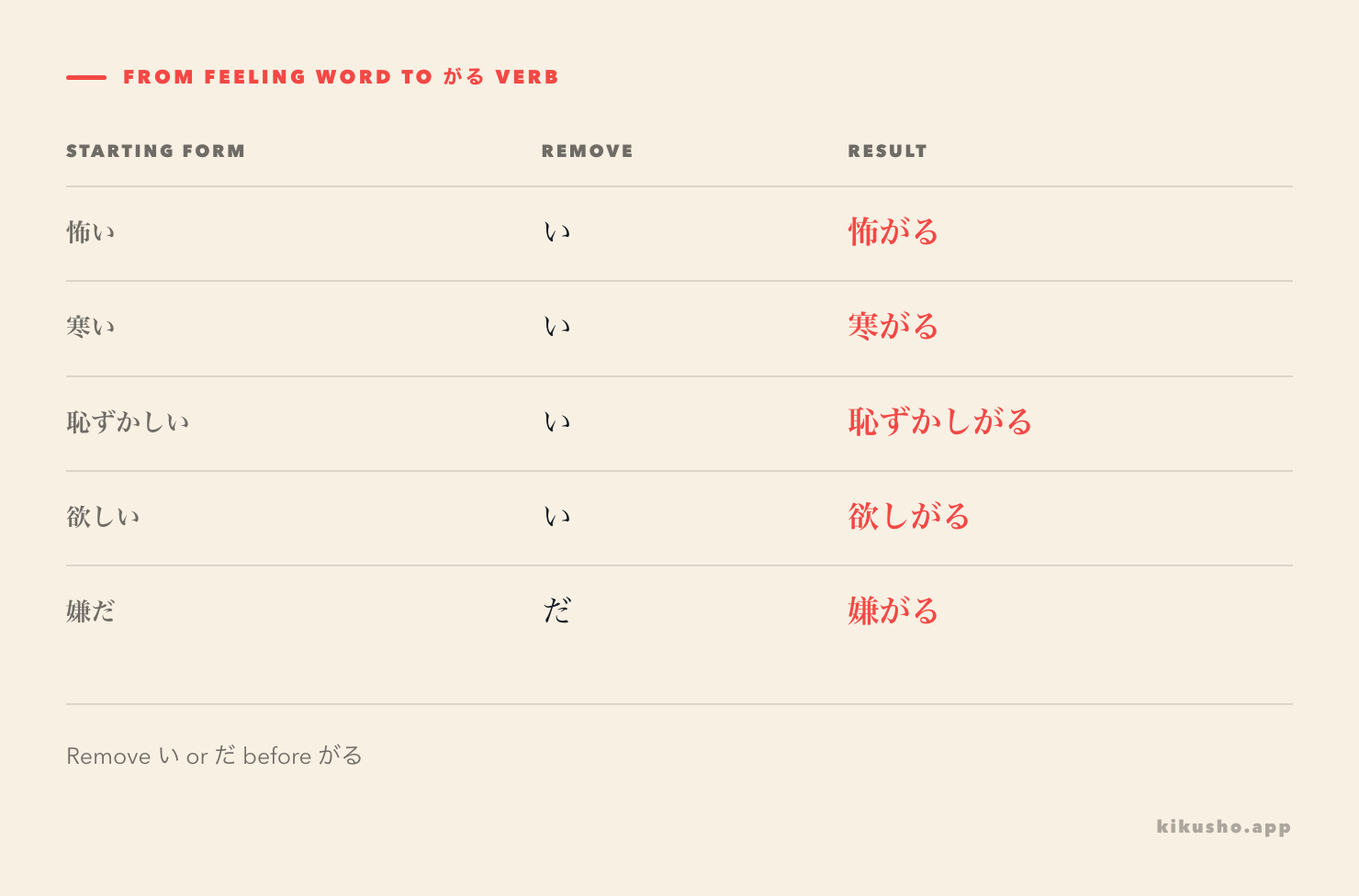
With an い-adjective, remove the final い and add がる. With the common な-adjective 嫌だ, attach it to the stem: 嫌がる.
| Starting expression | Remove | Result | Meaning in context |
|---|---|---|---|
| 怖い | い | 怖がる | show fear |
| 寒い | い | 寒がる | show that one feels cold |
| 恥ずかしい | い | 恥ずかしがる | act shy or embarrassed |
| 欲しい | い | 欲しがる | show that one wants something |
| 嫌だ | だ | 嫌がる | show dislike or reluctance |
Once attached, がる is a godan verb. It carries tense, negation and politeness like other verbs ending in る:
| Form | 怖がる | 欲しがる |
|---|---|---|
| dictionary | 怖がる | 欲しがる |
| polite | 怖がります | 欲しがります |
| ongoing | 怖がっている | 欲しがっている |
| past | 怖がった | 欲しがった |
| negative | 怖がらない | 欲しがらない |
The って in がっている comes from conjugating がる. It is not a separate “がっている grammar point.” In a scene unfolding now, the ongoing form is common because the sentence reports a reaction you can observe:
子どもは大きな音を怖がっています。
こどもは おおきな おとを こわがっています。
The child is showing fear of the loud noise.
The plain form suits a habit, a prediction or a repeated response:
うちの猫は掃除機の音を怖がる。
うちの ねこは そうじきの おとを こわがる。
Our cat is afraid of the vacuum cleaner's noise.
That difference comes from ordinary verb aspect. 怖がる presents the general response; 怖がっている places the response in progress.
The particle often changes because がる creates a verb
Compare a direct feeling with an observed one:
私は犬が怖い。
わたしは いぬが こわい。
I am afraid of dogs.
弟は犬を怖がっている。
おとうとは いぬを こわがっている。
My younger brother is showing fear of dogs.
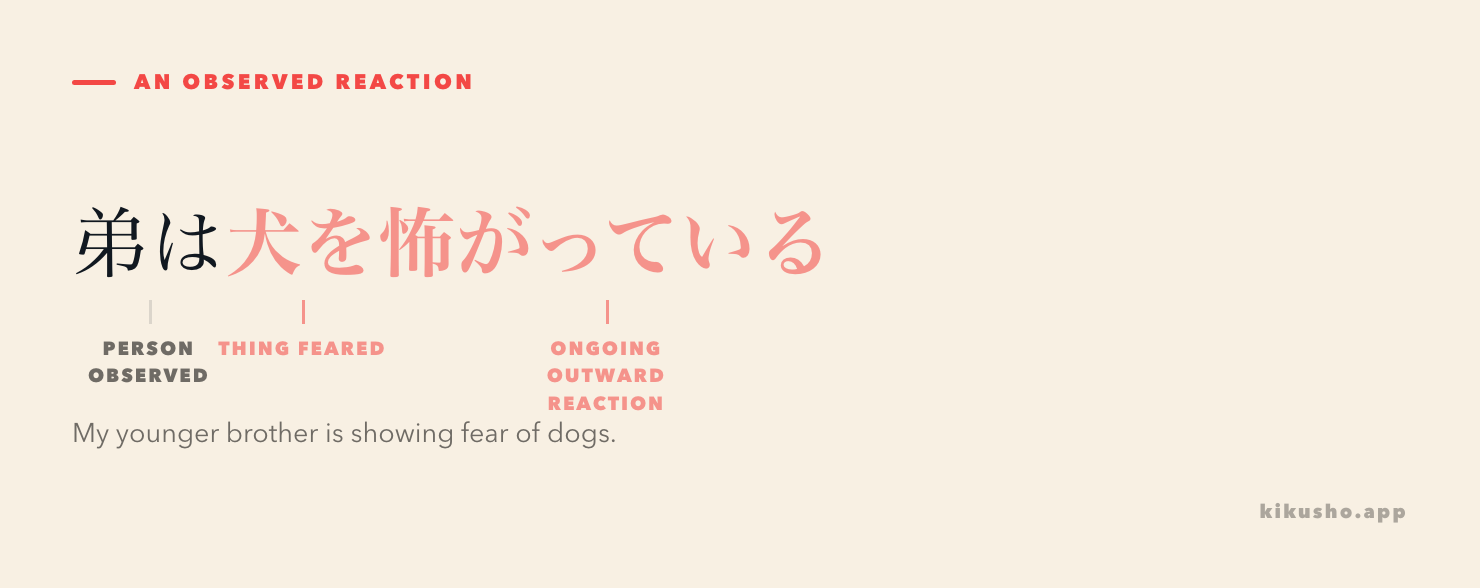
In the first sentence, 怖い is an adjective and 犬 takes が. In the second, 怖がる behaves as a transitive verb and the thing feared takes を. The same shift appears with desire:
私は新しい自転車が欲しい。
I want a new bicycle.
息子は新しい自転車を欲しがっている。
My son is showing that he wants a new bicycle.
The particle is part of the new construction. Keep the whole phrase 自転車を欲しがる, rather than attaching がる while leaving every particle unchanged.
がり names a tendency, not one reaction happening now
がり is the noun-like stem of がる. It describes someone who regularly reacts a certain way or is sensitive to a condition.
私は寒がりです。
わたしは さむがりです。
I feel the cold easily.
彼は怖がりだから、お化け屋敷に入りません。
かれは こわがりだから、おばけやしきに はいりません。
He scares easily, so he will not enter the haunted house.
This form can describe the speaker with no perspective problem. 私は寒がりだ is a judgment about your usual sensitivity, not a claim about an inaccessible feeling.
Some established person labels take 屋, including 寂しがり屋 and 恥ずかしがり屋. Others commonly stand alone, including 暑がり, 寒がり and 怖がり. Treat these as words you meet and learn, rather than a promise that any adjective plus がり will make a natural personality label.
The time scale separates the nearby forms:
- 父は寒がっている。 Father is showing that he feels cold now.
- 父は寒がりだ。 Father tends to feel cold easily.
- 父は寒そうだ。 Father looks cold.
The last sentence is an appearance judgment. The first reports his reaction. The second classifies a recurring sensitivity.
たがる reports another person's displayed wish to act
たがる is built from たい + がる. Make the verb's ます-stem, add たい, drop the final い, then add がる. In practice, you can remember ます-stem + たがる.
| Dictionary verb | ます-stem | たがる form |
|---|---|---|
| 行く | 行き | 行きたがる |
| 食べる | 食べ | 食べたがる |
| する | し | したがる |
| 来る | 来(き) | 来たがる |
子どもたちは外で遊びたがっている。
こどもたちは そとで あそびたがっている。
The children are showing that they want to play outside.
田中さんは会議で何も話したがらなかった。
たなかさんは かいぎで なにも はなしたがらなかった。
Mr Tanaka showed no desire to say anything at the meeting.
Like がる, たがる is a godan verb: たがります, たがっている, たがった, たがらない. The negative example is therefore 話したがらなかった, not 話したくなかった if your point is the reluctance you observed in someone else.
When the desired action has an object, that object ordinarily keeps を because the whole predicate is verbal:
私は映画が見たい。
I want to see a film.
彼はその映画を見たがっている。
He is showing that he wants to see that film.
The focused lesson on たい covers the particle variation possible with a speaker's own desire. Here, remember that 見たがる behaves as a verb and readily takes を.
Direct feelings use the simpler form
For your current inner state, say it directly:
- 私は怖い。 I am scared.
- 私は水が欲しい。 I want water.
- 私は帰りたい。 I want to go home.
Using 私は怖がっている or 私は帰りたがっている makes you look at your own behaviour from outside. That can work when the behaviour is the point, as in “Whenever I show that I want sweets, my sister shares hers.” It is marked if you simply mean “I want to go home now.”
The listener can also answer directly about their own mind. Ask 帰りたいですか, “Do you want to go home?” Asking 帰りたがっていますか normally places the wanted person at a distance, as if you are asking someone else whether that person's behaviour shows the wish.
These are strong beginner defaults, not a ban on narrative perspective. Fiction can state a character's feelings directly, and context can make another person's state known through words rather than inference. The practical rule is to match the form to your evidence instead of treating third person as a mechanical switch.
N4 sources agree on the forms, while the JLPT publishes no complete list
JLPT Sensei's がる reference places がる and がっている at N4 and shows their verb conjugation. Its separate pages place がり and たがる at the same level.
Tofugu's がる guide independently explains the outward-evidence perspective, the first-person behaviour exception, the change to を, and the noun forms with or without 屋. Bunpro also treats たがる as N4. Because the exam maker provides no complete catalogue of tested grammar, those N4 labels remain editorial study guidance.
If a drama line contains 帰りたがっている, save the full line rather than a card for 帰る alone. In Kikusho, a text capture can preserve who was observed and what they did; you can edit the drafted explanation before the card enters review. That scene is what makes the perspective choice retrievable later.
Practice: choose reaction, tendency or wish
Complete all seven questions before reading the shared answer section.
Question 1
Your brother is shivering and rubbing his hands now. Complete the sentence.
弟は( )。
A. 寒い
B. 寒がっている
C. 寒がり
D. 寒そうな
Question 2
Which sentence means “Mika tends to feel the cold easily”?
A. ミカさんは寒がりです。
B. ミカさんは寒がっています。
C. ミカさんは寒いたがります。
D. ミカさんは寒いですか。
Question 3
Choose the natural sentence for a child who is pointing repeatedly at a toy and asking for it.
A. 子どもはそのおもちゃが欲しいです。
B. 子どもはそのおもちゃを欲しがっています。
C. 子どもはそのおもちゃを欲しいがっています。
D. 子どもはそのおもちゃが欲しがりです。
Question 4
Change the sentence so it reports Yuki's displayed wish rather than the speaker's own wish.
私は早く帰りたい。 → ゆきさんは( )。
Question 5
The speaker is describing a habitual trait. Complete the short text.
兄はホラー映画を見ません。小さいころから( )だからです。
A. 怖い
B. 怖がっている
C. 怖がり
D. 怖いたがる
Question 6
Put the words in a natural order. Use every item.
外で / 遊び / 子どもたちは / たがっています
Question 7
Read the exchange and choose the best completion.
A: どうして窓を閉めたの?
B: 田中さんが( )。手も冷たかったよ。
A. 寒いから
B. 寒がっていたから
C. 寒がりたいから
D. 寒いたがったから
Answers and explanations
1
寒がっている (B). The sentence describes a reaction visible now, so the ongoing verb fits. 寒い would state the brother's inner feeling directly; 寒がり names a recurring sensitivity. D needs a noun after 寒そうな and changes the claim to appearance.
2
A. ミカさんは寒がりです。 がり labels someone who regularly feels the cold easily. B describes a current reaction. C incorrectly combines 寒い with たがる, which belongs after a verb stem, and D asks whether Mika is cold now.
3
B. 子どもはそのおもちゃを欲しがっています。 欲しい loses い before がる, and the wanted object takes を with the resulting verb. A directly asserts the child's internal desire; C keeps the い that must drop. D wrongly makes 欲しがり a predicate for this present scene.
4
One natural answer is ゆきさんは早く帰りたがっている。 帰る supplies the ます-stem 帰り, followed by たがる. The ongoing form presents Yuki's wish through current words or behaviour.
5
C. 怖がり. The first sentence describes what the brother habitually avoids, and 小さいころから extends that trait over time. 怖がっている would locate a reaction in progress. A can describe a scary thing or the speaker's fear in another construction; D has no valid attachment.
6
子どもたちは外で遊びたがっています。 “The children are showing that they want to play outside.” 遊ぶ becomes the stem 遊び before たがる; たがっています carries the polite ongoing form.
7
B. 寒がっていたから. Cold hands are observable evidence, and the reaction preceded the closing of the window, so the past ongoing form fits. A states Tanaka's feeling directly. C and D attach たい or たがる to an adjective in ways this construction does not allow.
Common questions
What is the difference between がる and がっている?
がる is the dictionary form of a godan verb and can describe a general, repeated or expected reaction. がっている presents the visible reaction as ongoing, so it is especially common when you are observing someone now.
What does がり mean after an adjective?
がり is a noun for a person with a recurring sensitivity or tendency, as in 寒がり for someone who feels the cold easily and 怖がり for someone easily frightened. Some established forms also take 屋, such as 寂しがり屋.
How do I form たがる?
Take the verb's ます-stem and add たがる: 行きます becomes 行きたがる, 食べます becomes 食べたがる, and します becomes したがる. It conjugates as a godan verb, including たがっている, たがった and たがらない.
Can がる or たがる describe the speaker?
They can when the speaker views their own outward behaviour from the outside, often as a habit or in relation to someone else's response. For a direct present feeling or wish, use the adjective, 欲しい or たい instead.