On this page
Use たら~たで when a condition, once accepted, brings its own consequence; use V-stem + ようによっては when changing the method or viewpoint can change the result. The first repeats a state: 忙しかったら忙しかったで. The second turns an action into a “way of doing”: 考えようによっては.
This lesson covers inventory items g-e5cf4ec6f608, たら~たで, and g-5bb5fa1aa4bc, ようによっては/ようでは. JLPT Sensei and 日本語NET give the repeated-predicate joins and place たら~たで at N1. For the second item, 毎日のんびり日本語教師 and JLPT Sensei agree on V-stem + ようによっては/ようでは and its dependence on method. These are independent teaching classifications; the JLPT does not publish a complete grammar syllabus.
The test is whether the variable is a state or a method
Ask what the speaker allows to vary.
| If this varies... | Choose | Core question |
|---|---|---|
| whether a state or event holds | たら~たで | If that is the case, what follows from it? |
| how an action is done or viewed | V-stem + ようによっては | Could another method or viewpoint produce another result? |
会議が長引いたら長引いたで、夕方の予定を変えればいい。
かいぎが ながびいたら ながびいたで、ゆうがたの よていを かえれば いい。
If the meeting runs long, then we can change the evening plan accordingly.
The meeting either runs long or it does not. The sentence accepts the long meeting as one possible state and supplies the response belonging to it.
この資料は読みようによっては、計画への反対意見とも取れる。
この しりょうは よみようによっては、けいかくへの はんたいいけんとも とれる。
Depending on how you read this document, it can also be taken as opposition to the plan.
The document stays the same. Its interpretation changes with the way it is read. That is the domain of ようによっては.
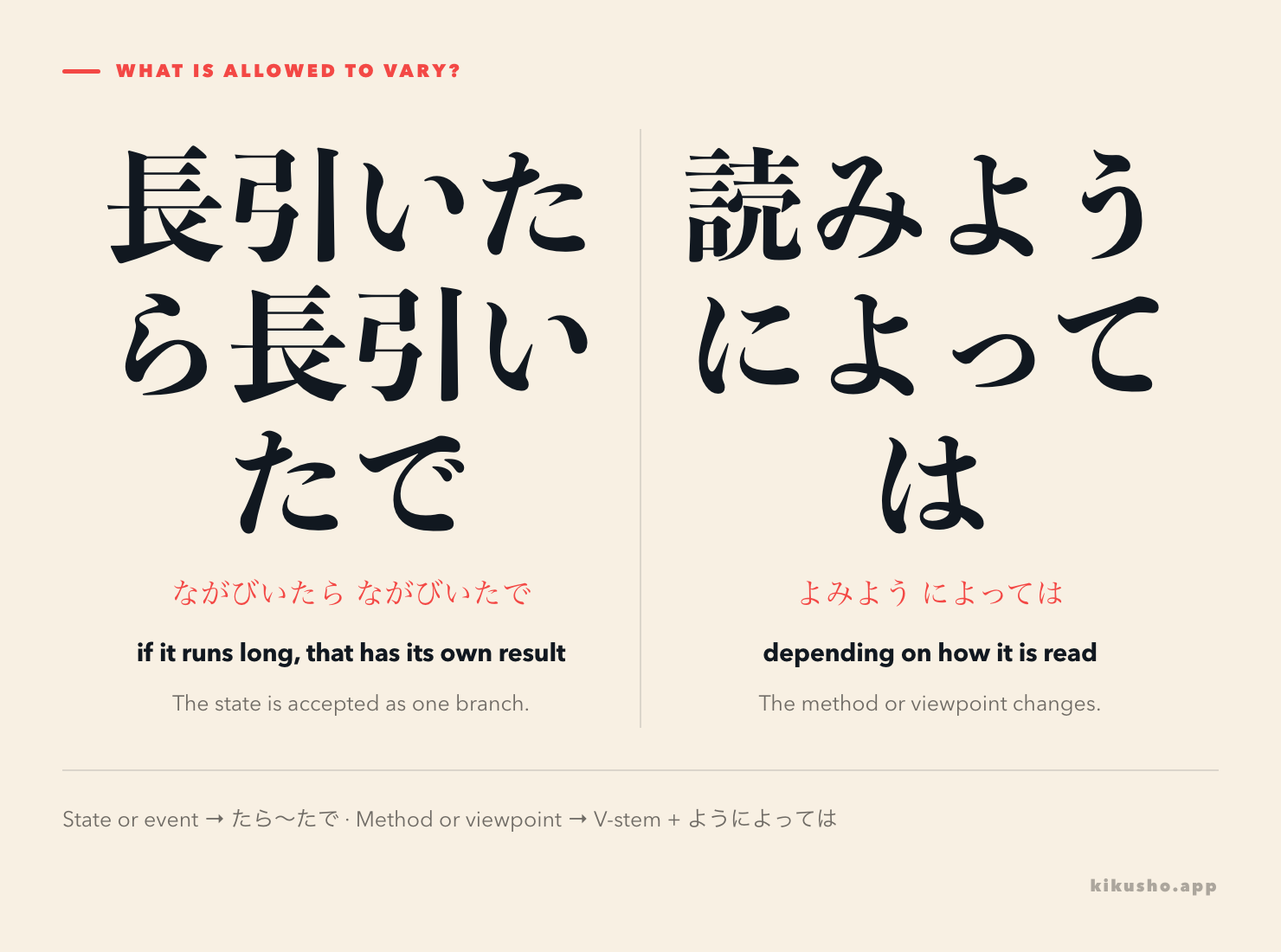
たら~たで repeats the condition inside its consequence
With verbs and い-adjectives, repeat the same past-form predicate on both sides of ら. With nouns and な-adjectives, the related pattern uses なら~で.
| Base | Pattern | Example frame |
|---|---|---|
| 行く | 行ったら行ったで | if one goes, then that has its own result |
| 行かない | 行かなかったら行かなかったで | if one does not go, then that has its own result |
| 広い | 広かったら広かったで | if it is spacious, that has its own issue |
| 静かだ | 静かなら静かで | if it is quiet, that has its own character |
| 雨だ | 雨なら雨で | if it rains, respond on that basis |
The repetition is structural. 行ったらしたで does not work as this pattern because the repeated predicate has changed. The second predicate may sometimes be omitted in loose conversation when it is recoverable, but keeping the full pair makes the N1 construction unmistakable.
予約できなかったらできなかったで、当日券を探そう。
よやく できなかったら できなかったで、とうじつけんを さがそう。
If we cannot make a reservation, then we will look for same-day tickets.
部屋は広いほうがいいが、広かったら広かったで、掃除に時間がかかる。
へやは ひろい ほうが いいが、ひろかったら ひろかったで、そうじに じかんが かかる。
A spacious room is preferable, but if it is spacious, cleaning takes time in its own way.
The result is often inconvenient, compensating or mildly resigned. It need not be disastrous. 行ったら行ったで楽しかった can even introduce an unexpectedly good result: going felt troublesome beforehand, yet the experience was enjoyable once it happened.
This makes the pattern useful when neither branch is simple. 忙しくなかったら心配だし、忙しかったら忙しかったで休めない says that quiet business causes worry, while busy business creates a different problem. The second half does not cancel the first. It gives the busy branch its own consequence.
ようによっては makes the manner the deciding factor
Here よう is a noun meaning a way or manner. Attach it to the ます-stem of a verb, then add によっては or the shorter では.
| Polite verb | Stem + よう | Condition |
|---|---|---|
| 使います | 使いよう | 使いようによっては |
| 考えます | 考えよう | 考えようによっては |
| 見ます | 見よう | 見ようでは |
| 受け取ります | 受け取りよう | 受け取りようによっては |
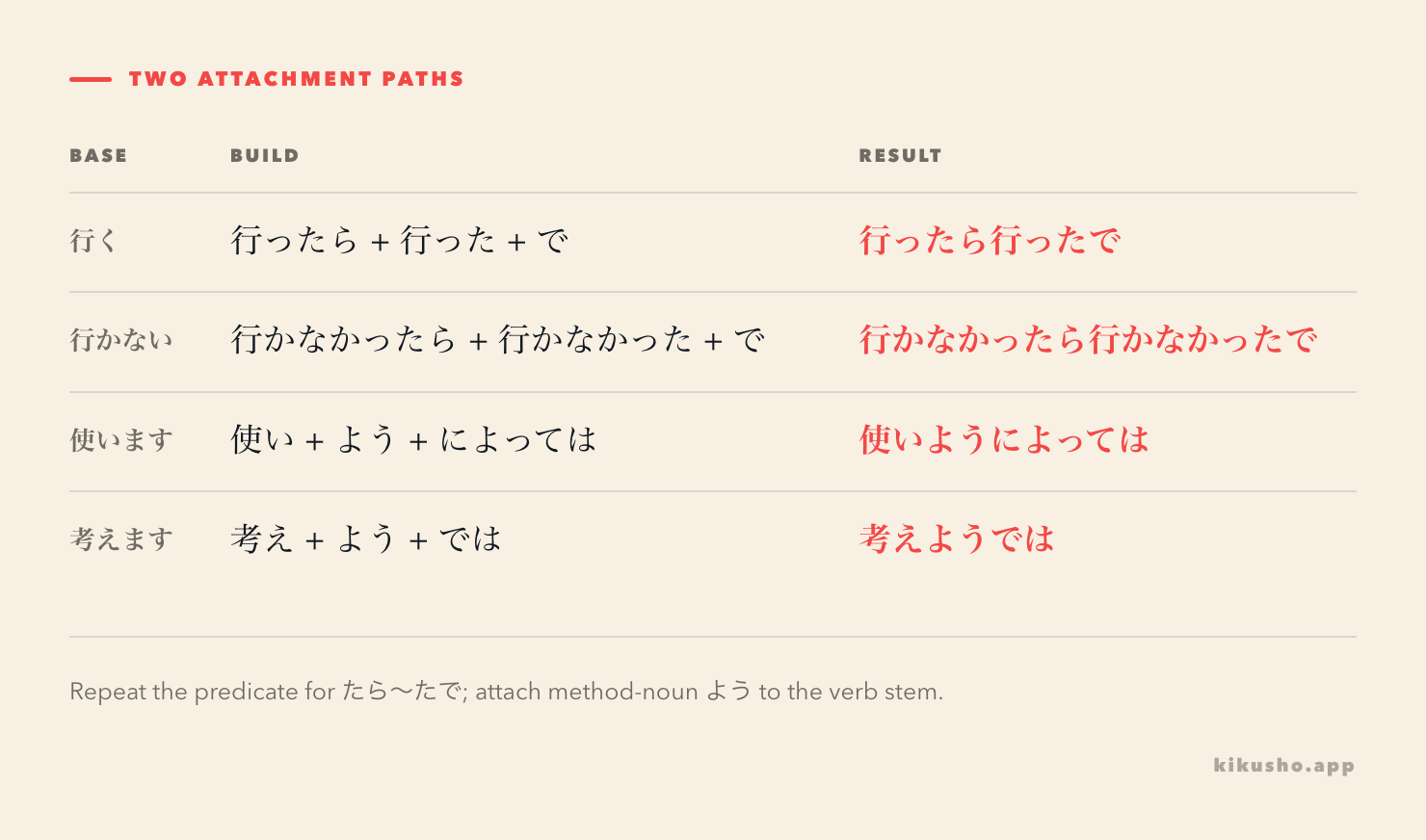
Do not mistake 考えよう here for the volitional “let us think.” In 考えようによっては, the segmentation is 考え + よう + によっては: “depending on the way of thinking.” The particles after よう reveal that it is a method noun.
この小さな箱も使いようによっては、便利な仕切りになる。
この ちいさな はこも つかいようによっては、べんりな しきりに なる。
Depending on how it is used, this small box can become a useful divider.
考えようでは、予定の変更も準備時間が増えたことになる。
かんがえようでは、よていの へんこうも じゅんびじかんが ふえた ことに なる。
From one way of looking at it, the schedule change also means that we gained preparation time.
によっては makes the dependency explicit and often highlights one possible method among several. では is tighter and relies more on context, but the same method noun remains. Common combinations such as やりよう, 使いよう, 考えよう, 見よう, and 受け取りよう all name something that can be varied.
The same situation can produce two different arguments
Suppose a team chooses a very simple plan.
計画が単純だったら単純だったで、見落としがないか心配になる。
けいかくが たんじゅんだったら たんじゅんだったで、みおとしが ないか しんぱいに なる。
If the plan is simple, that itself makes me worry that we may have overlooked something.
The plan's simplicity is treated as a settled branch. Once that state holds, a particular worry follows.
単純な計画も進めようによっては、十分な成果につながる。
たんじゅんな けいかくも すすめようによっては、じゅうぶんな せいかに つながる。
Depending on how it is carried out, even a simple plan can lead to adequate results.
Now simplicity is fixed and execution varies. The speaker sees room to alter the outcome through the manner of proceeding. Translation words such as “if” and “depending” cannot make this decision for you; identify what changes inside the Japanese argument.
The contrast also changes the speaker's stance. たら~たで often sounds like accepting a branch and dealing with it. ようによっては preserves agency or interpretive flexibility: another technique, use or angle may yield another result. Neither form is inherently optimistic, but ようによっては often introduces a possibility that was easy to miss.
V-stem + ようでは is not plain-form + ようでは
Two constructions can end in the same hiragana:
| Form before ようでは | Meaning | Example |
|---|---|---|
| verb stem: 考え + ようでは | depending on the way of thinking | 考えようでは価値がある |
| plain verb: 諦める + ようでは | if such behavior or state holds | 諦めるようでは成功できない |
The second pattern usually evaluates behavior, ability or a state as inadequate, then predicts a bad result. It is taught separately at N2. The ていては and ようでは lesson gives that evaluative construction its full treatment.
Compare 見ようでは意味が変わる, “the meaning changes depending on how one looks,” with 意味を説明できないようでは困る, “it is a problem if you cannot explain the meaning.” In the first, 見 is a stem and よう means “way.” In the second, 説明できない is a complete plain negative predicate, and ようでは presents that inability as evidence.
There is one more visual trap: 考えようではないか contains the volitional 考えよう and makes a rhetorical invitation, “let us think.” Look beyond the string ようでは. The form immediately before it and the material immediately after it identify the construction.
Choose the form before translating
When producing a sentence, sketch its logic in this order:
- Name the fact that might vary.
- Decide whether the alternatives are states or ways of acting.
- For a state, repeat the same predicate with たら~たで.
- For a method, turn the verb stem into a method noun with よう, then add によっては or では.
This is easier to retain as a complete pair than as two English glosses. Save 狭かったら狭かったで、工夫が必要だ with both clauses intact. For the other form, save 使いようによっては役に立つ and mark the boundary 使い|よう|によっては. Kikusho can keep those boundaries in the editable explanation while the original sentence remains available for review.
The nearby ばそれまでだ lesson helps with a different conditional judgment. 壊れたら壊れたで直せばいい accepts breakage and supplies a response; 壊れてしまえばそれまでだ says breakage ends the matter. One condition opens a branch, while the other closes it.
Practice
1. Choose the condition with its own consequence
部屋は狭くてもいいが、__、大きな机は置けない。
ア. 狭かったら狭かったで イ. 狭いようによっては ウ. 狭くするようでは
2. Build a method noun
Which form means “depending on how it is used”?
ア. 使ったら使ったで イ. 使うようでは ウ. 使いようによっては
3. Identify what varies
Match each sentence to its variable.
- 参加者が少なかったら少なかったで、全員でゆっくり話せる。
- この文章は読みようによっては、冗談にも批判にも取れる。
ア. the way an action is performed or interpreted
イ. whether a state holds
4. Complete the repeated predicate
予約が取れなかったら__、別の日を選べばいい。
ア. 取れないようでは イ. 取れなかったで ウ. 取りようによっては
5. Separate two meanings of ようでは
Which sentence contains the N1 method-noun pattern?
ア. 基本的な質問に答えられないようでは、面接は難しい。
イ. 答えようでは、同じ内容でも失礼に聞こえる。
6. Reconstruct the sentence
Arrange every segment to express: “Depending on how you think about it, this delay can become useful preparation time.”
ア. 有効な準備時間になる イ. この遅れも ウ. 考えようによっては
7. Choose the variable in context
小さい店は商品をたくさん置けない。しかし、__、客が選びやすい売り場を作ることもできる。
ア. 小さかったら小さかったで
イ. 売り場の作りようによっては
ウ. 小さいようでは
Commit to all seven choices before opening the explanations below.
Answers and explanations
- ア. 狭かったら狭かったで. The room's size is the possible state. The same adjective is repeated in its past form, and the second clause gives the limitation belonging to that state.
- ウ. 使いようによっては. Remove ます from 使います to get 使い, add the method noun よう, then によっては. Choice ア accepts the event of using something; choice イ contains a plain-form evaluative condition.
- 1–イ; 2–ア. Sentence 1 asks what follows if attendance is low. Sentence 2 keeps the text fixed and varies how it is read.
- イ. 取れなかったで. The complete pair is 取れなかったら取れなかったで. Both halves repeat the same past negative predicate.
- イ. 答えようでは. 答え is the verb stem and よう means “way of answering.” In sentence ア, 答えられない is a complete plain negative form evaluated as inadequate.
- イ–ウ–ア: この遅れも、考えようによっては、有効な準備時間になる. The delay stays fixed; a different interpretation changes what it represents.
- イ. 売り場の作りようによっては. The second sentence introduces a constructive result made possible by changing the layout method. Choice ア would accept smallness and then give its own consequence, but it would not make the sales-floor design the variable.
The search results place both assigned constructions at N1, with no recorded level disagreement in the Kikusho inventory. The sources agree on attachment: repeated predicates for たら~たで, and verb stems plus method-noun よう for ようによっては/ようでは. The separate plain-form ようでは boundary was checked against the existing N2 lesson so identical spelling does not collapse two uses into one.
This lesson was reviewed for both inventory items, attachment, negation, noun and adjective variants, register, the two readings of ようでは, and seven original questions. AI-assisted language and practice review checked each example and ensured that the answers remain hidden below the complete question set.
Common questions
What does たら~たで mean in Japanese?
It repeats the same predicate to say that if a state occurs, that state has its own consequence, response or difficulty. For example, 忙しかったら忙しかったで means “if it is busy, that brings its own situation.”
How do you form ようによっては?
Remove ます from a verb and add ようによっては: 使います becomes 使いようによっては. Here よう is a noun meaning a way or manner of doing something.
Are the two ようでは grammar patterns the same?
No. V-stem plus ようでは means “depending on how it is done.” Plain-form plus ようでは evaluates a behavior or state as evidence of a likely bad result.