On this page
にかかっている says that an outcome hinges on a decisive factor. The most useful frame is outcome は factor にかかっている: the left side names what is at stake, and the noun before に names what will determine it.
計画の成功は、事前の準備にかかっている。
けいかくのせいこうは、じぜんのじゅんびにかかっている。
The success of the plan hinges on advance preparation.
This is stronger than merely saying that preparation is related to success. It puts preparation at the point where the result will be decided.
Build the dependency from outcome to deciding factor
| Sentence role | Japanese | What it contributes |
|---|---|---|
| outcome | 計画の成功は | what is at stake |
| decisive factor | 事前の準備に | what the result rests on |
| dependency | かかっている | the result currently hinges there |
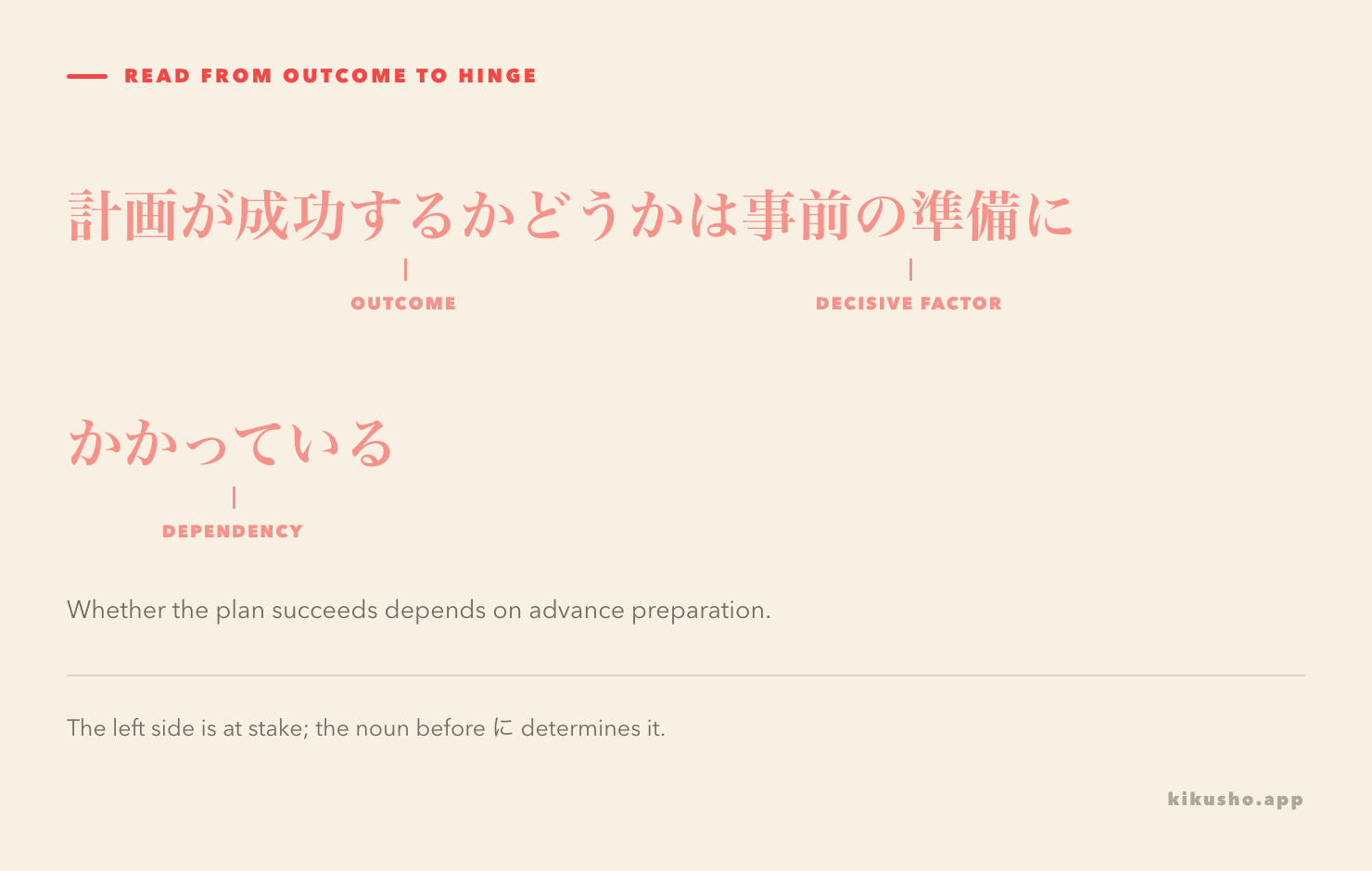
The ている form describes an existing state of dependence. It does not mean that someone is in the middle of performing an action called かかる. The relationship is already in force now, even when the result will be known later.
地域の将来は、若い世代への教育にかかっている。
ちいきのしょうらいは、わかいせだいへのきょういくにかかっている。
The region’s future depends on the education given to the younger generation.
この試合の勝敗は、最後の一球にかかっている。
このしあいのしょうはいは、さいごのいっきゅうにかかっている。
The outcome of this game rests on the final pitch.
Abstract outcome nouns fit naturally: 成功, success; 成否, success or failure; 勝敗, victory or defeat; 合否, passing or failing; 将来, future; and 運命, fate. The factor can be concrete, like the last pitch, or abstract, like preparation, judgment or trust.
JLPT Sensei gives noun + にかかっている, embedded questions ending in か and an N1 placement. 毎日のんびり日本語教師 independently explains that the form identifies the content or condition that decides whether something will be realized and compares it with 次第だ.
Put an unresolved outcome on the left
A frequent left side is an embedded yes-or-no question followed by は:
新製品が予定どおり完成するかどうかは、今週の試験結果にかかっている。
しんせいひんがよていどおりかんせいするかどうかは、こんしゅうのしけんけっかにかかっている。
Whether the new product is completed on schedule depends on this week’s test results.
交渉がまとまるかは、双方が条件を受け入れるかにかかっている。
こうしょうがまとまるかは、そうほうがじょうけんをうけいれるかにかかっている。
Whether the negotiations succeed depends on whether both sides accept the terms.
The second sentence contains two embedded questions. 交渉がまとまるか is the outcome under discussion; 双方が条件を受け入れるか is the determining condition. The particles show which question plays which role.
Do not attach the grammar directly to a plain verb:
- × 成功するにかかっている
- ○ 成功するかどうかは、準備にかかっている
- ○ 成功は、準備にかかっている
The first correction turns the uncertain outcome into a question. The second names the outcome with a noun.
The factor can itself be a question
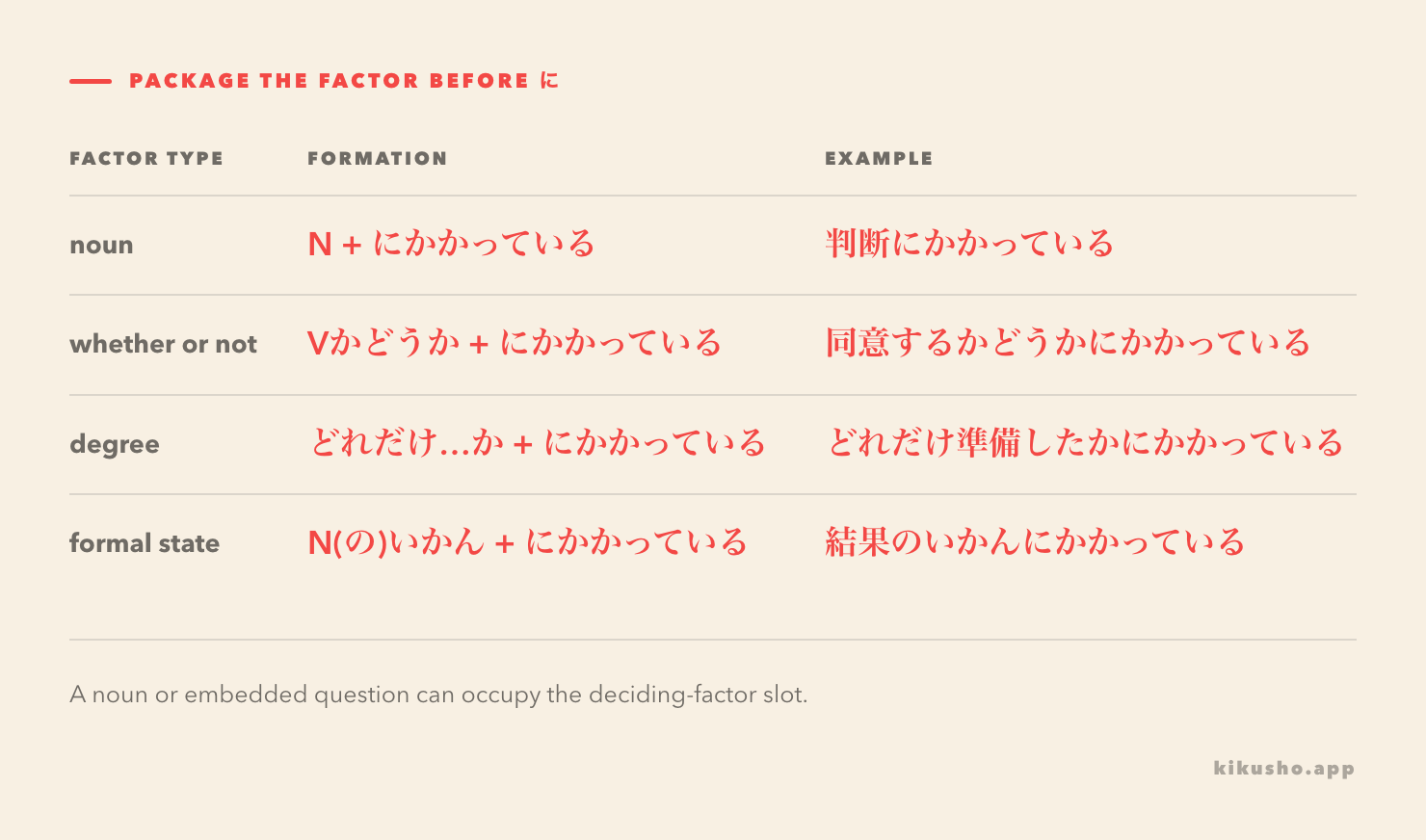
When the deciding factor is not a simple noun, package it with か, かどうか, どれだけ…か or どう…か.
| Factor type | Formation | Example |
|---|---|---|
| noun | N + にかかっている | 判断にかかっている |
| whether or not | clause + かどうか + にかかっている | 同意するかどうかにかかっている |
| degree | どれだけ…か + にかかっている | どれだけ準備したかにかかっている |
| manner or content | どう…か + にかかっている | どう説明するかにかかっている |
利用者が戻ってくるかどうかは、問題にどう対応するかにかかっている。
りようしゃがもどってくるかどうかは、もんだいにどうたいおうするかにかかっている。
Whether users return depends on how the problem is handled.
合格できるかどうかは、残りの時間をどれだけ有効に使えるかにかかっている。
ごうかくできるかどうかは、のこりのじかんをどれだけゆうこうにつかえるかにかかっている。
Whether you can pass depends on how effectively you can use the remaining time.
The Iku老師 reference confirms the noun and question-clause attachments and notes that the determining factor is often foregrounded as the key to success, failure, fate or realization.
Strong focus does not automatically prove one sole cause
にかかっている often feels like “hinges on” or “rests with,” especially in speeches, commentary and advice. A manager might say:
この改革の成否は、皆さんの協力にかかっています。
このかいかくのせいひは、みなさんのきょうりょくにかかっています。
The success of this reform rests on your cooperation.
The sentence foregrounds cooperation as decisive. It may also place responsibility or pressure on the listeners. The grammar alone does not logically prove that no other factor exists. Words such as すべて, まさに and ひとえに strengthen the claim:
結果はひとえに、現場の判断にかかっている。
けっかはひとえに、げんばのはんだんにかかっている。
The result rests entirely on the on-site judgment.
Use that stronger wording only when the context supports it. In factual analysis, 結果は複数の要因による may be more accurate than assigning everything to one factor.
Compare による, 次第だ and いかん
All four can express dependence, but they frame it differently.
- 結果は天候による neutrally says the result depends on the weather.
- 実施できるかは天候次第だ presents the weather as the condition that will settle the matter.
- 実施できるかは天候にかかっている puts stronger focus on the weather as the decisive hinge.
- 実施できるかは天候のいかんにかかっている adds a formal “depending on how the weather is” frame.
The によって lesson covers neutral cause, means, agent and variation. にかかっている is narrower: it identifies what an outcome rests on.
The formal extension is N + (の) + いかんにかかっている:
事業を継続できるかは、今期の売上のいかんにかかっている。
じぎょうをけいぞくできるかは、こんきのうりあげのいかんにかかっている。
Whether the business can continue depends on how this term’s sales turn out.
いかん means the state, course or content of the factor. The 如何 family lesson also shows the reverse relationship: いかんによらず means the result stays unchanged regardless of that state.
Separate dependency from a result in someone’s hands
These two sentences use related sounds but different structures:
修理が終わるかどうかは、部品の到着にかかっている。
Whether the repair is completed depends on the arrival of the part.
あの技師にかかれば、難しい修理も一日で終わる。
In that technician’s hands, even a difficult repair is finished in one day.
The first names a condition that decides the outcome. The second praises the agent whose handling produces a notable result. The に言わせれば and にかかっては comparison teaches that handled-by-agent family.
Ordinary lexical uses also remain separate. 壁に絵がかかっている means a picture is hanging on the wall. 準備に三時間かかっている reports time spent. The dependency reading becomes clear when an outcome such as success, fate or whether-or-not is tied to a determining factor.
Save the two sides of the hinge
For a Kikusho card, do not save only にかかっている = depends on. Keep both the outcome and the deciding factor: 交渉がまとまるかは、双方の譲歩にかかっている. During review, identify what is at stake, then reconstruct the factor on which it rests.
Practice: find the outcome and its hinge
Complete the set before revealing the answers.
Question 1 — decisive factor
Choose the form that says the event’s success hinges on preparation.
イベントの成功は、十分な準備__。
- ア. に限ったことではない
- イ. にかかっている
- ウ. によらず
- エ. にかかれば
Question 2 — embedded outcome
Which beginning correctly presents an unresolved yes-or-no outcome?
- ア. 計画が成功するに
- イ. 計画が成功しますは
- ウ. 計画が成功するかどうかは
- エ. 計画を成功することに
Question 3 — question as factor
Complete: 顧客が戻るかどうかは、会社が苦情にどう対応する( )にかかっている。
- ア. を
- イ. か
- ウ. ので
- エ. まで
Question 4 — dependency or skilled handling
Which sentence expresses dependency rather than a notable result caused by an expert?
- ア. 彼にかかれば、この時計も直る。
- イ. 職人にかかると、古い家具も美しくなる。
- ウ. 修理できるかは、部品の在庫にかかっている。
- エ. 母の手にかかったら、残り物がごちそうになった。
Question 5 — sentence composition
Arrange the pieces to say “Whether the team wins depends on how well it communicates.”
- チームが勝てるかどうかは
- どれだけうまく連絡を取り合えるかにかかっている
Question 6 — rhetorical strength
Does 会社の未来は社員の協力にかかっている prove that cooperation is literally the company’s only relevant factor? Explain what the grammar foregrounds.
Question 7 — connected text
Choose the pair that first marks a decisive dependency, then removes dependence on weather.
開催できるかどうかは、会場の確保( )。オンライン配信は、天候( )行います。
- ア. によらず/にかかっている
- イ. にかかっている/によらず
- ウ. にかかれば/に限って
- エ. によって/にかかったら
Answers and explanations
1. イ, にかかっている. Preparation is the determining factor on which success rests. にかかれば would instead suggest a capable agent whose handling produces a result.
2. ウ, 計画が成功するかどうかは. The embedded かどうか packages success or failure as the outcome under discussion. The other options do not form this outcome frame.
3. イ, か. どう対応するか is an embedded question meaning “how the company responds.” That entire question is the factor before にかかっている.
4. ウ. The availability of parts determines whether repair is possible. The other three sentences place an object or task in someone’s capable hands and describe the resulting transformation.
5. チームが勝てるかどうかは、どれだけうまく連絡を取り合えるかにかかっている。 The first question is the outcome; the degree question before にかかっている supplies the deciding factor.
6. No. The sentence foregrounds employee cooperation as decisive and may place responsibility on the employees. Without an intensifier such as すべて or ひとえに, the grammar does not establish a literal one-cause model.
7. イ, にかかっている/によらず. Securing the venue decides whether the event can be held. The online stream, by contrast, proceeds regardless of the weather.
Level and review note
The frozen inventory and the checked JLPT Sensei, Bunpro and native-teacher references place this dependency use at N1, with no recorded disagreement. The handled-by-agent にかかれば/にかかると family, literal hanging, time-taking かかる, neutral による and the already mapped いかん family are contrasts or prerequisites and receive no credit here. Because the JLPT publishes no exhaustive grammar-item list, the N1 label reports reference agreement rather than an official assignment.
Common questions
What does にかかっている mean?
It says that an outcome, success, decision or future hinges on a decisive factor. A natural translation is “depends on,” “rests on,” or “is up to,” depending on whether the factor is a thing, circumstance or person.
What is the basic sentence pattern for にかかっている?
The common frame is outcome は factor にかかっている: 計画の成功は準備にかかっている. The outcome can also be a whether-or-not question, as in 成功するかどうかは.
Can a clause come before にかかっている?
Yes, when it is packaged as an embedded question ending in か or かどうか: 結果は、相手が同意するかどうかにかかっている. A plain verb cannot attach directly.
Is にかかっている the same as にかかると or にかかれば?
No. にかかっている marks dependency: success hinges on preparation. The agent construction says a notable result occurs when someone handles something: 彼にかかれば直る.