On this page
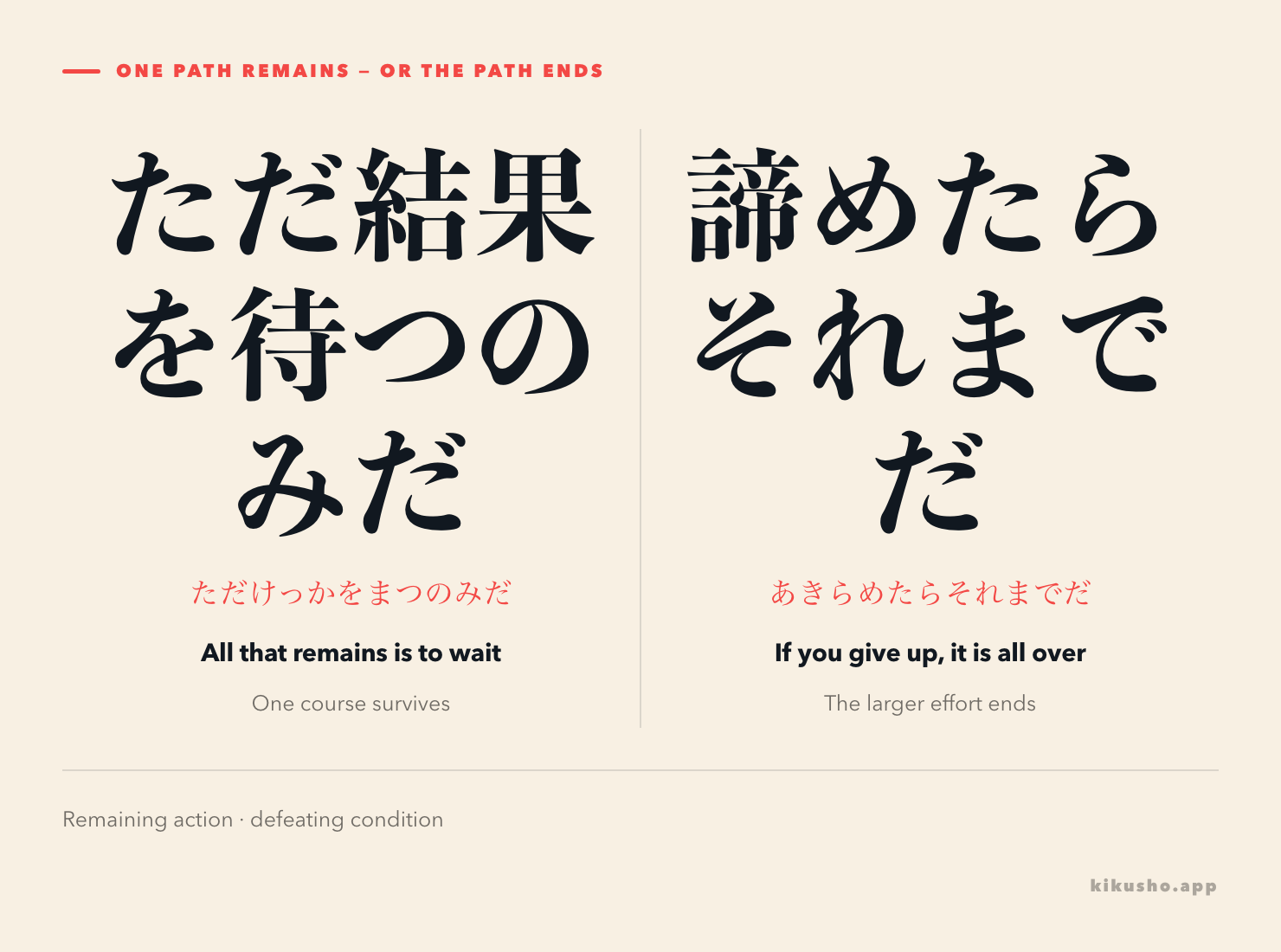
After the work is finished, 今はただ結果を待つのみだ narrows the future to one remaining action. During the work, 途中で諦めたらそれまでだ marks giving up as the point where the effort loses its value. ただ~のみだ concludes “nothing remains but X”; ば/たらそれまでだ concludes “if X happens, that is the end of it.”
Both constructions close alternatives, but in opposite directions. One preserves a final course of action. The other names the condition that closes the course down.
Ask whether the conclusion leaves one path or ends the path
The decisive question is what survives at the end of the sentence.
| Construction | What comes before it | What the conclusion does |
|---|---|---|
| ただ + X + のみだ | the sole action, state or item left | narrows the available path to X |
| Vば/Vたら + それまでだ | a condition that would defeat the larger effort | says that the path ends if X occurs |
準備は終わった。あとはただ本番で力を出すのみだ。
じゅんびはおわった。あとはただほんばんでちからをだすのみだ。
Preparation is complete. All that remains is to perform at our best in the real event.
どれほど準備しても、本番で諦めたらそれまでだ。
どれほどじゅんびしても、ほんばんであきらめたらそれまでだ。
No matter how much you prepare, if you give up during the real event, it is all for nothing.
Bunpro describes ただ~のみ as a formal way to say that an action is all that remains or is required. J-Nihongo explains ば/たらそれまでだ as the point where earlier effort, value or planning ends or becomes meaningless. That difference is more useful than translating both with “only” or “that's it.”
ただ~のみだ narrows what remains
The productive core is ただ + dictionary-form verb + のみだ. ただ means “merely” or “simply”; のみ is the formal restrictive particle; だ/です closes the sentence.
今できるのは、ただ連絡を待つのみです。
いまできるのは、ただれんらくをまつのみです。
All we can do now is wait for contact.
The speaker is not saying that waiting has no value. The sentence removes other available actions and leaves waiting as the single course.
方針は決まった。あとはただ計画を実行するのみだ。
ほうしんはきまった。あとはただけいかくをじっこうするのみだ。
The policy is settled. All that remains is to carry out the plan.
The form can sound resolute because it presents debate as finished. It can also sound resigned when the remaining action is passive, such as waiting or praying. Context supplies that stance; のみ supplies the formal restriction.
Tanosuke's N1 explanation gives the wider attachment pattern. Keep the following forms distinct:
| Material after ただ | Pattern | Example |
|---|---|---|
| ordinary verb | ただ + Vる + のみだ | ただ待つのみだ |
| する verb | ただ + Nする + のみだ | ただ練習するのみだ |
| elevated する-verb variant | ただ + N + あるのみだ | ただ練習あるのみだ |
| noun | ただ + N + のみだ | 答えはただ一つのみだ |
| な-adjective or noun predicate | ただ + Xである + のみだ | ただ静かであるのみだ |
| い-adjective | ただ + Aい + のみだ | ただ寂しいのみだ |
The adjective patterns are grammatical but markedly formal and far less useful in ordinary speech than the verb pattern. For production, ただVるのみだ is the centre to learn first. The form Nあるのみだ is elevated: 努力あるのみだ means that determined effort is the sole course remaining. Do not turn every する verb into this version when an ordinary 練習するのみだ is clearer.
ただ strengthens のみ but does not create the restriction alone
のみ already means “only.” The earlier のみ and でしかない comparison teaches its ordinary restriction after nouns, verbs and case-marked phrases. In the N1 pattern, ただ doubles down on the narrow conclusion.
Compare:
あとは結果を待つのみだ。
あとはけっかをまつのみだ。
All that remains is to wait for the result.
あとはただ結果を待つのみだ。
あとはただけっかをまつのみだ。
All that remains now is simply to wait for the result.
Both are valid. The second makes the “nothing else” stance more explicit. ただただ can intensify it further in an emotional sentence, as in ただただ無事を願うのみです, “All I can do is pray for their safety.” That repetition is expressive, not a required part of the construction.
Use のみで when the sentence continues:
この制度はただ複雑であるのみで、利用者には利点がない。
このせいどはただふくざつであるのみで、りようしゃにはりてんがない。
This system is merely complicated and offers users no benefit.
Here the construction limits the first assessment, then で connects it to the contrasting claim. This is formal written Japanese. In ordinary conversation, ただ複雑なだけで would usually be more natural.
ば/たらそれまでだ names the defeating condition
Attach それまでだ to a verb condition:
| Conditional form | Model | Meaning |
|---|---|---|
| Vば + それまでだ | 使わなければそれまでだ | If it is not used, the prior effort has no point |
| Vたら + それまでだ | 諦めたらそれまでだ | If you give up, that is the end of it |
| polite ending | それまでです | That will be the end of it, addressed politely |
| continued clause | それまでだが/けれど | That would end the point, but… |
高価な道具をそろえても、使わなければそれまでだ。
こうかなどうぐをそろえても、つかわなければそれまでだ。
Even if you buy expensive equipment, it is all pointless if you do not use it.
毎日データを保存しても、保管先が壊れたらそれまでだ。
まいにちデータをほぞんしても、ほかんさきがこわれたらそれまでだ。
Even if you save the data every day, it is all over if the storage location fails.
The first clause often contains ても, どれほど~ても, or いくら~ても. It builds up the effort or value that the later condition could cancel. JapaneseNET and N1et's dedicated lesson both identify this pairing and place the construction at N1.
The condition need not describe physical destruction. Giving up can waste practice; failing to use a resource can make buying it pointless; a single rule can end a plan. English changes among “then it is over,” “then it is useless,” and “then there is nothing more to say.” Japanese lets context decide what reaches its limit.
ば and たら are variants here, not a rigid opposition
JLPT Sensei lists both forms together as N1. Use the ordinary conditional form demanded by your clause, but do not invent a special contrast in which one variant always means warning and the other always means resignation.
The inventory, JLPT Sensei, Bunpro, Tanosuke, JapaneseNET and N1et all place the target constructions at N1. Those are teaching placements: the exam authority explains that it no longer publishes a vocabulary, kanji and grammar specification. The agreement is useful for study order, but it is not an official item guarantee.
最後まで読まなければ、それまでだ。
さいごまでよまなければ、それまでだ。
If you do not read to the end, that is where it stops.
途中で読むのをやめたら、それまでだ。
とちゅうでよむのをやめたら、それまでだ。
If you stop reading midway, that is the end of it.
The exact contexts differ, but both identify a condition that closes the larger project. A sentence that needs the broader rules for conditionals belongs with the ば and なら comparison, not with a false micro-rule invented for それまでだ.
と言えばそれまでだ can close an argument too quickly
The construction also appears after a quoted summary:
経験不足だと言えばそれまでだが、指示の出し方にも問題があった。
けいけんぶそくだといえばそれまでだが、しじのだしかたにももんだいがあった。
You could end the discussion by calling it inexperience, but the way instructions were given was also a problem.
Xと言えばそれまでだ concedes that X could settle or shut down the discussion. The following が/けれど resists that oversimplification and adds what the label misses. This is not the same as saying that an object physically becomes useless.
好みの問題だと言われればそれまでだけれど、使いやすさには大きな差がある。
このみのもんだいだといわれればそれまでだけれど、つかいやすさにはおおきなさがある。
If someone says it is merely a matter of taste, that could end the discussion, but there is a large difference in usability.
The passive と言われれば shifts the possible summary to what another person might say. This extended use explains why “if X, everything becomes useless” is too narrow as a definition.
Neighbouring endings close different things
Three nearby patterns deserve separate slots:
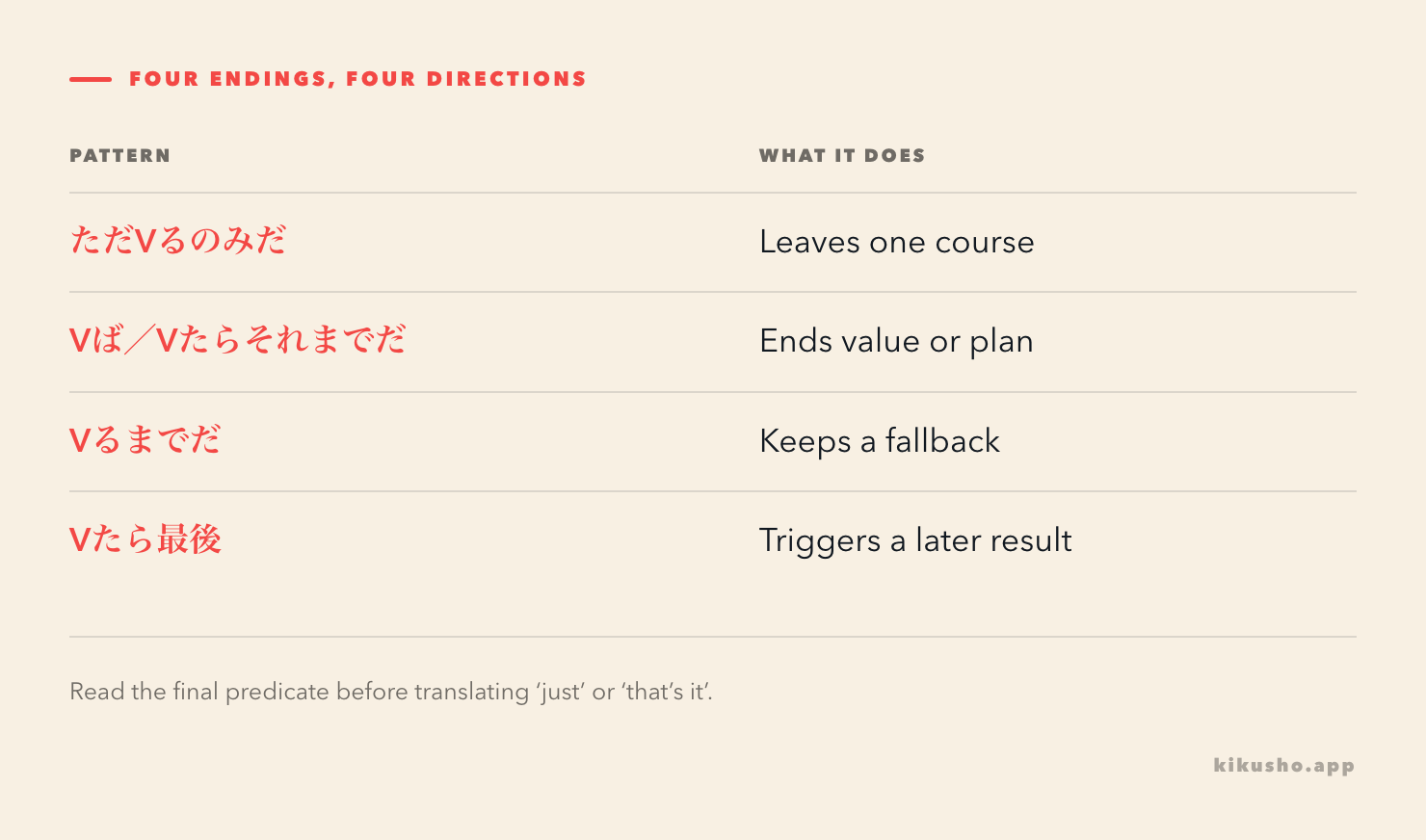
- Vるまでだ presents a fallback action: “if necessary, I will simply do V.” The までだ lesson teaches that response and the past Vたまでだ explanation.
- Vたら最後 presents an irreversible trigger followed by a recurring or unavoidable result. The たら最後 comparison develops that sequence.
- ただVるのみだ says one course remains. It does not require a prior condition, though one may appear in the context.
Compare the direction of the predicate:
| Sentence | What follows from the condition? |
|---|---|
| 失敗したら、やり直すまでだ | I retain a fallback: I will redo it |
| 失敗したら、それまでだ | failure ends the value or plan |
| 始めたら最後、途中ではやめられない | starting triggers an unavoidable later result |
| 準備後は、ただ実行するのみだ | execution is the one course left |
Practice
For each item, mark either the path that survives or the event that cuts the path off. Keep your seven choices hidden from the commentary below until the whole set is complete.
Question 1
The team has completed every preparation. Which ending presents waiting as the sole remaining action?
できる準備はすべて終えた。あとはただ連絡を待つ( )。
ア. それまでだ
イ. のみだ
ウ. たら最後だ
エ. まででない
Question 2
Choose the sentence that says expensive equipment has no value if nobody uses it.
ア. 高価な道具をそろえれば、ただ使うのみだ。
イ. 高価な道具はただ便利であるのみだ。
ウ. 高価な道具をそろえても、使わなければそれまでだ。
エ. 高価な道具を使ったまでだ。
Question 3
Which form gives the formal する-verb variant meaning “All that remains is effort”?
ア. ただ努力したらそれまでだ
イ. ただ努力であるのみだ
ウ. ただ努力するそれまでだ
エ. ただ努力あるのみだ
Question 4
Read the exchange. B wants to resist an explanation that would close the discussion too quickly.
A: 経験が足りなかっただけでしょう。
B: 経験不足だと( )、指示にも問題がありました。
ア. 言えばそれまでですが
イ. 言うのみですが
ウ. 言ったまでですが
エ. 言ったら最後ですが
Question 5
Which sentence presents starting as an irreversible trigger for a later result, rather than as the condition that makes prior effort pointless?
ア. この作業は始めたら最後、途中では止められない。
イ. この作業は始めたらそれまでだ。
ウ. この作業はただ始めるのみだ。
エ. この作業は始めるまでだ。
Question 6
Complete the connected text with the form that preserves a course of action.
計画は承認された。必要な資料もそろっている。今は( )。
ア. 途中で諦めたらそれまでだ
イ. ただ実行するのみだ
ウ. 実行したら最後だ
エ. 実行しなければそれまでだ
Question 7
Arrange the chunks to say, “No matter how much you practise, if you give up during the match, it is all for nothing.” The ★ marks the third chunk.
ア. 試合中に諦めたら
イ. それまでだ
ウ. どれほど練習しても
エ. 、
Record the four-part order and starred position first. The disclosure below should stay closed until both are fixed.
Answers and explanations
Answer 1
イ. のみだ. The full sentence is あとはただ連絡を待つのみだ. The dictionary-form verb 待つ names the one course left. それまでだ would require a condition and would say that something ends, reversing the requested direction.
Answer 2
ウ. そろえても establishes the investment, and 使わなければそれまでだ names non-use as the condition that makes it pointless. ア says that using the equipment is the sole course after buying it. イ merely calls it convenient in a formal limiting frame. エ minimizes a completed act of using it.
Answer 3
エ. ただ努力あるのみだ. This elevated variant replaces the する of a verbal noun with ある. 努力するのみだ is also valid and more transparent. イ would make 努力 a noun predicate rather than the action that remains.
Answer 4
ア. 言えばそれまでですが. The complete sentence concedes that “inexperience” could close the discussion, then adds a second cause. イ says that saying it is the only action left. ウ means the speaker merely said it, and エ frames saying it as an irreversible trigger.
Answer 5
ア. 始めたら最後 makes starting the trigger for the later inability to stop. B says starting itself ends the value or plan, which does not fit the described sequence. C leaves starting as the sole course. D presents starting as a fallback action.
Answer 6
イ. ただ実行するのみだ. Approval and complete materials leave execution as the remaining course. D is grammatical in a different warning: failure to execute would make the preparations pointless. The prompt asks for the course that remains, not the condition that would defeat it.
Answer 7
ウ → エ → ア → イ; ★ is ア. The sentence is どれほど練習しても、試合中に諦めたらそれまでだ. Read どれほどれんしゅうしても、しあいちゅうにあきらめたらそれまでだ. The ても clause builds the effort; the たら clause names the defeating condition.
Save the surrounding stakes, not only the ending
An isolated card reading それまでだ = that's it cannot tell you what is lost. Keep the effort clause and the condition together: どれほど準備しても、途中で諦めたらそれまでだ. For ただ~のみだ, keep the situation that has removed every other option.
When you capture one of these lines in Kikusho, edit the explanation around the direction of the conclusion: “one action survives” or “the larger effort ends.” That small note will still distinguish the pair when both English translations have faded into “all you can do” and “then it's over.”
Common questions
What is the difference between ただ~のみだ and ばそれまでだ?
ただ~のみだ narrows the remaining course to one action or state: all that remains is X. ば/たらそれまでだ names a condition after which earlier effort, value, planning or discussion ends or becomes pointless.
Can ただ be omitted from ただ~のみだ?
Yes. のみ supplies the restriction, while ただ reinforces it. あとは待つのみだ and あとはただ待つのみだ are both possible; the second presses the idea that there is truly nothing else to do.
Are ばそれまでだ and たらそれまでだ different?
They are variants of the same N1 construction. The ordinary conditional choice still follows the sentence, but teaching references do not support a rigid meaning split between the two endings here.
Is たらそれまでだ the same as たら最後?
No. たらそれまでだ evaluates the condition as the point where previous effort or value ends. たら最後 presents an event as an irreversible trigger for a later consequence.