On this page
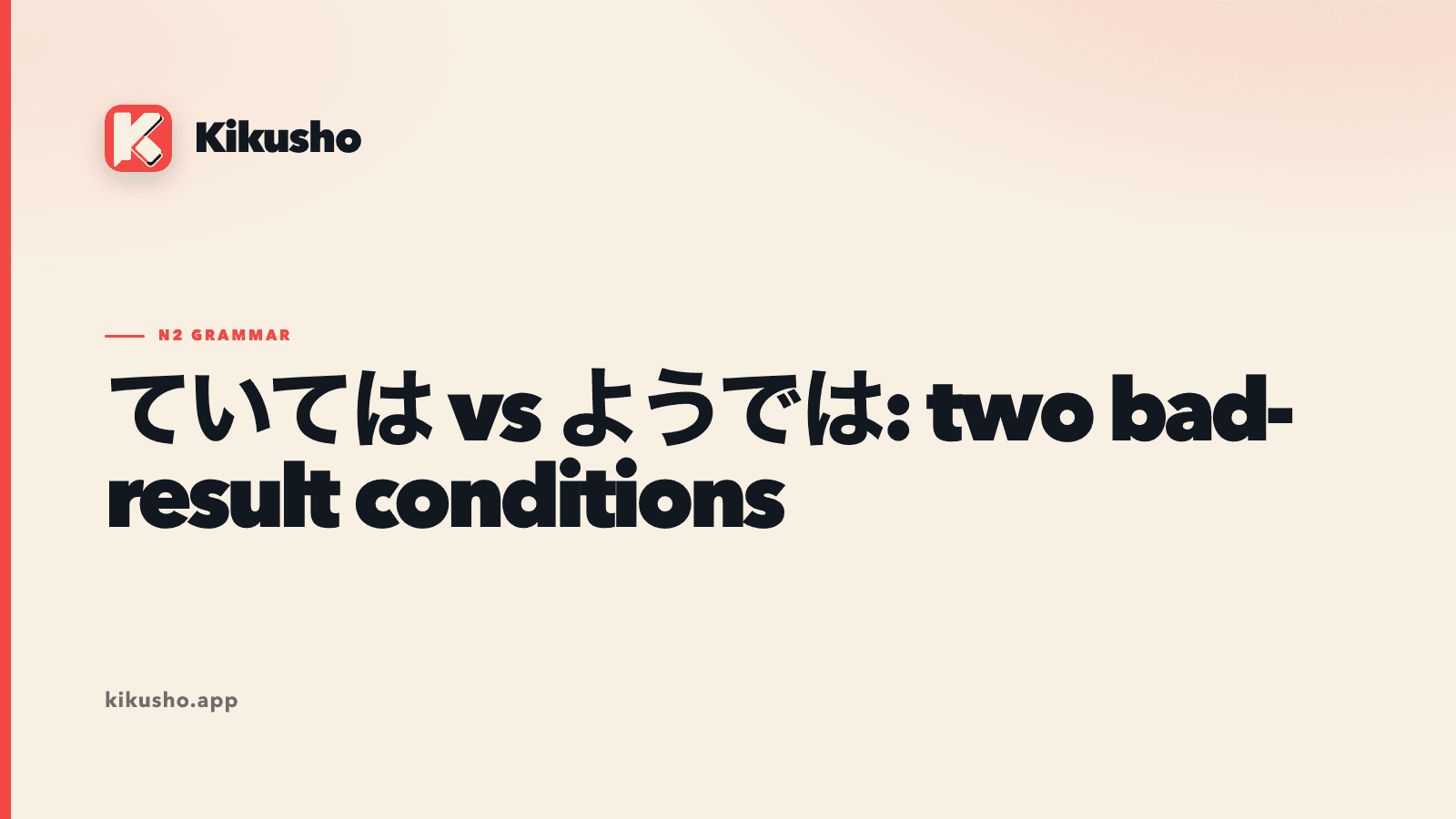
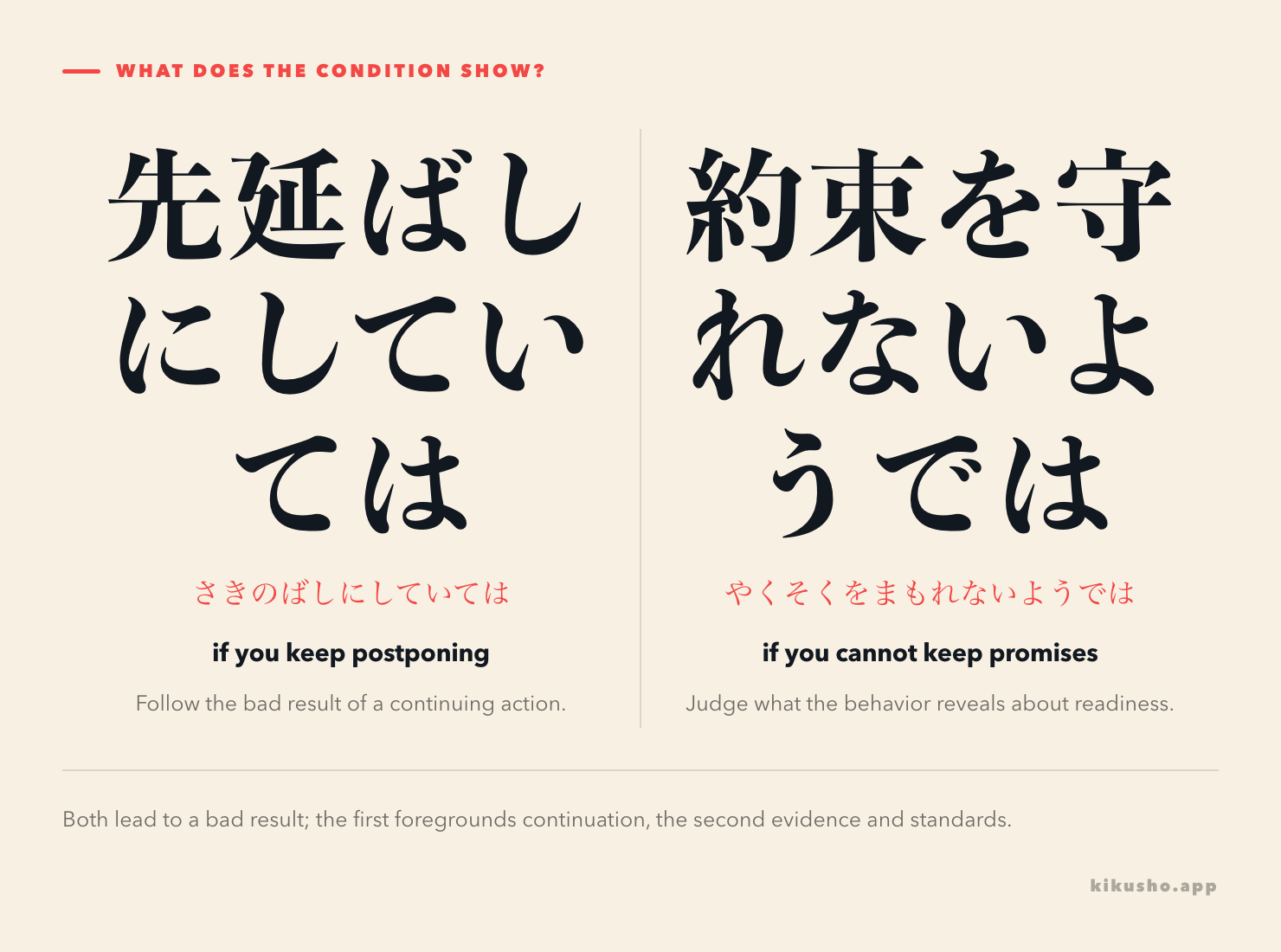
Use Vていては when a continuing action or habit will cause an unwanted result: 返事を先延ばしにしていては、機会を逃してしまう, “If you keep delaying your reply, you will miss the opportunity.” Use ~ようでは when a behavior, ability or state shows that someone does not meet a standard: 約束を守れないようでは、信頼されない, “If you cannot keep promises, you will not be trusted.”
Both patterns introduce a troublesome condition, but they point the reader toward different evidence. ていては asks what will happen if the present course continues. ようでは asks what the observed behavior or state says about a wider prospect.
This lesson covers inventory items g-199dd431091b, ていては, and g-70178f10decb, ようでは. JLPT Sensei and Kotomora place ていては at N2. JLPT Sensei and Bunpro place ようでは/ようじゃ at N2. These are editorial study classifications; the JLPT does not publish an exhaustive grammar syllabus.
The fastest decision test
| Pattern | What the first clause presents | Question to ask |
|---|---|---|
| Vていては B | an action, habit or state continuing | What goes wrong if this keeps happening? |
| ~ようでは B | behavior or a state taken as evidence | What does this reveal about the person's prospects or standard? |
毎晩遅くまで働いていては、体を壊すよ。
まいばん おそくまで はたらいていては、からだを こわすよ。
If you keep working late every night, you will damage your health.
基本的な操作もできないようでは、この仕事は任せられない。
きほんてきな そうさも できないようでは、この しごとは まかせられない。
If you cannot even perform the basic operations, I cannot entrust this job to you.
The first sentence traces a consequence from a repeated habit. The second treats inability to perform a basic task as evidence of insufficient readiness. That evaluation of a standard is the characteristic work of ようでは.
Build ていては from ている
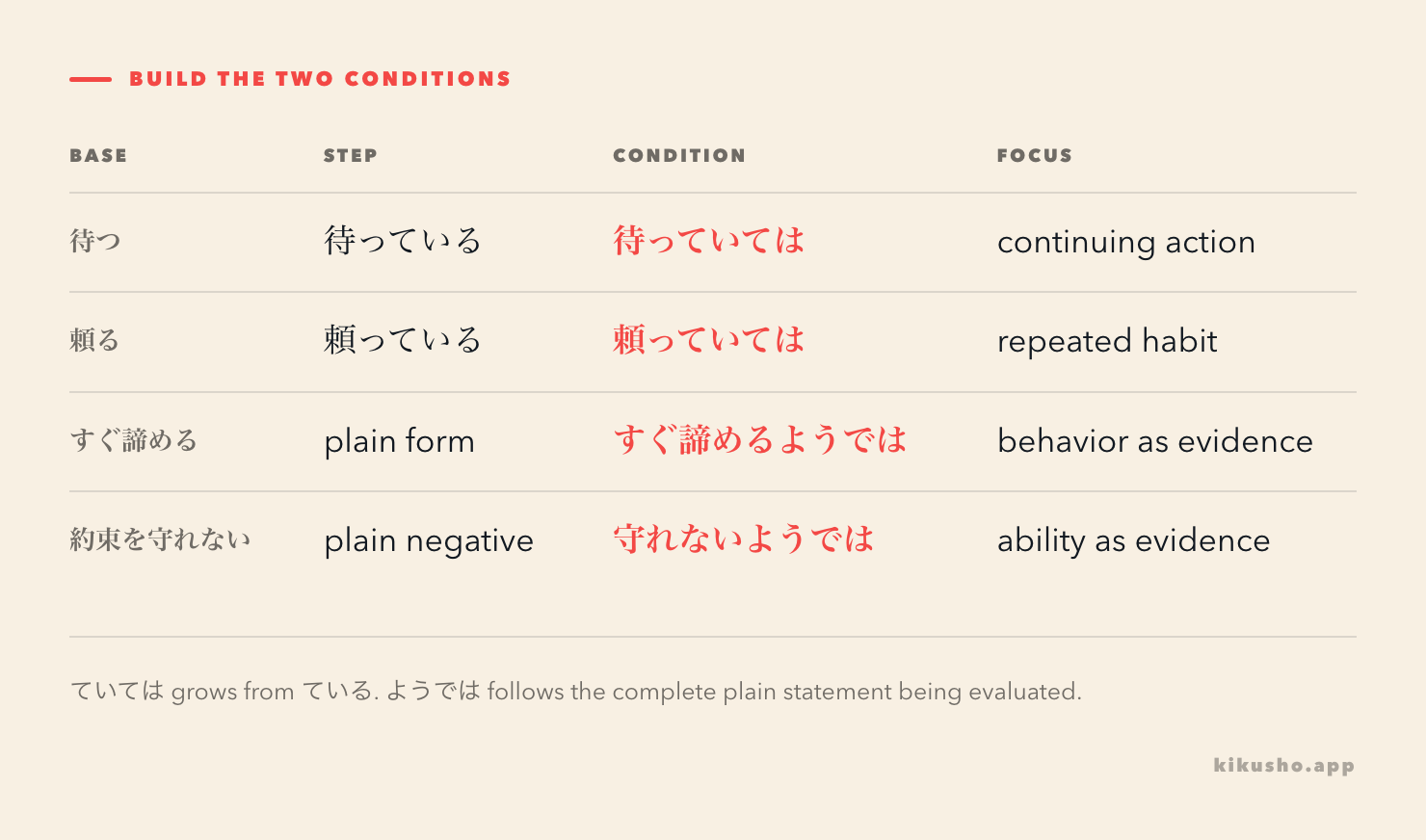
Start with the continuing form Vている. Remove the final る, then add ては:
| Dictionary form | Continuing form | Target form |
|---|---|---|
| 待つ | 待っている | 待っていては |
| 頼る | 頼っている | 頼っていては |
| 遊ぶ | 遊んでいる | 遊んでいては |
| 先延ばしにする | 先延ばしにしている | 先延ばしにしていては |
The two occurrences of て have different jobs. The first belongs to ている and presents the action as ongoing or habitual. The second combines with は to make that continuing situation the condition under assessment: 待っている → 待っていては.
このままここで待っていては、終電に間に合わない。
このまま ここで まっていては、しゅうでんに まにあわない。
If we keep waiting here like this, we will miss the last train.
いつも親に頼っていては、自分で判断できるようにならない。
いつも おやに たよっていては、じぶんで はんだんできるように ならない。
If you keep relying on your parents, you will not learn to decide for yourself.
問題を先送りにしていては、いつまでも解決しない。
もんだいを さきおくりに していては、いつまでも かいけつしない。
If we keep postponing the problem, it will never be resolved.
Time expressions such as 毎晩, いつも, いつまでも and このまま often make the continuation easy to see. They are helpful context, not mandatory pieces of the grammar.
Build ようでは from the plain form
Attach ようでは to a plain verb form. Dictionary, negative and continuing forms are all possible when their meaning fits. In conversation, ようじゃ commonly replaces ようでは.
| Base statement | Condition | What is being evaluated |
|---|---|---|
| すぐ諦める | すぐ諦めるようでは | the behavior of giving up quickly |
| 約束を守れない | 約束を守れないようでは | inability to keep promises |
| 毎回遅刻している | 毎回遅刻しているようでは | an observed repeated state |
| 基本が分からない | 基本が分からないようじゃ | lack of basic understanding, conversational |
一度の失敗で諦めるようでは、大きな目標は達成できない。
いちどの しっぱいで あきらめるようでは、おおきな もくひょうは たっせいできない。
If you give up after one failure, you cannot achieve a major goal.
敬語を正しく使えないようでは、接客の仕事は難しい。
けいごを ただしく つかえないようでは、せっきゃくの しごとは むずかしい。
If you cannot use honorific language correctly, customer service work will be difficult.
こんな問題も解けないようじゃ、次の試験が心配だ。
こんな もんだいも とけないようじゃ、つぎの しけんが しんぱいだ。
If you cannot solve even a problem like this, I am worried about the next exam.
ようでは often sounds critical because it measures the first clause against a standard. The subject might be a learner, worker, leader or system whose current performance is inadequate for what comes next. Use it carefully when speaking directly to someone: the grammar can sound like a judgment of their competence or attitude.
The same situation can support either form
Compare two sentences about repeated lateness:
毎回遅刻していては、仕事が終わらない。
まいかい ちこくしていては、しごとが おわらない。
If you keep arriving late every time, the work will not get finished.
毎回遅刻するようでは、社会人として信頼されない。
まいかい ちこくするようでは、しゃかいじんとして しんらいされない。
If you are the kind of person who is late every time, you will not be trusted as a working adult.
The first traces a practical chain: repeated lateness reduces the time available, so the work remains unfinished. The second treats lateness as evidence about professional reliability. The event is similar, but the speaker organizes the argument differently.
This is why translation alone is unreliable. English “if you keep arriving late” may represent either Japanese sentence. Decide whether you want to foreground the continued action and its direct consequence, or evaluate what that behavior reveals.
How ていては relates to the broader warning ては
ては already introduces a condition whose result is unwelcome. ていては is narrower because ている makes continuation, repetition or an ongoing state central.
今ここを出ては、先生に会えない。
いま ここを でては、せんせいに あえない。
If you leave here now, you will not be able to meet the teacher.
いつまでもここにいては、先生に会えない。
いつまでも ここに いては、せんせいに あえない。
If you remain here indefinitely, you will not be able to meet the teacher.
The first makes leaving a one-time troublesome condition. The second begins with いる, “to be/stay,” and warns about allowing that state to continue. Our conditional ては lesson covers the broader warning form, its adjective and noun joins, and its difference from たら.
Do not confuse ていては with てはいられない. 待っていては間に合わない predicts a bad result if waiting continues. 待ってはいられない says the speaker cannot afford to continue waiting. The てはいられない comparison develops that difference.
In casual speech, a sequence such as 遊んでいてはだめ may contract to 遊んでちゃだめ. The shorter form depends heavily on its ending and context, so keep the full ていては in careful writing and while learning the structure.
Do not read ようでは as an invitation
The sequence ようでは in this lesson follows a plain form: 遅刻するようでは, “if one is doing things like arriving late.” A different construction uses a volitional verb before ではないか:
一緒に考えようではないか。
いっしょに かんがえようでは ないか。
Let us think about it together.
Here 考えよう is the volitional form of 考える, and ではないか makes a rhetorical invitation. It is not the bad-result condition ようでは plus a negative ending. The ではないか lesson explains that invitation alongside confirmation and challenge uses.
Choose from the argument, not from one word
When producing either pattern, build the logic before the ending:
- Identify the troublesome fact.
- Decide whether the action continuing is the main issue, or whether the fact demonstrates inadequate ability, attitude or conditions.
- State the concrete bad result or negative assessment after the pattern.
For a delayed project, 相談ばかりしていては、作業が進まない warns that ongoing discussion prevents progress. 小さな問題も自分で判断できないようでは、責任者は務まらない judges inability to handle small problems as evidence that someone is not ready to lead.
Kikusho can store the whole cause-and-result pair as one editable example. During review, recall the second clause first: a direct consequence points toward ていては, while a judgment about readiness or prospects often points toward ようでは. Keeping both clauses prevents the condition from becoming a vague formula.
Practice
1. Build the form from 待つ
Which form means “if one keeps waiting”?
ア. 待っては イ. 待っていては ウ. 待つようでは
2. Choose the condition focused on an inadequate standard
基本的な漢字も読めない__、この資料を理解するのは難しい。
ア. ていては イ. ようでは ウ. てはいられない
3. Choose the direct continuing consequence
毎晩二時まで起きて__、朝の授業に集中できない。
ア. いるようでは イ. はいられなくて ウ. いては
4. Match each sentence to its focus
- 人の答えを写していては、力がつかない。
- 自分の意見を説明できないようでは、面接に合格するのは難しい。
ア. observed ability is judged insufficient
イ. continuation of an action causes a bad result
5. Put the pieces in order
Use all three pieces to say “If you keep postponing it, the problem will not be solved.”
ア. 問題は解決しない イ. 先延ばしにしていては ウ. いつまでも
6. Choose the sentence with a rhetorical invitation
ア. 一緒に考えようではないか。
イ. 一緒に考えられないようでは、解決は難しい。
7. Complete the connected text
新人は同じ入力ミスを毎日繰り返している。__、大事なデータの管理は任せられない。
ア. 同じミスを繰り返すようでは
イ. 同じミスを繰り返してはいられない
ウ. 同じミスを繰り返そうではないか
Answers and explanations
- イ. 待っていては. 待つ → 待っている → 待っていては explicitly makes continued waiting the condition. 待っては is a broader conditional, and 待つようでは evaluates the behavior rather than directly encoding continuation.
- イ. ようでは. Inability to read basic kanji is evidence that the learner does not meet the standard needed for this material. 読めないようでは attaches to the plain negative form.
- ウ. いては. The full sequence is 起きていては: staying awake until two every night directly prevents concentration the next morning.
- 1–イ; 2–ア. Copying answers repeatedly causes failure to develop ability. Inability to explain one's opinion is evaluated as insufficient readiness for the interview.
- イ–ウ–ア: 先延ばしにしていては、いつまでも問題は解決しない. していては presents continued postponement, and the second clause gives its bad result.
- ア. 一緒に考えようではないか. 考えよう is volitional and ではないか invites joint action. Sentence イ contains the target bad-result condition after 考えられない.
- ア. 同じミスを繰り返すようでは. The repeated mistakes are observed evidence that the newcomer is not ready to manage important data. イ says the subject cannot afford to keep making the mistakes, which changes the argument, and ウ is an inappropriate invitation to repeat them.
The exact search results consistently classify both constructions at N2 but mostly explain them on separate pages. The useful contrast is the role of the first clause: ていては follows the consequences of continued behavior, while ようでは treats behavior, ability or conditions as evidence for a negative judgment.
This lesson was reviewed for attachment, continuation, evaluative force, the ようじゃ contraction, the broader conditional ては, and the unrelated volitional invitation ようではないか. AI-assisted comparison and editing were used to check every example and ensure each exercise has one intended answer.
Common questions
What does ていては mean?
Vていては warns that if an action, habit or state continues, an unwanted result will follow. It is built from Vている by changing the final る to ては.
What does ようでは mean?
ようでは presents a behavior, ability or state as evidence that the person or situation does not meet a standard, then gives a bad result or negative judgment.
What is the difference between ていては and ようでは?
ていては focuses on allowing an ongoing or repeated action to continue. ようでは evaluates what the observed behavior or state reveals about a wider prospect, qualification or result.
Is ようじゃ different from ようでは?
ようじゃ is the conversational contraction of ようでは. The core meaning remains the same, but ようでは is safer in formal writing.