On this page
買う and 購入する can describe buying the same chair; choosing a Sino-Japanese word does not necessarily change the event. Kango (漢語, かんご) uses Chinese-derived readings or elements, while wago (和語, わご) is native Japanese vocabulary: compare meaning and customary partners before deciding which sounds right in your sentence.
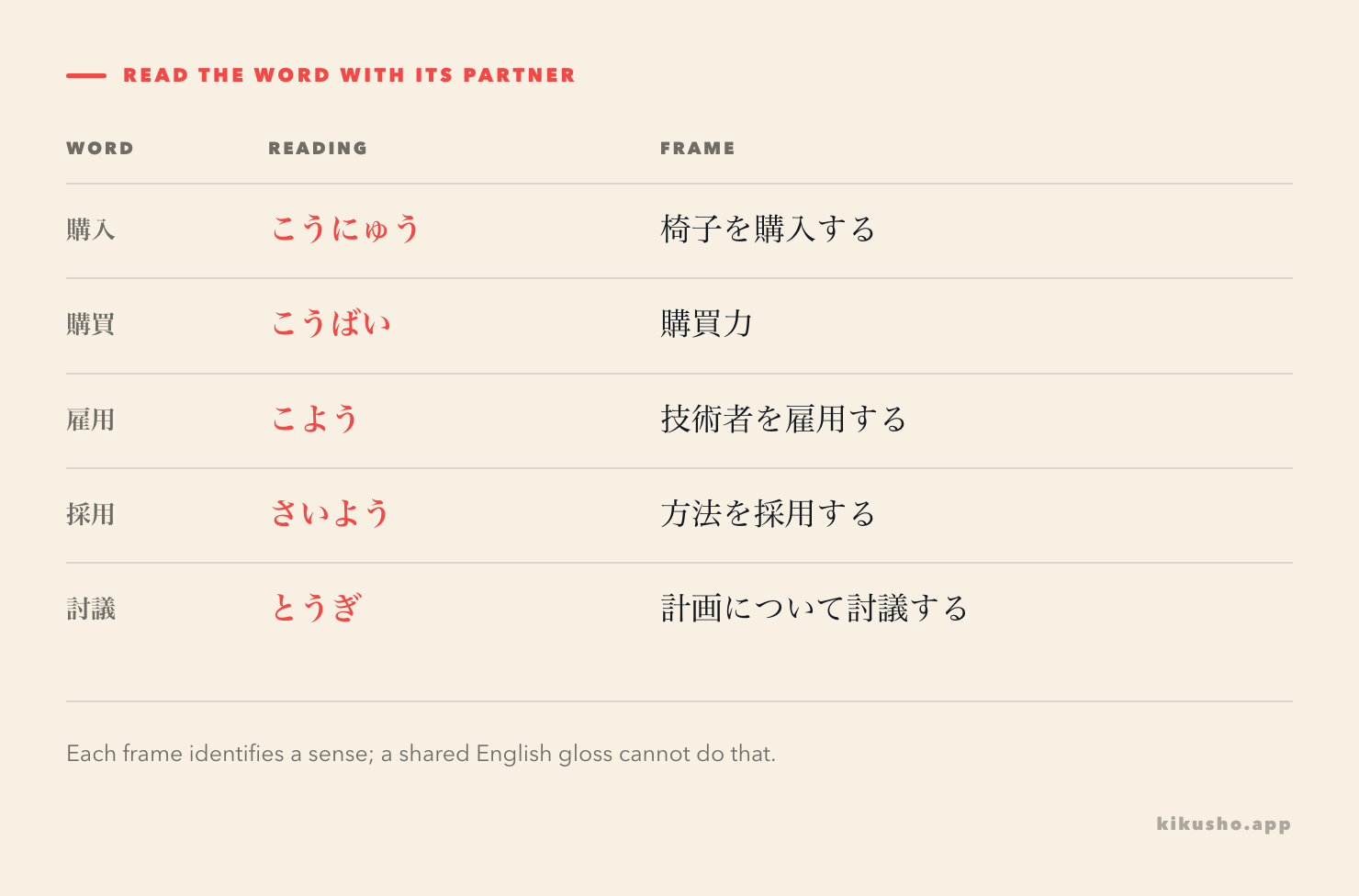
This N1 vocabulary lesson teaches 購入(こうにゅう), 購買(こうばい), 雇用(こよう), 採用(さいよう) and 討議(とうぎ). The native comparison words are prerequisites, not a new advanced word list. The planning inventory places the five compounds at N1, but that is a teaching estimate: JapaneseTest4You's 購入 page even has an N2 heading alongside N1 metadata. The JLPT supplies no exhaustive official vocabulary syllabus.
Check the object before the register
Ask three questions, in order. What event does the word describe? What noun or topic accompanies it? Does the wording suit this situation? The last question cannot repair a wrong answer to the first two.
An employment notice, a shopping receipt and minutes of a meeting invite different vocabulary. They do not all become more precise simply by replacing native verbs with two-kanji compounds. The N1 accomplishment-verb comparison makes the same practical point through the nouns those verbs accompany.
| Word | Reading | Part of speech and sense taught | Useful frame |
|---|---|---|---|
| 購入 | こうにゅう | noun; with する, buy or purchase | 椅子を購入する: purchase a chair |
| 購買 | こうばい | noun; with する, purchase; also in buying-related compounds | 購買力: purchasing power |
| 雇用 | こよう | noun; with する, employ someone for paid work | 技術者を雇用する: employ an engineer |
| 採用 | さいよう | noun; with する, adopt a suitable method or opinion, or hire a person | 方法を採用する: adopt a method |
| 討議 | とうぎ | noun; with する, discuss a matter through an exchange of opinions | 計画について討議する: discuss a plan |
These readings and senses are checked in two separately produced dictionaries: Kanjipedia, from the Japan Kanji Aptitude Testing Foundation, and Shogakukan's Digital Daijisen. Their specific entries are linked in the comparisons below.
Wago verbs carry their own changing endings
買う(かう), 雇う(やとう) and 話し合う(はなしあう) are the native counterparts used here. Their past forms are 買った, 雇った and 話し合った. You do not add する to the dictionary form of these verbs.
話し合う is itself a compound verb; buying and hiring do not require a compound native counterpart. Writing a word with kanji does not make it kango. Taishukan's explanation of the distinction also points out that native vocabulary can be written without kanji.
For the discussion sense, Daijisen's 話し合う entry describes people exchanging their positions or thoughts. Kanjipedia's 雇う entry supports hiring a person for pay. We compare that person-hiring sense, rather than pretending every use of 雇う has the same counterpart.
Kango supplies nouns that can work with する
The five assigned words are nouns usable with する. The verb ending belongs to する: 購入する becomes 購入した in the plain past and 購入しました in the polite past. The noun itself also appears inside expressions such as 購買力 and 雇用契約(こようけいやく, employment contract).
This pattern explains these five words; it is not a rule that every kango noun permits する. Nor does “Sino-Japanese” mean that every complete word arrived from China. NINJAL's account by Hideki Ogura describes Japanese-created translation vocabulary, including new kango formations, later taken into Chinese. Classifying a word's vocabulary stratum and establishing its individual history are separate tasks.
購入 and 購買 overlap in their buying sense
Kanjipedia's 購入 and Daijisen's 購入 describe buying. Compare these original sentences:
新しい椅子を買った。
あたらしいいすをかった。
I bought a new chair.
新しい椅子を購入した。
あたらしいいすをこうにゅうした。
I purchased a new chair.
Both can report the same transaction. 買った suits an ordinary account of what you bought; 購入した suits the wording of a purchase record. The latter does not imply a company bought the chair, or that the chair was expensive.
購買 shares that dictionary buying sense. Its partners are especially useful: 購買力(こうばいりょく), purchasing power, and 購買意欲(こうばいいよく), desire to buy. Kanjipedia's 購買 supplies the former; Daijisen's 購買 supplies the latter.
購買力が低下した。
こうばいりょくがていかした。
Purchasing power fell.
Here you need the established compound for ability to buy. A shared English gloss does not license assembling 購入力 as its replacement. Learn that pairing without imposing a false rule that 購入 belongs only to individuals and 購買 only to organizations.
雇用 concerns paid work; 採用 can also adopt a method
雇用 focuses on employing a person for pay. Kanjipedia specifies paid work; Daijisen also records the employment relationship. The headword does not itself mean “long-term.” A duration must come from surrounding wording.
会社は技術者を雇用している。
かいしゃはぎじゅつしゃをこようしている。
The company employs engineers.
会社は技術者を雇っている also describes employing them. The compound suits a report about employment; the native verb offers a direct account of hiring. Neither sentence tells you how many years anyone will work there.
採用 includes hiring people, so 技術者を採用した can describe taking engineers on. But it also takes suitable opinions or methods as its object. Both Kanjipedia's two senses and Daijisen's entry support that wider range.
会社は新しい方法を採用した。
かいしゃはあたらしいほうほうをさいようした。
The company adopted a new method.
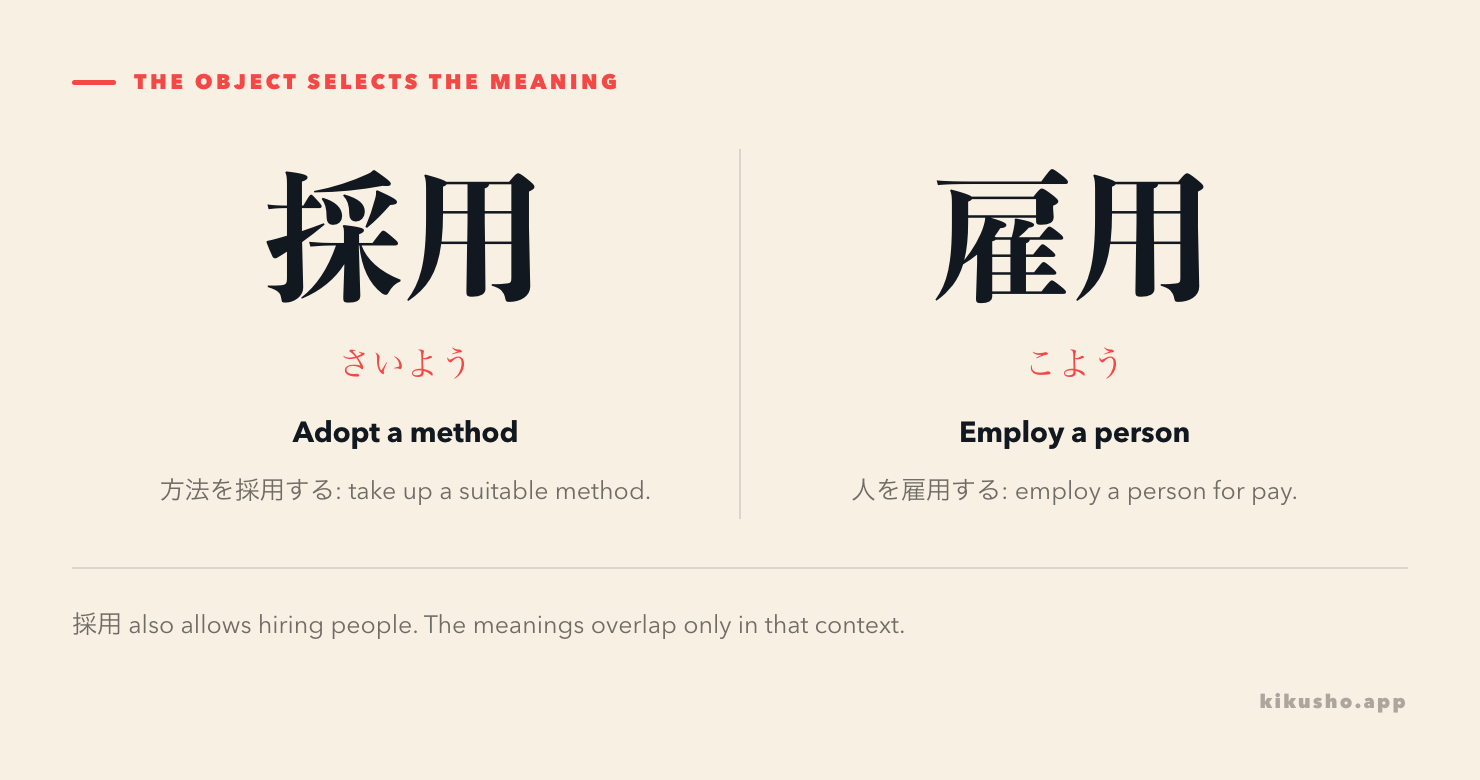
Replacing 採用 with 雇用 here would say you employed the method in the person-hiring sense being compared. English “employ a method” cannot choose the Japanese word for you. Conversely, translating every 採用 as “adopt” would hide the hiring meaning in 採用通知(さいようつうち), a hiring notice.
討議 names an exchange of opinions
討議 presents discussion of a matter, commonly suitable for a meeting's stated business. Kanjipedia and Daijisen describe the exchange of views.
委員会で計画について討議した。
いいんかいでけいかくについてとうぎした。
We discussed the plan in the committee.
The sentence does not assert that the plan was adopted. That would require a further statement, perhaps with 採用. “Debate” is a possible translation, but it must not force a contest with winners and losers into every occurrence.
家族で予定について話し合った。
かぞくでよていについてはなしあった。
We talked over the schedule as a family.
話し合う is a natural native choice here, and it can also appear in a workplace. There is overlap in discussing a topic; there is no universal rule assigning one verb to home and the other to work. For the words that describe a claim within such discussion, continue to the academic-argument vocabulary lesson.
A change of vocabulary can change more than tone
Keep politeness apart from vocabulary choice: 買いました has a polite ending although 買う is native; 購入した has a plain ending although 購入 is kango. Choosing one stratum does not supply the other sentence ending automatically.
Also keep the particular sense. Daijisen's 買う entry includes recognizing someone's value. In 努力を買う(どりょくをかう), the person values the effort. Substituting 購入する does not preserve that meaning. Synonymy in a purchase sentence is not synonymy in every sentence.
When saving a hiring notice or a meeting summary in Kikusho, paste enough text to retain the noun accompanying the compound. You can edit the resulting vocabulary card to keep that distinction: a method being adopted and an engineer being employed need different reminders despite English allowing “employ” for both.
Practice
Attempt the six numbered tasks in order. They cover kanji reading, meaning in context, paraphrase and usage; solutions follow the complete set.
Question 1
Which kana option corresponds to the purchase noun 購入?
- A. こうにゅ
- B. こにゅう
- C. こうにゅう
- D. こうじゅう
Question 2
How is the discussion word 討議 pronounced?
- A. とうい
- B. とうぎ
- C. とぎ
- D. とくぎ
Question 3
Choose the word meaning “adopt” in this account of choosing a method.
委員会は二つの方法を比較し、より安全な方法を( )。今後はその方法を使う。
- A. 雇用した
- B. 購入した
- C. 討議した
- D. 採用した
Question 4
What does 購買力 express in this sentence?
購買力が低下したため、買える商品の量が減った。
- A. The ability to buy goods
- B. The number of people hired
- C. The speed of delivering goods
- D. The decision to adopt a method
Question 5
Which paraphrase preserves the person-employment meaning?
会社は技術者を雇用している。
- A. 会社は技術者の意見を採用している。
- B. 会社は技術者に賃金を払って働いてもらっている。
- C. 会社は技術者と計画について討議している。
- D. 会社は技術者になる方法を購入している。
Question 6
Select the sentence that uses 雇用 in the sense taught here.
- A. 委員会は新しい意見を雇用した。
- B. 店は新しい椅子を雇用した。
- C. 会社は技術者を雇用した。
- D. 家族は旅行の予定を雇用した。
Write a short reason for your choice as well as its letter.
Answers and explanations
Answer 1
C: こうにゅう. Both こう and にゅう retain their long vowels. A shortens the ending, B shortens the opening, and D substitutes じゅう for にゅう.
Answer 2
B: とうぎ. 議 supplies ぎ. A loses its consonant, C shortens とう, and D changes the first element to とく. Recognizing “discussion” does not settle its written reading.
Answer 3
D: 採用した. The question asks for adopting the chosen method. A refers to paid person-employment; B describes purchase; C says discussion occurred. Those meanings do not express the requested adoption, even if buying or discussing something could precede choosing it.
Answer 4
A: the ability to buy goods. The continuation describes fewer goods being affordable. B concerns hiring, C concerns delivery, and D concerns choosing a method; none explains 購買力 in this buying context.
Answer 5
B. Paying the engineers for their work preserves the employment meaning. A adopts their opinions, C discusses a plan with them, and D purchases a method of becoming an engineer. Each changes what the company is doing; mentioning 技術者 alone is insufficient.
Answer 6
C. Engineers are people the company can employ for paid work. A supplies an opinion, B supplies a chair, and D supplies a travel plan as the object of 雇用. Those are not employees in the meaning this exercise tests. Adopting an opinion would instead use 採用; purchasing the chair would use 購入 or 買う.
Common questions
Are all kango words borrowed directly from Chinese?
No. Kango includes words built from Sino-Japanese elements in Japan as well as words imported from Chinese. Chinese-derived readings do not prove that the complete word was borrowed.
Can I replace 雇用する with 採用する?
They overlap when referring to hiring people. 採用する also means adopting a suitable opinion or method, whereas 雇用する here concerns employing people for paid work. Check the object and intended meaning before substituting.
Does wago always mean casual Japanese?
No. Wago describes native vocabulary, not a politeness level. A native verb can have a polite ending, and kango can appear with a plain ending. The particular word and situation determine register.