
On this page
バラ on a plant label names a rose, using a Japanese word rather than a foreign borrowing. Katakana can identify a conventional label or make a word conspicuous as well as spell a loanword; its appearance alone settles neither origin nor tone.
This N1 vocabulary lesson separates those decisions, then teaches seven borrowed words whose meanings still need context: カテゴリー, シナリオ, ジャンル, ニュアンス, フィルター, メディア and モニター. They are the borrowed comparison set, not examples of native Japanese vocabulary.
The level is a study placement. Our September 2026 reference inventory puts these records at N1 through the Waller list family. The two adaptations of that family are not independent confirmations, and Bunpro labels ニュアンス N2. There is no official exhaustive JLPT vocabulary list. Reading ordinary kana and understanding noun phrases are prerequisites, not new N1 achievements.
The spelling can change while the word stays the same
ばら and バラ both give the reading bara and the meaning “rose”. The katakana version is familiar in plant naming. It does not require an English word behind it, and it does not make the flower exotic or the sentence sarcastic.
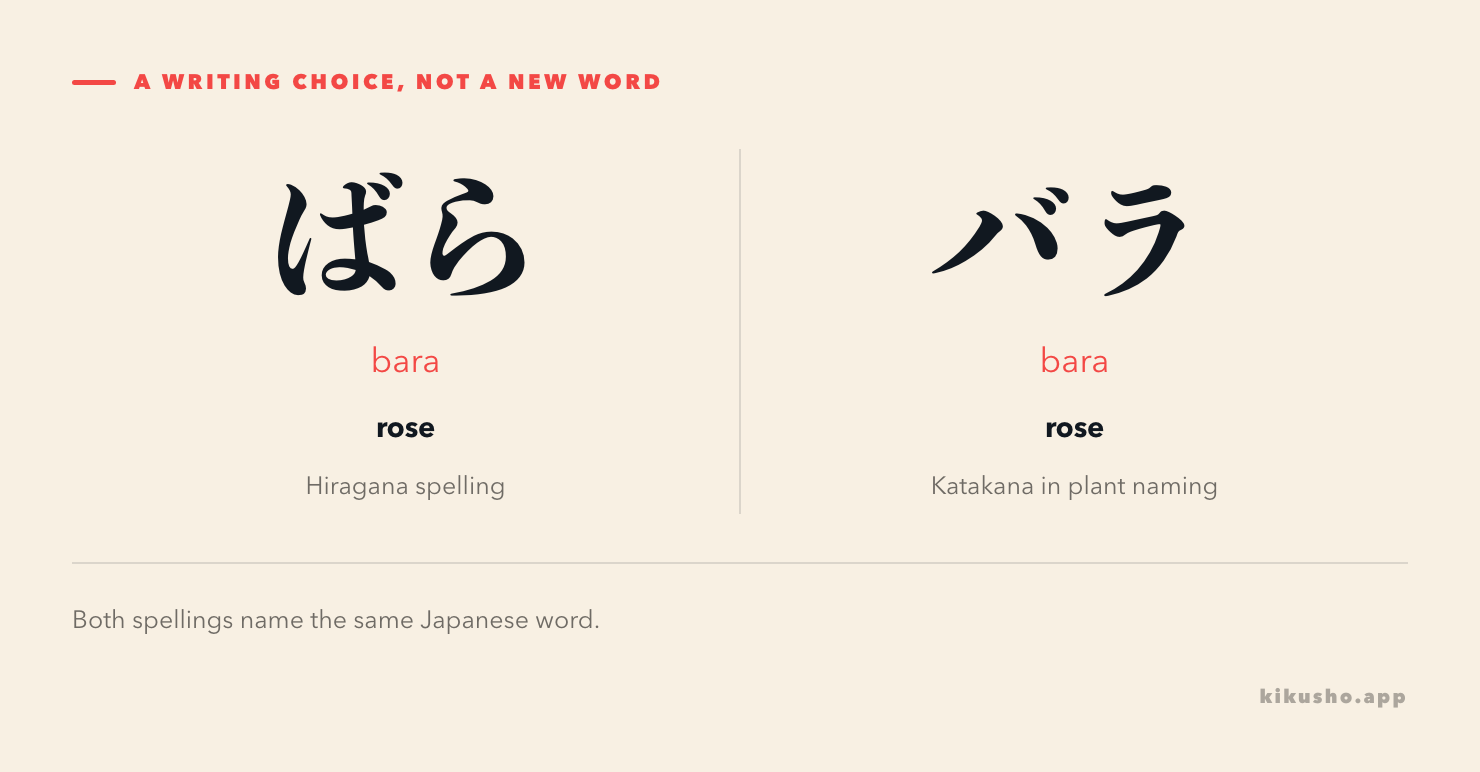
IMABI's orthography lesson distinguishes loanword spelling from katakana used for native words, including emphasis and plant or animal names. Independently, the CJK Dictionary Institute's katakana database includes native Japanese entries alongside loans. Katakana is a script with several jobs, not a dictionary category of foreign origin.
For sounds being adapted, clipped words and misleading resemblances to English, use the existing loanword decoding guide. The question here comes after you can read the letters: what is this word doing in this sentence? Native mimetics have their own context-based lesson; they are not additional items in this seven-word set.
A familiar shape still needs a specific sense
All seven headwords below are nouns. The reading column transcribes their Japanese sounds in hiragana; it does not recommend replacing their normal katakana spelling. Keep the long-vowel mark in カテゴリー, フィルター and モニター. Small ュ in ニュアンス and ャ in ジャンル belong to the preceding consonant, while フィ in フィルター forms fi.
| Headword | Reading | Sense taught | A useful phrase |
|---|---|---|---|
| カテゴリー | かてごりー | category or classification group | カテゴリーに分ける: divide into categories |
| シナリオ | しなりお | film/television script; a projected course of events or plan | シナリオを書く: write a script |
| ジャンル | じゃんる | genre or field, especially a classification of artistic works | 音楽のジャンル: musical genre |
| ニュアンス | にゅあんす | subtle meaning, implication or shade of feeling | ニュアンスが違う: differ in nuance |
| フィルター | ふぃるたー | an optical camera filter; also a device or program selecting what passes through | カメラのフィルター: camera filter |
| メディア | めでぃあ | a medium of communication; collectively, media such as newspapers and television | メディアを通じて伝える: communicate through the media |
| モニター | もにたー | a computer display; in another context, a person testing a product and giving feedback | モニターに表示する: display on a monitor |
The definitions concern these senses, not every dictionary entry with the same letters. For instance, a dictionary may also list メディア as a historical place name. That is not what メディアを通じて伝える means. Borrowed words can have multiple Japanese uses just as words in other scripts can.
Categories, genres and scripts describe different parts of a work
カテゴリー names a group formed by classification. Shogakukan's dictionaries distinguish the general grouping sense from specialised philosophical or hurricane-scale uses. Here you need the everyday grouping sense:
商品を三つのカテゴリーに分けた。
しょうひんをみっつのかてごりーにわけた。
“I divided the products into three categories.”
ジャンル also classifies, but it is especially useful for artistic kinds. Daijisen's entry allows the broader meaning “kind” or “field” too, so “only for art” would be too strict.
この店は幅広いジャンルの音楽を扱っている。
このみせははばひろいじゃんるのおんがくをあつかっている。
“This shop carries music in a wide range of genres.”
A shop's categories could include music, stationery and clothing. Within its music selection, genres could include jazz and classical music. These are useful tendencies, not a rule that makes カテゴリー impossible beside 音楽. A question demanding that you choose between the two without a more specific clue would be unfair.
シナリオ concerns what happens, rather than the class the work belongs to. In a film context it can mean the written script, including dialogue and actions. The Shogakukan entry also records a plan or course of developments.
監督はシナリオを書き直した。
かんとくはしなりおをかきなおした。
“The director rewrote the script.”
Outside filmmaking, 最悪のシナリオ(さいあくのしなりお)is “the worst-case scenario”. Translate the noun with its setting. “Scenario” may fit the projected outcome; “script” fits the director rewriting dialogue. The katakana spelling does not decide between them.
Technical nouns name objects without adding emphasis
カメラのフィルター names a camera's optical filter, which controls transmitted light. This is the photographic sense assigned to this lesson, verified in Daijisen and the independently published Heibonsha entry.
撮影前にカメラのフィルターを交換した。
さつえいまえにかめらのふぃるたーをこうかんした。
“I replaced the camera filter before the shoot.”
The same noun can concern liquids, gases or computer data. A camera filter and a program that filters data share a selecting function, but the equipment involved differs. Without a domain clue, the object is underspecified; カメラの supplies the relevant domain. Do not learn only a digital-photo effect and assume that accounts for the physical optical filter.
モニター likewise has more than one referent. Shueisha's imidas dictionary, by 信達郎 and James M. Vardaman, records both a computer display and someone who tries a product and reports their impressions.
パソコンのモニターに画像を表示した。
ぱそこんのもにたーにがぞうをひょうじした。
“I displayed an image on the computer monitor.”
新商品のモニターを募集している。
しんしょうひんのもにたーをぼしゅうしている。
“They are recruiting testers for a new product.”
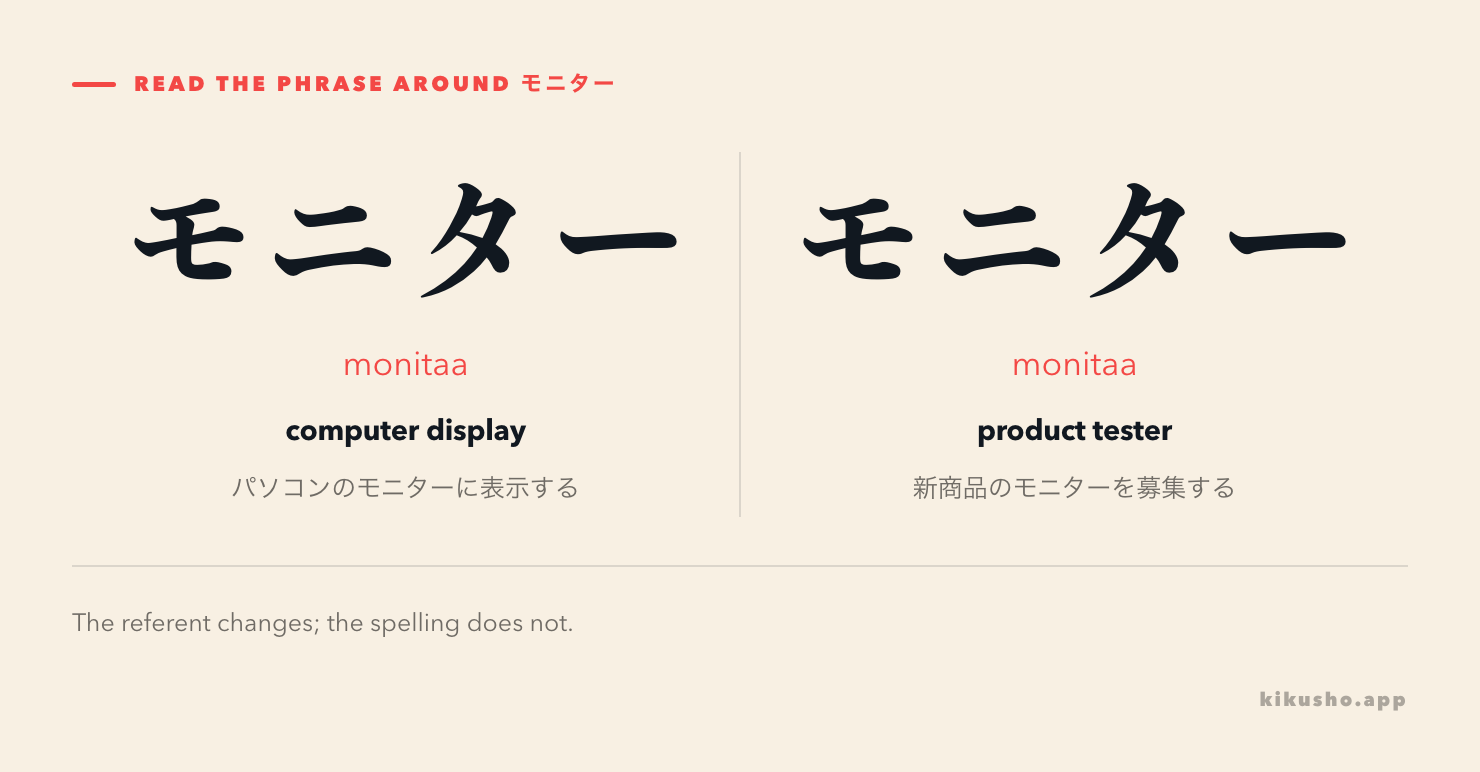
In the second sentence the company wants people, not screens. The noun's ordinary katakana spelling stays unchanged. Treating every technical-looking word as a piece of hardware misses the Japanese sense.
メディア identifies a channel or medium. The Shogakukan definition includes newspapers, magazines, television and radio; the same page's separately published Kodansha IT dictionary also distinguishes communication from storage media.
新聞やテレビなどのメディアを通じて知らせた。
しんぶんやてれびなどのめでぃあをつうじてしらせた。
“They announced it through media such as newspapers and television.”
Here メディア is not shorthand for social media alone. 記録メディア(きろくめでぃあ)instead points toward a recording medium. Neither phrase becomes ironic merely because it contains katakana.
Nuance belongs to the whole statement
ニュアンス names a subtle shade of meaning or intention, and can also describe fine differences in colour or sound. Daijisen and the independently authored imidas entry support those distinctions. Here the target sense is linguistic:
同じ意味でも、ニュアンスが違う。
おなじいみでも、にゅあんすがちがう。
“Even with the same meaning, the nuance differs.”
A writer might replace native すごい with スゴイ to make the word stand out. That spelling draws your eye; its intention could still be admiration. You need more evidence before deciding that the praise is ironic. Consider this deliberately constructed example:
彼は「スゴイ」人だ。毎回、約束を忘れる。
かれは「すごい」ひとだ。まいかい、やくそくをわすれる。
“He's an ‘amazing’ person. Every time, he forgets his promises.”
The negative follow-up makes an ironic reading of the apparent praise plausible. Quotation marks also frame the word as something being questioned. Katakana contributes conspicuousness; it is not a universal sarcasm marker. With a follow-up praising an achievement, the same adjective could be sincere.
These are two separate learning problems: the spelling choice makes スゴイ conspicuous, while the borrowed noun ニュアンス gives you a way to discuss the resulting shade of interpretation. For a different origin contrast, the N1 lesson on purchase, hiring and discussion compounds compares Sino-Japanese compounds with native phrases.
A card for モニター needs the phrase that tells you whether it is equipment or a person. In Kikusho, pasting the sentence lets you review the generated meaning and example before keeping the card. Preserve that context when editing it: a bare English “monitor” would hide the distinction you just learned.
Practice questions
Choose a single option for each numbered task. The exercises test contextual meaning, paraphrase and usage; katakana recognition is not being counted as a kanji-reading task. Complete the question block before moving to the explanations.
Question 1
In 商品を三つのカテゴリーに分けた, what does カテゴリー name?
A. The written dialogue for a film
B. The groups used to classify the products
C. People giving feedback on a new product
D. Subtle differences in a speaker's intention
Question 2
The phrase 幅広いジャンルの音楽 concerns which distinction?
A. Different kinds of music
B. Several screen sizes
C. The stages in a worst-case plan
D. The amount of light passing through a lens
Question 3
An editor asks the director to シナリオを書き直す. Which paraphrase fits the film setting?
A. Replace an optical filter
B. Sort products into groups
C. Rewrite the script
D. Recruit people to evaluate a product
Question 4
Which explanation best preserves ニュアンスが違う when two expressions have a similar basic meaning?
A. Their katakana characters cannot be pronounced
B. Their complete meanings must be opposites
C. They refer to two different computer displays
D. Their shades of meaning or feeling differ
Question 5
A photographer replaces a physical フィルター attached to the camera lens. What is being replaced?
A. A communication channel used for a public announcement
B. An optical accessory controlling transmitted light
C. A person hired to test a new product
D. A classification of artistic works
Question 6
Which sentence uses モニター for a computer display, rather than for a product tester?
A. モニターとして、新しい洗剤を試した。
B. 新商品のモニターを十人募集した。
C. パソコンのモニターに写真を表示した。
D. モニターから製品の感想を聞いた。
Question 7
In 新聞やテレビなどのメディアを通じて知らせた, which sense belongs to メディア?
A. A film's script
B. A shade of emotional meaning
C. A computer screen
D. Channels for communicating information
Before checking, write down which surrounding word or phrase supported each decision. For Question 6, distinguish a valid use of the noun from the particular sense requested.
Answers and explanations
Answer 1
B. カテゴリー names the classification groups into which 商品 are divided. 書き直す would help identify a script, and 募集する would help identify testers. The other definitions belong to シナリオ, モニター and ニュアンス, not this grouping sense.
Answer 2
A. 音楽 supplies the domain: ジャンル describes kinds of music. Screens, projected events and transmitted light concern other nouns in the lesson. This does not imply that カテゴリー can never classify music; the question asks for ジャンル's meaning, not a forced choice between overlapping synonyms.
Answer 3
C. In the film setting, シナリオ is the script and 書き直す means rewrite. An imagined course of developments is another legitimate sense, but “scenario” should not obscure the written text being edited here. None of the other actions paraphrases the director's task.
Answer 4
D. ニュアンス concerns a fine difference in implication or feeling, even when the broad meaning is similar. It need not reverse the whole meaning. The spelling and the computer-display options substitute unrelated facts for that subtle difference.
Answer 5
B. The physical lens attachment selects or modifies transmitted light. “Filter” also has other Japanese technical uses, but the camera and lens identify the optical one. The distractors describe media, testers and genres rather than this accessory.
Answer 6
C. パソコン, 写真 and 表示した locate the display sense. A describes someone trying detergent as a tester; B recruits ten testers; D obtains people's impressions of a product. Those three sentences use real meanings of モニター, but none gives the computer-display meaning requested.
Answer 7
D. 新聞やテレビ gives examples of communication media, and 通じて means the announcement travels through them. The alternatives confuse the channel with a script, an implication or a display device. A useful review prompt now has two sides: identify the noun's referent, then name the phrase that made that reading possible.
Common questions
Does katakana always identify a foreign loanword?
No. It can also write Japanese plant and animal names, highlight a word or represent a pronunciation. Word origin and the writer's spelling choice are separate questions.
Does katakana automatically make a word sarcastic?
No. Katakana can draw attention to a word, but irony depends on the surrounding statement and situation. Ordinary borrowed technical nouns are routinely written in katakana without irony.
Are these seven words exclusively N1 vocabulary?
This N1 vocabulary lesson follows an editorial reference inventory, not an official exhaustive JLPT syllabus. Its seven comparison words have N1 placements in the Waller-derived baseline, but Bunpro places ニュアンス at N2. Familiarity can begin before N1.