
On this page
目標を達成する reports achieving a goal; 役割を果たす reports fulfilling a role. When choosing between Japanese verbs with similar English translations, ask what the accompanying noun names, then check the verb's sense in that phrase.
This comparison teaches 達成、遂げる、果たす、施す、催す、損なう. The first three overlap around accomplishment. The remaining three prevent a broader mistake: turning every action into “do” and treating the noun as decoration.
The page belongs to N1 vocabulary. Its planning placements credit Jonathan Waller's Tanos resources; both imported adaptations descend from that collection. Current JapaneseTest4You entries call 達成 and 果たす N2, despite the inventory's retained N1 index matches. Treat them as earlier foundations within this comparison. JLPT level labels come from preparation lists, rather than an official word-by-word syllabus.
Let the noun and the intended action decide
Ask three questions mid-sentence: What is the object? What happens to it? Which familiar phrase expresses that event? A goal can be achieved, a role fulfilled, a treatment applied and a party held. Shared English glosses do not erase those differences.
The table gives the readings, word classes and bounded senses used below. Godan and ichidan identify conjugation classes; する noun means a noun that also forms a verb with する. All the pictured object phrases use を.
| Headword and reading | Word class here | Sense to retrieve | Starting phrase |
|---|---|---|---|
| 達成(たっせい) | Noun; する noun | Achievement; achieve an objective | 目標を達成する: achieve a goal |
| 遂げる(とげる) | Ichidan transitive verb | Accomplish; reach an outcome | 成長を遂げる: undergo growth |
| 果たす(はたす) | Godan transitive verb | Accomplish; fulfil a role or obligation | 役割を果たす: fulfil a role |
| 施す(ほどこす) | Godan transitive verb | Apply a treatment or addition; bestow aid | 加工を施す: apply processing or a finish |
| 催す(もよおす) | Godan verb; を phrases below | Hold an event; begin to feel a state | 歓迎会を催す: hold a welcome party |
| 損なう(そこなう) | Godan transitive verb; also a stem-attached element | Harm or impair; fail or miss an opportunity | 健康を損なう: harm one's health |
These are starting combinations, rather than six sealed compartments. The lesson on learning words in sentences explains why the partner noun belongs with the verb on a vocabulary card.
達成する puts a goal or objective in view
達成 is the noun “achievement.” Add する to make 達成する, “achieve” or “accomplish.” In 目標を達成する, 目標(もくひょう)is the goal attained.
チームは今月、売上目標を達成した。
チームは こんげつ、うりあげもくひょうを たっせいした。
The team achieved its sales target this month.
The sentence evaluates the result against a target. 目的を達成する(もくてきをたっせいする) is another useful partner. A goal need not be numerical: the word also covers accomplishing an aim.
Shogakukan's Daijisen identifies 達成 as a noun with する usage; Kanjipedia confirms its accomplishment sense and たっせい reading. Avoid the bare-verb guess 目標を達成た: the past verb is 達成した.
遂げる presents accomplishment or a resulting outcome
遂げる can mean bringing an intended thing to completion. It also appears when describing an outcome reached, as in 成長を遂げる(せいちょうをとげる).
この町は十年で大きな成長を遂げた。
この まちは じゅうねんで おおきな せいちょうを とげた。
This town underwent substantial growth over ten years.
Here the town's development is the result described. You are not being told that someone organized a “growth event” or fulfilled a duty called growth. 遂げる → 遂げた follows ichidan conjugation; the plain-past reference supplies that prerequisite.
Daijisen and Kanjipedia distinguish accomplishment from arriving at a particular result. Do not infer that every outcome is desirable: 非業の死を遂げる(ひごうのしをとげる), meet an untimely or tragic death, is a recognised expression. The growth example teaches the outcome sense without making “success” the word's only definition.
果たす fits a role, promise or task fulfilled
果たす foregrounds doing what a position, obligation or intended task calls for. Useful partners include 役割(やくわり), role, and 約束(やくそく), promise.
姉は家族の中で重要な役割を果たしている。
あねは かぞくの なかで じゅうような やくわりを はたして いる。
My older sister plays an important role in our family.
The role can be ongoing. 果たしている need not describe one finished milestone. In 約束を果たす, the focus is carrying out what was promised.
Daijisen's entry under 果(た)す separates accomplishing something from performing the work of a role; Kanjipedia confirms the reading and accomplishment sense. For related nouns in public documents, legal and administrative vocabulary includes 行政の役割, the role of public administration.
Achievement verbs overlap without sharing every partner
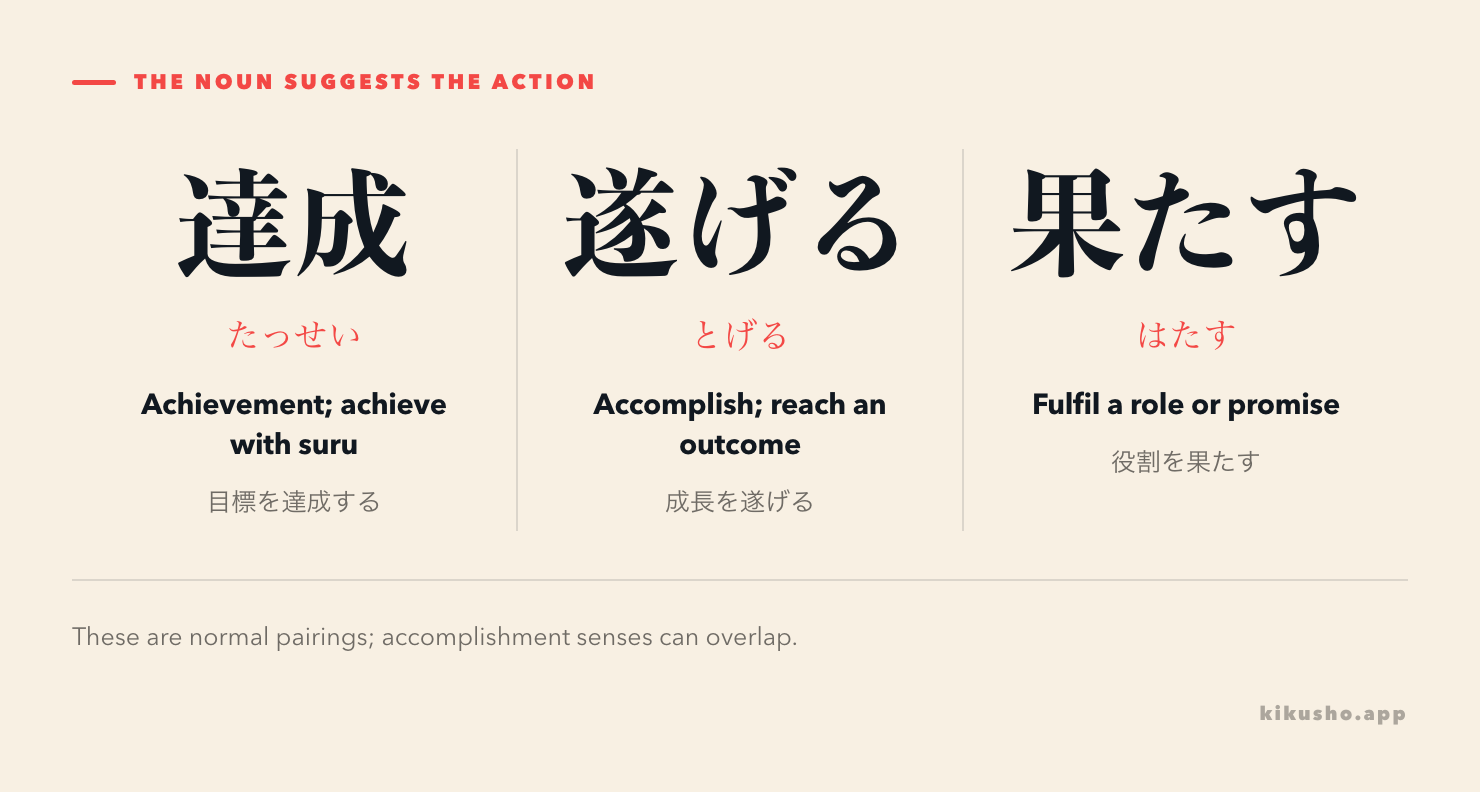
目的を達成する and 目的を果たす can both describe accomplishing a purpose. That overlap is supported by the dictionaries' own definitions. There is no dependable rule that only 達成する accepts goals, or that 果たす always demands a moral duty.
The familiar pairings help you produce language: 成長を遂げる for growth and 役割を果たす for a role. Substituting a verb merely because it shares “accomplish” in English can produce an unfamiliar or ill-fitting combination. A collocation is evidence about normal usage; it is not proof that every alternative is impossible.
施す applies something or bestows aid
施す often takes an object naming a treatment, measure or addition. 加工(かこう) is processing or a finish; 治療(ちりょう) is treatment. The recipient or surface can appear with に.
職人は木材に防水加工を施した。
しょくにんは もくざいに ぼうすいかこうを ほどこした。
The craftsperson applied a waterproof finish to the timber.
The timber receives the processing. Compare 患者に治療を施す(かんじゃにちりょうをほどこす), administer treatment to a patient. These phrases describe an intervention, rather than attainment of a target.
The giving sense also matters: 金品を施す(きんぴんをほどこす) means bestowing money or goods as aid. It is not the default wording for casually giving a birthday present. Daijisen describes aid, additions and action intended to have an effect; Kanjipedia independently confirms giving and taking necessary measures. Those dictionary senses do not make 施す a universal replacement for する.
催す holds an event or marks the onset of a feeling
The event sense is “hold” or “organize,” with people gathered for an occasion.
来月、新しい会員のために歓迎会を催します。
らいげつ、あたらしい かいいんの ために かんげいかいを もよおします。
Next month we will hold a welcome party for the new members.
歓迎会を催す(かんげいかいをもよおす) names that organized occasion. But 眠気を催す(ねむけをもよおす) uses another sense: begin to feel sleepy.
暖かい部屋に入ると、眠気を催した。
あたたかい へやに はいると、ねむけを もよおした。
When I entered the warm room, I became sleepy.
You are not holding a party called sleepiness. Daijisen and Kanjipedia both record the event and developing-state senses. Keep もよおす in the reading: the middle sequence is よお, not よう. An event invitation and a narrative about someone's condition select different senses of the same word.
損なう damages something; a preceding stem changes the task
Standalone 損なう means impairing, spoiling or harming something. Health, feelings and an object's condition can supply its object.
無理を続けて、健康を損なった。
むりを つづけて、けんこうを そこなった。
I harmed my health by continuing to push myself too hard.
It is godan: 損なう → 損なった, with small っ. With another verb's connecting stem, it can instead describe an unsuccessful action or a missed opportunity. 乗る → 乗り+損なう → 乗り損なう means failing to catch or missing a ride.
急いだのに、最終バスに乗り損なった。
いそいだのに、さいしゅうバスに のりそこなった。
Although I hurried, I missed the last bus.
The bus is not damaged. The missed action is boarding it, expressed with バスに乗る. Daijisen separates harm from stem-attached failure and missed opportunities; Kanjipedia likewise identifies that second construction. Do not translate every V-stem+損なう as “damage”: the preceding action and context decide what went wrong.
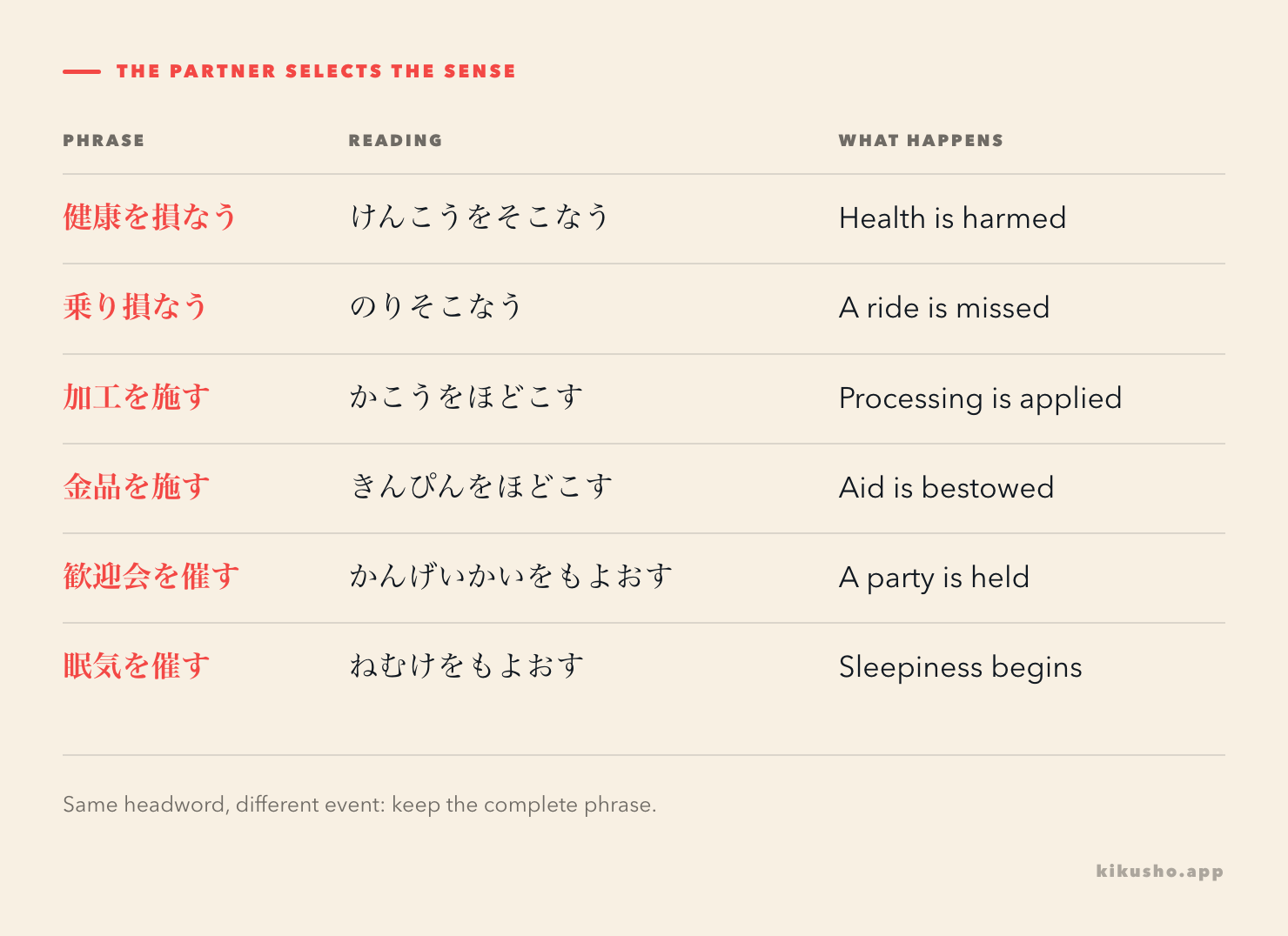
| Phrase | Reading | Event or sense |
|---|---|---|
| 健康を損なう | けんこうをそこなう | Harm one's health |
| 乗り損なう | のりそこなう | Fail to catch / miss a ride |
| 加工を施す | かこうをほどこす | Apply processing or a finish |
| 金品を施す | きんぴんをほどこす | Bestow money or goods as aid |
| 歓迎会を催す | かんげいかいをもよおす | Hold a welcome party |
| 眠気を催す | ねむけをもよおす | Begin to feel sleepy |
Keep a second encounter when it changes the sense
If you have kept an invitation with 催す, a later sentence about 眠気 deserves attention: the reading stays while the meaning shifts. For a digital text, Kikusho lets you paste the unfamiliar phrase and inspect an editable card. Check that its meaning and example preserve the invitation or bodily-state context before saving. A card glossed only “hold” would leave the later sentence unexplained.
The language checks here use two editorial families: Shogakukan's dictionaries and the Japan Kanji Aptitude Testing Foundation's 漢検 漢字辞典, published through Kanjipedia. They support readings and senses, without assigning official JLPT levels. The separately published study pages label 損なう and 施す N1; their underlying list independence is unestablished. This lesson does not survey historical meanings or every compound containing these verbs.
Practice: eight questions
Attempt the complete sequence before scrolling farther. The original items below sample kanji reading, contextual meaning, paraphrase and usage for N1 preparation; they do not reproduce exam questions.
Question 1
Read the bold verb in the sentence about a decorated fabric.
この布には細かい刺繍が施されている。
- A. しされている
- B. ほどこされている
- C. ほどされている
- D. せされている
Question 2
Select the verb that expresses damage to health in this report.
休まず働き続けた結果、健康を( )。
- A. 催した
- B. 施した
- C. 損なった
- D. 達成した
Question 3
Complete the update about meeting a goal that had been set.
チーム全員の協力で、予定していた目標を( )。
- A. 達成した
- B. 損なった
- C. 催した
- D. 施した
Question 4
Find the sentence where 果たす describes a fitting role or obligation.
- A. 来週の歓迎会を果たします。
- B. この木材に防水加工を果たしました。
- C. 暖房のせいで眠気を果たしました。
- D. 彼女は代表としての役割を果たしました。
Question 5
Preserve the meaning of this statement about the town's development.
その町は大きな成長を遂げた。
- A. その町では大きな歓迎会を開いた。
- B. その町は大きく発展した。
- C. その町の人々は成長する機会を失った。
- D. その町の建物に加工を加えた。
Question 6
Choose the action planned by the organizers for the new members.
来月、新会員の歓迎会を( )予定です。
- A. 催す
- B. 損なう
- C. 施す
- D. 遂げる
Question 7
Interpret the feeling described after entering a room in this account.
暖かい部屋に入って、眠気を催した。
- A. 部屋に集まって会を開いた。
- B. 部屋の中で健康を損なった。
- C. 部屋を出る機会を失った。
- D. 部屋に入って眠くなった。
Question 8
Choose the interpretation that matches the unsuccessful journey described here.
急いだのに、最終バスに乗り損なった。
- A. 急いだ結果、バスを壊した。
- B. 急いで最終バスに乗ることができた。
- C. 急いだが、最終バスに乗ることができなかった。
- D. 急いでバスの歓迎会を開いた。
Record eight letters before consulting the explanations. Each solution identifies the reading or event, rather than assigning an English gloss to every appearance of the verb.
Answers and explanations
Answer 1: B. 施す is ほどこす; passive 施されている is ほどこされている. The fabric has fine embroidery applied to it. A and D substitute し/せ for this headword's reading; C drops こ from ほどこす.
Answer 2: C. 健康を損なった reports harmed health after uninterrupted work. 催した would concern an event or an arising state, 施した an intervention or gift, and 達成した an achievement. None describes the deterioration named here.
Answer 3: A. 目標を達成した reports attaining the goal through everyone's cooperation. B would say it was impaired; C treats it as an occasion held; D treats it as an applied measure. 遂げる and 果たす are absent from the choices, so this question does not pretend that accomplishment verbs never overlap.
Answer 4: D. 代表としての役割を果たす means fulfilling the role of representative. A needs an event-holding verb such as 催す; B calls for 施す to apply processing; C calls for 催す to describe developing sleepiness. 果たす does not supply those intended actions.
Answer 5: B. 成長を遂げた describes substantial development, preserved by 大きく発展した. A replaces growth with a party, C with a missed opportunity, and D with processing added to buildings. Those introduce different events.
Answer 6: A. 歓迎会を催す means holding the welcome party. The other choices would describe harm, an intervention or an accomplished outcome, rather than organizing this gathering. 予定です tells you that it is planned, without asserting that it already happened.
Answer 7: D. 眠気を催した means becoming sleepy. The same verb can hold an event, but 眠気 selects the developing-state sense. A imports a gathering, B damage to health, and C a missed opportunity to leave; the sentence states none of those.
Answer 8: C. 乗り損なった reports failure to catch the bus despite hurrying. A wrongly reads 損なう as physical damage; B reverses failure into successful boarding; D invents a welcome party. The stem 乗り identifies the missed action, and バスに preserves the particle used with boarding.
Common questions
Are 達成する, 遂げる and 果たす interchangeable?
Their accomplishment senses overlap, but their usual partners differ. Start with 目標を達成する for achieving a goal, 成長を遂げる for undergoing growth, and 役割を果たす for fulfilling a role. These are useful starting phrases, not a rule that each noun permits only one verb.
Does 催す always mean to hold an event?
No. 歓迎会を催す means to hold a welcome party, while 眠気を催す means to become sleepy. The noun distinguishes the event sense from the onset of a feeling or bodily state. 催す is read もよおす.
What does a verb followed by 損なう mean?
With the verb's connecting stem, 損なう can mean doing something unsuccessfully or missing the opportunity. 乗る becomes 乗り損なう: fail to catch or miss a ride. This differs from standalone 健康を損なう, harm one's health; the surrounding sentence selects the sense.
Are all six words exclusive to JLPT N1?
No. The planning inventory places all six at N1, using Waller-derived study lists. The inspected JapaneseTest4You pages instead label 達成 and 果たす N2, and 損なう and 施す N1. These estimates do not establish an official syllabus or restrict when a learner may encounter a word.