On this page
A care label begins with 繊維, a tailor adjusts the 裾, and a product description calls a colour はやり. These six N1 entries move beyond naming clothes: they identify garment structure, the stages that turn fibre into fabric, and the reading that presents a fashion as the thing currently in vogue.
The earlier sequence supplies the foundation. The N3 lesson teaches 布, 生地, 袖 and 流行(りゅうこう); the N2 lesson distinguishes 編む from 縫う. Here the new entries are 襟, 織物, 裾, 繊維, 染める and 流行(はやり). The last is a separate spelling-reading record, not a repetition of the N3 entry.
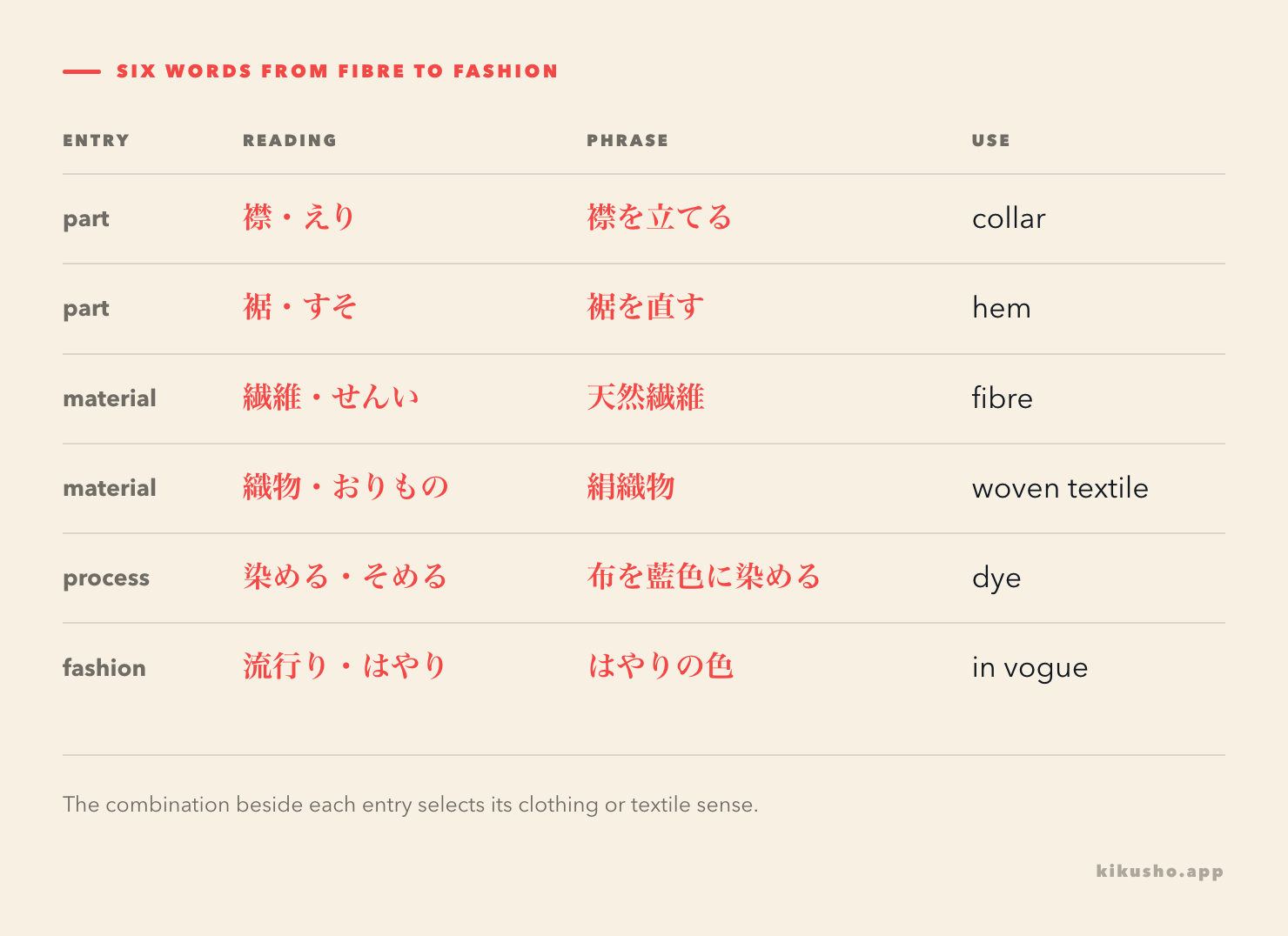
Six entries trace a garment from material to fashion
| Headword | Sound | Grammar | Clothing or textile role | Phrase to remember |
|---|---|---|---|---|
| 襟 | えり | noun | collar; clothing around the neck | 襟を立てる: turn up the collar |
| 裾 | すそ | noun | hem, lower edge; trouser cuff | 裾を直す: alter or fix the hem |
| 繊維 | せんい | noun | fibre; textile fibre or industry | 天然繊維: natural fibre |
| 織物 | おりもの | noun | woven textile or fabric | 絹織物: silk textile |
| 染める | そめる | transitive ichidan verb | dye or colour something | 布を藍色に染める: dye cloth indigo |
| 流行 / 流行り | はやり | noun; adjectival use with の | fashion, vogue, current craze | はやりの色: a fashionable colour |
The material chain is 繊維 → 糸 → 織物: fibre can be spun into thread, and threads can be woven into cloth. 染める can add colour to fibre, thread or finished fabric at different stages. Once the material becomes a garment, 襟 and 裾 name two edges far apart on the body. はやり judges whether its style belongs to the current moment.
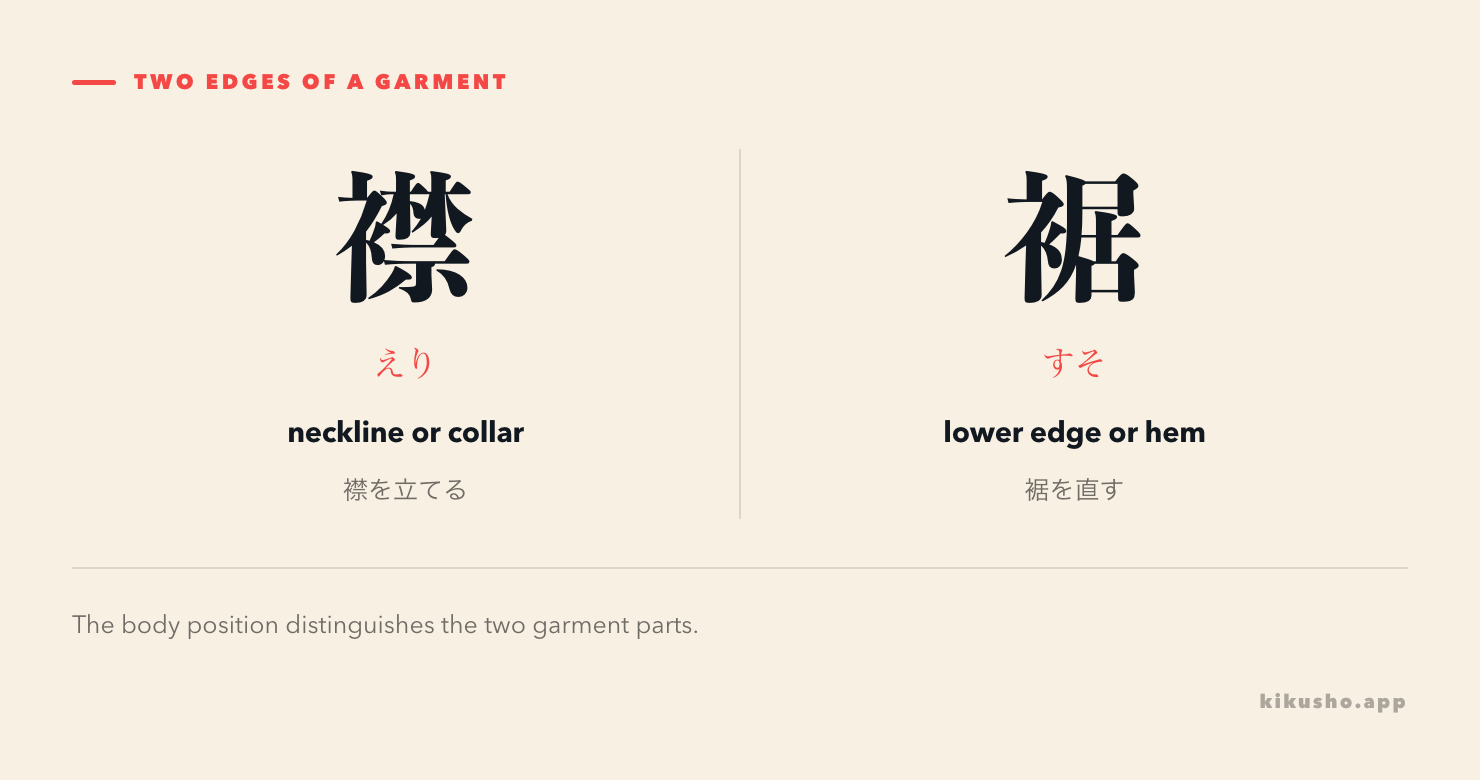
襟 and 裾 locate opposite edges of a garment
襟(えり) names the part of clothing around the neck, including a collar and its facing. It appears with verbs that describe position or handling:
- 襟を立てる: turn up the collar
- 襟を正す: straighten one’s collar; figuratively, compose oneself
- 襟元が開いている: the neckline is open
風が冷たかったので、コートの襟を立てた。
かぜがつめたかったので、コートのえりをたてた。
“The wind was cold, so I turned up my coat collar.”
Digital Daijisen’s 襟 entry gives the clothing around the neck and the added strip of cloth there. It also records the back of the neck. The idiom 襟を正す begins with a literal clothing action but commonly means adopting a serious, respectful attitude.
裾(すそ) is the lower edge of a garment. With trousers it can refer to the cuff or the length at the bottom; with a skirt or kimono it is the hem.
ズボンが長すぎたので、裾を五センチ短くしてもらった。
ズボンがながすぎたので、すそをごセンチみじかくしてもらった。
“The trousers were too long, so I had the hems shortened by five centimetres.”
Useful combinations include 裾が広がる, flare toward the bottom; 裾を上げる, shorten or take up a hem; and 裾を引きずる, drag the hem. Digital Daijisen’s 裾 entry extends the same lower-edge image to the foot of a mountain, 山の裾. It can also name the lower edge of hair at the nape.
繊維 is the material; 織物 is one result
繊維(せんい) means a thin, threadlike fibre. In clothing contexts, it can refer to natural or manufactured fibres used as raw material. Common categories include 天然繊維, natural fibre; 合成繊維, synthetic fibre; and 化学繊維, manufactured chemical fibre.
この表示には、使われている繊維の種類が書かれています。
このひょうじには、つかわれているせんいのしゅるいがかかれています。
“This label lists the types of fibre used.”
The word also occurs in biology, engineering and industry. The encyclopedia entry for 繊維 defines a long, thin substance and separates natural fibres from regenerated, synthetic and other manufactured types. 繊維産業 refers to the textile industry, so a news article may be discussing a sector rather than one visible strand.
織物(おりもの) is material made by weaving threads. The verb inside it is 織る(おる), to weave, and the noun reads おりもの.
この地域は、丈夫な絹織物の産地として知られている。
このちいきは、じょうぶなきぬおりもののさんちとしてしられている。
“This region is known as a production area for durable silk textiles.”
The dictionary and encyclopedia entries for 織物 describe cloth made by crossing lengthwise and crosswise threads. This makes 織物 narrower than a loose English use of “fabric.” 布 can name cloth generally, and 生地 often treats fabric as material chosen for a product. Knitted material is 編物(あみもの) rather than a woven textile, while nonwoven fabric is explicitly 不織布(ふしょくふ).
染める changes the colour of an object
染める(そめる) is a transitive ichidan verb. The thing whose colour changes takes を, and the resulting colour commonly takes に:
白い布を藍色に染めました。
しろいぬのをあいいろにそめました。
“I dyed the white cloth indigo.”
Its forms follow the ichidan pattern: 染めます, 染めて, 染めた, 染めない. Digital Daijisen’s 染める entry covers applying dye or colour to hair, cloth and other objects. It also includes light colouring a scene, as in 夕日が空を赤く染める, and fixed figurative phrases such as 悪事に手を染める, become involved in wrongdoing.
Keep the transitive and intransitive views apart:
| View | Pattern | Example |
|---|---|---|
| someone colours something | object を colour に 染める | 布を青に染める |
| something takes on colour | subject が colour に 染まる | 空が赤に染まる |
The result may look similar, but only 染める presents an actor causing the colour change.
流行り makes the current fashion into a noun
The assigned entry is 流行(はやり), also commonly written 流行り so the reading is visible. It comes from the continuative form of 流行る(はやる) and names what is currently popular, fashionable or in vogue.
この形は去年の流行りで、今はあまり見かけない。
このかたちはきょねんのはやりで、いまはあまりみかけない。
“This shape was last year’s fashion, and you do not see it much now.”
店には、はやりの色を使ったコートが並んでいた。
みせには、はやりのいろをつかったコートがならんでいた。
“Coats using fashionable colours were lined up in the shop.”
Digital Daijisen’s 流行り entry defines something temporarily widespread because it suits the taste of the time. はやりの服, 今はやりの髪形 and 流行り廃り are useful combinations.
The familiar reading 流行(りゅうこう) covers the same broad domain but behaves differently in many sentences: 流行する, become popular; 流行を追う, follow trends; 流行の傾向, fashion trends. Do not assign the reading from the kanji alone. A visible okurigana 流行り fixes はやり, while a する-form fixes りゅうこう.
The inventory places はやり at N1 through one Waller-derived baseline, while a separately published Japanesetest4you comparison page labels the matching headword N3. Its underlying list provenance is not established, so the disagreement is evidence of an unstable study boundary, not proof that one level is correct. The current JLPT publishes no exhaustive vocabulary syllabus. Learn the reading contrast because it occurs in ordinary prose regardless of its prep-book label.
When a clothing label or shop description contains one of these words, Kikusho can keep the exact phrase rather than flatten it to one English gloss. A saved card for 天然繊維, 裾を直す or 今はやりの色 retains the clue that will select the right meaning and reading during offline review.
Practice questions
Complete all eight before checking the shared answer section.
Question 1: kanji reading
How is 襟 read in コートの襟を立てる?
- ア. そで
- イ. えり
- ウ. すそ
- エ. え
Question 2: orthography
Choose the spelling for せんい, “fibre.”
- ア. 織物
- イ. 染維
- ウ. 繊維
- エ. 線衣
Question 3: garment repair
A tailor will adjust one part. Select the word for that part.
ズボンが長いので、店で( )を直してもらいます。
- ア. 襟
- イ. 裾
- ウ. 繊維
- エ. 流行り
Question 4: material sequence
Which statement correctly distinguishes the two words?
- ア. 繊維 is raw fibre; 織物 is material made by weaving threads.
- イ. 織物 is always raw fibre; 繊維 is always a finished coat.
- ウ. Both words mean only a decorative pattern.
- エ. Both words name parts around the neck.
Question 5: usage
Choose the sentence that correctly says “The artisan dyed the cloth red.”
- ア. 職人が布を赤に染めた。
- イ. 職人が布に赤を染まった。
- ウ. 布を職人が赤に染まった。
- エ. 赤が職人を布に染めた。
Question 6: reading in context
How is 流行 read in これは去年の流行だ when it means “last year’s fashion”?
- ア. りゅうぎょう
- イ. ながれ
- ウ. りゅうこう
- エ. はやり
Question 7: paraphrase
What does 山の裾に小さな村がある mean?
- ア. A small village is at the foot of the mountain.
- イ. A small village dyes mountain cloth.
- ウ. A small village is inside a collar.
- エ. A small village produces synthetic fibre.
Question 8: word formation
Which phrase names a silk textile made by weaving?
- ア. 絹織物
- イ. 絹襟
- ウ. 絹裾
- エ. 絹流行り
Answers and explanations
Answer 1
イ, えり. 襟 names the collar or clothing around the neck. 袖(そで)is a sleeve, 裾(すそ)is the lower edge, and 柄(え)can mean a handle.
Answer 2
ウ, 繊維. 繊維 is read せんい and means fibre. 織物 is おりもの, a woven textile. The other two options are not the established spelling of the requested word.
Answer 3
イ, 裾. Altering the bottom of trousers is 裾を直す or 裾上げをする. 襟 is at the neck, while 繊維 and 流行り do not name an adjustable garment edge.
Answer 4
ア. 繊維 is fibre that may become thread or other material. 織物 is one product made by weaving threads. The distinction concerns a stage and production method, not pattern or location on a garment.
Answer 5
ア, 職人が布を赤に染めた. With transitive 染める, the cloth takes を and the resulting colour takes に. 染まる is intransitive and would present the cloth itself as taking on the colour.
Answer 6
エ, はやり. The noun “last year’s fashion” is はやり and is often written 流行り. 流行する would instead use the reading りゅうこう. The sentence supplies no する-form.
Answer 7
ア. 裾 extends from the lower edge of clothing to the foot or lower slope of a mountain. The sentence places the village there; it says nothing about dyeing or textiles.
Answer 8
ア, 絹織物. 絹 is silk and 織物 is woven textile, so 絹織物 names silk fabric made by weaving. The other compounds do not express that material and process.
Common questions
What do 襟 and 裾 mean on clothing?
襟(えり)is the collar or the part around the neck. 裾(すそ)is the lower edge or hem of a garment and can also describe a trouser cuff. 裾 extends to the foot of a mountain, while 襟 also appears in figurative phrases.
What is the difference between 繊維 and 織物?
繊維(せんい)is fibre, the thin material from which yarn and textiles can be made. 織物(おりもの)is woven fabric produced by interlacing threads. Not every fibre has become cloth, and not every cloth-like material is woven.
Is 流行 read はやり or りゅうこう?
Both readings exist. 流行り(はやり)is a noun meaning what is currently fashionable or popular, as in はやりの服. 流行(りゅうこう)is the common Sino-Japanese reading in 流行する and 流行の傾向. Context and written form guide the reading.
Are all six words officially JLPT N1 vocabulary?
A Waller-derived study baseline places the six entries at N1, but はやり also has an N3 comparison-list observation. The JLPT publishes no exhaustive official vocabulary list, so these labels are study estimates.