On this page
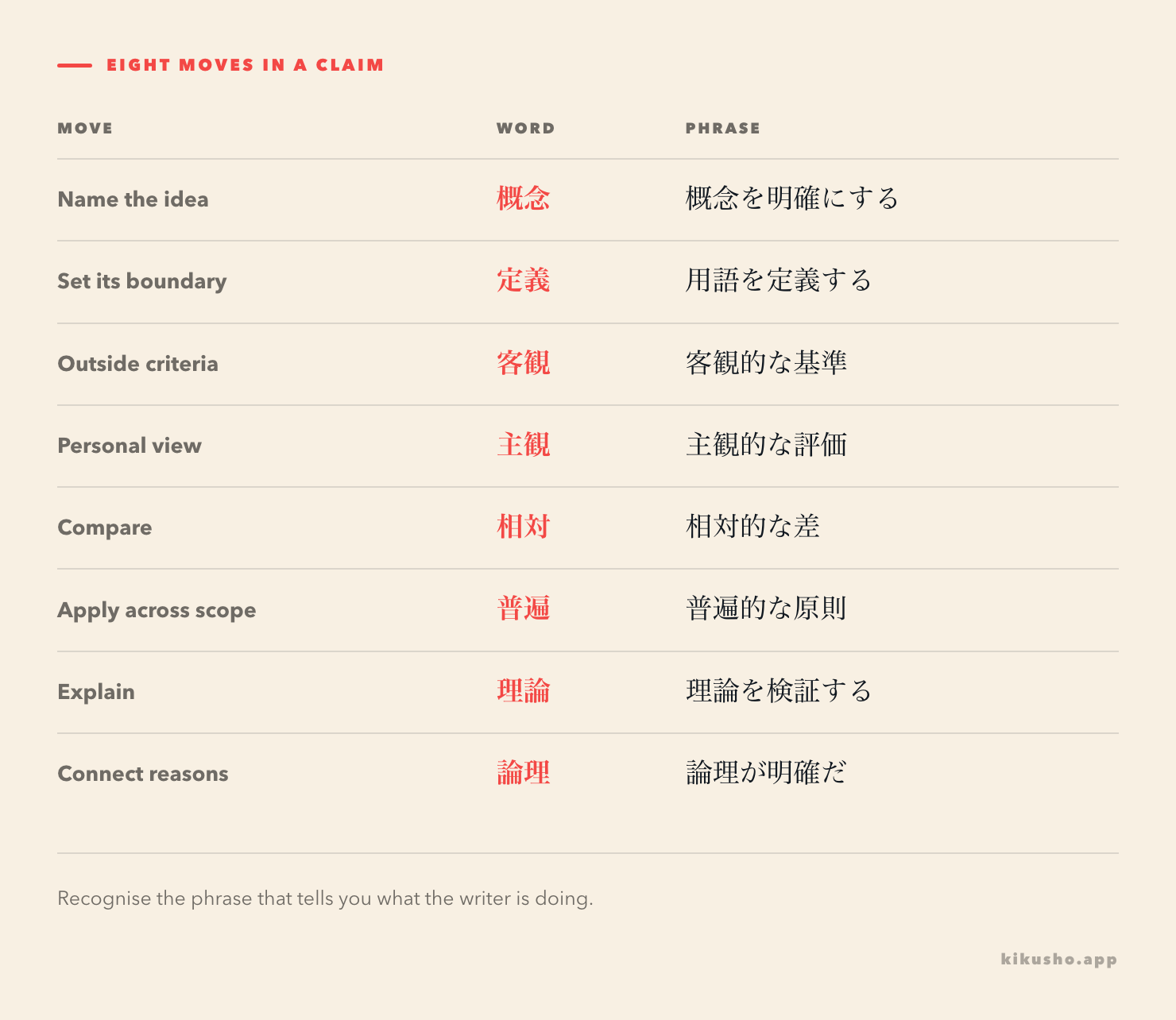
In Japanese academic writing, 概念 names an idea, 定義 fixes its meaning, and 論理 connects reasons to a conclusion. These eight N1 study words help you follow what a writer defines, compares and claims, instead of treating every abstract noun as a synonym for “idea.”
These words follow the moves in an argument
A passage might begin with a 概念, define it, contrast 客観 with 主観, ask whether a claim is 相対 or 普遍, and then test a 理論's 論理. That is a reading path, not a fixed order of Japanese composition. The words also occur in news and workplace prose; “academic” describes a useful shared setting, not an exclusive register.
The N1 placement comes from this curriculum's study inventories and Nihongo Master's N1 dictionary. Related descendants of one vocabulary list count as one source family. The JLPT has no exhaustive official vocabulary syllabus, so a level label is a study estimate. The examples assume ordinary noun modification, the particle の and XをYと定義する (“define X as Y”).
The set gives each word a different job
| Word and reading | Word class | Sense here | Phrase to recognise |
|---|---|---|---|
| 概念(がいねん) | Noun | Abstract concept | 概念を明確にする |
| 定義(ていぎ) | Noun / する-verb | Definition; to define | 用語を定義する |
| 客観(きゃっかん) | Noun | Objective standpoint | 客観的な基準 |
| 主観(しゅかん) | Noun | Subjective standpoint | 主観的な評価 |
| 相対(そうたい) | Noun | Relation to a comparison | 相対的な差 |
| 普遍(ふへん) | Noun | Universality across a stated scope | 普遍的な原則 |
| 理論(りろん) | Noun | Theory or explanatory system | 理論を検証する |
| 論理(ろんり) | Noun | Logic; chain of reasoning | 論理が明確だ |
客観的, 主観的, 相対的 and 普遍的 modify nouns with な; 定義する acts as a verb. Keep the whole phrase in memory, not only an English gloss.
概念 comes before 定義
概念 names the idea being discussed; 定義 specifies what counts as an instance of it.
この研究では、「参加」という概念を、会議に出席することと定義する。
この けんきゅうでは、「さんか」という がいねんを、かいぎに しゅっせきすることと ていぎする。
In this study, “participation” is defined as attending meetings.
The writer chooses a working definition for the study, without claiming that every use of 参加 has this boundary. Shogakukan's 概念 and 定義 entries separate the abstract idea from its specified meaning. Nihongo Master confirms 定義 as a noun that takes する.
客観 and 主観 locate the standpoint
客観的 aims to judge by criteria beyond the evaluator's personal impression; 主観的 points to that impression. Neither word alone proves that a claim is right or wrong.
評価は主観的になりやすいので、客観的な基準を示す。
ひょうかは しゅかんてきに なりやすいので、きゃっかんてきな きじゅんを しめす。
Evaluations tend to be subjective, so we present objective criteria.
The criteria help make evaluation less dependent on one person; they do not guarantee perfect neutrality. See Shogakukan's 客観 and 主観 entries and Nihongo Master's 主観 entry.
相対 depends on comparison; 普遍 reaches across a scope
相対的 asks “relative to what?” 普遍的 asks whether a claim applies throughout the scope the writer states. Something common is not necessarily universal.
この結果は調査方法によって変わる。したがって、普遍的な結論とは言えない。
この けっかは ちょうさほうほうに よって かわる。したがって、ふへんてきな けつろんとは いえない。
The result changes with the survey method. Therefore, it cannot be called a universal conclusion.
この方法は、前の方法と比べると相対的に費用が低い。
この ほうほうは、まえの ほうほうと くらべると そうたいてきに ひようが ひくい。
Compared with the previous method, this method has relatively low costs.
The second sentence supplies a baseline. Shogakukan's 相対 entry also lists あいたい for a separate face-to-face sense of the same spelling. In 相対的, read そうたいてき; Nihongo Master confirms that comparison sense.
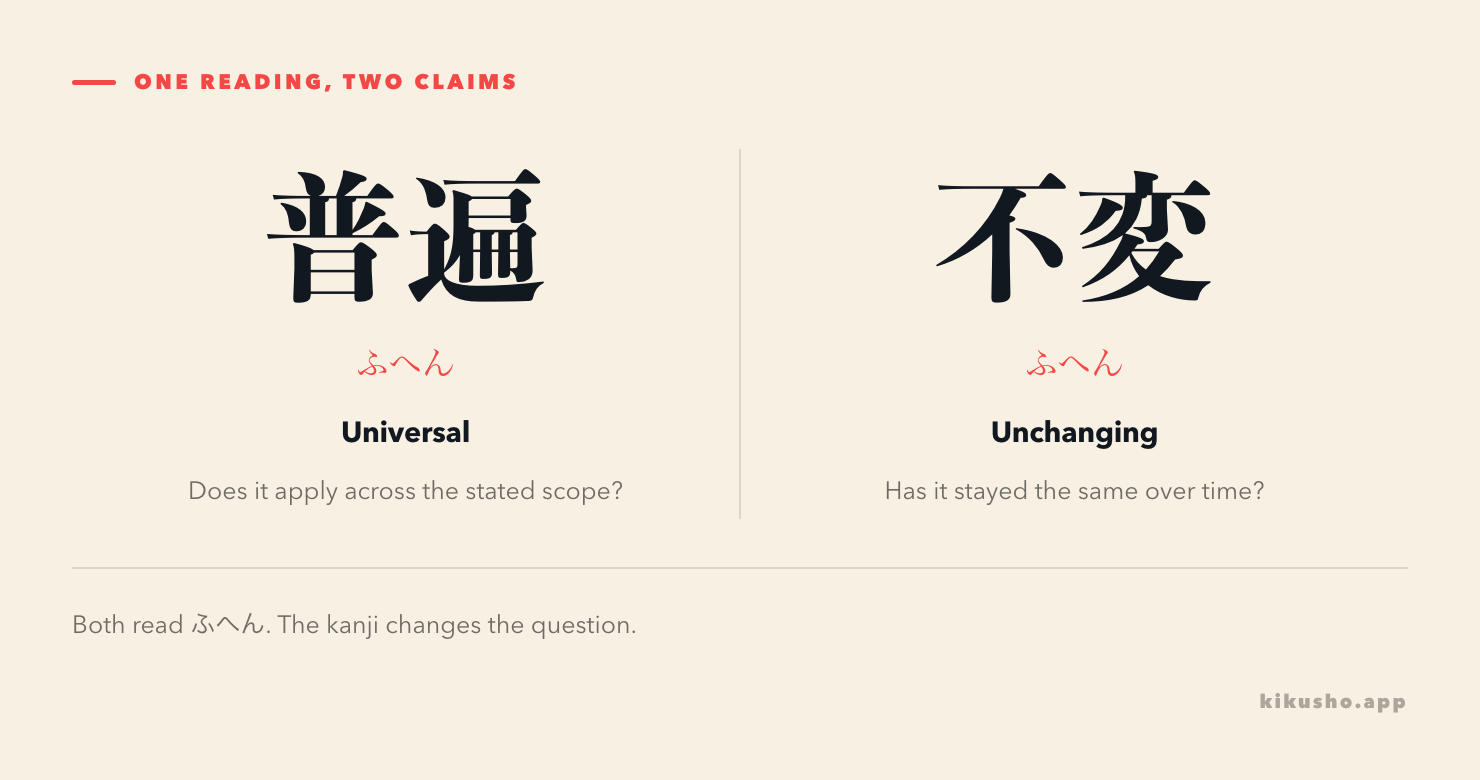
Do not confuse 普遍(ふへん), “universal,” with 不変(ふへん), “unchanging.” A principle might stay unchanged without applying to everyone. Shogakukan's 普遍 and 不変 entries distinguish them.
理論 explains; 論理 connects
理論 is a system of ideas used to explain observations. 論理 is the structure of the reasoning from premises to conclusion. You can grasp a theory's terms and still question the logic used in a particular argument for it.
この理論は観察結果を説明するが、結論に至る論理はまだ明確ではない。
この りろんは かんさつけっかを せつめいするが、けつろんに いたる ろんりは まだ めいかくではない。
This theory explains the observations, but the reasoning leading to the conclusion is not yet clear.
Shogakukan's 理論 and 論理 entries support this distinction. Nihongo Master's 論理 entry confirms the reading and noun use. To read the tone around an argument, see five N1 words for Japanese prose.
Try all five questions before checking the answers
Question 1 (reading). In 相対的な差, how is 相対 read? A. あいたい B. そうたい C. しょうたい D. そうだい
Question 2 (meaning in context). A report says 評価は主観的になりやすい. What is the concern? A. Evaluations always stay unchanged. B. They may reflect the evaluator's own impression. C. They apply universally. D. They have no definition.
Question 3 (paraphrase). Which sentence best paraphrases 普遍的な結論とは言えない? A. The conclusion cannot be presented as applying across the stated scope. B. The conclusion will never change. C. The conclusion has no logic. D. The conclusion is relatively small.
Question 4 (usage). Complete この研究では「参加」を、会議に出席することと___。 A. 定義する B. 概念する C. 論理する D. 客観する
Question 5 (meaning in context). A principle has not changed for decades, but applies only to one team. Which word describes the fact that it has not changed? A. 普遍 B. 不変 C. 主観 D. 相対
Decide on all five choices before looking below. For each one, ask whether the word points to a definition, a standpoint, a comparison, a scope or a change over time.
Answers and explanations
Answer 1. B, そうたい. 相対的 relates one thing to a comparison. あいたい is a different dictionary reading and sense; しょうたい and そうだい are not the reading of this phrase.
Answer 2. B. 主観 concerns the evaluator's standpoint. A describes 不変, C describes 普遍, and D concerns 定義. The Japanese warns about a tendency, not an inevitable error.
Answer 3. A. 普遍 concerns application across the stated scope. B confuses it with 不変; C changes the subject to 論理; D invents a comparison.
Answer 4. A, 定義する. XをYと定義する means “define X as Y.” The other options are not the natural verb for setting a definition.
Answer 5. B, 不変. The claim is about stability over time. 普遍 would concern how widely the principle applies, which the question limits to one team; 主観 and 相対 describe other relationships.
Keep the phrase when you keep the word
If you meet 客観的な基準 or 論理が明確だ in a real article, save the phrase with its context rather than a bare English equivalent. Kikusho turns a word noticed in text, speech or a photo into an editable card; you can check its reading and example before saving it, then review offline. For the step from short study passages into denser news writing, see N2 newspaper vocabulary.
Common questions
Is 相対 always read そうたい?
No. The comparison-related word in 相対的 is そうたい. Dictionaries also list あいたい for a separate face-to-face sense written 相対.
Do 普遍 and 不変 mean the same thing?
No. Both can be read ふへん, but 普遍 means universal within a stated scope, while 不変 means unchanging over time.
Are these words on an official N1 vocabulary list?
The JLPT does not publish an exhaustive official vocabulary list. N1 is the study-list placement for this lesson, not a guaranteed exam item.