On this page
These seven N1 Japanese body, senses and physical movement vocabulary records look like a small body-part list, but the real challenge is reading and viewpoint. 傾く(かたぶく) is a rare alternative to ordinary かたむく, 骨(こつ) means a knack rather than a physical bone, and 感触 moves easily from touch to an inferred impression.
The remaining nouns reward precise scope. 顎 covers the jaw or chin area, 腸 names the intestines, 内臓 groups internal organs, and 眉 becomes part of expressions that reveal attitude without stating an emotion directly.
The 7 records and the phrases that identify them
| Target | Sound | Grammar | N1 sense | Anchor phrase |
|---|---|---|---|---|
| 顎 | あご, ago | noun | jaw; chin | 顎に手を当てる: rest a hand on one's chin |
| 傾く | かたぶく, katabuku | intransitive godan verb | incline; slant; decline; older or literary reading | 日が西に傾く: the sun sinks toward the west |
| 感触 | かんしょく, kanshoku | noun | tactile feel; impression or sense | 柔らかい感触: a soft feel |
| 骨 | こつ, kotsu | noun | knack; key point; technique | コツをつかむ: get the knack |
| 腸 | ちょう, chō | noun | intestine; intestinal tract | 腸の働き: intestinal function |
| 内臓 | ないぞう, naizō | noun | internal organs; viscera | 内臓を保護する: protect the internal organs |
| 眉 | まゆ, mayu | noun | eyebrow | 眉をひそめる: knit one's brows |
Broad N1 lists independently include 顎 and other assigned words, but a list does not explain why two identical spellings receive different readings or why a body noun suddenly means a technique. This lesson treats those distinctions as the examinable unit.
The N2 body and movement lesson teaches the ordinary reading 傾く(かたむく), transitive 曲げる and the register pair 皮膚/肌. Keep that common layer active before adding the rarer N1 reading here.
傾く is ordinarily かたむく; かたぶく is the marked reading
The kanji and conjugation do not tell you which reading the writer intends. In contemporary neutral prose, かたむく is the default:
強風で古い塀が道路側に傾いています。
きょうふうでふるいへいがどうろがわにかたむいています。
The old wall is leaning toward the road because of the strong wind.
The assigned N1 record かたぶく is an older alternative preserved in dictionaries, historical quotations and literary writing. Kanjipedia lists かたむく as the head reading and notes that it is also read かたぶく. The National Institute for Japanese Language and Linguistics likewise records かたぶく as a reading variant.
山の端に日が傾くころ、旅人は宿を探した。
やまのはにひがかたぶくころ、たびびとはやどをさがした。
As the sun sank toward the ridge, the traveller looked for an inn.
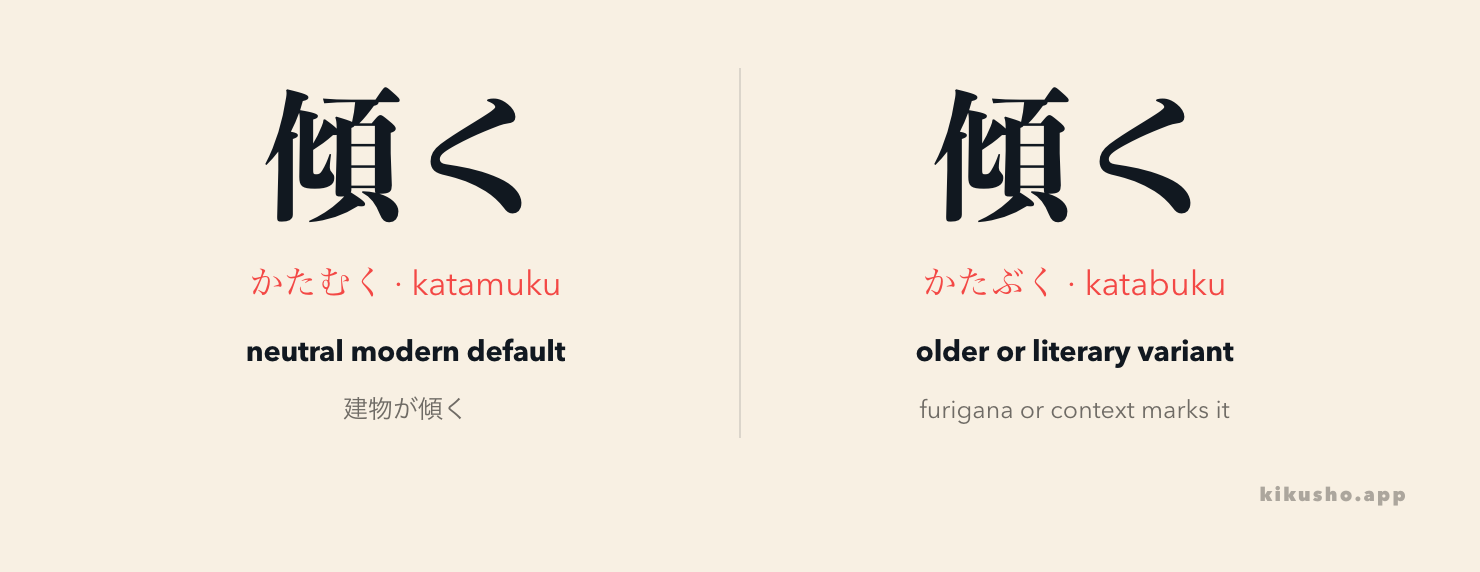
Both readings can carry the same physical and figurative range: something slants, opinion inclines in one direction, the sun sinks, or a business declines. Do not assign an invented meaning contrast to the variant reading. The difference is mainly frequency and register.
In an unannotated modern sentence, read 傾く as かたむく unless the work, quotation or furigana gives a reason to choose かたぶく. An N1 learner needs recognition more than forced everyday production.
骨(こつ) is the key point that makes a skill work
Physical bone is 骨(ほね). The assigned reading こつ has a lexical sense: the essential point, trick or technique that helps someone perform an action well. In contemporary informal writing, this sense is very often written コツ.
箸を上手に使うコツは、上の一本だけを動かすことです。
はしをじょうずにつかうこつは、うえのいっぽんだけをうごかすことです。
The key to using chopsticks well is to move only the upper one.
The dictionary entry for 骨 separates こつ, a knack or crucial point, from ほね, the hard tissue of the skeleton. Learn こつ with a limited set of productive patterns:
| Pattern | Meaning | Example |
|---|---|---|
| コツをつかむ | get the knack | 練習して発音のコツをつかむ |
| コツが分かる | understand how to do it | 数回試すとコツが分かる |
| コツを教える | show someone the trick | 写真を撮るコツを教える |
| ちょっとしたコツ | a small but useful trick | 料理にはちょっとしたコツがある |
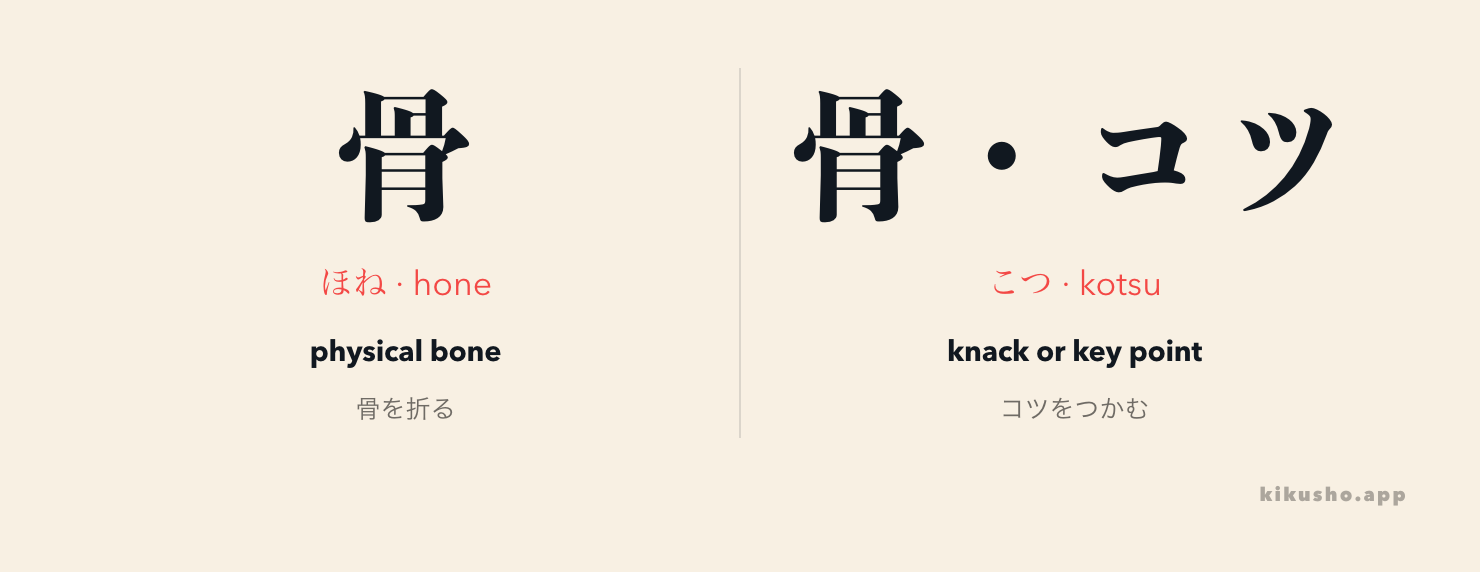
The reading こつ still appears in anatomical compounds such as 骨格(こっかく) and can refer to cremated bones in お骨(おこつ). Context remains necessary; the lesson's standalone lexical record is the “knack” sense.
感触 begins with touch and extends to an impression
In its concrete use, 感触(かんしょく) is the feel produced when skin or a hand touches something. The material or object commonly takes の, while an adjective describes the resulting quality.
この布は絹のようになめらかな感触です。
このぬのはきぬのようになめらかなかんしょくです。
This fabric has a smooth, silk-like feel.
The word also names an impression inferred from a response, atmosphere or early result. No physical contact is involved.
担当者の反応から、契約を更新できそうな感触を得ました。
たんとうしゃのはんのうから、けいやくをこうしんできそうなかんしょくをえました。
From the representative's reaction, I got the sense that we would be able to renew the contract.
The 感触 dictionary entry gives both a tactile feel and an indirect impression, including 議案が通りそうな感触を得る. That figurative pattern is common in reporting, negotiations and analysis.
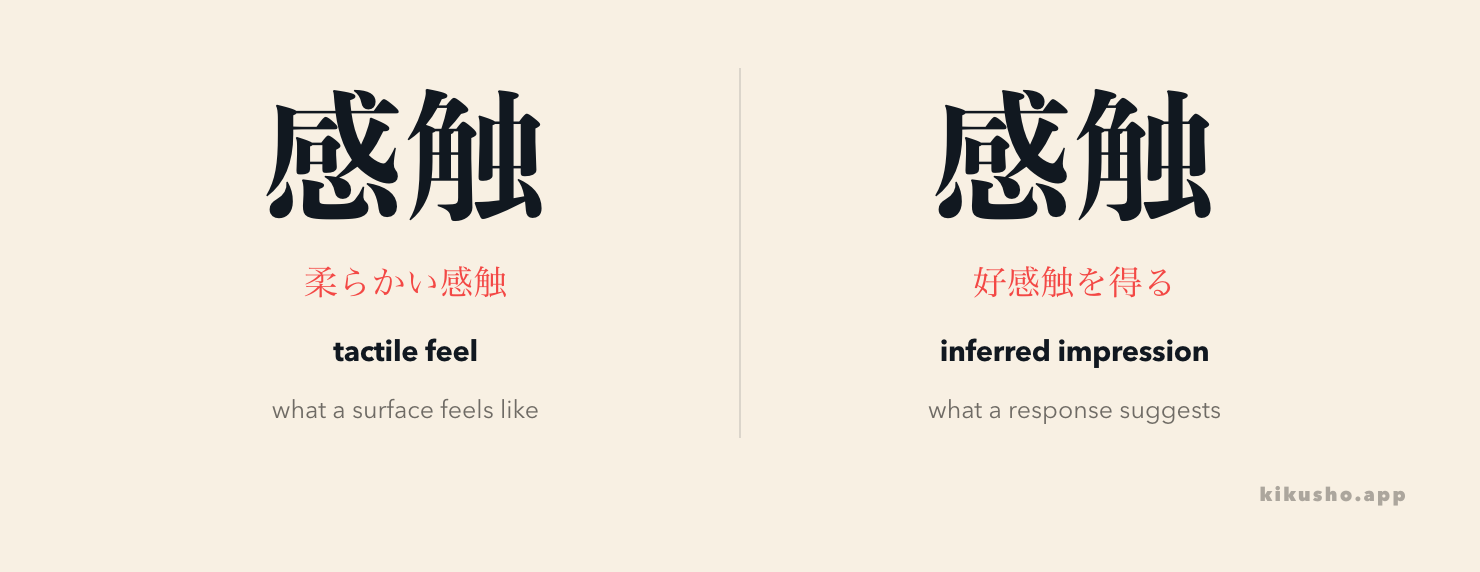
手触り stays close to the texture felt by the hand. 感覚 is broader and can cover any sense, bodily sensation or intuitive judgment. 感触 sits between them: it can name tactile feel, then extend that “felt” result to an impression. 好感触 is specifically favourable; bare 感触 can be good, bad or uncertain.
顎 is the jaw area and, in everyday speech, often the chin
顎(あご) refers to the structures around the upper and lower jaw. Everyday Japanese also uses あご for the projecting lower part that English often calls the chin. The dictionary entry explicitly notes this broader everyday use, so translation depends on the action.
硬い物をかみすぎて、顎が痛くなりました。
かたいものをかみすぎて、あごがいたくなりました。
My jaw began to hurt from chewing too much hard food.
彼は顎に手を当てて、しばらく考え込みました。
かれはあごにてをあてて、しばらくかんがえこみました。
He put a hand to his chin and thought for a while.
Anatomical compounds usually use the on-reading ガク: 上顎(じょうがく), upper jaw; 下顎(かがく), lower jaw; 顎関節(がくかんせつ), jaw joint. Do not read the standalone everyday word 顎 as がく.
腸 is one tract; 内臓 is a collective category
腸(ちょう) names the intestinal tract from the stomach toward the anus. It appears most naturally in technical or semi-technical compounds: 小腸, small intestine; 大腸, large intestine; 腸内, inside the intestine; 腸炎, enteritis.
腸は食べ物の消化と栄養の吸収に関わっています。
ちょうはたべもののしょうかとえいようのきゅうしゅうにかかわっています。
The intestines are involved in digesting food and absorbing nutrients.
The 腸 definition treats it as the principal part of the digestive tract and divides it into the small and large intestines. The reading はらわた exists, but it has a more visceral or expressive register and can refer more broadly to entrails.
内臓(ないぞう) groups organs inside the body, especially those in the chest and abdominal cavities. The category includes more than the intestines: the stomach, liver, lungs and kidneys can all be discussed as internal organs.
肋骨には心臓や肺などの内臓を保護する役割があります。
ろっこつにはしんぞうやはいなどのないぞうをほごするやくわりがあります。
The ribs help protect internal organs such as the heart and lungs.
The 内臓 definition describes the internal systems treated in anatomy. 臓器 focuses on an organ as a functional structure and readily counts individual organs; 内臓 often presents the internal organs collectively or contrasts them with the body's exterior and musculoskeletal structures.
The N1 illness and recovery lesson extends this register into diagnosis, chronic conditions and treatment language.
眉 is an eyebrow and a visible clue to attitude
眉(まゆ) means an eyebrow and often alternates with the more explicit 眉毛(まゆげ). Literal collocations include 眉を整える, shape the eyebrows; 太い眉, thick eyebrows; and 眉を上げる, raise the eyebrows.
写真を撮る前に、鏡を見て眉を整えました。
しゃしんをとるまえに、かがみをみてまゆをととのえました。
I checked the mirror and shaped my eyebrows before the photo.
The expression 眉をひそめる describes drawing the brows together and conventionally signals worry, displeasure or disapproval. It does not automatically mean anger.
住民は無責任な発言に眉をひそめました。
じゅうみんはむせきにんなはつげんにまゆをひそめました。
Residents frowned at the irresponsible remark.
Kanjipedia's entry for 眉 records both 眉をひそめる and the warning expression 眉に火がつく, which presents danger as having drawn extremely close. Learn these as full phrases rather than deriving them from “eyebrow” during a timed question.
One archival scene connects all 7 records
学芸員は古い医学書の紙を指でなぞり、ざらざらした感触を確かめました。「日が西に傾く」という一文には、かたぶくと振り仮名があります。腸やその他の内臓を描いた図を見た新人が眉をひそめ、顎に手を当てると、学芸員は「古い文章は振り仮名を先に確認するのが読むコツです」と説明しました。
がくげいいんはふるいいがくしょのかみをゆびでなぞり、ざらざらしたかんしょくをたしかめました。「ひがにしにかたぶく」といういちぶんには、かたぶくとふりがながあります。ちょうやそのたのないぞうをえがいたずをみたしんじんがまゆをひそめ、あごにてをあてると、がくげいいんは「ふるいぶんしょうはふりがなをさきにかくにんするのがよむこつです」とせつめいしました。
The curator ran a finger over the paper of an old medical text and checked its rough feel. One sentence, “the sun sinks toward the west,” gives かたぶく in furigana. A newcomer frowned and put a hand to their chin on seeing a diagram of the intestines and other internal organs. The curator explained, “The trick to reading old prose is to check the furigana first.”
N1 practice: reading, context, paraphrase and usage
1 · Kanji reading in a literary note. A glossary identifies 傾く as the older alternative to ordinary かたむく. Which reading does it give?
ア. かたぶく
イ. かたよく
ウ. かぶせく
エ. かしぐく
2 · Reading by meaning. How is 骨 read in 運転の骨をつかむ when it means “get the knack of driving”?
ア. ほね
イ. こち
ウ. こつ
エ. ぼね
3 · Physical context. Complete: この革は、使うほど柔らかい__になります。
ア. 内臓
イ. 感触
ウ. 顎
エ. 眉
4 · Figurative paraphrase. What does 交渉相手から好感触を得た mean?
ア. The negotiator touched a high-quality material.
イ. The other party caused physical pain.
ウ. The negotiator received a favourable impression from the response.
エ. The other party explained a practical trick.
5 · Natural usage. Which sentence is natural?
ア. 深く考えながら顎に手を当てた。
イ. 顎を西に傾くと日が沈んだ。
ウ. 柔らかな顎を交渉から得た。
エ. 顎が技術のコツを吸収した。
6 · Scope in anatomy. Complete: 小腸と大腸をまとめて__と呼びます。
ア. 眉
イ. 顎
ウ. 腸
エ. 感触
7 · Category distinction. Which statement is accurate?
ア. 内臓 means only the small and large intestines.
イ. 腸 is a collective name for every organ inside the body.
ウ. 内臓 can include the heart, lungs, stomach and intestines.
エ. 腸 and 眉 are two readings of one kanji.
8 · Expression in context. In 住民はその説明に眉をひそめた, what did the residents most likely show?
ア. Displeasure or concern
イ. Mastery of a technique
ウ. A tactile sensation
エ. Intestinal pain
9 · Collocation. Which phrase means “get the knack”?
ア. コツをつかむ
イ. 感触を傾く
ウ. 内臓をひそめる
エ. 眉を吸収する
10 · Register and reading. An unannotated contemporary report says 建物が傾いている. Which reading is the safest default?
ア. かたぶいている
イ. かたむいている
ウ. かがんでいる
エ. かぶいている
Answers and explanations
1 · ア, かたぶく. This is the marked alternative reading recorded in historical and literary sources. In neutral modern prose, かたむく is far more usual.
2 · ウ, こつ. 骨(こつ) means a knack, crucial point or technique. 骨(ほね) is the ordinary standalone reading for physical bone.
3 · イ, 感触. 革 can acquire a softer feel through use. The adjective describes the tactile quality, and the other choices name body parts or organs.
4 · ウ. 好感触 is a favourable impression inferred from the other party's reaction. The sentence involves no literal touching.
5 · ア. 顎に手を当てる naturally describes putting a hand to the chin while thinking. The remaining sentences violate the words' meanings or argument structure.
6 · ウ, 腸. 腸 names the intestinal tract and covers the small and large intestines. 内臓 is the broader category that includes multiple internal organs.
7 · ウ. 内臓 is a collective category for internal organs, including organs from several systems. 腸 refers specifically to the intestinal tract.
8 · ア. 眉をひそめる describes knitting the brows and conventionally signals worry, concern, displeasure or disapproval according to context.
9 · ア. コツをつかむ is the fixed productive collocation for grasping how to perform something successfully.
10 · イ, かたむいている. Without furigana or a literary setting, contemporary readers normally choose かたむく. The N1 reading かたぶく is valuable for recognition precisely because it is marked.
Build the study cards around the reading contrast rather than the shared kanji: 傾く(かたむく/かたぶく) and 骨(ほね/こつ). Then pair the concrete and figurative uses of 感触, separate 腸 from the larger 内臓 category, and retain 顎 and 眉 inside actions that reveal their meaning.
Kikusho's September 2026 inventory assigns these seven exact spelling-and-reading records to N1. Its two baseline files share the Waller/Tanos source family, so agreement between them is not independent confirmation; current dictionaries and broad study lists supply the checks used here. The JLPT organisers do not issue a definitive current vocabulary list, making N1 an editorial study placement rather than an official word-by-word syllabus.
Common questions
Is 傾く read かたぶく or かたむく?
Both readings are recorded, but they are not equally common today. かたむく is the ordinary modern reading. かたぶく is an older or literary alternative that advanced readers should recognise when it is specified by context or furigana.
Why is 骨 read こつ when it means a knack?
骨(こつ) developed the sense of an essential point, technique or knack. It appears in コツをつかむ and コツが分かる. The physical bone is normally 骨(ほね), although こつ also occurs in compounds and for cremated bones.
Can 感触 describe something you did not physically touch?
Yes. 感触 can be a tactile feel, such as a fabric's softness, or an impression inferred from a situation, such as getting the sense that a proposal will be accepted.
What is the difference between 腸 and 内臓?
腸(ちょう) names the intestinal tract and is common in compounds such as 小腸, 大腸 and 腸内. 内臓(ないぞう) is a collective term for the internal organs located mainly inside the chest and abdominal cavities.
What does 眉をひそめる mean?
It literally describes drawing the eyebrows together and conventionally means to frown in worry, displeasure or disapproval. The emotion must be inferred from the surrounding context.