On this page
These 22 N3 Japanese body, senses and physical movement vocabulary records cover visible body parts, internal organs, breathing, sensation and stretching. The useful unit is a word with its reading and natural phrase: 肩がこる, 呼吸を整える and 腕を伸ばす are safer than three isolated English glosses.
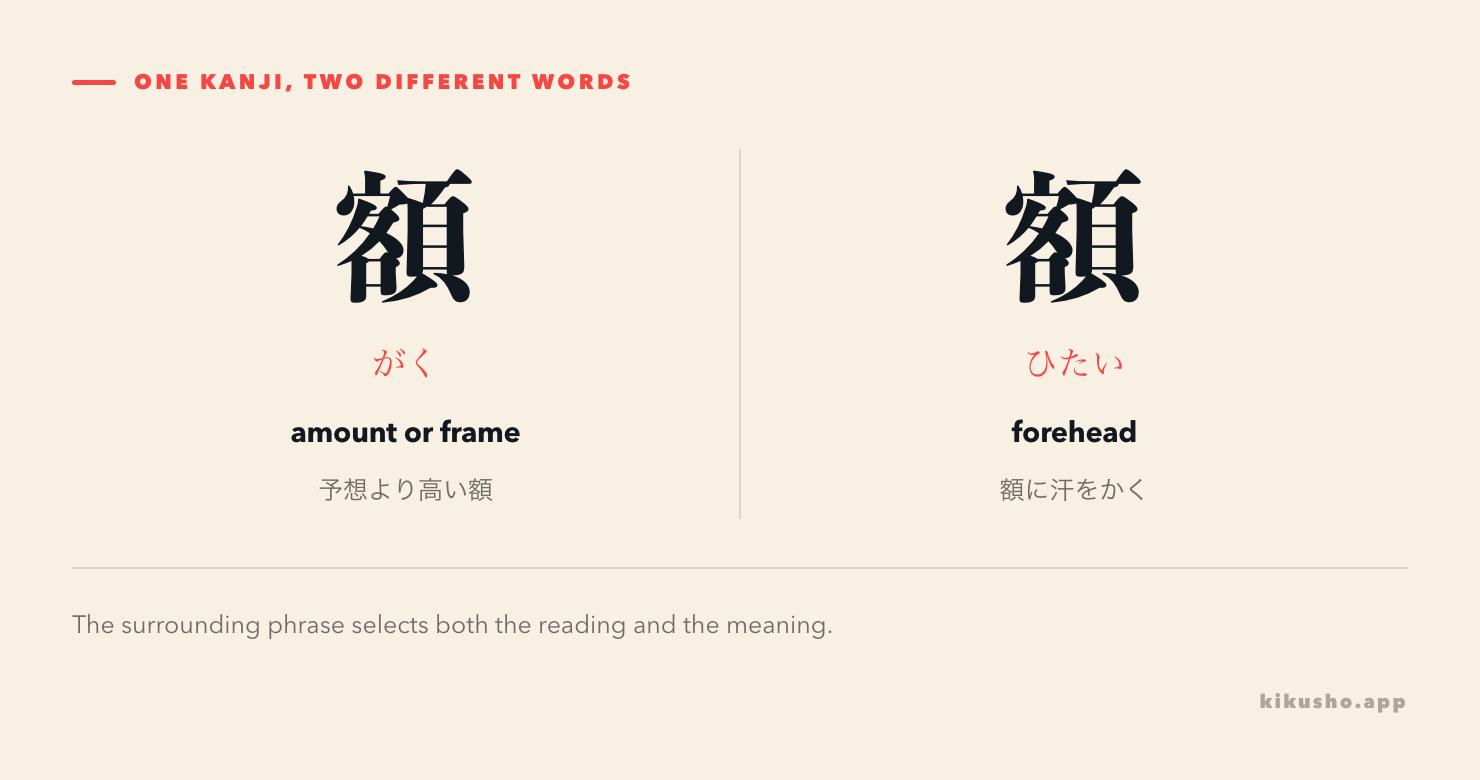
Two repeated kanji require special care. 額(がく) does not mean “forehead” as a standalone word; that body-part reading is 額(ひたい). 頬(ほお) and 頬(ほほ), by contrast, are two accepted readings of the same word “cheek.”
The 22 records and the phrases that make them usable
| Assigned form | Reading | Role | Meaning used here | Phrase to retain |
|---|---|---|---|---|
| 胃 | い, i | noun | stomach, the organ | 胃が痛い: the stomach hurts |
| 息 | いき, iki | noun | breath | 息を吸う: breathe in |
| 肩 | かた, kata | noun | shoulder | 肩がこる: have stiff shoulders |
| 感覚 | かんかく, kankaku | noun | sense; sensation | 指の感覚がない: have no feeling in a finger |
| 額 | がく, gaku | noun; noun suffix | framed picture; amount or sum | かなりの額を払う: pay a considerable sum |
| 筋肉 | きんにく, kinniku | noun | muscle | 筋肉を鍛える: train the muscles |
| 血液 | けつえき, ketsueki | noun | blood | 血液が流れる: blood flows |
| 呼吸 | こきゅう, kokyū | noun; suru verb | breathing; respiration | 呼吸を整える: steady one's breathing |
| 腰 | こし, koshi | noun | waist; lower back | 腰を曲げる: bend at the waist |
| 舌 | した, shita | noun | tongue | 舌を出す: stick out one's tongue |
| 尻 | しり, shiri | noun | buttocks; bottom | 尻もちをつく: fall on one's bottom |
| 心臓 | しんぞう, shinzō | noun | heart, the organ | 心臓が速く打つ: the heart beats fast |
| 脳 | のう, nō | noun | brain | 脳が情報を処理する: the brain processes information |
| 伸ばす | のばす, nobasu | transitive godan verb | stretch; extend; lengthen | 腕を伸ばす: stretch out an arm |
| 伸びる | のびる, nobiru | intransitive ichidan verb | become longer; stretch; grow | 背が伸びる: grow taller |
| 肺 | はい, hai | noun | lung | 肺に空気が入る: air enters the lungs |
| 膝 | ひざ, hiza | noun | knee; lap | 膝を曲げる: bend the knee |
| 額 | ひたい, hitai | noun | forehead; brow | 額に汗をかく: sweat on the forehead |
| 頬 | ほお, hō | noun | cheek | 頬が赤くなる: one's cheeks turn red |
| 骨 | ほね, hone | noun | bone | 骨を折る: break a bone |
| 頬 | ほほ, hoho | noun | cheek | 頬を染める: blush |
| 胸 | むね, mune | noun | chest; breast | 胸が痛い: the chest hurts |
The Ministry of Health, Labour and Welfare's care-work material labels 筋肉, 骨, 心臓, 血液 and 胃 inside the body. The Japan Foundation's health vocabulary list independently gives 胃, 肩, 胸 and 腰 with practical symptom language. These sources verify current readings and uses; they do not create an official JLPT syllabus.
The N5 body parts and pain lesson supplies the simpler location pattern body part が 痛い. This N3 set adds less visible organs, reading traps and the movement pair 伸ばす/伸びる.
額 changes meaning with its reading
The two 額 records are not interchangeable pronunciations of one body word.
| Reading | Core word | Natural examples |
|---|---|---|
| がく | an amount; a framed picture or frame | 支払う額, 額に絵を入れる |
| ひたい | the forehead | 額に汗をかく, 額に手を当てる |
予想していた額より、修理代が高くなりました。
よそうしていたがくより、しゅうりだいがたかくなりました。
The repair cost was higher than the amount I had expected.
走ったあと、額に汗をかきました。
はしったあと、ひたいにあせをかきました。
I sweated on my forehead after running.
The dictionary entry for 額 separates がく, used for sums and framed objects, from ひたい, the area between the eyebrows and hairline. An independent N3 study entry for 額(がく) also gives “framed picture” and “amount.” The inventory gloss that attached “forehead” to がく is therefore corrected here rather than repeated.
頬 has two standard readings for the same cheek
Both 頬(ほお) and 頬(ほほ) mean the side of the face between the eye, ear, nose and mouth. You may see either reading above the same kanji.
寒くて頬が赤くなりました。
さむくてほおがあかくなりました。
My cheeks turned red from the cold.
彼女は恥ずかしそうに頬を染めました。
かのじょははずかしそうにほほをそめました。
She blushed as if embarrassed.
The Culture Agency's Jōyō kanji table lists ほお and explicitly notes ほほ as another form. The anatomical entry confirms that both name the same part of the face. Treat this as reading variation, not a hidden semantic contrast.
Locate the outside body words before learning idioms
肩 is the shoulder. 腰 covers the waist and lower-back region; translating it mechanically as “hip” can point too far toward the hip joint. 胸 is the chest or breast, while 膝 is the knee and can also mean the lap. 舌, 尻 and 骨 name the tongue, bottom and bone.
荷物が重くて、肩と腰が痛くなりました。
にもつがおもくて、かたとこしがいたくなりました。
The luggage was heavy, and my shoulders and lower back began to hurt.
膝を曲げて、背筋を伸ばしてください。
ひざをまげて、せすじをのばしてください。
Bend your knees and straighten your back.
Register matters for 尻. Bare 尻 is direct and common in compounds such as 尻もち. お尻 is softer in ordinary conversation, while 殿部(でんぶ) is formal anatomical language. The N3 body list from NIHONGO NET independently places 胃, 血液, 腰, 心臓, 膝, 頬, 骨 and 胸 in a practical body set.
息 is a breath; 呼吸 is the breathing process
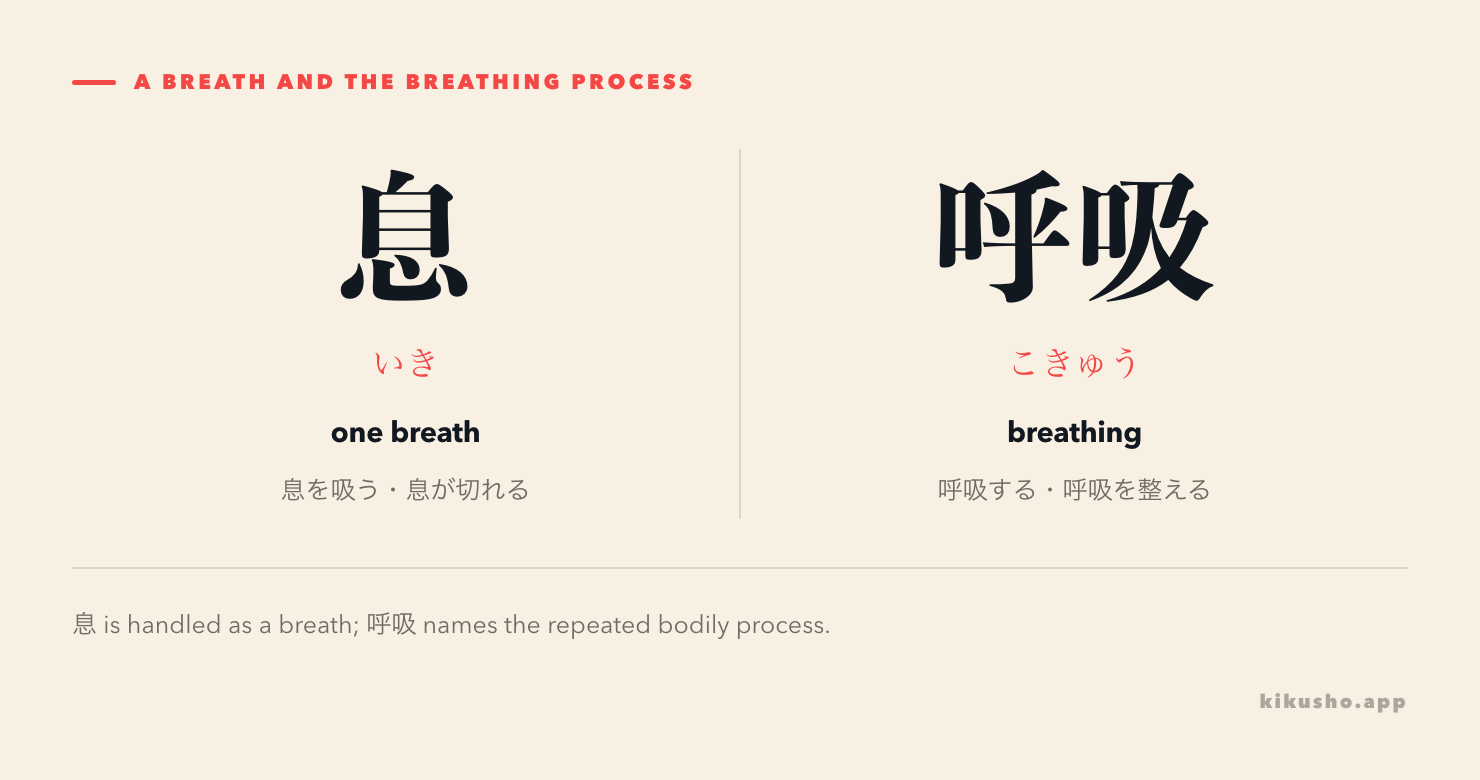
息(いき) is what you draw in, let out, hold or lose after exertion. It also extends to coordination in 息が合う, literally having matching breath.
階段を上ったら、息が切れました。
かいだんをのぼったら、いきがきれました。
I was out of breath after climbing the stairs.
呼吸(こきゅう) names the repeated process of breathing and works as a suru verb. It is the better choice when describing rhythm, depth or respiration as a bodily function.
運動のあと、ゆっくり呼吸して息を整えました。
うんどうのあと、ゆっくりこきゅうしていきをととのえました。
After exercising, I breathed slowly and caught my breath.
The 呼吸 dictionary entry gives 呼吸する, 呼吸を整える and the extended idea of people moving in coordination. The 息 entry treats breath as the air movement produced by breathing.
The organs form a connected system, but the nouns stay distinct
肺 takes in oxygen through breathing. 血液 carries it, 心臓 pumps the blood, and 脳 processes information and controls bodily activity. 胃 belongs to digestion rather than this breathing-and-circulation chain.
肺で取り入れた酸素は、血液によって全身に運ばれます。
はいでとりいれたさんそは、けつえきによってぜんしんにはこばれます。
Oxygen taken in through the lungs is carried throughout the body by the blood.
Do not replace 心臓 with 胸. 心臓 is the organ; 胸 is the outside region and also appears figuratively in 胸がいっぱい, be overwhelmed with emotion. The Ministry's medical-care vocabulary material groups 胃, 肺 and 心臓 as words learners need to understand in a clinic.
感覚 reports sensation and extends to judgment
感覚(かんかく) first names the ability to feel stimuli and the resulting sensation. Cold can make 指の感覚がなくなる, and an anaesthetic can leave 感覚がない in one area. The word also extends to judgment or a kind of sense: バランス感覚, sense of balance, and 金銭感覚, sense of money.
足の指にまだ感覚がありますか。
あしのゆびにまだかんかくがありますか。
Can you still feel your toes?
The 感覚 dictionary entry separates bodily sensation from aesthetic or practical “sense.” Context decides whether a sentence concerns nerves, perception or judgment.
伸ばす acts on something; 伸びる describes the result
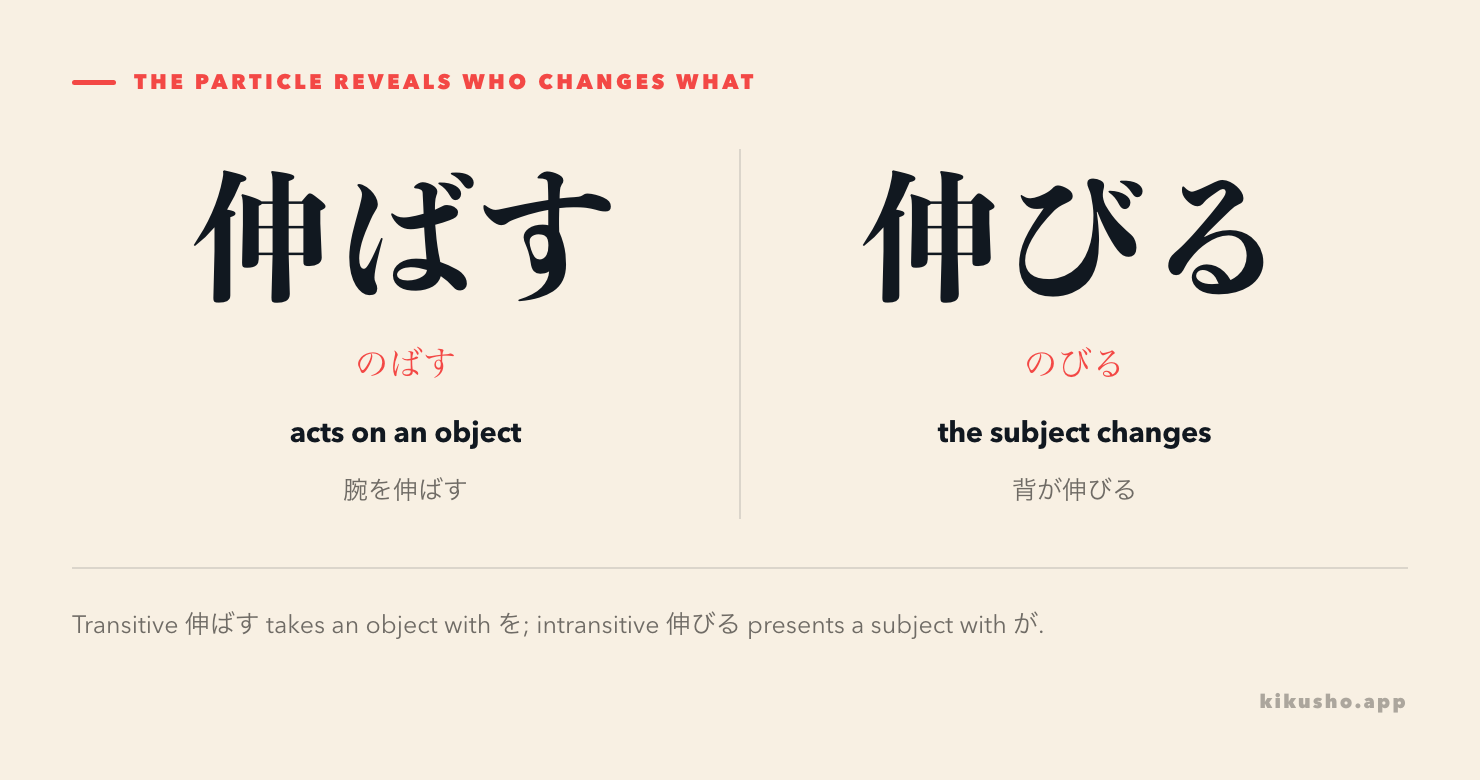
伸ばす(のばす) is transitive. The person deliberately stretches, straightens or lengthens an object or body part, which normally takes を.
両腕を頭の上まで伸ばしてください。
りょううでをあたまのうえまでのばしてください。
Please stretch both arms above your head.
伸びる(のびる) is intransitive. The subject itself grows, lengthens, straightens or improves, so it normally takes が.
子どもの背が一年で五センチ伸びました。
こどものせがいちねんでごセンチのびました。
The child grew five centimetres taller in one year.
The dictionaries for 伸ばす and 伸びる verify the same contrast across bodies, hair, skills and organisations. The spelling 延ばす/延びる often shifts toward extension in time or postponement; this lesson keeps the physical 伸 forms.
One examination connects all 22 records
健康診断で、医師は額に汗をかいた選手の頬の色を見ました。肩、胸、腰、膝、筋肉と骨を調べ、舌も見せてもらいました。胃に違和感がないか、息が苦しくないかを尋ね、心臓、肺、脳、血液、呼吸の状態を確認しました。次に指先の感覚を調べ、腕を伸ばすよう指示しました。選手が腕を伸ばすと、背筋も自然に伸びました。最後に選手は診療費の額を確認してから立ち上がり、尻についたほこりを払いました。
けんこうしんだんで、いしはひたいにあせをかいたせんしゅのほおのいろをみました。かた、むね、こし、ひざ、きんにくとほねをしらべ、したもみせてもらいました。いにいわかんがないか、いきがくるしくないかをたずね、しんぞう、はい、のう、けつえき、こきゅうのじょうたいをかくにんしました。つぎにゆびさきのかんかくをしらべ、うでをのばすようしじしました。せんしゅがうでをのばすと、せすじもしぜんにのびました。さいごにせんしゅはしんりょうひのがくをかくにんしてからたちあがり、しりについたほこりをはらいました。
During a health examination, the doctor looked at the cheeks of an athlete whose forehead was sweaty. The doctor examined the shoulders, chest, lower back, knees, muscles and bones, and asked to see the tongue. After asking about stomach discomfort and difficulty breathing, the doctor checked the heart, lungs, brain, blood and respiration. Next came a fingertip sensation check and an instruction to extend the arms. When the athlete stretched out both arms, the spine naturally straightened too. Finally, the athlete checked the amount of the medical fee, stood up and brushed dust from their bottom.
The passage uses 額 twice with different readings: forehead is ひたい, while an amount is がく. It uses 頬 as ほお; reading the same cheek word as ほほ would not change the meaning.
N3 practice: readings, collocations and viewpoint
1 · Reading an amount. How is 額 read in 予想より高い額を払いました?
ア. ひたい
イ. がく
ウ. ぬか
エ. かく
2 · Reading a body part. How is 額 read in 額に汗をかきました?
ア. がく
イ. こう
ウ. ひたい
エ. ほほ
3 · Choosing the kanji. Which kanji writes ほお/ほほ, “cheek”?
ア. 額
イ. 頬
ウ. 胸
エ. 肩
4 · Choosing breath or breathing. Complete: 走ったあと、まず__を整えました。
ア. 呼吸
イ. 舌
ウ. 血液
エ. 感覚
5 · Controlling transitivity. Which sentence naturally means “Please stretch your arms”?
ア. 腕が伸ばしてください。
イ. 腕を伸びてください。
ウ. 腕を伸ばしてください。
エ. 腕が伸びてください。
6 · Reporting sensation. Complete: 寒さで指の__がなくなりました。
ア. 額
イ. 呼吸
ウ. 感覚
エ. 筋肉
7 · Separating organ and region. Which sentence specifically names the organ that pumps blood?
ア. 胸が痛いです。
イ. 心臓が血液を送ります。
ウ. 肺に空気が入ります。
エ. 胃が食べ物を消化します。
8 · Interpreting a body complaint. What does 肩がこっています mean here?
ア. My shoulders are stiff.
イ. My knees are bent.
ウ. My heart is beating.
エ. My tongue is swollen.
9 · Matching a natural collocation. Which pairing is natural?
ア. 膝を曲げる
イ. 骨を呼吸する
ウ. 舌が血液を送る
エ. 肺をこる
10 · Reading the examination report. The athlete first has 額に汗 and later checks 診療費の額. Which reading sequence is correct?
ア. がく → がく
イ. ひたい → ひたい
ウ. ひたい → がく
エ. がく → ひたい
Answers and explanations
1 · イ, がく. An amount or sum is 額(がく). The payment context rules out the body-part reading.
2 · ウ, ひたい. Sweat appears on the forehead, 額(ひたい). The same kanji does not preserve one reading across unrelated words.
3 · イ, 頬. Both ほお and ほほ are accepted readings of 頬 and mean the cheek. 額 is the forehead only when read ひたい.
4 · ア, 呼吸. 呼吸を整える means to steady one's breathing. 息を整える is also established, but 息 is not among the answer choices and the other three nouns cannot name the process being steadied.
5 · ウ. 伸ばす is transitive, so 腕 takes を. The request form is 伸ばしてください. 伸びる describes the arm or another subject extending without presenting an agent acting on it.
6 · ウ, 感覚. 指の感覚がなくなる means losing sensation in a finger. The other choices name an amount or frame, breathing, and muscle.
7 · イ. 心臓 specifically names the heart and sends blood around the body. 胸 names the chest region; ウ and エ describe different organs.
8 · ア. 肩がこる is the standard collocation for stiffness or tightness in the shoulders. It does not describe a change in the knees, heart or tongue.
9 · ア. 膝を曲げる, bend the knee, pairs a body part with a natural physical action. The remaining choices assign impossible functions or collocations to the nouns.
10 · ウ, ひたい → がく. The first 額 is a sweaty forehead. The second is the amount of the medical fee. The surrounding noun phrase selects each reading.
Build the cards around contrasts and particles: 額(がく)/額(ひたい), 息/呼吸, 腕を伸ばす/背が伸びる. Keep 頬(ほお/ほほ) on one meaning card with two readings, and attach the remaining body nouns to a verb that locates their normal use. Continue with the N2 body, senses and movement lesson for 傾く/曲げる, 皮膚/肌 and physical versus figurative 姿勢.
Kikusho's September 2026 inventory places these exact records at N3, but the source families disagree on 血液, 脳 and 肺. Current independent materials also split: 血液 appears on both N3 and N2 lists, while several lists put 肺 and 脳 at N1. The JLPT organisers do not publish a definitive current vocabulary list, so the level here is an editorial study placement. The readings, meanings and collocations remain useful regardless of where another deck files them.
Common questions
Is 額 read がく or ひたい?
Both readings exist, but they name different words. 額(ひたい) is the forehead. 額(がく) is a framed picture or a sum, especially an amount of money. Context therefore controls both the reading and the meaning.
Is 頬 read ほお or ほほ?
Both ほお and ほほ are standard readings meaning the cheek. The official Jōyō kanji table gives ほお and notes ほほ as an alternative. Learn both for recognition; do not assign them different body parts.
What is the difference between 息 and 呼吸?
息 is an individual breath or the air involved in breathing, so it appears in 息を吸う, 息を吐く and 息が切れる. 呼吸 names breathing as a process and suits 呼吸する, 呼吸が浅い and 呼吸を整える.
What is the difference between 伸ばす and 伸びる?
伸ばす is transitive: a person stretches or lengthens something, as in 腕を伸ばす. 伸びる is intransitive: something becomes longer, straighter or more developed, as in 背が伸びる and 背筋が伸びる.