On this page
These eight N1 Japanese illness, symptoms and recovery vocabulary records test more than medical glosses. Two familiar kanji conceal marked readings: 傷(しょう) belongs mainly inside compounds such as 軽傷, while 吐く(つく) survives in fixed expressions such as ため息をつく.
The rest of the set rewards control of viewpoint and register. 感染 focuses on infection within a host, 安静 restricts activity, だるい reports a felt heaviness, and 疲労 gives that tired state a more formal name.
Eight records, with their usable grammatical frames
| Assigned form | Reading | Linguistic role | Meaning in this lesson | Phrase to retain |
|---|---|---|---|---|
| 安静 | あんせい, ansei | noun; na-adjective | physical rest; keeping still | 安静にする: rest and avoid exertion |
| 感染 | かんせん, kansen | noun; intransitive suru verb | infection | ウイルスに感染する: become infected with a virus |
| 下痢 | げり, geri | noun; suru verb | diarrhoea | 下痢が続く: diarrhoea continues |
| 傷 | しょう, shō | on-reading used in compounds | injury or damage element | 軽傷を負う: sustain a minor injury |
| だるい | だるい, darui | i-adjective | feel heavy, sluggish or languid | 体がだるい: the body feels heavy |
| 吐く | つく, tsuku | transitive godan verb in fixed phrases | breathe or utter in set expressions | ため息をつく: sigh |
| 腫れる | はれる, hareru | intransitive ichidan verb | become swollen | 足首が腫れる: the ankle swells |
| 疲労 | ひろう, hirō | noun; suru verb | physical or mental fatigue | 疲労が蓄積する: fatigue accumulates |
This table deliberately narrows two source glosses. It does not license the standalone phrases しょうがある for “there is a wound” or 食べ物をつく for “vomit food.” The exact reading and construction must travel together.
傷 is きず alone but しょう inside injury compounds
The common noun 傷 is read きず:
腕の傷はもう治りました。
うでのきずはもうなおりました。
The wound on my arm has already healed.
The assigned N1 record uses the on-reading しょう. Japanese normally exposes that reading as one part of a compound:
| Compound | Reading | What the other element adds |
|---|---|---|
| 外傷 | がいしょう | an injury caused by an external force |
| 軽傷 | けいしょう | a minor injury |
| 重傷 | じゅうしょう | a serious injury |
| 負傷 | ふしょう | sustaining an injury |
| 損傷 | そんしょう | damage to a body part, object or system |
事故で二人が軽傷を負いました。
じこでふたりがけいしょうをおいました。
Two people sustained minor injuries in the accident.
検査では、骨に損傷は見つかりませんでした。
けんさでは、ほねにそんしょうはみつかりませんでした。
The examination found no damage to the bone.
The dictionary entry for 傷 separates the noun きず from the kanji reading しょう and lists しょう compounds for injury, damage and emotional pain. The inventory's broad “wound, injury, hurt, scratch” gloss belongs to the meaning family; the しょう record is useful as a compound-building reading.
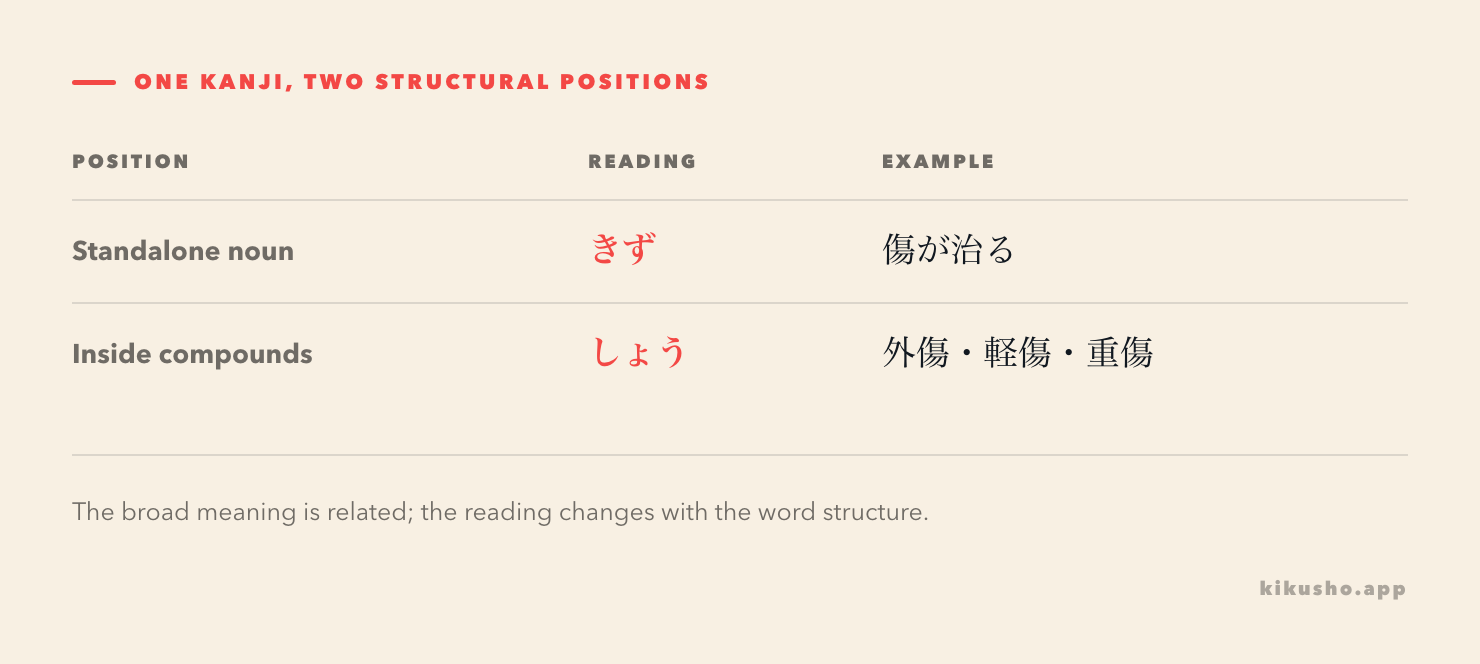
This also explains the apparent level disagreement. A study page can place 傷(きず) at N3 while an N1 inventory tests control of the on-reading through less elementary compounds. Those are different spelling-and-reading records, not contradictory claims about one identical item.
吐く read つく lives in fixed expressions
The productive reading 吐く(はく) describes expelling something from inside. The N3 health lesson teaches 食べた物を吐く, 息を吐く and うそを吐く with that reading.
The assigned reading 吐く(つく) has a narrower modern life. It appears in established combinations, and the verb is commonly written in kana:
| Fixed expression | Meaning | What to notice |
|---|---|---|
| ため息をつく | sigh | the whole expression names a sigh |
| 一息つく | pause to catch one's breath | 一息 forms a lexical unit with つく |
| うそをつく | tell a lie | normally written in kana |
| 悪態をつく | hurl abuse; speak abusively | a marked expression for bad words |
結果を聞いた彼は、安心してため息をつきました。
けっかをきいたかれは、あんしんしてためいきをつきました。
When he heard the result, he sighed with relief.
少しここで一息ついてから、作業を再開しましょう。
すこしここでひといきついてから、さぎょうをさいかいしましょう。
Let us take a short breather here before resuming the work.
The dictionary entry for 吐く(つく) identifies breathing out and uttering bad words, then notes that this reading occurs in fixed expressions such as ため息 and うそ. Kanjipedia likewise describes 吐く read つく as putting breath out through the mouth.
Do not decide between はく and つく from the kanji alone. 息を吐く in a literal breathing instruction is ordinarily はく; 一息つく means taking a breather and fixes つく.
感染 and 伝染 choose different viewpoints
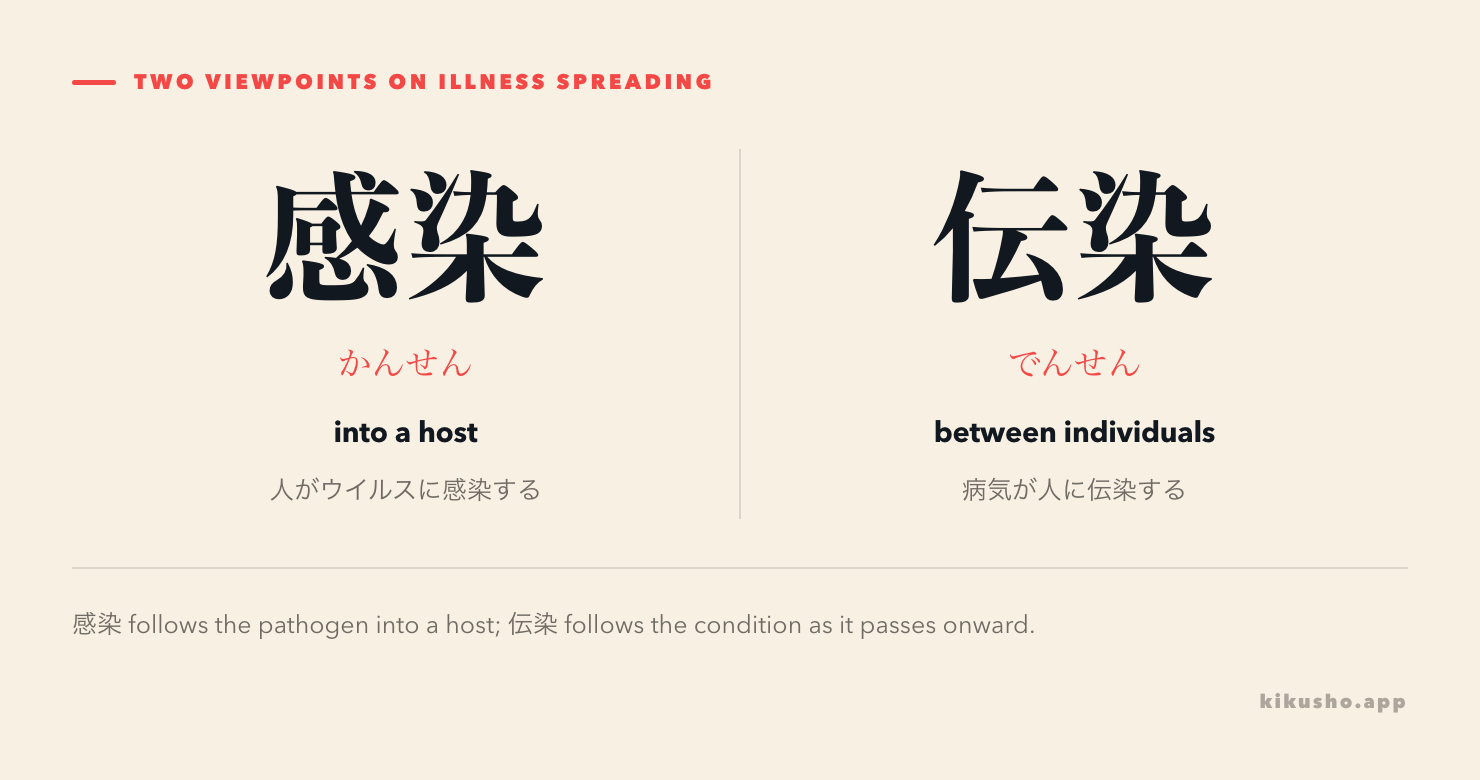
感染(かんせん) describes a host acquiring a pathogen that then reproduces inside it. The person or organism takes が, and the pathogen or disease often takes に.
患者はウイルスに感染していました。
かんじゃはウイルスにかんせんしていました。
The patient was infected with the virus.
The infection reference distinguishes infection from the appearance of symptoms: a pathogen can multiply without the person developing an overt illness.
伝染(でんせん), introduced in the N2 illness lesson, foregrounds transmission from one individual to another. The disease commonly becomes the grammatical subject.
| Viewpoint | Natural sentence | Focus |
|---|---|---|
| host | 人がウイルスに感染する | the pathogen enters the host |
| transmission | 病気が人に伝染する | the condition passes to another person |
Every 伝染 describes something spreading, but not every 感染 implies person-to-person spread. The dictionary discussion of 感染症 and 伝染病 gives non-transmissible infection as the boundary case.
下痢, だるい and 腫れる report different kinds of symptoms
下痢(げり) is a noun and can combine with する. Natural reports include 下痢をする, 下痢が続く, 下痢になる and 下痢を起こす.
昨夜から下痢が続いています。
さくやからげりがつづいています。
The diarrhoea has continued since last night.
The Digital Daijisen entry marks 下痢 as a noun that can take する. In a vocabulary question, do not confuse the condition with 腹痛(ふくつう), abdominal pain; the two can occur together but name different symptoms.
だるい is an i-adjective for a subjective sense that the body or a body part feels heavy and hard to move.
熱はありませんが、朝から全身がだるいです。
ねつはありませんが、あさからぜんしんがだるいです。
I do not have a fever, but my whole body has felt sluggish since this morning.
Its noun is だるさ: 体のだるさを感じる. The dictionary also records older or extended senses such as slack and slow, but the bodily sense is the one assigned here.
腫れる(はれる) is intransitive: a body part becomes swollen, so that body part takes が.
転んだあと、右の足首が腫れました。
ころんだあと、みぎのあしくびがはれました。
After I fell, my right ankle became swollen.
The transitive partner is 腫らす(はらす), as in 泣いて目を腫らす, make one's eyes swollen by crying. The noun is 腫れ(はれ), used in 腫れが引く, the swelling goes down. The 腫れる entry confirms that inflammation causes skin or mucous membrane to swell.
Do not choose the homophone 晴れる in a health sentence. 晴れる describes weather clearing or a doubt lifting; 腫れる contains the flesh radical and describes swelling.
疲労 is a formal state; だるい is how heaviness feels
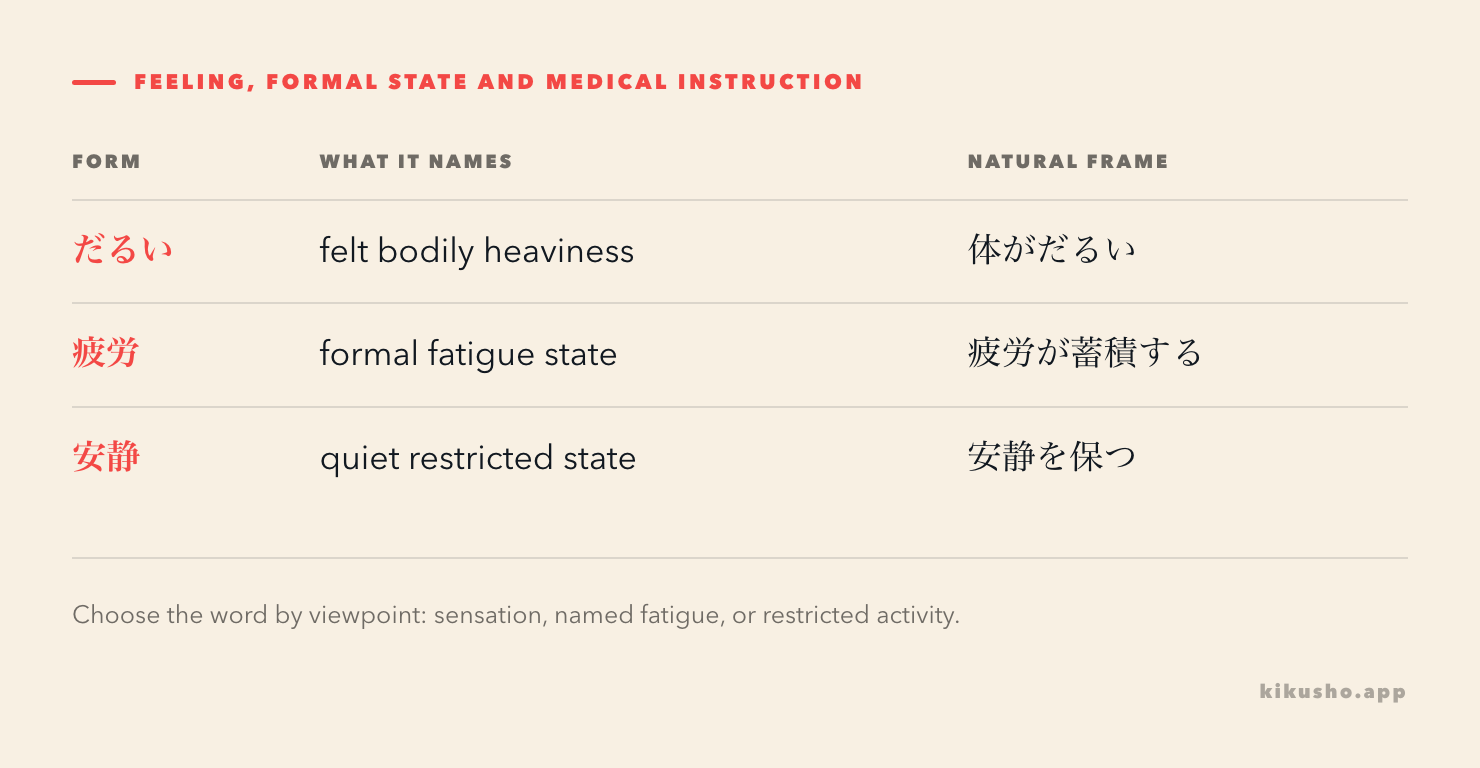
疲労(ひろう) names physical or mental fatigue in a more formal register than everyday 疲れ(つかれ). It often appears in reports, workplace language and compounds.
| Form | Register and viewpoint | Common partner |
|---|---|---|
| だるい | subjective bodily feeling | 体がだるい |
| 疲れ | everyday noun for tiredness | 疲れが取れる |
| 疲労 | formal physical or mental fatigue | 疲労が蓄積する |
長時間の作業で、目の疲労を感じました。
ちょうじかんのさぎょうで、めのひろうをかんじました。
I felt eye fatigue after working for a long time.
疲労が蓄積すると、判断力も低下します。
ひろうがちくせきすると、はんだんりょくもていかします。
When fatigue accumulates, judgment also declines.
The 疲労 entry connects continued activity with reduced capacity and records physical, mental, industrial and material uses. Machinery and materials can also undergo 疲労, so the word is not restricted to a speaker's felt tiredness.
安静 restricts activity; 休養 restores strength more broadly
安静(あんせい) in health language means keeping the body quiet and avoiding exertion. It is common in instructions:
医師から、二日間は自宅で安静にするように言われました。
いしから、ふつかかんはじたくであんせいにするようにいわれました。
The doctor told me to remain at rest at home for two days.
Useful patterns are 安静にする, 安静を保つ and 絶対安静. Kanjipedia defines 安静 as resting the body and lying still for treatment.
休養(きゅうよう) is broader recuperative rest. A person can spend a quiet weekend restoring physical and mental strength without being under an instruction to keep still.
| Instruction or purpose | Better fit |
|---|---|
| avoid movement after a procedure | 安静にする |
| maintain a quiet physical state | 安静を保つ |
| take several days to regain strength | 休養をとる |
| devote a holiday to recuperation | 休養に充てる |
The distinction is about focus, not a guaranteed duration. 安静 foregrounds stillness and restriction; 休養 foregrounds recovery through rest.
One report uses all eight assigned records
感染症と診断された患者は、下痢が続き、全身がだるいと訴えていました。前日に転倒したため足首も腫れていましたが、検査の結果、外傷は軽傷でした。疲労も蓄積していたため、医師はしばらく安静を保つよう指示しました。説明を聞いた患者は、安心したようにため息をつきました。
かんせんしょうとしんだんされたかんじゃは、げりがつづき、ぜんしんがだるいとうったえていました。ぜんじつにてんとうしたためあしくびもはれていましたが、けんさのけっか、がいしょうはけいしょうでした。ひろうもちくせきしていたため、いしはしばらくあんせいをたもつようしじしました。せつめいをきいたかんじゃは、あんしんしたようにためいきをつきました。
The patient, who had been diagnosed with an infectious disease, reported continuing diarrhoea and whole-body sluggishness. The ankle was also swollen after a fall the previous day, but the examination showed that the external injury was minor. Because fatigue had also accumulated, the doctor instructed the patient to remain at rest for a while. After hearing the explanation, the patient appeared relieved and sighed.
Here 傷(しょう) is visible inside 外傷 and 軽傷, while 吐く(つく) appears through ため息をつく. The passage never forces either marked reading into an unnatural standalone form.
N1 practice: readings, register and contextual precision
1 · Reading an injury report. How is 軽傷 read?
A. けいきず
B. けしょう
C. かるしょう
D. けいしょう
2 · Selecting the fixed reading. In 彼はため息を吐いた, which reading matches the fixed expression intended here?
A. はいた
B. ついた
C. といた
D. ふいた
3 · Keeping a patient still. Complete: 処置のあとは、しばらく__を保ってください。
A. 感染
B. 下痢
C. 安静
D. 疲労
4 · Locating the viewpoint. Which sentence focuses on a pathogen entering a host?
A. 笑いが教室中に伝染した。
B. 患者がウイルスに感染した。
C. 疲労が職場に伝染した。
D. 安静が患者に感染した。
5 · Choosing the physical condition. Complete: 昨夜から__が続き、何度もトイレに行きました。
A. 下痢
B. 外傷
C. 安静
D. 一息
6 · Matching subject and verb. Which sentence naturally describes swelling without naming an agent who caused it?
A. 足首が腫れました。
B. 足首を腫れました。
C. 足首が晴らしました。
D. 足首を腫れるでした。
7 · Distinguishing feeling from formal state. A speaker says 全身がだるい. Which paraphrase is closest?
A. The speaker's whole body feels heavy and sluggish.
B. The speaker has sustained a serious injury.
C. The speaker is transmitting an infection.
D. The speaker has been ordered to remain completely still.
8 · Recognising formal fatigue language. Which sentence uses 疲労 naturally?
A. 疲労を吐いて休みました。
B. 長時間の作業で疲労が蓄積しました。
C. 足首が疲労に腫れました。
D. 疲労にウイルスを感染しました。
9 · Controlling the reading of one kanji. Which pairing is accurate?
A. 傷がある(しょう)/軽傷(けいきず)
B. 傷がある(きず)/軽傷(けいしょう)
C. 傷がある(しょう)/軽傷(けいしょう)
D. 傷がある(きず)/軽傷(けいきず)
10 · Reading the connected report. Read: 検査では外傷は軽傷だと分かりましたが、疲労が蓄積していたため、医師は安静を保つよう指示しました。 Which statement is supported?
A. The examination found a serious injury, so the patient was told to exercise.
B. No injury existed, and the fatigue had disappeared.
C. The injury was minor, but accumulated fatigue led to an instruction to remain at rest.
D. An infection spread because the patient sighed.
Answers and explanations
1 · D, けいしょう. 傷 takes its on-reading しょう inside 軽傷. Reading the final kanji as きず would treat the compound as though it were the standalone noun.
2 · B, ついた. ため息をつく is a fixed expression meaning to sigh. The same spelling can represent はく elsewhere, but the collocation selects つく here.
3 · C, 安静. 安静を保つ means to maintain a quiet bodily state and avoid exertion. The other nouns do not name the instructed state.
4 · B. The host 患者 is the subject, and ウイルス marked by に is what enters the host. A is a valid figurative use of 伝染, but it focuses on laughter spreading between people.
5 · A, 下痢. Continued diarrhoea explains repeated trips to the toilet. The remaining choices name an injury, a state of rest and a breather.
6 · A. 腫れる is intransitive, so 足首 is the subject marked by が. B incorrectly treats it as transitive; C changes the kanji and verb to weather clearing or making something clear; D combines an object marker with an ungrammatical ending.
7 · A. だるい describes the felt heaviness or sluggishness of the body. It does not itself assert a diagnosis, infection or instruction.
8 · B. 疲労 can accumulate after prolonged activity. The other options combine it with particles and verbs that do not express a natural relationship.
9 · B. The standalone noun is 傷(きず), while the compound 軽傷 uses しょう. The distractors assign the two readings to the wrong structural positions.
10 · C. 軽傷 states that the injury was minor. The conjunction が preserves a second concern: fatigue had accumulated, so the doctor instructed the patient to maintain rest.
Save the two marked records as phrase-level cards: 軽傷(けいしょう) and ため息をつく. For the remaining six, keep the particle or grammatical frame visible: 安静にする, ウイルスに感染する, 下痢が続く, 体がだるい, 足首が腫れる and 疲労が蓄積する.
Kikusho's reference inventory places these exact records at N1, but that label needs qualification. The source files share one Waller/Tanos family; other materials place the common readings 傷(きず) and 吐く(はく) at N3. The N1 scope here is the harder reading control, formal compounds and contextual distinctions. As with every modern JLPT vocabulary map, it is a study placement rather than an official exhaustive syllabus.
Common questions
Is 傷 read きず or しょう?
The ordinary standalone noun 傷 is read きず. The on-reading しょう appears inside compounds such as 外傷, 軽傷, 重傷, 負傷 and 損傷. An inventory row written 傷(しょう) is therefore best learned as a compound-building reading, not as the usual pronunciation of the standalone noun.
When is 吐く read つく instead of はく?
はく is the productive reading for expelling breath, stomach contents or words. The reading つく survives mainly in fixed expressions, usually written in kana, such as ため息をつく, 一息つく, うそをつく and 悪態をつく. The surrounding noun determines the expression.
What is the difference between 安静 and 休養?
安静 focuses on keeping the body still and avoiding exertion, often under a medical instruction. 休養 is broader recuperative rest intended to restore physical or mental strength. Use 安静にする and 休養をとる.
How are だるい and 疲労 different?
だるい is an i-adjective for the subjective feeling that the body or a body part is heavy and hard to move. 疲労 is the more formal noun for accumulated physical or mental fatigue and appears in compounds such as 疲労回復 and 眼精疲労.