On this page
These ten N2 Japanese body, senses and physical movement vocabulary records help you describe what a body part is, what a person deliberately moves and what changes position by itself. Learn the particle with the action: 体が傾く but 膝を曲げる, and 声を聞いて振り向く rather than an isolated English gloss.
The set also crosses register and abstraction. 皮膚 is anatomical skin, 姿勢 can be physical posture or a figurative stance, and 振り向く can move from turning the body to directing one's attention.
The 10 records and a phrase for each one
| Assigned form | Reading | Role | Core meaning | Phrase to retain |
|---|---|---|---|---|
| うなずく | うなずく, unazuku | intransitive godan verb | nod | 説明を聞いてうなずく: nod while listening to an explanation |
| 傾く | かたむく, katamuku | intransitive godan verb | tilt; lean; incline toward; decline | 体が右に傾く: the body tilts to the right |
| 唇 | くちびる, kuchibiru | noun | lip; lips | 唇をかむ: bite one's lip |
| 姿勢 | しせい, shisei | noun | posture; attitude or stance | 姿勢を正す: straighten one's posture |
| しゃがむ | しゃがむ, shagamu | intransitive godan verb | squat; crouch | その場にしゃがむ: squat down on the spot |
| 爪 | つめ, tsume | noun | fingernail; toenail; claw | 爪を切る: cut one's nails |
| 肘 | ひじ, hiji | noun | elbow | 肘を曲げる: bend the elbow |
| 皮膚 | ひふ, hifu | noun | skin as an organ or tissue | 皮膚を保護する: protect the skin |
| 振り向く | ふりむく, furimuku | intransitive godan verb | turn around; direct attention toward | 声を聞いて振り向く: turn around on hearing a voice |
| 曲げる | まげる, mageru | transitive ichidan verb | bend; alter or distort | 膝を曲げる: bend the knee |
Official Japanese care-work materials label 唇, 爪 and other body parts and teach 肘 and 姿勢 in practical movement contexts. Broad N2 study lists independently include しゃがむ, 振り向く and 曲げる. These sources support the readings and uses in the lesson; they do not form an official JLPT vocabulary list.
The N3 body and movement lesson supplies earlier words such as 膝, 感覚 and 伸ばす/伸びる. This N2 set asks you to control viewpoint, transitivity, register and figurative extensions.
しゃがむ, 傾く and 曲げる show three kinds of movement
The three verbs can occur in one action, but their grammar describes different parts of it.
しゃがむ presents the whole person lowering the body by bending the knees and hips. The place where the action happens can take に.
子どもと話すために、その場にしゃがみました。
こどもとはなすために、そのばにしゃがみました。
I squatted down there to talk with the child.
傾く is intransitive. The thing that loses a level or upright position takes が. Buildings, heads, bodies and scales can all be the subject.
重い荷物のせいで、体が左に傾いています。
おもいにもつのせいで、からだがひだりにかたむいています。
The heavy luggage is making my body lean to the left.
曲げる is transitive. Someone actively changes the shape or direction of the object marked by を.
背中をまっすぐにして、両膝をゆっくり曲げてください。
せなかをまっすぐにして、りょうひざをゆっくりまげてください。
Keep your back straight and slowly bend both knees.
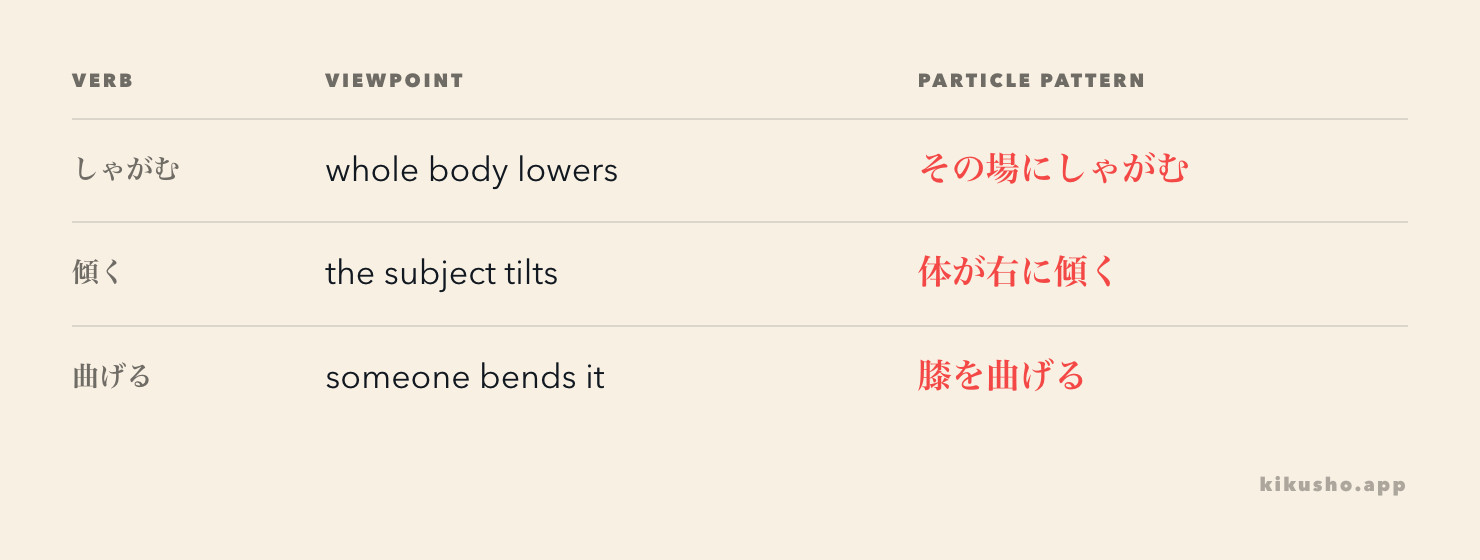
The intransitive partner of 曲げる is 曲がる: 肘を曲げる means that a person bends the elbow, while 肘が曲がる describes the elbow becoming or being bent. The transitive partner of 傾く is 傾ける, as in 首を傾ける, tilt one's head.
Do not reduce しゃがむ and かがむ to one English word. The dictionary definition of しゃがむ foregrounds bending the knees and lowering the hips. かがむ foregrounds bending or lowering the torso.
低い枝の下でかがみ、落ちた鍵を拾うためにしゃがみました。
ひくいえだのしたでかがみ、おちたかぎをひろうためにしゃがみました。
I ducked under the low branch and squatted down to pick up the fallen key.
うなずく and 振り向く move the head for different reasons
うなずく is a small vertical movement of the head that commonly signals understanding, agreement or acknowledgement. The word is normally written in kana in contemporary prose, although the kanji spelling 頷く also exists.
医師の説明を聞き、患者は静かにうなずきました。
いしのせつめいをきき、かんじゃはしずかにうなずきました。
The patient listened to the doctor's explanation and nodded quietly.
A nod may accompany あいづち, but the terms are not synonyms. うなずく describes visible movement. あいづち names listener responses such as はい, ええ and そうですね that signal attention and help a conversation continue.
振り向く means turning the face or body toward something, often behind the person. A trigger can be marked by に, or the action can follow a cause with て.
名前を呼ばれて、彼女はすぐに振り向きました。
なまえをよばれて、かのじょはすぐにふりむきました。
When her name was called, she immediately turned around.
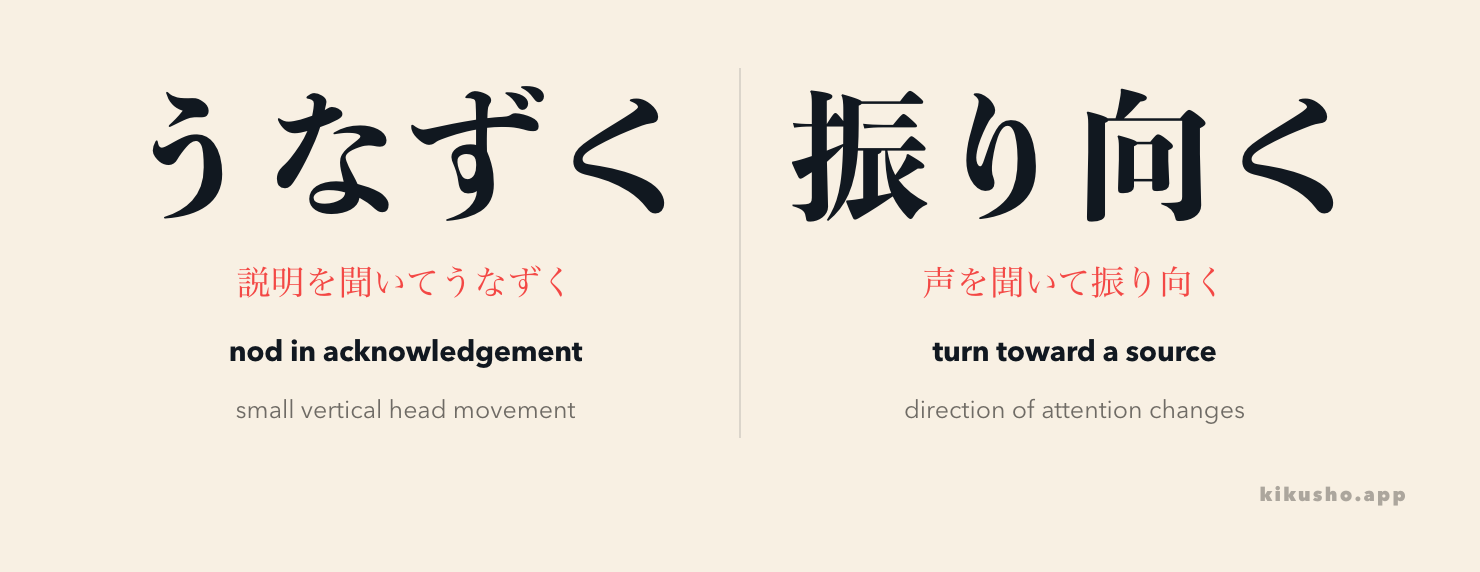
振り向く also extends to attention or interest. In 便利でも誰も振り向かない商品, nobody “turns toward” the product: it fails to attract attention. The physical image remains visible inside the figurative use.
姿勢 can be physical or figurative
姿勢(しせい) first describes the way someone holds the body. Common combinations include 姿勢がいい, 姿勢が悪い, 姿勢を正す and 楽な姿勢を取る.
長時間同じ姿勢でいると、首が痛くなることがあります。
ちょうじかんおなじしせいでいると、くびがいたくなることがあります。
Staying in the same posture for a long time can make your neck hurt.
The same noun expresses a stance, attitude or manner of approaching a matter. Nothing about the body needs to change in this use.
会社は利用者の意見を聞く姿勢を示しました。
かいしゃはりようしゃのいけんをきくしせいをしめしました。
The company showed a willingness to listen to users' opinions.
Read the following noun and verb before choosing a translation. 座る姿勢 is bodily posture; 学ぶ姿勢 is an attitude toward learning. The 姿勢 dictionary entry records both uses.
唇, 爪 and 肘 become easier through collocations
唇(くちびる) names one or both lips. Japanese normally leaves number to context, so English may require “lip” or “lips.” 唇をかむ is literal, but it can suggest frustration or an effort to endure emotion.
悔しそうに唇をかみました。
くやしそうにくちびるをかみました。
She bit her lip in frustration.
爪(つめ) names a fingernail or toenail and also the claw or talon of an animal. Context supplies the body or creature: 手の爪, 足の爪, 猫の爪.
料理の前に、爪を短く切っておきます。
りょうりのまえに、つめをみじかくきっておきます。
I trim my nails before cooking.
肘(ひじ) is the elbow. It pairs naturally with 曲げる, 伸ばす, つく and ぶつける.
机に肘をつかないでください。
つくえにひじをつかないでください。
Please do not rest your elbows on the desk.
The body-part compounds lesson shows how body nouns also build figurative expressions. First secure the literal body part and a normal verb; then learn extensions as complete phrases.
皮膚 is anatomical skin; 肌 is the everyday surface
皮膚(ひふ) is the neutral anatomical term for the body's outer organ. It is common in medicine, care, biology and formal explanations: 皮膚科, dermatology; 皮膚を保護する, protect the skin; 皮膚に炎症が起きる, inflammation develops in the skin.
この薬を傷のある皮膚に塗らないでください。
このくすりをきずのあるひふにぬらないでください。
Do not apply this medicine to injured skin.
肌(はだ) is more usual for skin as it looks or feels in everyday life. It appears in 肌が乾燥する, 肌がきれいだ and 肌に合う. Its meaning also reaches the surface of an object, the feel of a place or personal compatibility.
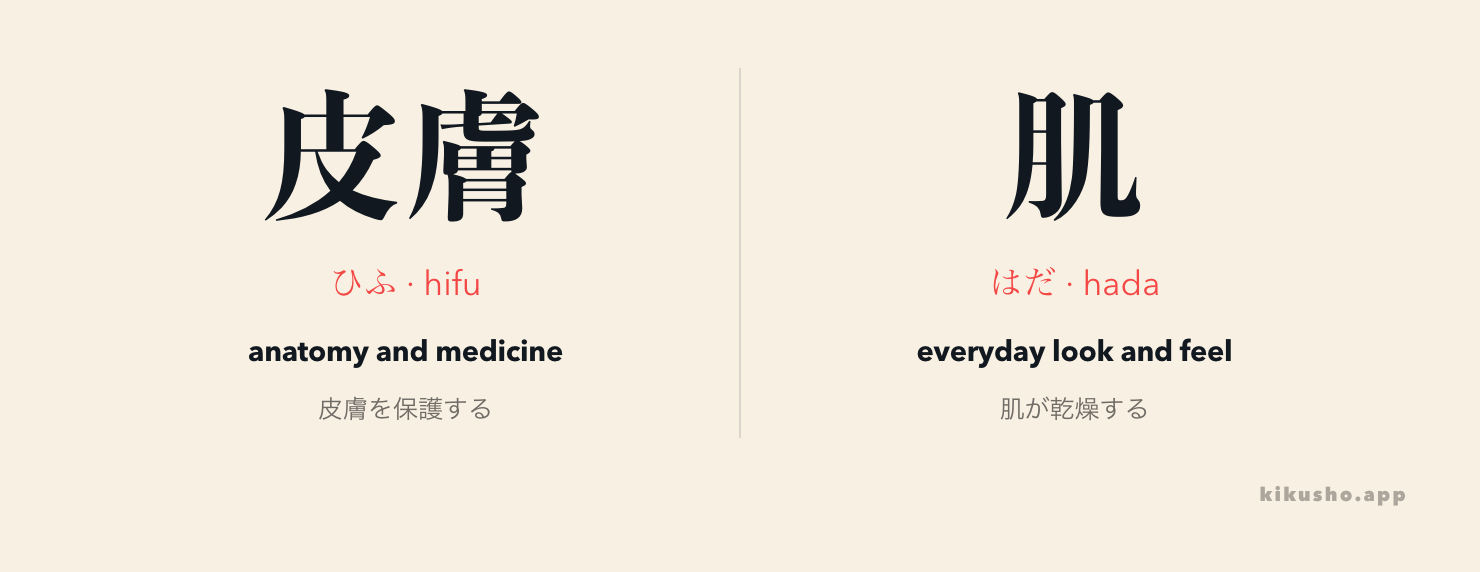
The distinction is one of register and viewpoint rather than two separate layers of the body. A doctor may examine 皮膚, while the same person says 肌がかゆい at home. The 皮膚 definition treats it as the body's outer organ, while the 肌 entry also covers surface, texture and disposition.
傾く, 曲げる and 振り向く also leave the body
Physical movement supplies productive figurative meanings.
| Physical image | Figurative extension | Example |
|---|---|---|
| 傾く: move away from level | incline toward an opinion; decline | 気持ちが賛成に傾く: become inclined to agree |
| 曲げる: change a straight shape | distort or change a principle | 自分の意見を曲げない: not change one's opinion |
| 振り向く: turn toward a source | pay attention or show interest | 若者が振り向く広告: an advert that attracts young people |
経営が傾く goes further: the management or business weakens. Context decides whether the subject is physically slanted, mentally inclined or declining.
One rehabilitation scene connects all 10 records
理学療法士は患者の姿勢を確認し、体が右に傾いていると説明しました。患者はうなずき、名前を呼ばれて振り向きました。次にその場にしゃがみ、膝と肘をゆっくり曲げました。立ち上がるとき、痛みで唇をかみましたが、爪や皮膚に異常はありませんでした。
りがくりょうほうしはかんじゃのしせいをかくにんし、からだがみぎにかたむいているとせつめいしました。かんじゃはうなずき、なまえをよばれてふりむきました。つぎにそのばにしゃがみ、ひざとひじをゆっくりまげました。たちあがるとき、いたみでくちびるをかみましたが、つめやひふにいじょうはありませんでした。
The physical therapist checked the patient's posture and explained that the body was leaning to the right. The patient nodded and turned when their name was called. Next, they squatted down and slowly bent their knees and elbows. They bit their lip from the pain while standing up, but there were no abnormalities in the nails or skin.
N2 practice: reading, formation, context and usage
1 · Kanji reading. How is 傾く read in 体が右に傾く?
ア. かたむく
イ. かがむ
ウ. うつむく
エ. かたよる
2 · Orthography. Which kanji writes ひじ, “elbow”?
ア. 膝
イ. 肘
ウ. 爪
エ. 唇
3 · Word formation. Which word means “dermatology,” the medical department for skin?
ア. 姿勢科
イ. 爪科
ウ. 皮膚科
エ. 肘科
4 · Context. Complete: 落とした鍵を拾うために、その場に__。
ア. うなずいた
イ. しゃがんだ
ウ. 振り向いた
エ. 傾いた
5 · Grammar and viewpoint. Which sentence naturally means “The body is leaning to the left”?
ア. 体を左に傾いています。
イ. 体が左に曲げています。
ウ. 体が左に傾いています。
エ. 体を左にしゃがんでいます。
6 · Paraphrase. What does 会社は意見を聞く姿勢を示した mean here?
ア. The company demonstrated good sitting posture.
イ. The company showed an attitude of listening to opinions.
ウ. The company tilted toward a chair.
エ. The company turned around when called.
7 · Usage. Which sentence is natural?
ア. 医師の説明を聞いてうなずいた。
イ. 爪をうなずいた。
ウ. 皮膚が意見を曲げた。
エ. 唇にしゃがんだ。
8 · Register. A medical instruction refers to skin as an organ. Which word fits best?
ア. 肌
イ. 姿勢
ウ. 皮膚
エ. 唇
9 · Literal or figurative meaning. What does 振り向く mean in 新しい広告なのに、誰も振り向かなかった?
ア. Nobody bent the advertisement.
イ. Nobody paid attention to it.
ウ. Nobody nodded in agreement.
エ. Nobody crouched beside it.
10 · Particle control. Complete: 椅子に座る前に、膝__曲げてください。
ア. が
イ. に
ウ. で
エ. を
Answers and explanations
1 · ア, かたむく. 傾く is read かたむく. It describes the subject tilting or leaning, so 体 takes が.
2 · イ, 肘. 肘 is ひじ, the elbow. 膝 is the knee, 爪 a nail or claw, and 唇 the lips.
3 · ウ, 皮膚科. 皮膚 combines with 科, a medical department, to form 皮膚科, dermatology. This formal compound matches the anatomical register of 皮膚.
4 · イ, しゃがんだ. Picking something up from the ground naturally motivates lowering the whole body by bending the knees and hips. しゃがむ becomes しゃがんだ in the past tense.
5 · ウ. 傾く is intransitive, so the body that leans is marked by が. To present a person deliberately tilting the body, use the transitive 傾ける: 体を左に傾けています.
6 · イ. 姿勢 is figurative here. 意見を聞く姿勢 means a stance or willingness to listen, not a visible way of holding the body.
7 · ア. Explanation plus a nod forms a natural cause and response. The other choices combine body nouns and actions in ways their meanings and particles do not permit.
8 · ウ, 皮膚. 皮膚 is the standard anatomical or medical term. 肌 is more conversational when describing appearance, touch or everyday condition.
9 · イ. 振り向く extends from physically turning toward something to directing attention or interest toward it. The advertisement attracted no attention.
10 · エ, を. 曲げる is transitive. The person bends 膝, so the body part is the object marked by を.
Retain the words as small systems: 体が傾く/体を傾ける, 膝を曲げる/膝が曲がる, and しゃがむ/かがむ. Add the register pair 皮膚/肌, then attach 唇, 爪 and 肘 to one natural action each. The N1 body, senses and movement lesson adds the literary reading 傾く(かたぶく), 感触 and 骨(こつ).
All ten spelling-and-reading records occupy the N2 tier in Kikusho's September 2026 inventory, with no disagreement between its two source files. Treat that tier as a study-guide placement: the JLPT organisers stopped issuing an exhaustive public vocabulary specification. The readings, particles and register choices tested above remain useful even if another deck files one word elsewhere.
Common questions
What is the difference between 傾く and 曲げる?
傾く is intransitive: a subject tilts or leans, as in 体が右に傾く. 曲げる is transitive: an actor bends a body part or object, as in 膝を曲げる. The matching intransitive verb for 曲げる is 曲がる.
What is the difference between しゃがむ and かがむ?
しゃがむ lowers the whole body by bending the knees and hips, like squatting beside a child. かがむ foregrounds bending the upper body forward or lowering the torso, like ducking under a low doorway.
What is the difference between 皮膚 and 肌?
皮膚 is the neutral anatomical or medical term for skin as an organ or tissue. 肌 is more common in everyday descriptions of appearance, touch, dryness and texture, and it also has broader figurative uses.
Can 姿勢 mean attitude as well as posture?
Yes. 姿勢 names physical posture in 姿勢を正す, but it also names a stance or attitude toward an issue in 問題に取り組む姿勢.
Is うなずく the same as giving あいづち?
No. うなずく is the visible action of nodding. あいづち are listener responses that keep a conversation moving; they may include words such as はい or そうですね, and a nod can accompany them.