On this page
These eleven N1 Japanese medical care, emergency and welfare words describe a chain rather than one room: prevention, immediate response, clinical care and longer-term support. The important work lies in the boundaries between them, especially 介護/看護, 応急/救済, 手当/手当て and the homophones 保険/保健.
Eleven N1 words divide prevention, response and support
| Word | Reading | Word class | Meaning here | Phrase to remember |
|---|---|---|---|---|
| 衛生 | えいせい, eisei | noun | hygiene; sanitation; public health | 衛生管理を徹底する: enforce thorough hygiene management |
| 応急 | おうきゅう, ōkyū | noun; no-adjective | temporary action for an urgent situation | 応急処置を行う: provide emergency treatment |
| 介護 | かいご, kaigo | noun; transitive suru verb | continuing assistance with daily life | 高齢の父を介護する: care for one's elderly father |
| 看護 | かんご, kango | noun; transitive suru verb | nursing; health and treatment support | 患者の看護に当たる: provide nursing care for patients |
| 救済 | きゅうさい, kyūsai | noun; transitive suru verb | relief; rescue from hardship; remedy | 被災者を救済する: provide relief to disaster victims |
| 診療 | しんりょう, shinryō | noun; suru verb | medical examination and treatment | 診療を受ける: receive medical care |
| 手当 | てあて, teate | noun | allowance; payment in addition to basic pay | 住宅手当を支給する: provide a housing allowance |
| 手当て | てあて, teate | noun; suru verb | treatment; practical care or provision | 傷の手当てをする: tend to a wound |
| 福祉 | ふくし, fukushi | noun | welfare; services that support well-being | 福祉サービスを利用する: use welfare services |
| 保険 | ほけん, hoken | noun | insurance | 保険に加入する: enrol in insurance |
| 麻酔 | ますい, masui | noun; suru verb | anaesthesia | 麻酔を受ける: receive anaesthesia |
Several long vowels disappear in fast speech but remain part of the word: 応急(おうきゅう), 救済(きゅうさい) and 診療(しんりょう). 麻酔 begins with ま, not ませい, and both spellings of てあて have the same pronunciation.
Current study resources place much of this group at N1, including 介護 on Bunpro and a broad N1 medical vocabulary set. The official JLPT does not publish an exhaustive vocabulary list, so N1 is an editorial study placement, not a promise that every item appears on a given test.
The N1 illness, symptoms and recovery lesson describes conditions such as 不調, 発作 and 衰弱. This lesson follows what institutions and carers do in response.
衛生 prevents harm; 応急 buys time in an urgent situation
衛生(えいせい) covers the conditions and practices that protect health and prevent disease. It is wider than simply being visibly clean. 食品衛生, 公衆衛生, 労働衛生 and 衛生管理 extend the word across food, communities and workplaces.
避難所では、飲み水の安全と衛生管理が重要です。
ひなんじょでは、のみみずのあんぜんとえいせいかんりがじゅうようです。
Safe drinking water and hygiene management are important at an evacuation centre.
The health ministry's multilingual glossary describes 公衆衛生 through healthy living environments and infection prevention. 清潔(せいけつ) can describe something as clean; 衛生 frames cleanliness and other measures as protection of health.
応急(おうきゅう) marks a measure taken for the immediate situation. The dictionary definition centres on doing what is necessary for the moment, so the word is not limited to medicine:
- 応急処置: emergency treatment; an immediate measure
- 応急手当: first aid
- 応急措置: emergency or temporary measure
- 応急修理: temporary repair
駅員が応急手当を行い、救急隊に引き継ぎました。
えきいんがおうきゅうてあてをおこない、きゅうきゅうたいにひきつぎました。
A station employee provided first aid and handed the person over to the ambulance crew.
The Tokyo Fire Department defines 応急手当 as temporary care before an ambulance arrives or a doctor examines the person. Linguistically, 応急 signals an urgent bridge to the next stage; it does not claim that the underlying problem is resolved.
介護, 看護 and 診療 assign different responsibilities
The three words can all appear around one patient, but their centre of gravity differs.
介護(かいご) supports daily living when age, disability or illness makes independent life difficult. Eating, bathing, dressing, moving and household tasks are common parts of the frame.
祖母は自宅で介護サービスを受けています。
そぼはじたくでかいごサービスをうけています。
My grandmother receives care services at home.
看護(かんご) is nursing: observing health, caring for a patient and supporting medical treatment. The health ministry distinguishes 介護 as help with daily activities and 看護 as care during recuperation plus assistance with medical treatment.
看護師が患者の状態を確認し、医師に報告しました。
かんごしがかんじゃのじょうたいをかくにんし、いしにほうこくしました。
The nurse checked the patient's condition and reported it to the physician.
診療(しんりょう) packages examination and treatment as a medical service. Its dictionary entry explicitly joins 診察 with 治療.
この診療所では、夜間も診療を行っています。
このしんりょうじょでは、やかんもしんりょうをおこなっています。
This clinic also provides medical care at night.
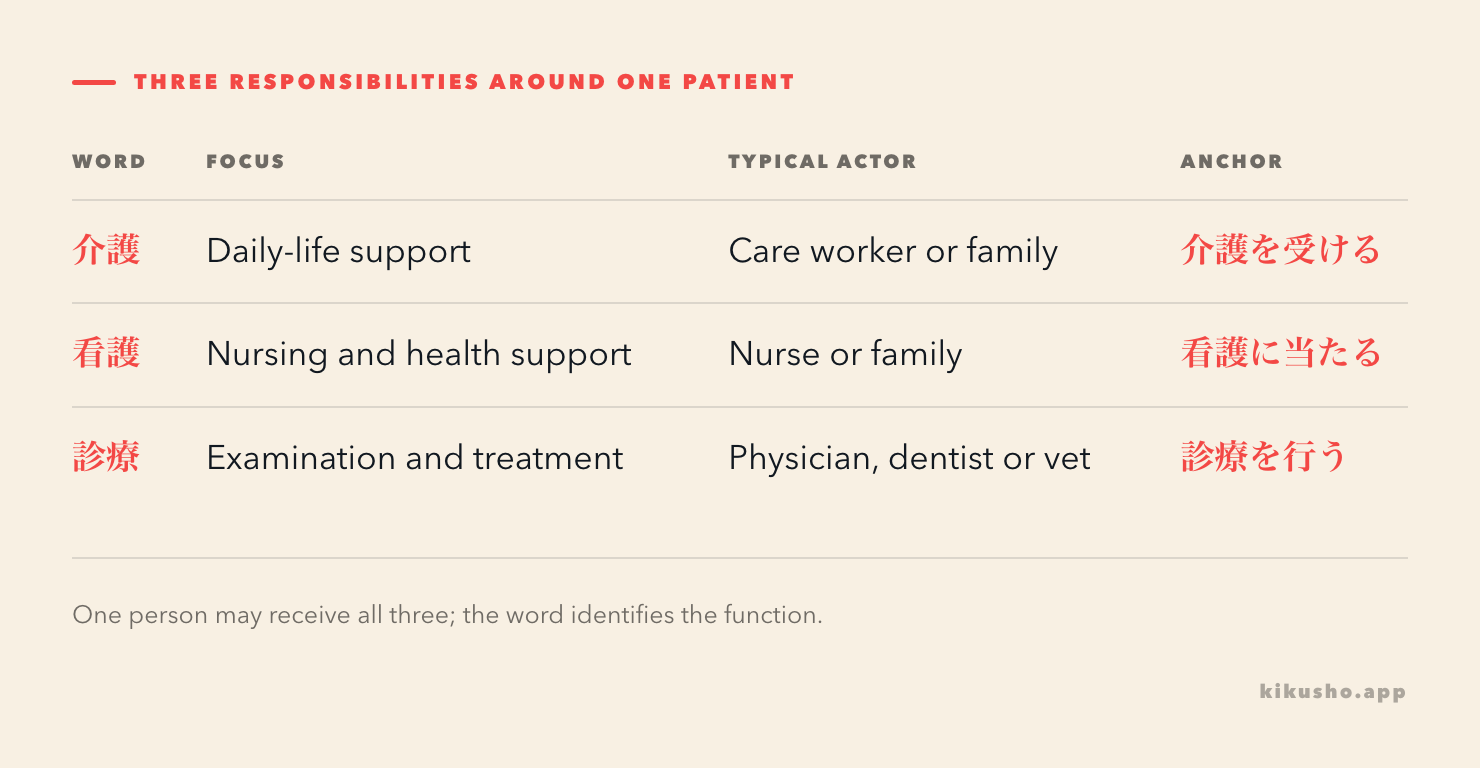
A person can receive all three. An older patient may use 介護 at home, receive 看護 from a visiting nurse and visit a clinic for 診療. The words distinguish the function being described, not three populations that never overlap.
手当 and 手当て share a reading but can signal different senses
Both 手当 and 手当て are read てあて. Dictionaries record a broad history of meanings under the word, including preparation, treatment, care and extra payment. Modern editorial practice often uses the spelling to make the intended sense visible:
| Spelling | Useful default | Examples |
|---|---|---|
| 手当 | a monetary allowance or benefit | 住宅手当, 通勤手当, 児童手当 |
| 手当て | treatment, practical action or provision | 傷の手当て, 応急手当て, 資金の手当て |
会社から通勤手当が支給されます。
かいしゃからつうきんてあてがしきゅうされます。
The company provides a commuting allowance.
看護師が傷の手当てをしました。
かんごしがきずのてあてをしました。
The nurse tended to the wound.
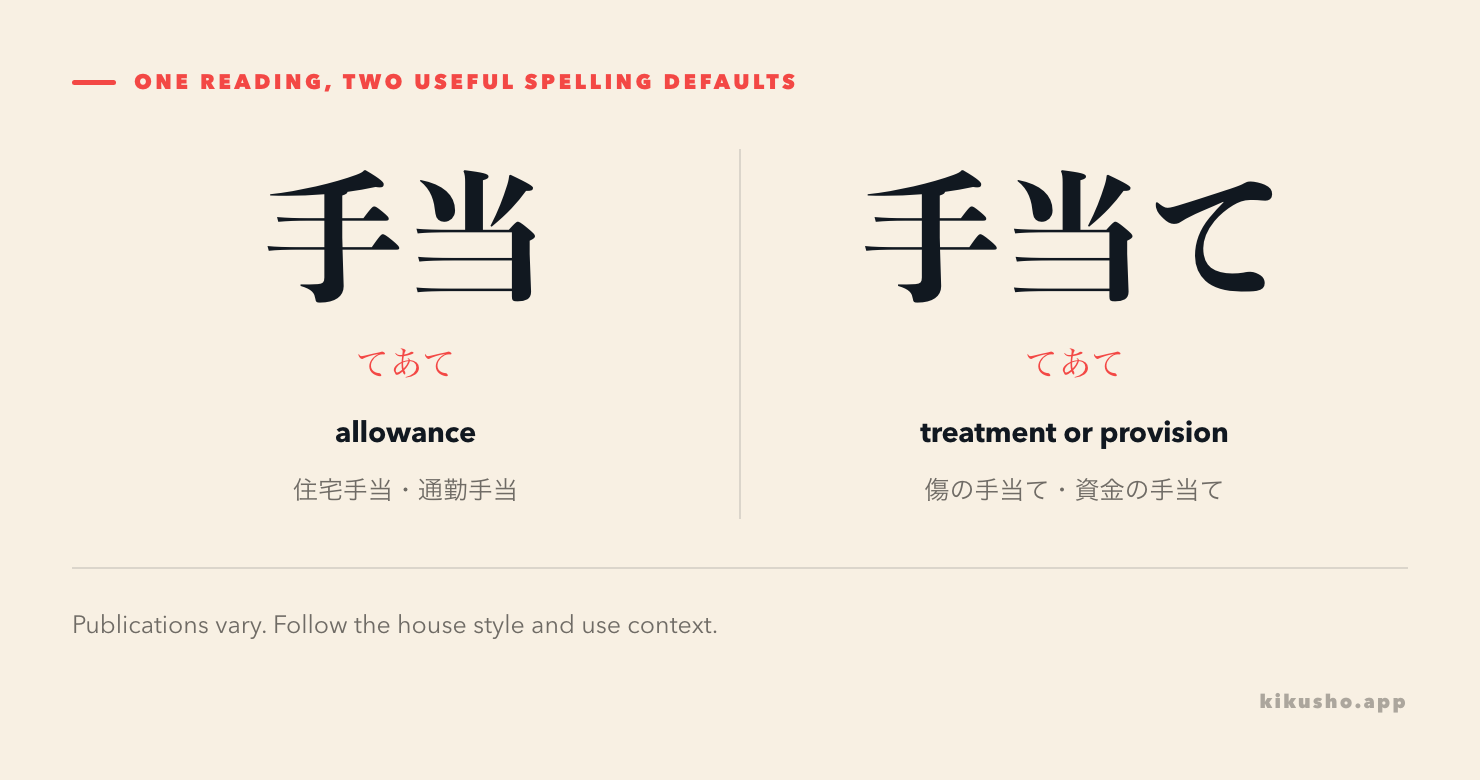
This is a reader-friendly convention rather than an absolute division in every publication. The dictionary entry for 手当 includes both medical treatment and extra wages, while the Mainichi proofreading guide writes monetary payments as 手当 and treatment or practical measures as 手当て. Follow the house style of the document you are reading, and use context when the spelling is 手当.
Established institutional names can preserve the shorter spelling: fire departments commonly write 応急手当, while editorial prose may use 応急手当て for the same first-aid sense. Treat the final て as a spelling choice here, not a change in pronunciation or meaning.
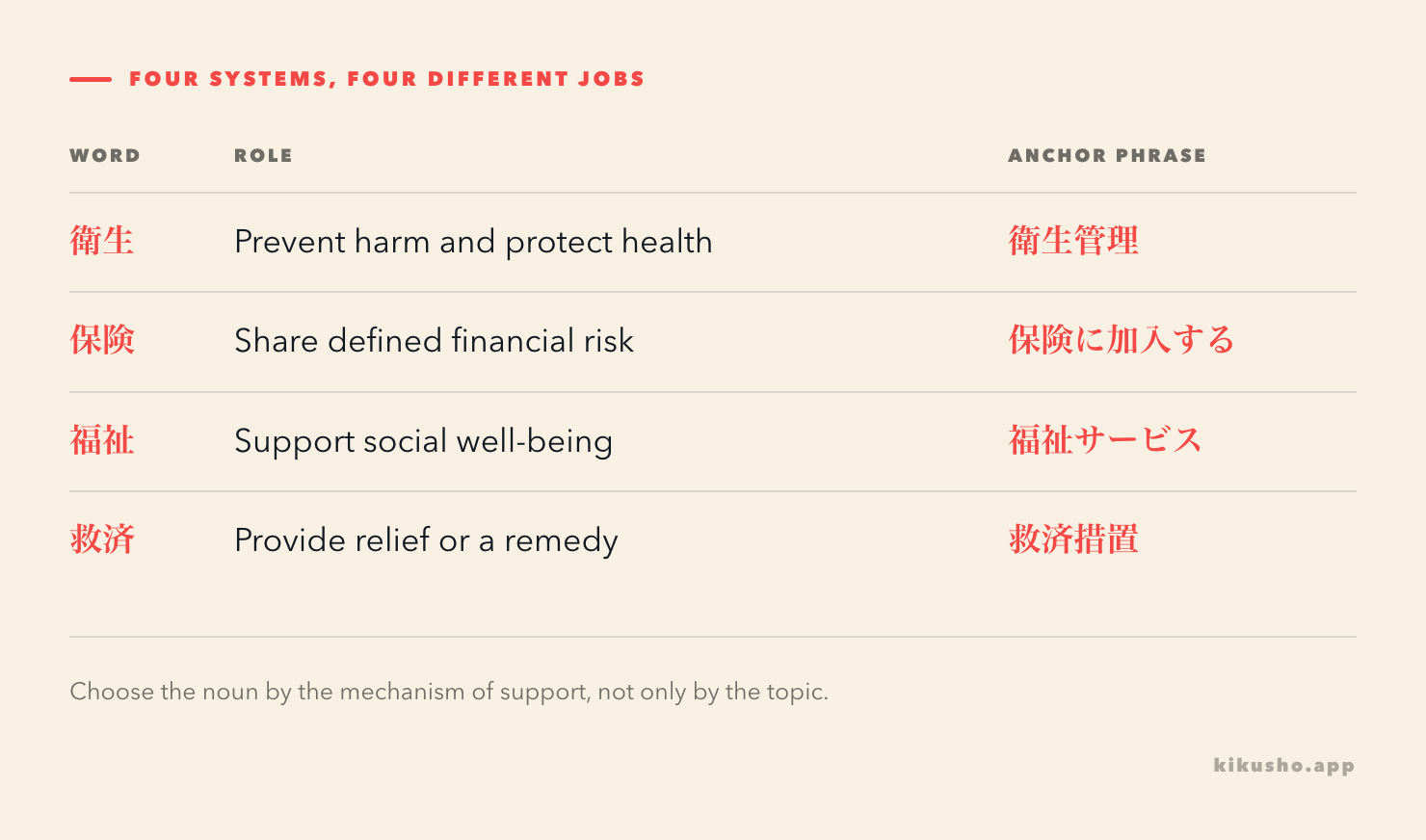
福祉, 保険 and 救済 describe three ways support is organised
福祉(ふくし) names well-being and the social services intended to support it. In modern institutional language, it often appears in 社会福祉, 児童福祉, 障害福祉 and 福祉施設.
市は高齢者向けの福祉サービスを拡充しました。
しはこうれいしゃむけのふくしサービスをかくじゅうしました。
The city expanded welfare services for older residents.
保険(ほけん) is insurance: people or organisations contribute money so that defined losses or needs can be covered. Natural partners include 保険に入る/加入する, 保険料を払う, 保険が適用される and 保険金を受け取る.
この治療には健康保険が適用されます。
このちりょうにはけんこうほけんがてきようされます。
Health insurance applies to this treatment.
Do not confuse 保険 with 保健(ほけん), which concerns preserving health. 健康保険 is insurance; 保健所 is a public health centre; 保健体育 is health and physical education.
救済(きゅうさい) is relief or rescue from hardship, damage or an unfair situation. Unlike 救助, which often brings someone physically out of danger, 救済 can operate through money, policy or law.
政府は被災した事業者への救済措置を発表しました。
せいふはひさいしたじぎょうしゃへのきゅうさいそちをはっぴょうしました。
The government announced relief measures for businesses affected by the disaster.
The dictionary entry includes helping people in distress and a religious sense of salvation. In public and legal prose, 被害者救済, 救済措置 and 法的救済 foreground a remedy or support system rather than a rescue operation at the scene.
麻酔 changes its verb with the viewpoint
麻酔(ますい) is anaesthesia. The noun stays the same while the verb shows who is describing the procedure:
| Viewpoint | Pattern | Meaning |
|---|---|---|
| clinician | 麻酔をかける | administer anaesthesia |
| patient | 麻酔を受ける | receive anaesthesia |
| effect | 麻酔が効く | the anaesthesia takes effect |
| recovery | 麻酔から覚める | emerge from anaesthesia |
手術の前に、麻酔科医から全身麻酔の説明を受けました。
しゅじゅつのまえに、ますいかいからぜんしんますいのせつめいをうけました。
Before surgery, I received an explanation of general anaesthesia from the anaesthesiologist.
The Japanese Society of Anesthesiologists explains that 全身麻酔 and regional forms of anaesthesia can be used separately or together. The vocabulary lesson does not choose a method; it prepares you to recognise 全身麻酔, 局所麻酔, 区域麻酔 and 麻酔科医 in explanations and consent materials.
One disaster response moves through all eleven words
豪雨で診療所が浸水したため、市は仮設の診療スペースを設けました。職員は衛生管理を徹底し、到着した人に応急手当てを行いました。看護師が患者の状態を確認し、医師が診療に当たりました。手術が必要な患者には、別の病院で麻酔をかけました。市は介護が必要な人を福祉施設へ移し、保険が適用されない損害についても救済措置を検討しました。避難所で働く職員には特別手当が支給されました。
ごううでしんりょうじょがしんすいしたため、しはかせつのしんりょうスペースをもうけました。しょくいんはえいせいかんりをてっていし、とうちゃくしたひとにおうきゅうてあてをおこないました。かんごしがかんじゃのじょうたいをかくにんし、いしがしんりょうにあたりました。しゅじゅつがひつようなかんじゃには、べつのびょういんでますいをかけました。しはかいごがひつようなひとをふくししせつへうつし、ほけんがてきようされないそんがいについてもきゅうさいそちをけんとうしました。ひなんじょではたらくしょくいんにはとくべつてあてがしきゅうされました。
Because the clinic flooded during heavy rain, the city set up a temporary treatment area. Staff enforced hygiene controls and provided first aid to arriving patients. Nurses checked their condition, and physicians examined and treated them. Patients who required surgery received anaesthesia at another hospital. The city moved people who needed daily-life care to a welfare facility and considered relief measures for damage not covered by insurance. Staff working at the evacuation centre received a special allowance.
The passage gives each word a job. 衛生 prevents secondary harm, 応急手当て covers the immediate gap, 看護 and 診療 separate nursing from the physician's examination and treatment, and 介護 continues after the acute response. 福祉, 保険 and 救済 then describe different institutional routes for support, while 特別手当 uses the monetary spelling.
Build each review card around a working phrase and its viewpoint. 衛生管理, 診療を受ける, 保険が適用される and 麻酔から覚める prepare you to produce the word in a real sentence.
Check each term in context, then reveal the key
1 · Reading check. Choose the reading used for 麻酔.
A. ませい
B. ますい
C. まさい
D. ますえ
2 · Reading check. Select the pronunciation of 診療 in 診療を受ける.
A. しんりょう
B. しんりゅう
C. しんろう
D. じんりょう
3 · Context. A service helps an older person bathe, dress and eat at home. Which word best describes it?
A. 看護
B. 介護
C. 診療
D. 麻酔
4 · Context. A damaged water pipe receives a temporary repair until replacement parts arrive. Which phrase fits?
A. 応急修理
B. 福祉修理
C. 診療修理
D. 保険修理
5 · Paraphrase. What does 被害者の救済措置 describe most directly?
A. a physical rescue team at the scene
B. measures that provide relief or remedy to victims
C. a nurse's observation of a patient
D. sanitation inspection of a building
6 · Usage. Which sentence uses 診療 naturally?
A. 医師が午前中に診療を行います。
B. 患者が医師を診療に加入します。
C. 診療が住宅手当を受け取ります。
D. 看護師を診療から覚めます。
7 · Usage. Following the editorial distinction taught here, which pair is written appropriately?
A. 住宅手当て・傷の手当
B. 住宅手当・傷の手当て
C. 住宅保健・傷の保険
D. 住宅救済・傷の福祉
8 · Context. Which sentence distinguishes the homophones 保険 and 保健 correctly?
A. 保健に加入して、保険所へ行く。
B. 健康保険に加入し、相談のため保健所へ行く。
C. 保険体育の授業で、保健料を払う。
D. 保険所で生命保健を申し込む。
9 · Usage. Which sentence presents anaesthesia from the patient's viewpoint?
A. 患者が医師に麻酔を受けました。
B. 患者が手術の前に麻酔を受けました。
C. 患者が麻酔を診療しました。
D. 患者が麻酔に加入しました。
10 · Scenario chain. Complete this facility report with one coherent four-word set: 施設は__管理を徹底した。看護師が__に当たり、医師が__を行った。費用には健康__が適用された。
A. 衛生・看護・診療・保険
B. 保険・診療・介護・衛生
C. 救済・麻酔・福祉・応急
D. 介護・手当・衛生・救済
Commit to the complete four-word sequence before you reveal the explanations.
Answers and explanations
1 · B, ますい. 麻 is ま and 酔 is すい in this compound. The other choices alter one of the established readings.
2 · A, しんりょう. Both parts use on-readings, and りょう contains a long vowel. The phrase means to receive medical examination and treatment.
3 · B, 介護. Assistance with bathing, dressing and eating belongs to daily-life support. 看護 centres on nursing and health support, 診療 on medical examination plus treatment, and 麻酔 on anaesthesia.
4 · A, 応急修理. 応急 marks a temporary response to an urgent need. The repair makes the situation usable or safer while a lasting solution is still pending.
5 · B. 救済措置 is a measure that relieves hardship or provides a remedy. A physical operation that removes someone from immediate danger is more likely to be described with 救助.
6 · A. A physician can 診療を行う, and a patient can 診療を受ける. The other choices combine 診療 with participants or verbs that belong to insurance, allowances or anaesthesia.
7 · B. The editorial convention uses 手当 for the monetary housing allowance and 手当て for tending to a wound. Real publications vary, so context and house style remain decisive.
8 · B. 健康保険 is health insurance, while 保健所 is a public health centre. The shared reading ほけん does not make the kanji interchangeable.
9 · B. A patient receives anaesthesia with 麻酔を受ける. The clinician's viewpoint would use 麻酔をかける, while 診療する and 加入する belong to different semantic frames.
10 · A, 衛生・看護・診療・保険. A facility manages hygiene with 衛生管理. A nurse provides care with 看護に当たる, a physician provides examination and treatment with 診療を行う, and insurance coverage is expressed as 保険が適用される.
Common questions
What is the difference between 介護 and 看護?
介護(かいご) focuses on assistance with daily life for someone who needs continuing support. 看護(かんご) covers nursing care, health observation and assistance with medical treatment, especially in professional contexts.
What is the difference between 手当 and 手当て?
Both are read てあて and both spellings occur. A useful editorial convention writes monetary allowances as 手当, such as 住宅手当, and treatment or practical measures as 手当て, such as 傷の手当て.
What is the difference between 保険 and 保健?
Both are read ほけん. 保険 is insurance, a system for sharing financial risk. 保健 concerns protecting and improving health, as in 保健所 and 保健体育.
Which verb is used with 麻酔?
A clinician can 麻酔をかける, administer anaesthesia, while a patient can 麻酔を受ける. 麻酔が効く means it takes effect, and 麻酔から覚める is to emerge from anaesthesia.