On this page
This N1 vocabulary set is less about exotic food than about readings a basic menu lesson cannot predict. 甘い(うまい) can mean tasty, 生(き) means pure or undiluted, 酸っぱい(すっぱい) means sour, and 調理(ちょうり) focuses on food preparation.
These four words turn familiar characters into reading traps
Three of the four look easier than they are. A beginner already knows 甘い(あまい) as “sweet” and 生(なま) as “raw.” The advanced task is noticing when the same spelling asks for うまい or き instead. 調理 adds a usage boundary: it names the process and technique of preparing food more readily than the finished dish.
| Word | Reading | Class | Meaning taught here | Phrase to retain |
|---|---|---|---|---|
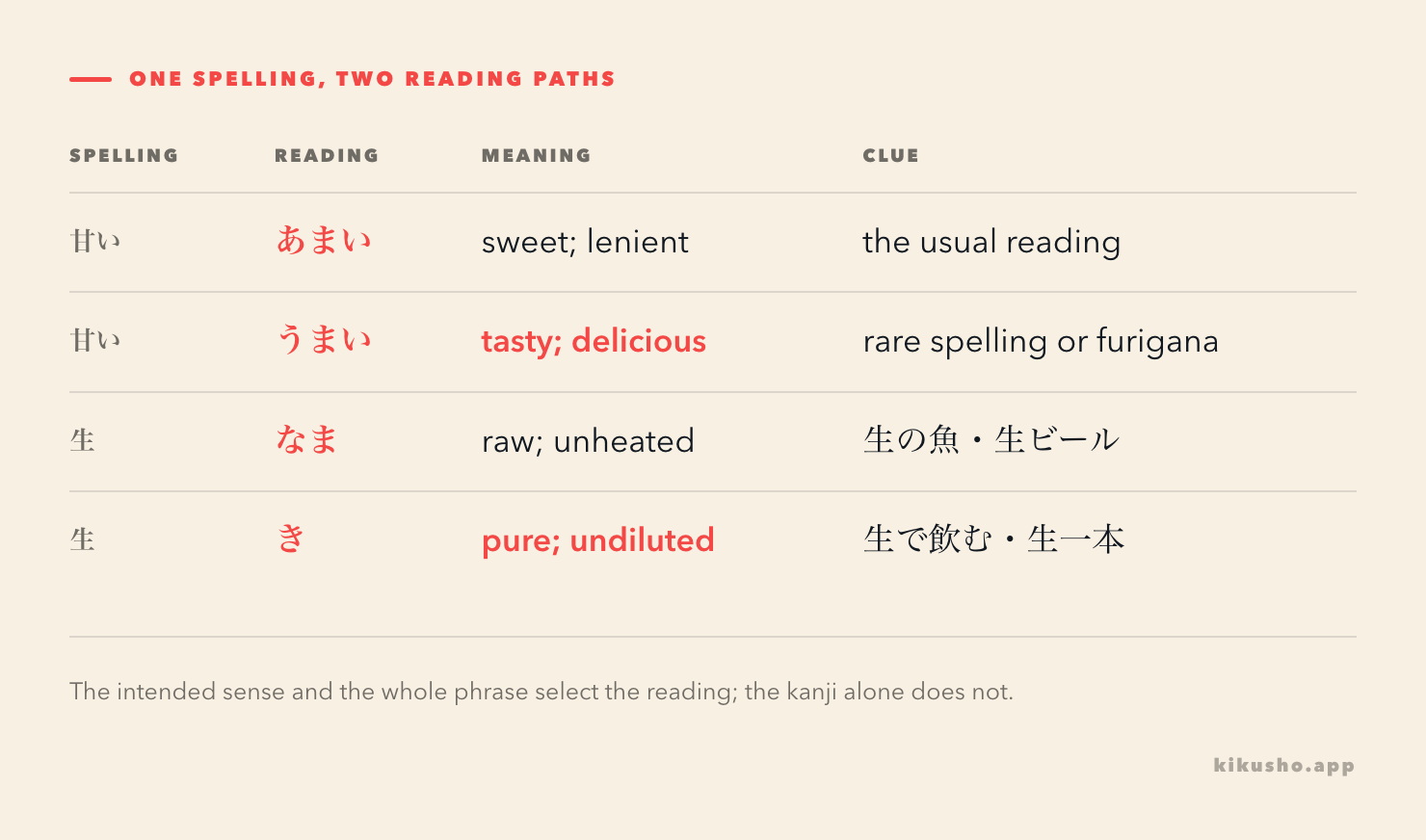
| 甘い | うまい | i-adjective | tasty; delicious, in a rare spelling | 甘(うま)い料理: tasty food |
| 生 | き | noun; prefix | pure, unmixed, undiluted | ウイスキーを生で飲む: drink whiskey neat |
| 酸っぱい | すっぱい | i-adjective | sour; acidic in taste | 酸っぱい果物: sour fruit |
| 調理 | ちょうり | noun; suru verb | cooking as food preparation | 魚を調理する: prepare or cook fish |
The level label needs care. Kikusho's September 2026 reference inventory places these exact spelling-and-reading rows at N1. Other resources disagree: Bunpro labels 生(き) and 調理 N1, 酸っぱい N2, and the wider うまい entry N5. The familiar 甘い(あまい) is taught from the beginner levels. The JLPT publishes no exhaustive official word list, so this page treats N1 as a study placement and teaches the precise reading and sense rather than claiming every appearance of these kanji is advanced.
甘い can hide うまい, but modern writing rarely makes you guess
When 甘い is read あまい, it means sweet, mild or lenient depending on context. That is the familiar word:
この果物は甘(あま)い。
この くだものは あまい。
This fruit is sweet.
Dictionaries also record 甘い as a spelling of うまい, “tasty” or “delicious.” In learning material, a reading aid makes the intended word visible:
見た目は地味だが、この煮物は甘(うま)い。
みためは じみだが、この にものは うまい。
It looks plain, but this simmered dish is delicious.
This spelling is rare. Digital Daijisen's うまい entry lists 甘い beside 旨い for the good-taste sense, and Kanjipedia's same-reading guide distinguishes 甘い(うまい) from 旨い while noting the risk of confusion with 甘い(あまい). In ordinary modern prose, expect うまい, 旨い or 美味い far more often.
That creates an asymmetric reading rule. When you see 甘い without furigana, あまい is the safe first reading. When a dictionary entry, literary text or exam prompt explicitly supplies うまい, keep the delicious sense and do not turn it back into “sweet.” The assigned item is this rare spelling-reading pair, not another lesson on beginner 甘い(あまい).
生(き) means pure or undiluted, not merely raw
生(なま) commonly describes something raw, fresh, unprocessed or unheated: 生の魚 is raw fish and 生ビール is draft beer. 生(き) takes a narrower route toward purity. It can stand as a noun meaning “undiluted” or work as a prefix meaning pure, unmixed or in the original state.
彼はウイスキーを生(き)で飲む。
かれは ウイスキーを きで のむ。
He drinks whiskey neat.
この酒は生一本(きいっぽん)だ。
この さけは きいっぽんだ。
This sake is pure and unmixed.
Kotobank's 生(き) entry records the noun use for liquor without water or another liquid added, and the prefix use in established words such as 生一本, 生そば and 生真面目. The reading is not productive in every word beginning with 生. Learn the whole expression.
生醤油 shows why that matters. The spelling has two established readings:
| Form | Main distinction |
|---|---|
| 生(き)醤油 | soy sauce without added seasoning; “straight” or unmixed soy sauce |
| 生(なま)醤油 | soy sauce sold without the usual heat treatment |
Kikkoman's explanation of the two labels treats them as different product terms, while Digital Daijisen records both readings and their overlapping history. A bottle may print kana or explanatory wording that resolves the reading. Kanji alone does not.
This is the useful N1 habit: retain the label around 生, not a rule that says the character “really” means raw. 火入れをしていない points toward なましょうゆ; だしなどを加えていない points toward きじょうゆ.
酸っぱい starts as taste and extends through one fixed image
酸っぱい(すっぱい) describes an acidic or sour taste.
このレモンは驚くほど酸っぱい。
この レモンは おどろくほど すっぱい。
This lemon is surprisingly sour.
牛乳が酸っぱいので、飲まないほうがいい。
ぎゅうにゅうが すっぱいので、のまない ほうが いい。
The milk tastes sour, so it is better not to drink it.
The adjective does not itself say whether the sourness is desirable. Lemon may be pleasantly tart; sour milk may signal spoilage. The noun and situation supply the evaluation. Digital Daijisen defines the adjective through acidic taste and also records its fixed figurative use.
That figurative expression is 口を酸っぱくして言う, literally to speak until one's mouth turns sour. It means to warn, remind or repeat something over and over:
母は戸締まりを忘れないよう、口を酸っぱくして注意した。
ははは とじまりを わすれないよう、くちを すっぱくして ちゅういした。
My mother repeatedly warned us not to forget to lock up.
Outside that established frame, do not freely extend 酸っぱい to every unpleasant experience. A painful memory is not normally 酸っぱい思い出 simply because English can call an experience “sour.”
調理 names the operations; 料理 can also name the result
調理(ちょうり) is a noun and suru verb for preparing food by operations such as washing, cutting, heating and seasoning it. Its common compounds keep attention on method and equipment: 調理法 (cooking method), 調理器具 (cooking utensils), 加熱調理 (cooking with heat), and 調理済み (already prepared or cooked).
魚は十分に加熱して調理してください。
さかなは じゅうぶんに かねつして ちょうりして ください。
Please cook the fish thoroughly with heat.
忙しい日は、調理済みの食品を利用する。
いそがしい ひは、ちょうりずみの しょくひんを りようする。
On busy days, I use prepared foods.
料理(りょうり) is broader. It can describe the activity of cooking, but it can also name a finished dish or a cuisine. You can 料理を作る and 料理を三品注文する. Saying 調理を三品注文する sounds wrong because three items on an order are dishes, not three preparation processes.
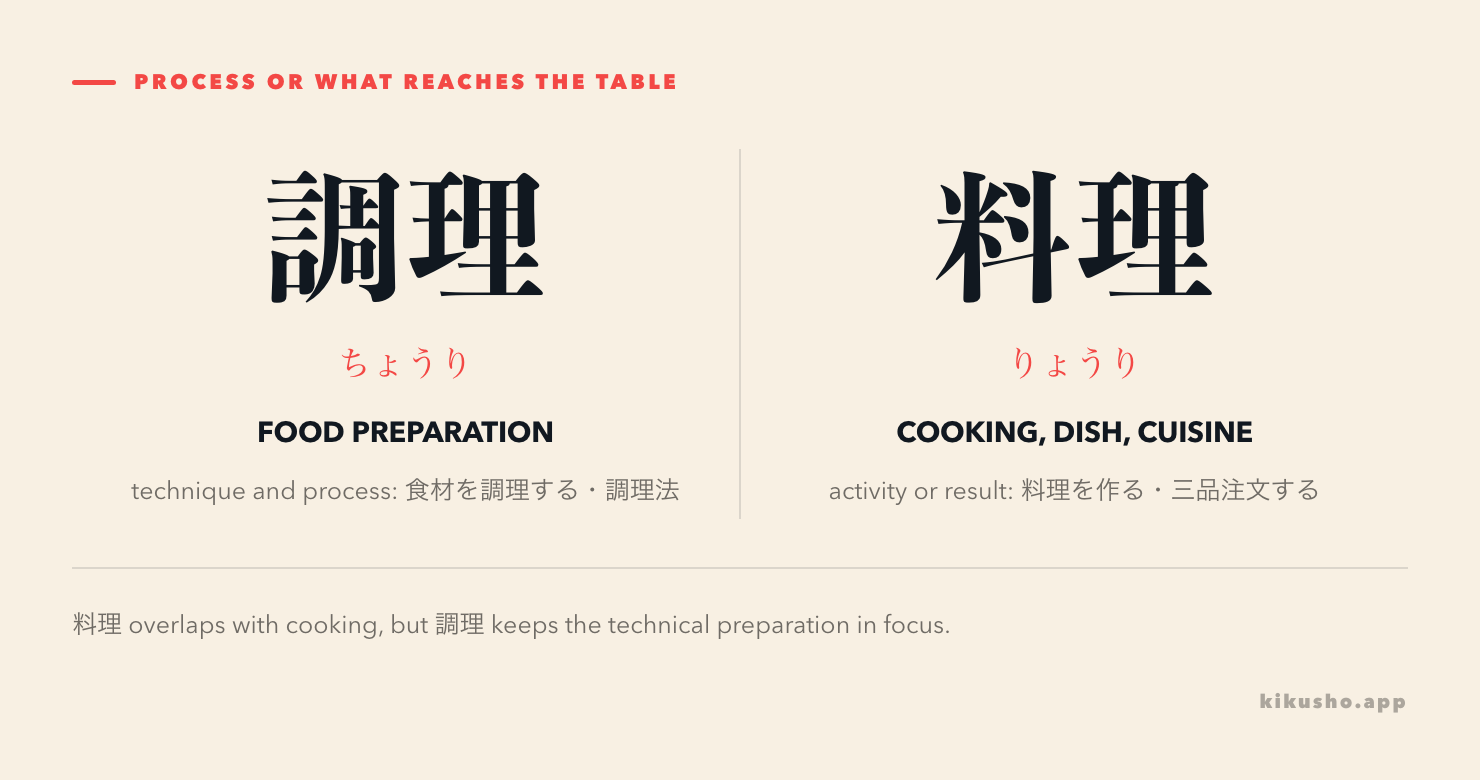
Kotobank's 調理 entry explains that specialists often use 調理 for the technical side of making food, whereas 料理 has a wider range that includes making food, the finished result and cuisine. The distinction is a focus, not a ban: 料理する can still mean to cook.
The earlier N3 cooking-method lesson owns the individual verbs for frying, boiling, simmering and steaming. Here they act as examples of what 調理 contains. The N1 item is the category word and the process-versus-dish boundary.
One product note can contain all four decisions
Imagine a review describing a sauce and its use:
この生醤油は、だしを加えていない生(き)醤油で、魚を調理するときに使う。少し酸っぱいが、焼き魚にかけると甘(うま)い。
この きじょうゆは、だしを くわえて いない きじょうゆで、さかなを ちょうりする ときに つかう。すこし すっぱいが、やきざかなに かけると うまい。
This is straight soy sauce with no stock added, used when preparing fish. It is slightly sour, but tastes good on grilled fish.
The context performs four different checks. だしを加えていない selects き for 生, 魚を調理する selects the process word, 酸っぱい evaluates acidity, and the supplied reading うまい makes 甘い an unusual spelling for “tasty.” Removing those clues would make the two rare readings hard to recover.
That is also what to preserve if you capture a label in Kikusho. Keep the kana, the product explanation or the full phrase beside 生醤油; then verify whether the drafted card chose き or なま before saving it. A card containing only the two kanji keeps the ambiguity and throws away the evidence that solved it.
Practice: readings and use in context
Question 1: kanji reading
A dictionary gives 甘い with the meaning “tasty; delicious” and marks the spelling rare. Which reading belongs to that entry?
- A. あまい
- B. うまい
- C. からい
- D. にがい
Question 2: kanji reading
How is 生 read in ウイスキーを生で飲む, “drink whiskey neat”?
- A. せい
- B. しょう
- C. なま
- D. き
Question 3: meaning in context
What does 酸っぱい contribute in 牛乳が酸っぱいので、飲まないほうがいい?
- A. The milk is too hot.
- B. The milk tastes sour and may have spoiled.
- C. The milk is undiluted.
- D. The milk is pleasantly sweet.
Question 4: usage
Which sentence uses 調理 naturally?
- A. 郷土調理を三品注文した。
- B. この調理は皿の上に置いてある。
- C. 新鮮な魚を低温で調理する。
- D. 京都の調理を食べてみたい。
Question 5: paraphrase
Which sentence best preserves 彼はウイスキーを生で飲む?
- A. He drinks whiskey without diluting or mixing it.
- B. He drinks only freshly brewed beer.
- C. He uses whiskey while cooking raw fish.
- D. He heats whiskey before drinking it.
Question 6: reading from a product clue
A soy-sauce label says 火入れをしていない生醤油. Which reading does that explanation most directly select?
- A. きじょうゆ
- B. なましょうゆ
- C. せいしょうゆ
- D. しょうじょうゆ
Question 7: words in connected text
Fill the blanks with 酸っぱい, 調理, or 料理. Use each once.
レモンは( A )味がする。魚は十分に加熱して( B )する。この店では魚の( C )を三品注文した。
Question 8: explain the reading boundary
Why is it unsafe to assign one reading to every occurrence of 生 in food writing? Use 生の魚, ウイスキーを生で飲む, and 生醤油 in your explanation.
Answers and explanations
Answer 1
B. うまい. The assigned entry is the rare spelling 甘い(うまい), meaning tasty or delicious. 甘い(あまい) is the common sweet or lenient adjective, a different reading-sense pairing.
Answer 2
D. き. 生(き)で飲む means drinking liquor neat, without water or another mixer. なま supplies the familiar raw or unheated reading in other phrases.
Answer 3
B. 酸っぱい describes sour taste. Milk is not normally expected to taste sour, so the context suggests spoilage; the adjective alone does not encode “spoiled.”
Answer 4
C. 新鮮な魚を低温で調理する. The sentence focuses on the technique and process used to prepare fish. The other choices need 料理, because they treat the word as a countable dish or a regional cuisine.
Answer 5
A. Here 生(き) means undiluted or unmixed. The sentence makes no claim about beer, fish or heating.
Answer 6
B. なましょうゆ. The explicit clue 火入れをしていない, “not heat-treated,” selects the なま product term. きじょうゆ instead focuses on straight or unseasoned soy sauce, although the two terms have overlapping historical definitions.
Answer 7
Use A=酸っぱい, B=調理, and C=料理. Lemon supplies a sour taste, heating fish belongs to the preparation process, and three ordered items are finished dishes.
Answer 8
生 participates in different whole words and senses. 生(なま)の魚 is raw fish, ウイスキーを生(き)で飲む means drinking whiskey neat, and 生醤油 can be きじょうゆ or なましょうゆ depending on whether the context emphasizes unmixed ingredients or absence of heat treatment. The surrounding phrase, kana and label explanation select the reading.
The rare forms on this page reward a reader who keeps evidence attached to the word. Furigana rescues 甘い(うまい); the liquid and verb rescue 生(き)で飲む; a product note rescues 生醤油. That evidence is part of the vocabulary, not decoration around it.
Common questions
Can 甘い be read うまい?
Yes, dictionaries record 甘い as a rare spelling of うまい when it means tasty or delicious. Without a reading aid, however, 甘い is normally read あまい, sweet. Modern writing usually spells うまい in kana, as 旨い, or as 美味い.
What does 生(き) mean?
As a noun or prefix, 生(き) means pure, unmixed, undiluted or left in its original state. ウイスキーを生で飲む means to drink whiskey neat. It is a different reading from 生(なま), raw or unheated.
What is the difference between 調理 and 料理?
調理 focuses on the operations and techniques that prepare food, as in 食材を調理する and 調理法. 料理 is broader: it can mean cooking, a finished dish, or a cuisine, as in 日本料理 and 料理を注文する.
Are these four words officially assigned to JLPT N1?
No official exhaustive JLPT vocabulary list exists. Kikusho's reference inventory places these spelling-and-reading entries at N1, while other study resources put some at earlier levels. The exact reading and sense matter more than the character alone.