On this page
絹、着物、毛、下着、スーツ and 手袋 take you from a fabric label to a complete outfit. The six readings are きぬ、きもの、け、したぎ、スーツ and てぶくろ. Their useful differences concern material, clothing type and the verb that naturally accompanies an item.
This N4 set builds on the N5 clothes and wearing-verbs lesson. That earlier lesson remains the main guide to 着る, はく, かぶる and 脱ぐ. Here the new work is learning these six assigned nouns, recognising their readings and choosing combinations such as 絹の着物 and 手袋をはめる.
Six words cover materials, garments and one accessory
| Word | Reading | Meaning in this lesson | Useful combination |
|---|---|---|---|
| 絹 | きぬ | silk; silk fabric | 絹の着物: a silk kimono |
| 着物 | きもの | kimono; Japanese traditional clothing | 着物を着る: put on or wear a kimono |
| 毛 | け | hair; fur; wool, depending on context | 猫の毛: cat fur |
| 下着 | したぎ | underwear; underclothes | 下着を洗う: wash underwear |
| スーツ | スーツ / sūtsu | a matching suit | スーツを着る: wear a suit |
| 手袋 | てぶくろ | glove or gloves | 手袋をはめる: put on gloves |
The current clothing list at Benkyoumashou independently gives the same readings and N4 study labels for these six words. The dated Kikusho inventory draws its labels from two related Waller/Tanos descendants. Agreement inside that source family is one baseline, not two independent level judgments.
絹 and 毛 can name what clothing is made from
絹(きぬ) means silk as a fibre or as fabric. It joins a garment with の:
祖母から絹の着物をもらいました。+> そぼからきぬのきものをもらいました。+> “I received a silk kimono from my grandmother.”
The phrase 絹の着物 identifies the material. You can make the relationship explicit with でできた, “made from”:
このスカーフは絹でできています。+> このスカーフはきぬでできています。+> “This scarf is made of silk.”
Digital Daijisen's 絹 entry gives both the fibre taken from a silkworm cocoon and cloth woven from silk thread. The everyday word here is read きぬ. In compounds, the same kanji can take the on-reading けん, as in 絹布(けんぷ), but that does not change the assigned headword's reading.
毛(け) has a wider range. It can be human hair, animal fur, a bird's feather or wool used as a material:
| Phrase | Reading | Meaning of 毛 |
|---|---|---|
| 髪の毛 | かみのけ | hair on the head |
| 猫の毛 | ねこのけ | a cat's fur |
| 毛のセーター | けのセーター | a wool sweater |
| 毛糸の手袋 | けいとのてぶくろ | gloves made of woollen yarn |
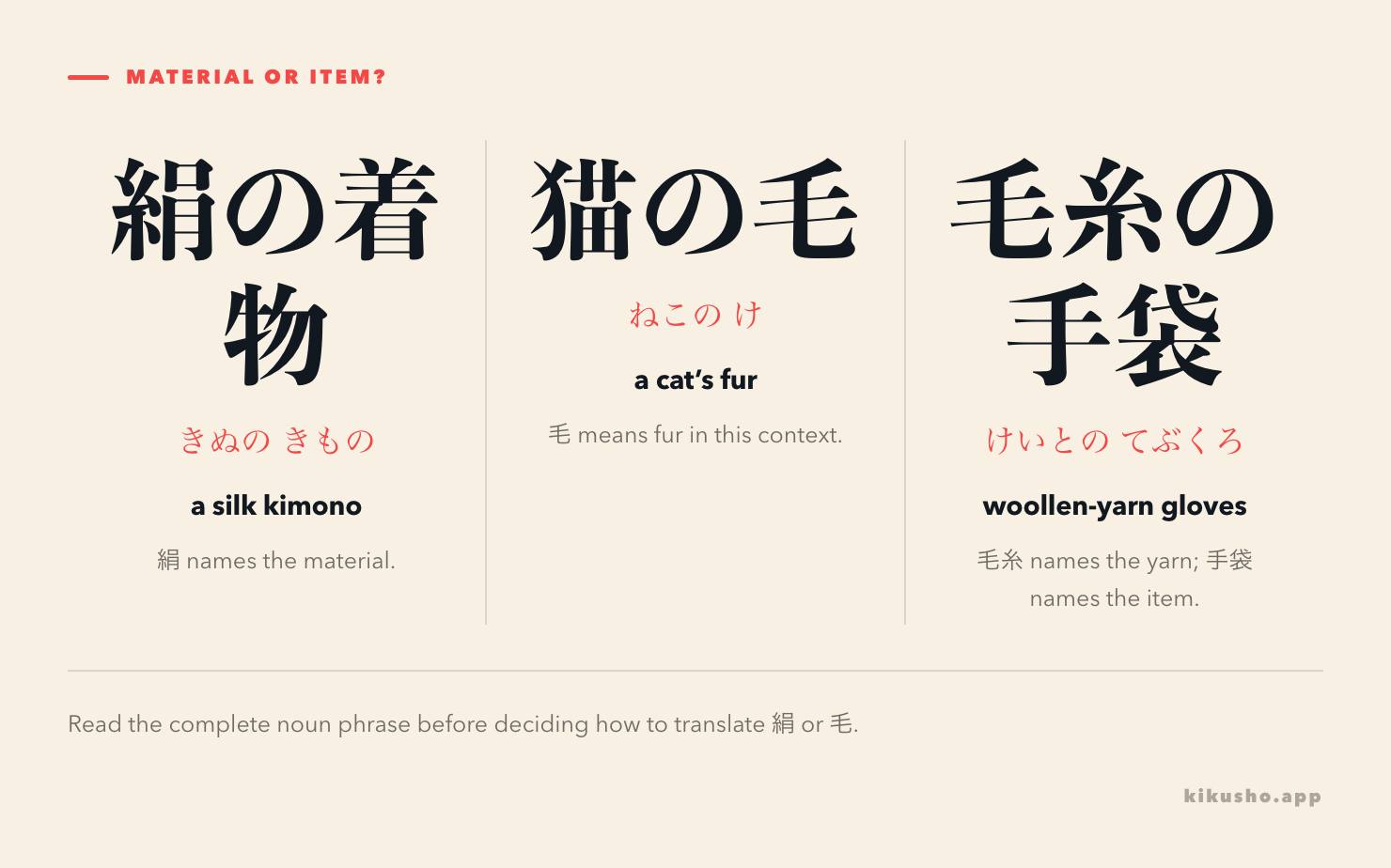
The dictionary entry for 毛 explicitly includes hair, fur and the wool or wool-product sense. Do not replace every 毛 with “wool.” 猫の毛 is fur, while 毛糸 is yarn spun from wool or other animal hair.
着物 usually means a kimono in modern clothing talk
The two kanji in 着物(きもの) are familiar-looking: 着 relates to wearing and 物 means a thing. The word is lexicalised with the reading きもの, not ちゃくぶつ.
Historically and in dictionary definitions, 着物 can broadly mean something worn on the body. In ordinary modern contrasts, it usually means a kimono or Japanese-style traditional clothing:
祭りで着物を着ている人を見ました。+> まつりできものをきているひとをみました。+> “I saw people wearing kimono at the festival.”
The repetition 着物を着る is natural. The noun is きもの and the verb is 着る(きる). An English translation avoids repeating “wear,” but Japanese does not need to.
Digital Daijisen's 着物 entry records both the broad “clothing” sense and the common contrastive sense of Japanese clothing as opposed to 洋服. Use 服 for clothes in general, 洋服 for Western-style clothing and 着物 when the traditional Japanese garment is intended.
The material and the garment can appear in one noun phrase:
絹の着物はきれいですが、手入れが必要です。+> きぬのきものはきれいですが、ていれがひつようです。+> “Silk kimono are beautiful, but they require care.”
This sentence does not claim that every kimono is silk. The noun before の identifies the material of this one.
下着 describes the layer underneath
下着(したぎ) combines 下, “under or below,” with 着 in its voiced reading ぎ. The result means underwear or underclothes. Digital Daijisen includes clothes worn directly against the skin and, in layered Japanese dress, garments worn under the outer layer.
Useful neutral combinations include:
- 下着を買う: buy underwear
- 下着を洗う: wash underwear
- 下着売り場(したぎうりば): the underwear department
Do not assume one wearing verb covers every item in the category. An undershirt takes 着る, while underpants normally take はく. 下着を着る can refer generally to putting on underclothes, but a specific item still chooses its natural verb.
旅行の前に、下着を三日分用意しました。+> りょこうのまえに、したぎをみっかぶんよういしました。+> “Before the trip, I prepared three days' worth of underwear.”
The counter-like 三日分 describes an amount for three days. The sentence keeps the private garment category neutral and practical.
スーツ is broader than the older word 背広
スーツ needs both long-vowel marks: スーツ. A missing bar changes the written form. It names a set of matching clothes, commonly a jacket with trousers or a skirt:
明日の面接には紺のスーツを着ます。+> あしたのめんせつにはこんのスーツをきます。+> “I will wear a navy suit to tomorrow's interview.”
The Kotobank entry for スーツ defines a matching set made from the same cloth and includes both men's and women's combinations. 背広(せびろ), taught in the prerequisite N5 lesson, traditionally refers to a men's Western-style business suit. When gender is unspecified or the outfit can be for anyone, スーツ is the safer broad term.
| Word | Main scope here | Example |
|---|---|---|
| スーツ | matching suit for a man or woman | スーツを着る |
| 背広 | men's business suit | 背広姿の男性 |
Both can describe formal business clothing in the right context. The difference is a boundary of scope, not a rule that one word is modern and the other can never be heard.
手袋 is a hand covering, but its verb is not 着る
手袋(てぶくろ) is built from 手(て), “hand,” and 袋(ふくろ), “bag or pouch.” The second element voices from ふくろ to ぶくろ inside the compound. The word can refer to one glove or a pair; Japanese nouns do not automatically mark singular and plural.
寒いので、毛糸の手袋をはめました。+> さむいので、けいとのてぶくろをはめました。+> “Because it was cold, I put on my woollen gloves.”
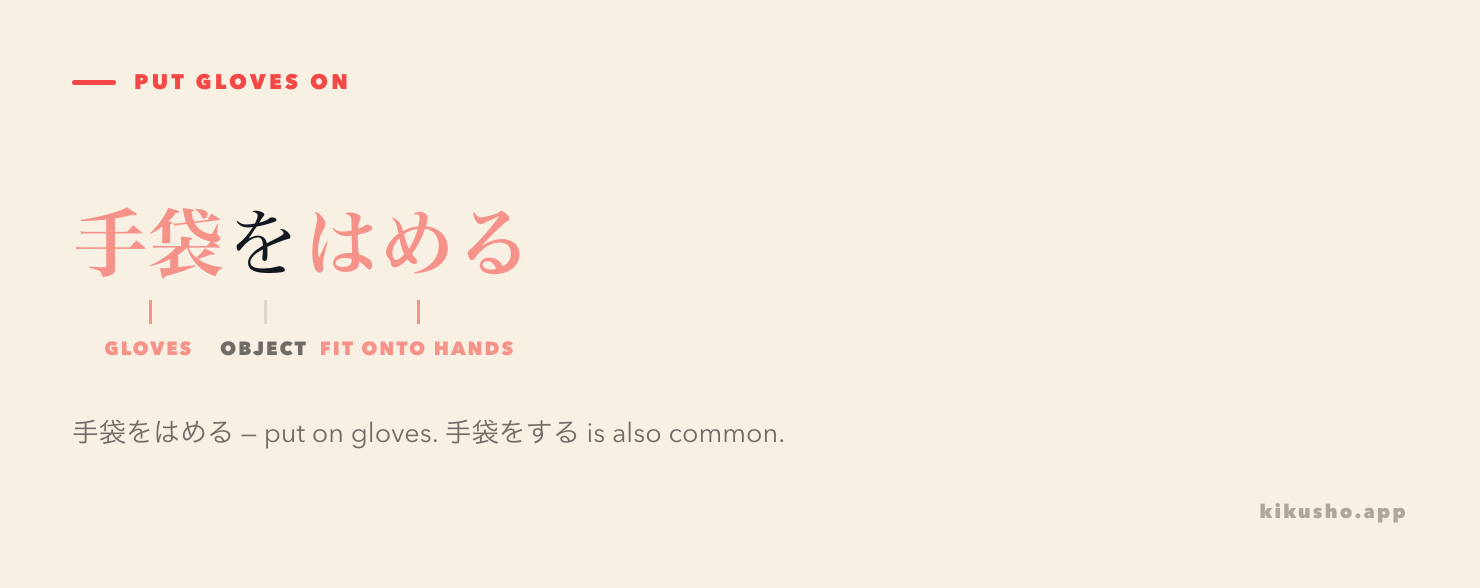
The National Institute for Japanese Language and Linguistics lists 手袋をはめる and 手袋をする for putting on or wearing gloves. For removal, it gives 手袋を取る and 手袋を脱ぐ. 外す(はずす) is also common for taking off something fitted or attached.
This is a useful limit on the beginner shortcut “clothes take 着る.” A suit and kimono cover the body and take 着る. Gloves fit onto the hands and commonly take はめる or する.
Read the compounds as whole words
Three assigned items show why reading one kanji at a time is unreliable:
| Written word | Whole-word reading | Reading trap |
|---|---|---|
| 着物 | きもの | not ちゃくもの |
| 下着 | したぎ | 着 voices to ぎ |
| 手袋 | てぶくろ | 袋 voices from ふくろ to ぶくろ |
The reading change is part of the stored word. It is more efficient to recall 手袋をはめる as a phrase than to rebuild て + ふくろ and repair it afterward.
The curriculum places all six records at N4 and records no level disagreement. Its two vocabulary baselines descend from the same Waller/Tanos source family. The independent dictionary checks above verify readings and senses, while Benkyoumashou supplies a separately published N4 comparison. The official JLPT FAQ explains that no exhaustive current vocabulary list is published, so N4 remains a study placement rather than an official promise about a test.
On an iPhone, Kikusho can turn a clothing label or shop sign into editable vocabulary cards. For this set, keep the material phrase or action with the noun: 絹の着物, 毛糸の手袋 and 手袋をはめる preserve distinctions that an isolated English gloss would lose. Cards and their audio remain available for offline review.
Seven questions to complete before checking the answers
These original tasks cover kanji reading, orthography, context, paraphrase and usage. Answer all seven before moving to the explanation block.
Question 1 — kanji reading. Choose the reading of the bold word.
このシャツは絹でできています。
ア. いと+イ. きぬ+ウ. け+エ. ぬの
Question 2 — orthography. Choose the correct spelling for したぎ, “underwear.”
ア. 上着+イ. 手着+ウ. 下着+エ. 下物
Question 3 — context. Complete the sentence with the most natural noun.
外は雪です。( )をはめてから出かけます。
ア. 着物+イ. 下着+ウ. スーツ+エ. 手袋
Question 4 — context. In which sentence does 毛 mean animal fur rather than wool or human hair?
ア. 猫の毛がソファーについています。+イ. 毛のセーターを買いました。+ウ. 髪の毛を短く切りました。+エ. 毛糸でマフラーを作りました。
Write the sense used in each option before continuing.
Question 5 — paraphrase. Which description best matches スーツ in this lesson?
ア. Any single jacket worn outdoors.+イ. A matching set such as a jacket with trousers or a skirt.+ウ. Only a traditional Japanese long garment.+エ. Only a men's shirt with a necktie.
Question 6 — usage. Choose the sentence that naturally says, “I wore a silk kimono.”
ア. 絹を着物に着ました。+イ. 絹の着物を着ました。+ウ. 着物の絹をはめました。+エ. 絹で手袋を着ました。
Question 7 — usage. Choose the natural way to say you put on gloves.
ア. 手袋をはめました。+イ. 手袋をかぶりました。+ウ. 手袋を履きました。+エ. 手袋を締めました。
Check that you have seven choices, then continue.
Answers and explanations
Answer 1: イ, きぬ. 絹 is read きぬ as the standalone word for silk. いと means thread and is written 糸; け is the reading of 毛; ぬの means cloth and is written 布. The sentence says the shirt is made of silk.
Answer 2: ウ, 下着. 下着 is read したぎ. 下 provides した, and 着 takes the voiced reading ぎ in this compound. 上着 is うわぎ, an outer or upper garment. 手着 and 下物 are not the assigned word.
Answer 3: エ, 手袋. Snow supplies the cold-weather context, and 手袋をはめる is a natural combination for putting on gloves. 着物 and スーツ are body garments and take 着る. 下着 is underwear; it does not fit the stated hand action.
Answer 4: ア, 猫の毛. Here 毛 means the cat's fur, which has stuck to the sofa. In イ, it describes wool as a clothing material. ウ contains 髪の毛, hair on the head. エ contains 毛糸, woollen or animal-hair yarn. The same reading け covers several related senses, so the surrounding noun decides the translation.
Answer 5: イ. A スーツ is a coordinated set, commonly a jacket with matching trousers or a skirt. A single outdoor jacket is an 上着 or ジャケット depending on the item. A Japanese traditional garment is a 着物. The word is not limited to men's clothing or to an outfit with a tie.
Answer 6: イ, 絹の着物を着ました. 絹の modifies 着物 and identifies its material; 着物 is the object of 着ました. A makes silk the garment and misconnects 着物. C reverses material and item, then uses the glove verb はめる. D gives 着る to gloves and does not express a kimono.
Answer 7: ア, 手袋をはめました. はめる describes fitting gloves onto the hands, and する is another common option. かぶる goes with a head covering, 履く or はく with footwear and lower-body clothing, and 締める with something tightened or tied such as a belt or necktie.
Common questions
What is the Japanese word for silk?
絹(きぬ)means silk, either the fibre or silk fabric. Use 絹の着物 for a silk kimono and 絹でできた服 for clothes made of silk. The reading of this standalone word is きぬ.
Does 毛 mean hair, fur or wool?
毛(け)can mean all three, and context selects the sense. 人の毛 or 髪の毛 concerns hair, 猫の毛 is a cat's fur, and a clothing label can use 毛 for wool. 毛糸(けいと)is yarn made from wool or other animal hair.
What is the difference between スーツ and 背広?
スーツ is a matching set of garments and can describe men's or women's clothing. 背広(せびろ)traditionally refers to a men's Western-style business suit. スーツ is therefore the broader everyday word.
Which verb is used with 手袋?
手袋(てぶくろ)commonly takes はめる or する for putting gloves on or wearing them. 手袋を脱ぐ, 取る or 外す can describe removing them. 着る is not the general verb for gloves.