On this page
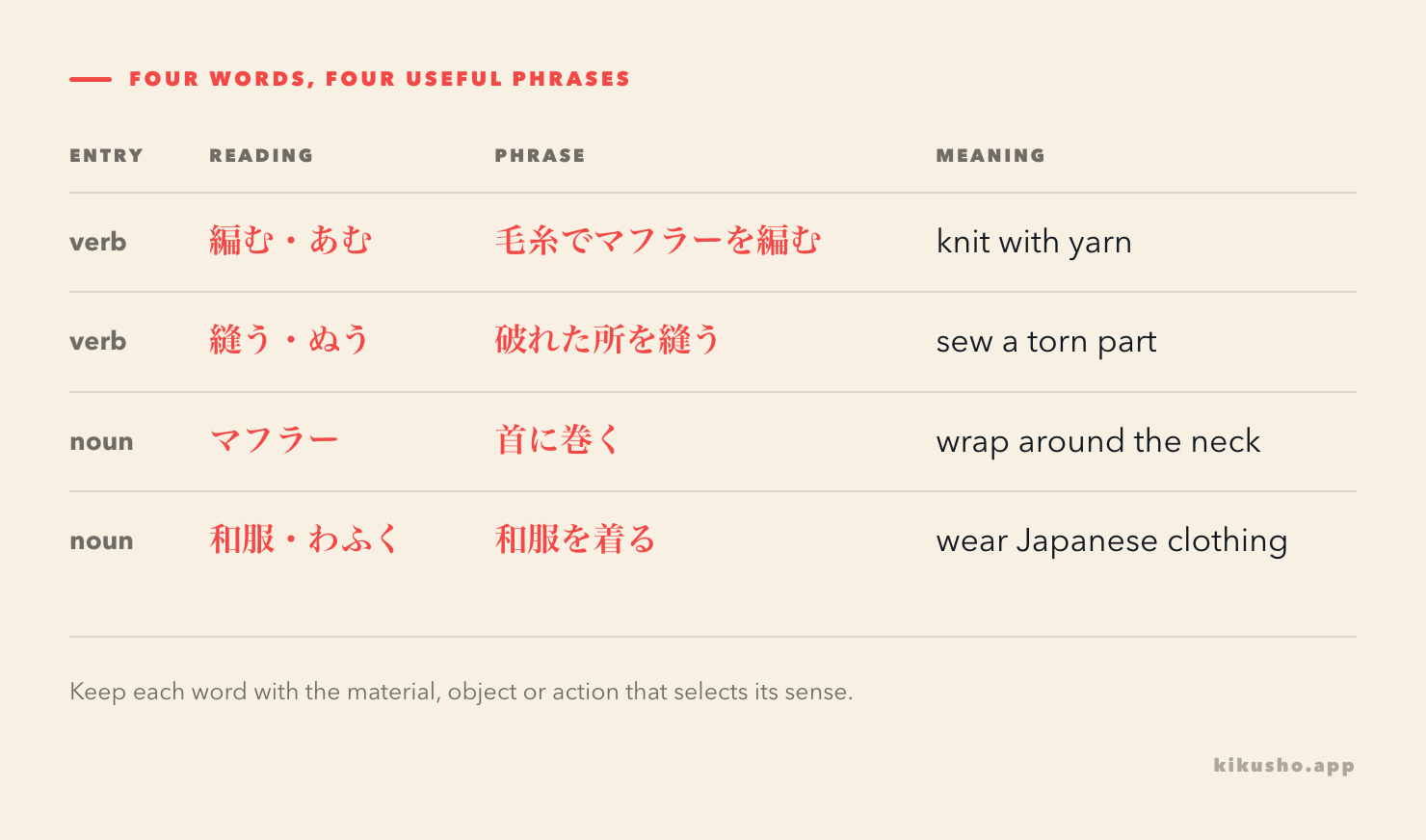
編む(あむ) and 縫う(ぬう) describe different ways of making something from material; マフラー and 和服(わふく) name two very different things you can wear. This N2 vocabulary set teaches those four entries through readings, natural combinations and contexts that keep their meanings apart.
The sequence starts earlier. The N5 clothes lesson teaches basic garments and wearing verbs, the N4 fabric lesson introduces 着物, 絹 and 毛, and the N3 fashion lesson covers 布, 生地, 柄 and fit. Those are prerequisites here. The new work is choosing between 編む and 縫う, reading both kanji verbs, and using マフラー and 和服 precisely.
Four entries connect materials, actions and clothing
| Entry | Reading | Part of speech | Sense taught here | Useful combination |
|---|---|---|---|---|
| 編む | あむ | transitive godan verb | knit, braid or weave together | 毛糸でマフラーを編む: knit a scarf with yarn |
| 縫う | ぬう | transitive godan verb | sew or stitch with a needle and thread | 破れた所を縫う: sew the torn part |
| マフラー | マフラー / mafuraa | noun | a warm scarf; also a vehicle muffler | マフラーを首に巻く: wrap a scarf around the neck |
| 和服 | わふく | noun | traditional Japanese-style clothing | 和服を着る: wear Japanese clothing |
The two verbs are actions, and both normally mark the thing made or worked on with を. A material or tool can take で: 毛糸で編む uses yarn, while 針と糸で縫う uses a needle and thread. The nouns take familiar clothing verbs: マフラーを巻く and 和服を着る.
編む builds a surface or form by interlacing material
編む(あむ) combines strands or long flexible pieces into a form. With wool or yarn, the usual English translation is “knit.” With hair it can be “braid,” and with materials such as bamboo it can be “weave.” The material and finished object narrow the translation.
祖母は毛糸で青いマフラーを編んでくれました。 そぼはけいとであおいマフラーをあんでくれました。 “My grandmother knitted me a blue scarf with yarn.”
The godan change matters: 編む → 編んで, not 編みて. The object is マフラーを, and the material is 毛糸で. Other reliable combinations are セーターを編む, 髪を編む and 竹で籠を編む. Digital Daijisen’s 編む entry covers interlacing yarn, bamboo, rattan, wire and hair, and also records extended senses such as compiling a book. This lesson practises the physical making sense.
妹は長い髪を三つ編みに編みました。 いもうとはながいかみをみつあみにあみました。 “My younger sister braided her long hair.”
The English word “weave” can tempt you to use 織る(おる) everywhere. Keep the production method in view. 織る typically makes cloth by crossing warp and weft, often on a loom; 編む builds with loops or interlaced strands. The finished product alone may not tell you the verb, so learn 毛糸でマフラーを編む as a complete unit.
縫う joins or repairs material with a threaded needle
縫う(ぬう) sends a threaded needle through cloth, leather or similar material. It can join separate pieces, make an item or repair a tear.
ボタンが取れたので、自分で縫い付けました。 ボタンがとれたので、じぶんでぬいつけました。 “The button came off, so I sewed it back on myself.”
破れた袖を針と糸で縫いました。 やぶれたそでをはりといとでぬいました。 “I sewed the torn sleeve with a needle and thread.”
The polite past is 縫いました, and the te-form is 縫って. Although 縫う ends in the written sequence う, its stem contains the reading ぬ. Digital Daijisen’s 縫う entry also records sewing a wound closed and figuratively moving through a narrow space, as in 人々の間を縫って進む. Those senses share an image of passing through points or gaps, but the garment sense needs cloth, needlework or repair context.
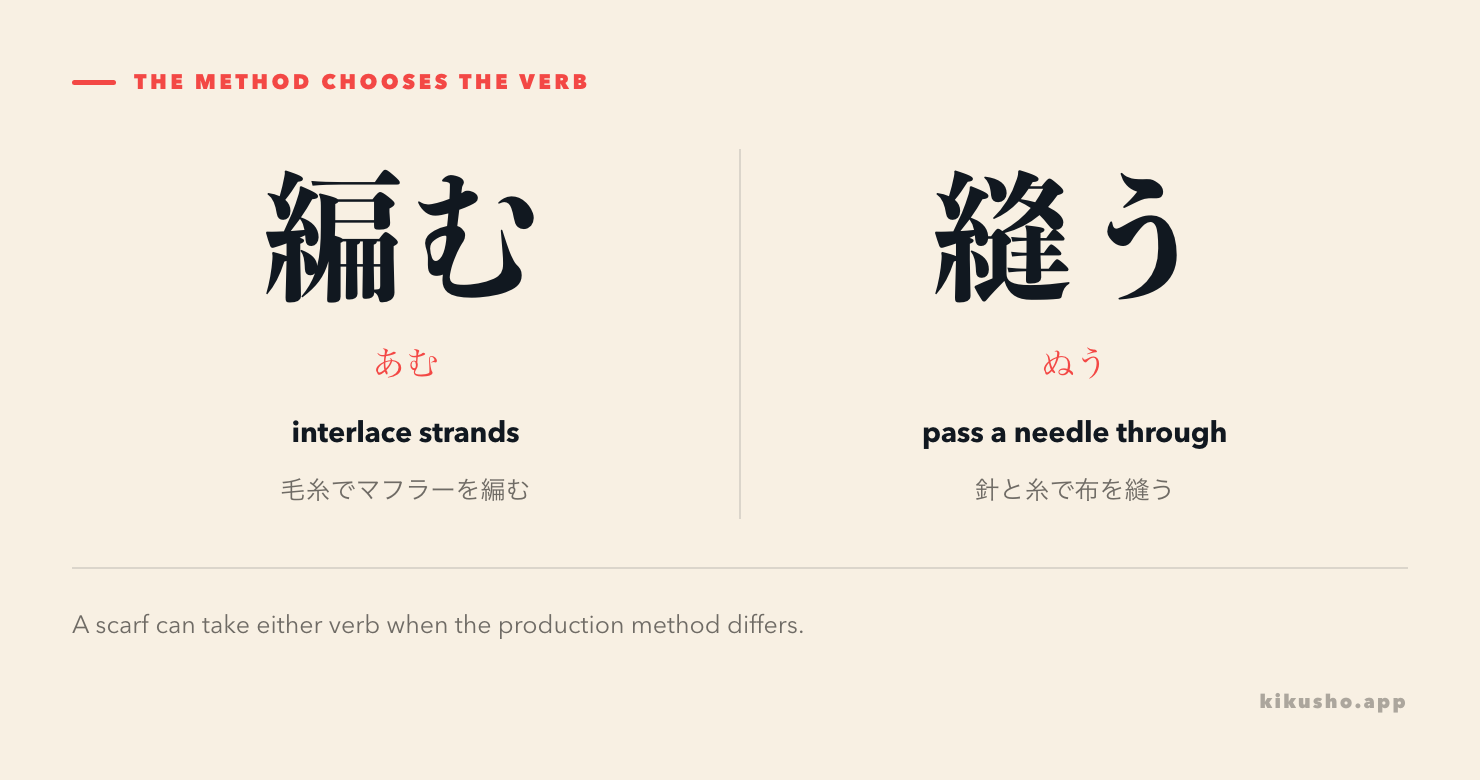
The contrast can be tested with one object. A knitted scarf is マフラーを編む because its yarn is looped into the fabric. If you make a scarf by cutting woven fabric and joining its edges, マフラーを縫う can be correct. Japanese chooses the production action being described.
マフラー needs context because it has two everyday senses
In clothing talk, マフラー is a long scarf worn around the neck, especially for warmth. Natural actions include 巻く, wrap; する, wear or put on; 外す, take off; and 編む, knit.
寒くなってきたから、マフラーを首に巻いた。 さむくなってきたから、マフラーをくびにまいた。 “It was getting cold, so I wrapped a scarf around my neck.”
Japanese マフラー does not cover every decorative scarf in exactly the same way. スカーフ often names a lighter decorative scarf, while マフラー strongly suggests warmth in ordinary clothing contexts. Material and fashion overlap prevent this from being an absolute boundary.
The same katakana word also names the muffler or silencer in a car or motorcycle exhaust system:
車のマフラーから変な音がします。 くるまのマフラーからへんなおとがします。 “There is a strange sound coming from the car’s muffler.”
Digital Daijisen’s マフラー entry lists both the warm neckwear and vehicle silencer senses. 首に巻く, 毛糸 and 寒い point to the scarf. 車, オートバイ, 排気音 and mechanical trouble point to the exhaust part.
和服 is the category opposite 洋服
和服(わふく) names clothing in a traditional Japanese style. The word is built from 和, Japanese or Japanese-style, and 服, clothing. Its usual contrast is 洋服(ようふく), Western-style clothing.
式では和服を着る人も洋服を着る人もいました。 しきではわふくをきるひともようふくをきるひともいました。 “At the ceremony, some people wore Japanese clothing and others wore Western-style clothing.”
The contrast concerns the clothing style, not where the garment was manufactured and not the nationality of its wearer. A suit made in Japan is still 洋服; a person from outside Japan can wear 和服.
和服 and 着物(きもの) overlap, but their scopes are useful to retain. Digital Daijisen defines 和服 as clothing in a style used in Japan from long ago, in contrast with 洋服. Its broader reference can include the traditional clothing category. 着物 often names a kimono or the main long garment, although dictionaries also record the older broad sense “clothing.” This is why 和服の種類として着物や浴衣を紹介する can treat Japanese-style clothing as the category and 着物 and 浴衣 as examples.
この店では和服の着付けも教えています。 このみせではわふくのきつけもおしえています。 “This shop also teaches how to dress in Japanese-style clothing.”
Do not transfer the kanji reading from 洋服: 和服 is わふく, while 洋服 is ようふく. The shared 服(ふく) makes the word-formation contrast visible.
The N2 label is a study placement
The Kikusho inventory records 編む, 縫う, マフラー and 和服 at N2 in two snapshots descended from the same Waller/Tanos vocabulary family. Their agreement supplies one historical study baseline rather than two independent level decisions. No item in this set carries a disagreement inside that inventory.
The official JLPT FAQ explains that the current test does not publish a fixed exhaustive vocabulary, kanji and grammar list. Dictionary evidence verifies the readings and uses taught here; it does not certify an official N2 boundary. Treat the level as a practical review target, with the N5 to N3 clothing lessons supplying the prerequisite words.
On an iPhone, Kikusho can turn a garment label, craft instruction or shop sign into an editable card. Save the phrase that identifies the action or sense: 毛糸でマフラーを編む, 破れた袖を縫う, マフラーを首に巻く and 和服を着る preserve more than four isolated translations. You can later hear and retrieve those complete combinations without a network connection.
Test the four words in eight contexts
Answer all eight questions before moving to the explanations.
Question 1: kanji reading
How is 編む read in this sentence?
母は毛糸で帽子を編んでいます。
- ア. こむ
- イ. あむ
- ウ. ぬう
- エ. おる
Question 2: orthography
Choose the kanji for ぬう, “to sew.”
- ア. 編う
- イ. 織う
- ウ. 縫う
- エ. 結う
Question 3: context
Choose the verb that best completes the sentence.
破れたズボンを針と糸で( )。
- ア. 編みました
- イ. 縫いました
- ウ. 巻きました
- エ. 着ました
Question 4: production method
A craft instruction says to make a winter scarf by forming loops with yarn and knitting needles. Which phrase fits?
- ア. 毛糸でマフラーを編む
- イ. 毛糸でマフラーを着る
- ウ. 毛糸でマフラーを縫う
- エ. 毛糸でマフラーを巻く
Question 5: word formation
Which established word contrasts with 洋服, Western-style clothing?
- ア. 和糸
- イ. 和布
- ウ. 和服
- エ. 和巻
Question 6: sense in context
What does マフラー name in this sentence?
車のマフラーを交換して、排気音が静かになりました。
- ア. A warm scarf
- イ. A seat belt
- ウ. A vehicle muffler
- エ. A winter coat
Question 7: paraphrase
Which sentence best preserves the meaning of 祖父は式に和服で出席しました?
- ア. My grandfather attended the ceremony in traditional Japanese-style clothing.
- イ. My grandfather knitted clothing during the ceremony.
- ウ. My grandfather attended the ceremony in a Western suit.
- エ. My grandfather repaired the ceremonial clothing.
Question 8: usage
Choose the natural sentence for “I wrapped a scarf around my neck because it was cold.”
- ア. 寒かったので、マフラーを首に巻きました。
- イ. 寒かったので、首をマフラーに縫いました。
- ウ. 寒かったので、マフラーが首を編みました。
- エ. 寒かったので、首に和服を巻きました。
Answers and explanations
Answer 1
イ, あむ. 編む is read あむ. The sentence says that the speaker’s mother is knitting a hat with yarn. ぬう is 縫う, while おる can read 織る, the verb for weaving cloth.
Answer 2
ウ, 縫う. 縫う is the established spelling and reading for sewing or stitching with a threaded needle. 編む is あむ. 織う and 編う are not the standard spellings of the requested verb.
Answer 3
イ, 縫いました. The trousers are torn, and a needle and thread are the tools, so sewing is the intended action. 編む would interlace material, 巻く would wrap something, and 着る would put clothing on the body.
Answer 4
ア, 毛糸でマフラーを編む. Loops made from yarn describe knitting, so 編む fits. 縫う could be used if cloth pieces were joined with a threaded needle, but that is not the method in the prompt. 巻く describes putting the finished scarf around the neck.
Answer 5
ウ, 和服. 和服 is the established category term for traditional Japanese-style clothing and contrasts with 洋服. The other choices are character combinations made from lesson elements, but they do not supply the requested established clothing word.
Answer 6
ウ, a vehicle muffler. 車, 交換する and 排気音 create a mechanical context. A clothing context would instead include clues such as 首に巻く, 毛糸 or cold weather.
Answer 7
ア. 和服で tells us the clothing in which the grandfather attended. The sentence gives no knitting or repair action, and 和服 is not a Western suit.
Answer 8
ア. The natural pattern is マフラーを首に巻く: マフラー is the object, 首に marks where it is wrapped, and 巻く names the action. The other choices reverse the roles or combine a body part with an unsuitable verb.
Common questions
What is the difference between 編む and 縫う?
編む(あむ)forms something by interlacing yarn, hair or another long, flexible material. 縫う(ぬう)passes a threaded needle through cloth or leather to join or repair it. A wool scarf may be 編む; a torn seam is 縫う.
Does マフラー mean scarf in Japanese?
Yes. In clothing talk, マフラー is a long scarf or neck warmer, especially one worn for warmth. The same word can also mean a vehicle muffler, so nouns such as 首, 車 and 排気音 identify the intended sense.
Are 和服 and 着物 the same?
They overlap, and dictionaries often gloss 和服 as 着物. 和服 is a broad category for traditional Japanese-style clothing in contrast with 洋服. 着物 can name clothing broadly in older usage, or a kimono and especially the main long garment in modern clothing talk.
Are these four words officially JLPT N2 vocabulary?
Two related Waller-derived study lists place all four at N2, and the Kikusho inventory records no disagreement between them. The current JLPT does not publish an exhaustive official vocabulary list, so N2 is a useful study placement rather than a guarantee about a particular exam paper.