On this page
Eight words carry an advanced travel notice from the calendar to the destination: 連休, 旅券, 旅客, 訪れる, ガイド, フロント, 民宿 and 名産. The point is not that all eight are rare. It is knowing which belong to official transport language, which name a service or establishment, and which everyday synonym changes the viewpoint.
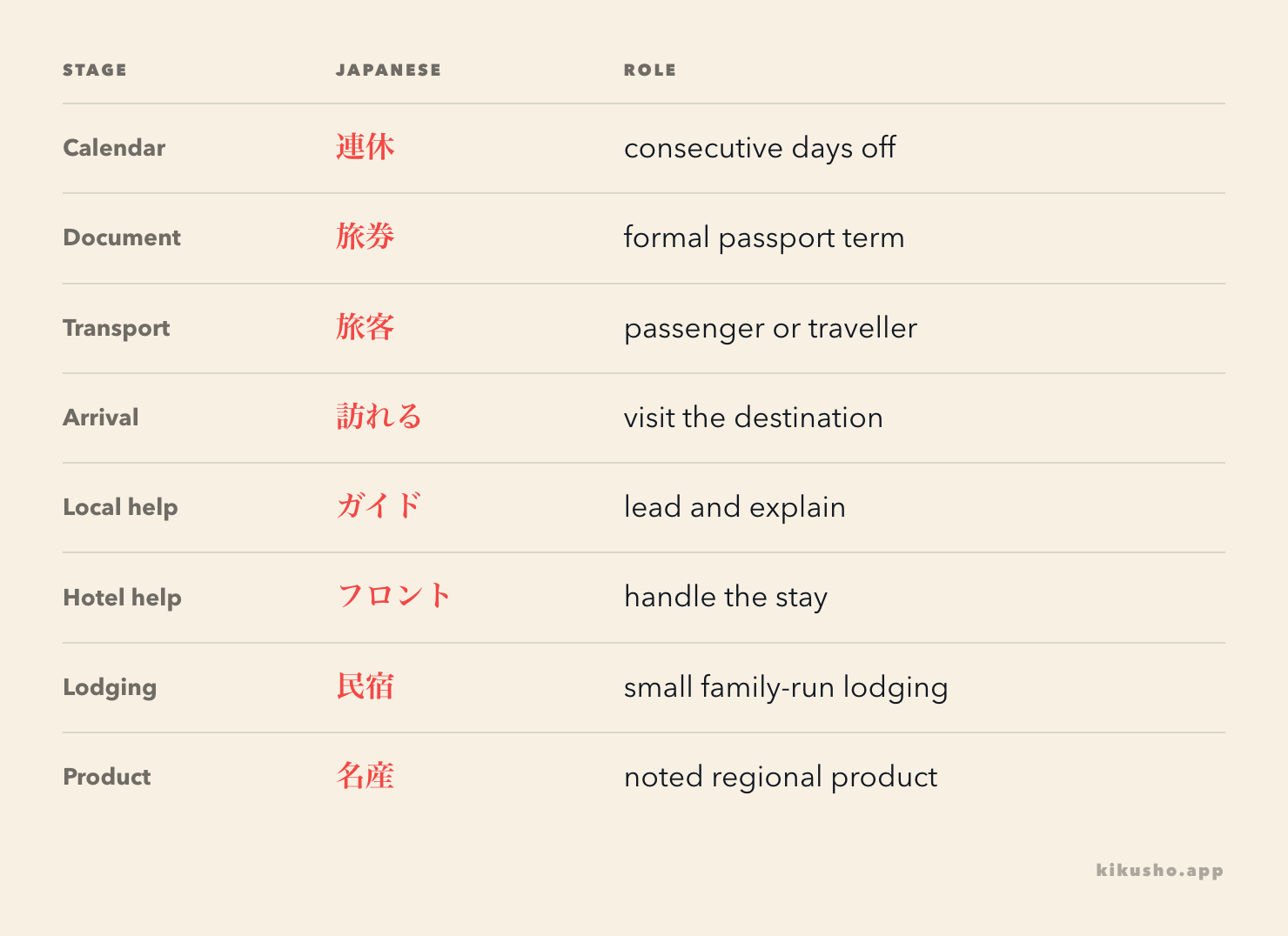
Read them as one journey. A 連休 creates the travel window; a 旅客 presents a 旅券; the traveller 訪れる a place; a ガイド shows the area; the hotel フロント handles requests; a 民宿 offers another kind of stay; and a 名産 is a product the region is known for.
Eight records follow a trip from departure to return
| Headword | Reading | Grammar and selected sense | Phrase worth keeping |
|---|---|---|---|
| 訪れる | おとずれる | ichidan verb: visit a place; a season or situation arrives | 京都を訪れる, visit Kyoto |
| ガイド | がいど | noun: a guide, especially a person who explains or leads | 観光ガイド, sightseeing guide |
| フロント | ふろんと | noun: a hotel reception or front desk in this context | フロントに問い合わせる, ask the front desk |
| 民宿 | みんしゅく | noun: small lodging traditionally operated from a private home | 民宿に泊まる, stay at a minshuku |
| 名産 | めいさん | noun: a noted product produced in a particular area | 地方の名産, a regional product |
| 旅客 | りょかく | noun: traveller or transport passenger | 旅客ターミナル, passenger terminal |
| 旅券 | りょけん | noun: passport, especially in formal or administrative language | 旅券を申請する, apply for a passport |
| 連休 | れんきゅう | noun: consecutive days off | 三連休, a three-day holiday |
The set contains three kinds of language. 旅券 and 旅客 appear readily in administration and transport. フロント, ガイド and 民宿 name what a traveller encounters on site. 訪れる, 名産 and 連休 are broader words whose travel meaning comes from the surrounding sentence.
連休 creates a block of days, not simply one holiday
連休(れんきゅう) means that days off continue one after another. The dictionary definition covers both the condition and the resulting block of holidays. A Saturday, Sunday and Monday off form 三連休; a longer busy period can be 大型連休.
三連休を利用して、北陸を旅行しました。
さんれんきゅうを りようして、ほくりくを りょこうしました。
I used the three-day holiday to travel around Hokuriku.
休日 names a day off. 休暇 is leave from work, school or another duty. 連休 adds the arrangement: multiple days off are adjacent. 飛び石連休 is the revealing exception in name only. It describes holidays separated by workdays, like stepping stones, so the calendar lacks one continuous block unless the intervening days are also taken off.
The word is operational, not only cultural. Current Japanese embassy passport guidance warns that delivery may take longer when processing overlaps with 年末年始等の連休. In travel notices, 連休中 often predicts crowding, higher demand or restricted availability.
旅券 is the document; 旅客 is the person travelling
The shared 旅 does not make these nouns a pair of tickets. 旅券(りょけん) is the formal Japanese word for a passport. 旅客(りょかく) is a person travelling, especially a passenger in transport or official language.
国際線の旅客は、搭乗前に旅券を提示した。
こくさいせんの りょかくは、とうじょうまえに りょけんを ていじした。
The international passenger presented a passport before boarding.
The 旅券 dictionary entry defines the document through which a country certifies a traveller's nationality and identity for foreign travel. Japan's current embassy guidance titles the same page 旅券(パスポート). That pairing settles the synonym question: パスポート is the ordinary loanword; 旅券 is prominent in forms, laws and official compounds such as 旅券申請, 旅券番号, 一般旅券 and 旅券手数料.
券 often means a ticket or certificate, but a 旅券 is not a train ticket. Rail tickets use words such as 乗車券. The travel document itself selects 旅券.
The 旅客 entry gives both a traveller and a fare-paying user of transport. It records りょかく and the alternative りょきゃく. This inventory record uses りょかく, the reading heard in compounds such as 旅客機, 旅客船, 旅客運賃 and 旅客ターミナル.
乗客(じょうきゃく) looks from the vehicle inward: the people riding it. 旅行者 looks at people engaged in travel. 旅客 is comfortable in signs, industry categories and collective descriptions. The same person may be all three, but the document chooses the viewpoint.
訪れる takes a destination or announces an arrival
訪れる(おとずれる) is an ichidan verb: 訪れます, 訪れて, 訪れた, 訪れない. Its two modern patterns are easy to distinguish once the particles remain visible.
毎年、多くの旅行者がこの町を訪れます。
まいとし、おおくの りょこうしゃが この まちを おとずれます。
Many travellers visit this town every year.
山にも春が訪れました。
やまにも はるが おとずれました。
Spring has arrived in the mountains too.
In the first pattern, a person visits a place marked by を. In the second, a season, opportunity, change or state arrives and takes が. The dictionary entry records both visiting someone or somewhere and a season or situation coming.
訪ねる(たずねる) often brings the person sought into focus: 先生を訪ねる. A useful dictionary comparison notes that 彼を訪れる is avoided where 彼を訪ねる works, while 彼の家を訪れる names the place visited. Tourism prose therefore readily uses 日本を訪れる, 寺を訪れる and 観光地を訪れる.
ガイド and フロント provide different kinds of help
A ガイド accompanies, leads or explains. A フロント is the hotel reception desk or the staff function represented by that desk. English guide and front are broad, but travel collocations narrow them.
午前中は、地元のガイドに港町を案内してもらいました。
ごぜんちゅうは、じもとの ガイドに みなとまちを あんないして もらいました。
In the morning, I had a local guide show me around the port town.
荷物を預けられるか、ホテルのフロントに問い合わせました。
にもつを あずけられるか、ホテルの フロントに といあわせました。
I asked the hotel front desk whether I could leave my luggage.
ガイドに案内してもらう clearly makes the guide a person. ガイドブック is a guidebook, and 音声ガイド is an audio guide. The noun alone needs its surroundings. Japan Tourism Agency material uses 通訳ガイド, 観光ガイド and the abbreviation T/G for tour guide, confirming the professional travel sense.
The フロント definition lists several meanings before the hotel desk. In a lodging context, フロントでチェックインする, フロントに鍵を預ける and フロントへ連絡する select the reception sense. Tourism Agency material likewise discusses cases where フロントが外国語で対応できない. The desk handles the stay; the guide explains the destination.
民宿 names a small lodging establishment, not every home stay
民宿(みんしゅく) traditionally describes a private home operating a small lodging business. The dictionary entry defines an ordinary home that has obtained permission to run accommodation. Family operation, simple facilities and local food are common associations, but they are not a promise about every property.
海の近くの民宿に二泊し、朝晩は地元の魚を食べました。
うみの ちかくの みんしゅくに にはくし、あさばんは じもとの さかなを たべました。
I stayed two nights at a minshuku near the sea and ate local fish morning and evening.
旅館 is a Japanese-style inn category and may be much larger. 民泊 now commonly refers to paid lodging offered in a residence or room under home-sharing arrangements. Its name describes the accommodation model, while 民宿 is an established lodging label with its own history. A property page is better evidence than assuming every small Japanese room belongs to the same category.
Official tourism material calls a typical Japanese family-run guesthouse a 民宿 and presents it as a way to experience local hospitality on a smaller budget. That confirms the useful prototype without turning it into a rigid checklist.
名産 stays with products; 名物 can represent a place more broadly
名産(めいさん) is a noted product produced in a particular area. The dictionary definition keeps both parts: it is famous and it comes from that place.
この地域は木工品の名産地として知られています。
この ちいきは もっこうひんの めいさんちとして しられています。
This area is known as a noted production region for wooden crafts.
駅で県の名産を集めた展示会が開かれていた。
えきで けんの めいさんを あつめた てんじかいが ひらかれていた。
An exhibition gathering the prefecture's noted products was being held at the station.
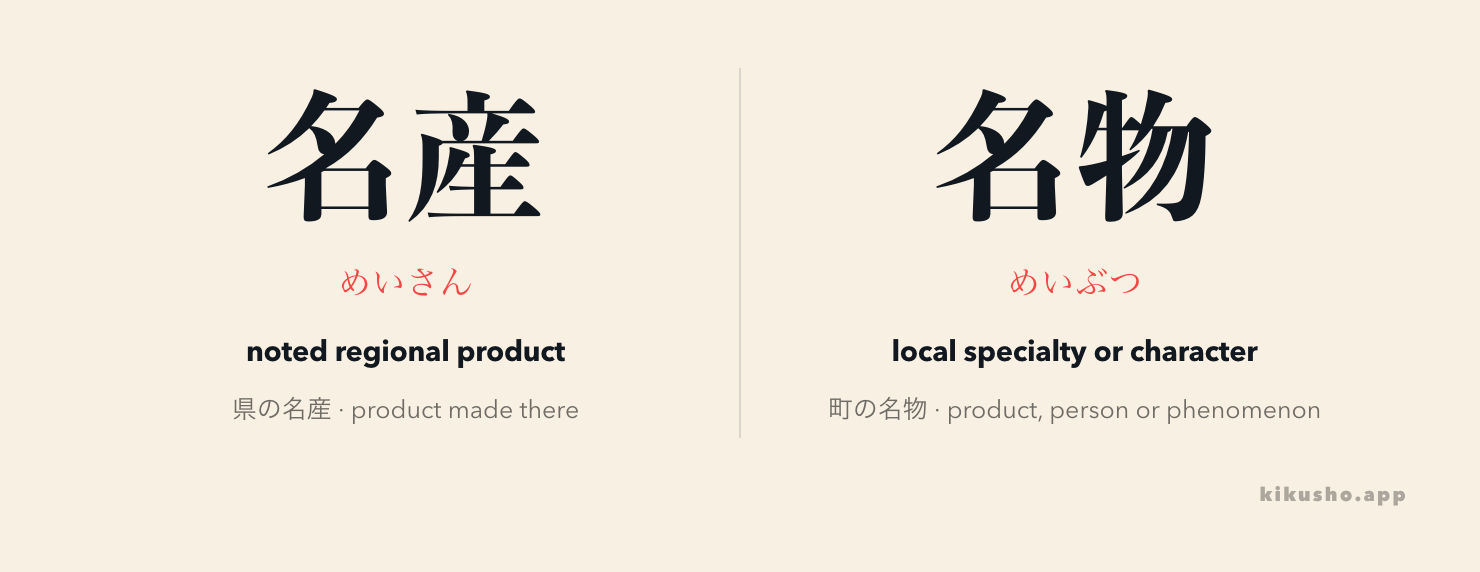
The earlier N2 sightseeing lesson teaches 名物, which can be a food or product but can also be a famous person or characteristic phenomenon. A school's 名物教師 is not its 名産. When a label stresses a region's renowned tea, pottery, fruit or craft as something produced there, 名産 is the tighter word.
One long-weekend itinerary uses every record
三連休を利用して日本を訪れました。空港の国際線旅客ターミナルで旅券を確認してから、市内のホテルへ向かいました。フロントに荷物を預け、午後はガイドと古い町並みを歩きました。翌日は海辺の民宿に泊まり、帰りに地域の名産である焼き物を買いました。
さんれんきゅうを りようして にほんを おとずれました。くうこうの こくさいせん りょかくターミナルで りょけんを かくにんしてから、しないの ホテルへ むかいました。フロントに にもつを あずけ、ごごは ガイドと ふるい まちなみを あるきました。よくじつは うみべの みんしゅくに とまり、かえりに ちいきの めいさんである やきものを かいました。
I used the three-day holiday to visit Japan. After checking my passport at the airport's international passenger terminal, I headed to a hotel in the city. I left my luggage at the front desk and walked through the old town with a guide in the afternoon. The next day I stayed at a minshuku by the sea and bought pottery, a noted product of the region, on my way home.
Each noun keeps its institution or object. The 旅客ターミナル processes people, while the 旅券 identifies one traveller. The フロント belongs to hotel service; the 民宿 is the later lodging establishment. 名産 selects the pottery as a regional product rather than simply something memorable.
All eight assigned records are placed at N1 by Kikusho's two baseline files, but those files descend from the same Tanos/Waller family. JapaneseTest4You separately indexes 訪れる at N1, with its reading and sense checked here against Japanese dictionaries. Official JLPT descriptions define proficiency bands rather than issuing a word-by-word N1 ledger. The label tells you where this lesson sits in a study plan; the dictionary and government sources establish what the words mean and how current travel material uses them.
For review, retain the combinations that reveal the register: 三連休, 旅券を申請する, 旅客ターミナル, 観光地を訪れる, 観光ガイド, ホテルのフロント, 民宿に泊まる, 地方の名産. Eight isolated English glosses would lose the distinctions that make the set useful.
Complete the itinerary before opening the explanations
Question 1 · identify the passport term
How is 旅券 read in an official application notice?
- ア. りょかん
- イ. りょけん
- ウ. たびけん
- エ. りょきゅう
Question 2 · read the passenger compound
Which reading fits 旅客ターミナル and the assigned inventory record?
- ア. りょかく
- イ. りょきゃくしつ
- ウ. たびきゃく
- エ. りょけん
Question 3 · choose the hotel service point
到着後、荷物を預けられるかホテルの__に聞きました。
- ア. 名産
- イ. 旅券
- ウ. フロント
- エ. 連休
Question 4 · identify the lodging type
Which description most directly points to a 民宿?
- ア. A passenger terminal used for international flights
- イ. A small lodging establishment traditionally run from a private home
- ウ. A formal document proving nationality for overseas travel
- エ. Several adjacent days away from work
Question 5 · restate the calendar
Which sentence preserves 土曜日から月曜日まで、三日続けて休みです?
- ア. 月曜日だけが休日です。
- イ. 三連休です。
- ウ. 三日間、旅券を申請します。
- エ. 飛び石連休で、毎日仕事があります。
Question 6 · give 訪れる its travel object
Which sentence uses 訪れる naturally for a trip?
- ア. 観光客が春に古い港町を訪れた。
- イ. 旅券がフロントを訪れて申請した。
- ウ. ガイドを連休が訪れる民宿です。
- エ. 名産が旅客を訪れて泊まった。
Question 7 · keep product and local character separate
Choose the natural pair.
この県の__は漆器です。駅前の市場そのものも町の__になっています。
- ア. 名産, then 名物
- イ. 名物教師, then 旅券
- ウ. フロント, then 名産
- エ. 旅客, then 民宿
Question 8 · follow the complete trip
What does the passage describe?
連休中は空港が旅客で混雑していた。旅券を見せて到着ロビーを出ると、予約したガイドが待っていた。ホテルのフロントで翌日の民宿への行き方を聞き、その地方の名産についても教えてもらった。
- ア. A traveller replaces a passport with a regional product at a deserted airport.
- イ. During a busy holiday, a passenger shows a passport, meets a guide, asks the hotel desk for directions to a minshuku and learns about a regional product.
- ウ. A guide applies for three days off and turns a hotel into a passenger terminal.
- エ. A minshuku employee cancels every flight during the holiday.
Answers and explanations
1. りょけん(イ). 旅券 is the formal word for a passport. 旅館 is read りょかん and names an inn, while the remaining readings do not identify this document.
2. りょかく(ア). 旅客 is normally read りょかく in compounds such as 旅客機 and 旅客ターミナル. Dictionaries also record りょきゃく, but option イ adds a syllable and a different ending that are absent from 旅客.
3. フロント(ウ). A hotel guest asks the front desk about leaving luggage. The other choices name a regional product, a passport and a block of holidays.
4. The small lodging establishment(イ). 民宿 traditionally uses a private home as a modest lodging business. That does not make it a passenger terminal, passport or calendar term.
5. 三連休です(イ). Three adjacent days off form a three-day holiday. 飛び石連休 would contain intervening workdays, which contradicts 三日続けて.
6. 観光客が春に古い港町を訪れた(ア). The traveller visits the port town, so the place takes を. The other sentences assign visiting, applying and staying to objects that cannot perform those actions coherently.
7. 名産, then 名物(ア). The lacquerware is a noted product produced in the prefecture, so 名産 is precise. A market can become a town's 名物 because 名物 extends beyond products to characteristic places, people and phenomena.
8. The full arrival and lodging sequence(イ). 旅客 explains the crowded airport users, 旅券 the document shown, ガイド the person waiting, フロント the hotel service point, 民宿 the next lodging and 名産 the regional product discussed.
Common questions
What is the difference between 訪れる and 訪ねる?
訪れる(おとずれる) readily takes a place as its object, as in 京都を訪れる, and can also describe a season or situation arriving, as in 春が訪れる. 訪ねる(たずねる) often focuses on going to see a person, as in 先生を訪ねる, though it can also take a place connected with the purpose of the visit.
Are 旅券 and パスポート different documents?
No. 旅券(りょけん) is the formal Japanese term for a passport, while パスポート is the common loanword. Government pages frequently write 旅券(パスポート) and use 旅券 in compounds such as 旅券申請 and 旅券番号.
What is the difference between 旅客 and 乗客?
旅客(りょかく) is a passenger or traveller and is common in transport, administrative and compound terms such as 旅客機 and 旅客運賃. 乗客 (じょうきゃく) focuses on people riding a particular vehicle. The groups can overlap, but the words choose different viewpoints.
How are 民宿, 民泊 and 旅館 different?
民宿(みんしゅく) is a small lodging establishment traditionally operated from a private home, often by a family. 民泊(みんぱく) describes paid lodging in a residence or room under modern home-sharing arrangements. 旅館 (りょかん) is the broader Japanese-style inn category.