On this page
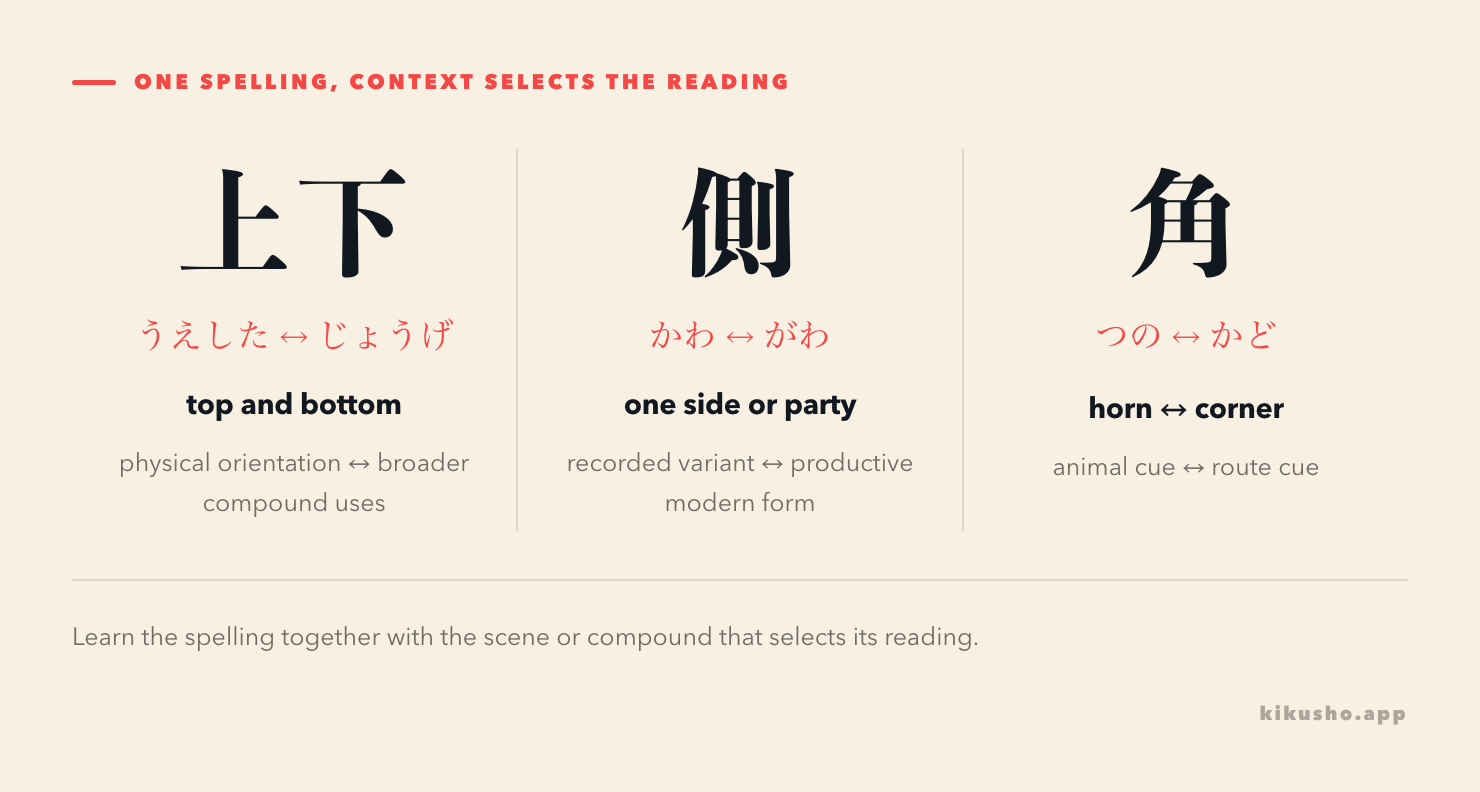
二つ目の角を曲がる uses 角(かど), “corner”; 鹿の角 uses 角(つの), “horn.” The six records assigned to this N1 set are most useful as a lesson in reading control: a map supplies context, but it does not make every word on the page a route word or an N1 word.
The exact records are 上下(うえした), 側(かわ), 側(がわ), 角(つの), 遠回り(とおまわり) and 曲がる(まがる). You will keep each source reading visible, learn the phrases that are natural today, and separate them from nearby readings that the same kanji invites.
Six records belong together because context chooses the reading
| Assigned record | Word class and sense taught | Phrase to keep | Essential contrast |
|---|---|---|---|
| 上下(うえした) | noun: top and bottom; the two ends reversed | 上下を間違える, confuse top and bottom | 上下(じょうげ) is the broader productive reading |
| 側(かわ) | noun variant: side, direction or party | a recorded variant of がわ | modern compounds normally surface as がわ |
| 側(がわ) | noun or suffix-like noun: one side, direction or party | 道の反対側, the opposite side of the road | 側(そば) means near or beside |
| 角(つの) | noun: an animal horn or horn-like projection | 鹿の角, a deer's antler | 角(かど) is a street corner |
| 遠回り(とおまわり) | noun; also 遠回りする: detour, roundabout route | 遠回りをする, take a detour | can also describe an indirect process |
| 曲がる(まがる) | godan intransitive verb: turn or bend | 角を曲がる; 道が曲がる | the route point can take を; the road itself takes が |
This is a spelling-and-reading set, not six synonyms. The N5 route lesson establishes the beginner sequence 地図を見る → 角を曲がる → 道を渡る. The present lesson asks what happens when the same written forms carry other readings, when a source level conflicts with common teaching order, and when a dictionary variant is less useful than its voiced form.
上下(うえした) points to concrete top and bottom
上下(うえした) can name the upper and lower parts of something. It also appears when those ends are mistaken or reversed:
地図の上下を間違えていた。
ちずの うえしたを まちがえて いた。
I had the map upside down; I had confused its top and bottom.
The reading is not a license to pronounce every 上下 as うえした. 上下(じょうげ) covers top and bottom, high and low, vertical movement and rank in a much wider range of current expressions: 上下する, move up and down; 上下関係, hierarchical relationship; 上下線, inbound and outbound lines. Shogakukan's dictionaries list both うえした and じょうげ under 上下, with 上下を間違える and an upside-down box illustrating the concrete うえした reading.
The inherited English gloss for this record also mentions loading and unloading, praise and blame, and high and low. Those meanings belong to the wider history of the spelling, related expressions or other readings. They are poor retrieval cues for うえした. Keep “top and bottom, especially when their physical order matters” as the usable centre.
側(かわ) and 側(がわ) are variants with unequal modern weight
The two assigned rows share one dictionary identity. Kanjipedia's 側 entry gives がわ for one of two opposed sides, a party or standpoint, and an outer edge; it adds that かわ is also a reading. Shogakukan's entry likewise records かわ, with がわ as a variant.
That does not make the variants equally productive in a route sentence. The forms you are likely to say and see are voiced:
資料館は道の反対側にある。
しりょうかんは みちの はんたいがわに ある。
The museum is on the opposite side of the road.
川の向こう側へ渡る。
かわの むこうがわへ わたる。
Cross to the other side of the river.
北側(きたがわ), 右側(みぎがわ), 外側(そとがわ), 利用者側(りようしゃがわ) and 向こう側(むこうがわ) all use がわ. It can label a physical side or the people occupying a standpoint. In this family, the initial voicing is part of the stored modern expression, much as many compound readings cannot be predicted by looking at the isolated kanji alone.
The inventory's 側(かわ) row still deserves explicit coverage: it is a dictionary-attested variant and helps explain why reference works may normalize the same entry differently. It is not a recommendation to replace 反対側(はんたいがわ) with an artificial はんたいかわ. For production, retrieve the full compound you met.
Do not mix either one with 側(そば), “near, beside.” 駅のそば locates something near a station; 駅の反対側(はんたいがわ) locates it on an opposed side. The location-word lesson develops そば, 横, 隣 and 向こう as spatial relations.
角(つの) is the horn, while the route turns at 角(かど)
角(つの) names an animal's horn or antler and, by extension, a horn-like projection. It does not mean the corner in a direction:
入口に角の大きな鹿の像がある。
いりぐちに つのの おおきな しかの ぞうが ある。
At the entrance there is a statue of a deer with large antlers.
二つ目の角を右に曲がる。
ふたつめの かどを みぎに まがる。
Turn right at the second corner.
Kanjipedia and Shogakukan's 角 entry both distinguish つの, the animal projection, from かど, an edge or corner. A route headline can tempt a writer to silently turn the assigned つの record into かど. Keeping both sentences together prevents that error and gives the written character two strong scenes.
The route sentence contains a second useful detail. 角を曲がる is conventional even though 曲がる is intransitive. Here を marks the point or path traversed, as it does in movement expressions such as 道を歩く and 橋を渡る. It does not turn 角 into a direct object being altered.
遠回り can be a detour through streets or through a process
遠回り(とおまわり) names a route that goes farther around. It combines naturally with する, になる and させる:
工事中だったので、駅まで遠回りをした。
こうじちゅうだったので、えきまで とおまわりを した。
Because of the construction, I took a detour to the station.
この道を通ると遠回りになる。
この みちを とおると とおまわりに なる。
Taking this road will make the route longer.
The same noun can evaluate an indirect method:
基礎から学び直すほうが、遠回りに見えても確実だ。
きそから まなびなおす ほうが、とおまわりに みえても かくじつだ。
Starting over from the basics is reliable, even if it looks like the long way around.
The figurative sentence preserves the route image. It does not simply mean “difficult” or “slow.” A method is 遠回り because it reaches the goal indirectly or after extra stages.
曲がる changes construction when the road becomes the subject
曲がる(まがる) is a godan, intransitive verb. Its polite form is 曲がります, its plain past is 曲がった, and its て-form is 曲がって. Route instructions often place the turn point before を:
次の角を左に曲がってください。
つぎの かどを ひだりに まがって ください。
Please turn left at the next corner.
When the road's shape is the claim, the road becomes the subject:
この先で道が大きく曲がっている。
この さきで みちが おおきく まがって いる。
The road bends sharply ahead.
The first sentence follows a route; the second describes geometry. 道を曲がる can mean turn into or along a road in context, while 道が曲がる says the road itself bends. Keeping the particle with the whole clause is more reliable than memorizing “曲がる takes を.”
An independent level check matters here. The inherited Waller-family row labels 曲がる N1, but JLPT Sensei lists 曲がる as N5 vocabulary. Its common route sense is also introduced in beginner materials. Kikusho keeps the assigned row visible for auditability, while treating the N1 label as disputed rather than presenting a beginner verb as an advanced discovery.
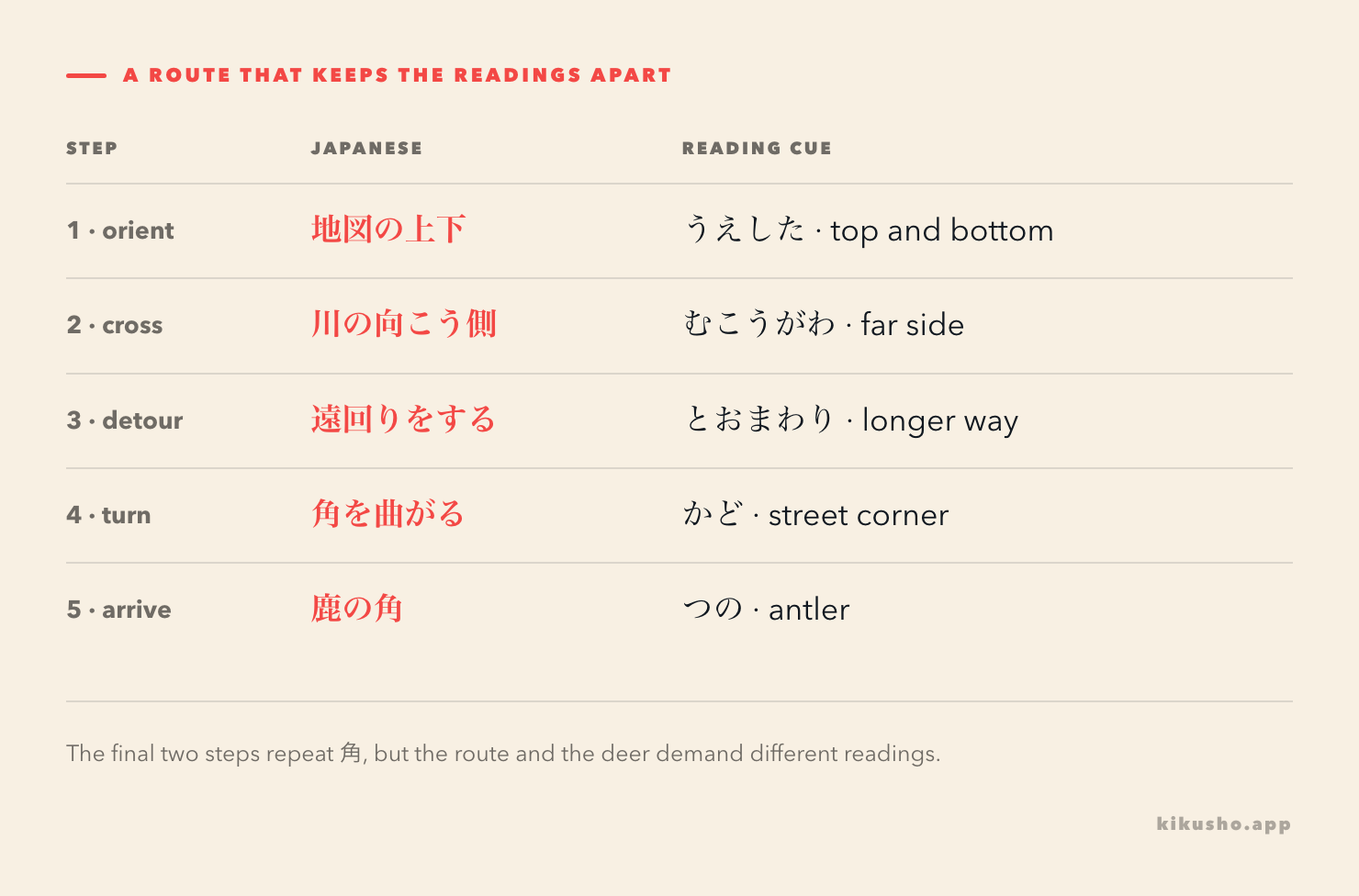
One route can hold all six records without blurring them
地図の上下を間違えないように確認し、川の向こう側にある資料館を目指した。工事中だったので遠回りし、二つ目の角を曲がると、入口に角の大きな鹿の像が見えた。
ちずの うえしたを まちがえない ように かくにんし、かわの むこうがわに ある しりょうかんを めざした。こうじちゅうだったので とおまわりし、ふたつめの かどを まがると、いりぐちに つのの おおきな しかの ぞうが みえた。
I checked which way up the map was and headed for the museum on the far side of the river. Construction forced me to take a detour; after I turned at the second corner, I saw a statue of a deer with large antlers at the entrance.
The scene does not force 側(かわ) into a phrase where modern Japanese prefers がわ. Its place in the lesson is metalinguistic: it explains the dictionary variant behind the assigned record. That distinction is part of knowing the item, just as recognizing that 角(つの) is irrelevant to a street corner is part of knowing 角.
When you save a sentence from a map, sign or novel in Kikusho, retain the characters that chose the reading. 二つ目の角を曲がる preserves かど; 鹿の角 preserves つの; 川の向こう側 preserves がわ. A bare 角 or 側 asks your memory to reconstruct a decision that the original sentence had already made.
The level labels come from dated study lists, not an official syllabus. Kikusho's two source files descend from the same Tanos/Waller family, so their agreement on 遠回り is one lineage rather than two independent votes. JLPT Sensei places the common 角(かど) noun and 曲がる at beginner level, while its kanji page places 角 at N2. The JLPT's official guide describes skills and test sections but does not supply an exhaustive word list. This page therefore teaches the six assigned records and reports the boundaries instead of claiming all six are exclusively N1.
Test the reading before you reveal the answers
Question 1: kanji reading. In the sentence below, how is 上下 read?
地図の上下を間違えていた。
- A. じょうか
- B. うえした
- C. かみしも
- D. じょうげする
Question 2: context. Which reading of 角 completes the route instruction?
二つ目の角を右に曲がってください。
- A. つの
- B. すみ
- C. かど
- D. かく
Question 3: context. Which reading of 角 completes the description of the deer?
あの鹿は角が大きい。
- A. つの
- B. かど
- C. すみ
- D. かく
Question 4: usage. Choose the natural reading and phrase for “the opposite side of the road.”
- A. 道の反対側(はんたいかわ)
- B. 道の反対側(はんたいがわ)
- C. 道の反対側(はんたいそば)
- D. 道の反対側(はんたいそく)
Question 5: particle and meaning. The road itself bends sharply ahead. Complete the sentence.
この先で道__大きく曲がっている。
- A. を
- B. に
- C. が
- D. へ
Question 6: paraphrase. Which sentence best paraphrases この道を通ると遠回りになる?
- A. この道なら目的地に早く着く。
- B. この道は通ることができない。
- C. この道を使うと余分に回ることになる。
- D. この道は大きく曲がっている。
Question 7: sentence composition. Put these chunks in a natural order to say, “Because it was under construction, I took a detour to the station.”
工事中だったので / 駅まで / 遠回りをした
Question 8: reading control. Read the connected sentence aloud, then write the two different readings of 角 in order.
二つ目の角を曲がると、角の大きな鹿の像が見えた。
Answers and explanations
1. Read うえした (choice B). The lesson's assigned record is 上下(うえした), and this sentence focuses on confusing the map's physical top and bottom. じょうげ is another common reading, but choice D adds a verb that is absent from the sentence; じょうか and かみしも do not fit this route context.
2. Read かど (choice C). A turn happens at a street corner, 角(かど). つの is a horn, すみ is a corner or recess seen as an inside area, and かく appears in compounds such as 角度.
3. Read つの (choice A). An animal's horn or antler is 角(つの). The deer's body supplies the cue that the spelling did not.
4. Use 道の反対側(はんたいがわ), choice B. Modern route phrases use がわ in 反対側, 向こう側 and 右側. Dictionaries record かわ as a variant, but はんたいかわ is not the productive form to retrieve here. そば means near or beside, and そく belongs to compounds such as 側面 rather than this phrase.
5. Insert が (choice C). 道が曲がっている describes the road as the thing whose shape bends. 角を曲がる uses を for the point followed on a route, but that is a different construction.
6. Choose C. 余分に回ることになる says the route makes you go farther around, which preserves the meaning of 遠回りになる. A promises speed, B says the road is impassable, and D describes a bend rather than an indirect route.
7. 工事中だったので、駅まで遠回りをした。 The reason comes first with ので, 駅まで names the endpoint, and 遠回りをした reports taking the detour. The phrase does not claim the station itself moved or became distant.
8. Read かど, then つの. 二つ目の角を曲がる selects the street-corner reading かど. 角の大きな鹿 selects the animal-horn reading つの. The repeated spelling is the trap; the surrounding nouns and verb resolve it.
Common questions
Is 角 read つの or かど in Japanese directions?
In a route phrase such as 二つ目の角を曲がる, 角 is read かど and means a corner. 角(つの) means an animal horn or a horn-like projection. The spelling alone does not determine the reading.
What is the difference between 上下(うえした) and 上下(じょうげ)?
Both can refer to top and bottom. うえした is useful when the two concrete ends or their reversal are in view, as in 上下を間違える. じょうげ is the productive reading in compounds and broader expressions such as 上下する and 上下関係.
Is 側 read かわ or がわ?
Dictionaries record かわ and がわ for the same family of senses, but modern route and standpoint phrases normally use がわ, as in 反対側, 北側 and 利用者側. Treat かわ as a recorded variant, not as a cue to force かわ into those familiar compounds.
Is 曲がる really N1 vocabulary?
No official exhaustive JLPT vocabulary list exists. Kikusho's inherited source row labels 曲がる N1, while JLPT Sensei and other learner lists place the common turn-or-bend verb at N5. This lesson records that disagreement.