On this page
Advanced Japanese finance vocabulary is less about replacing お金 with a difficult synonym than about identifying roles. 家計 has a balance, 賃金 and 報酬 enter by different routes, 融資 creates an amount to 返済する, and 利子 or 利息 names the cost attached to time.
This N1 set teaches 15 assigned entries, including two traps that a money theme could hide: 釣り(つり) also means fishing, and 札(ふだ) is a tag or card rather than the banknote reading さつ.
The 15 words form four practical groups
The table keeps every headword selectable and pairs it with a phrase that fixes its role.
| Word | Reading | Part of speech | Sense taught here | Phrase to recognise |
|---|---|---|---|---|
| 赤字 | あかじ, akaji | noun | deficit; being in the red | 赤字になる: run a deficit |
| 家計 | かけい, kakei | noun | household finances or budget | 家計を管理する: manage household finances |
| 貨幣 | かへい, kahei | noun | money or currency; coins in Japanese legal usage | 貨幣価値: monetary value |
| 黒字 | くろじ, kuroji | noun | surplus; being in the black | 黒字に転じる: move into surplus |
| 貯蓄 | ちょちく, chochiku | noun; suru verb | savings; accumulating saved assets | 貯蓄を取り崩す: draw down savings |
| 賃金 | ちんぎん, chingin | noun | wages paid for labour | 賃金を支払う: pay wages |
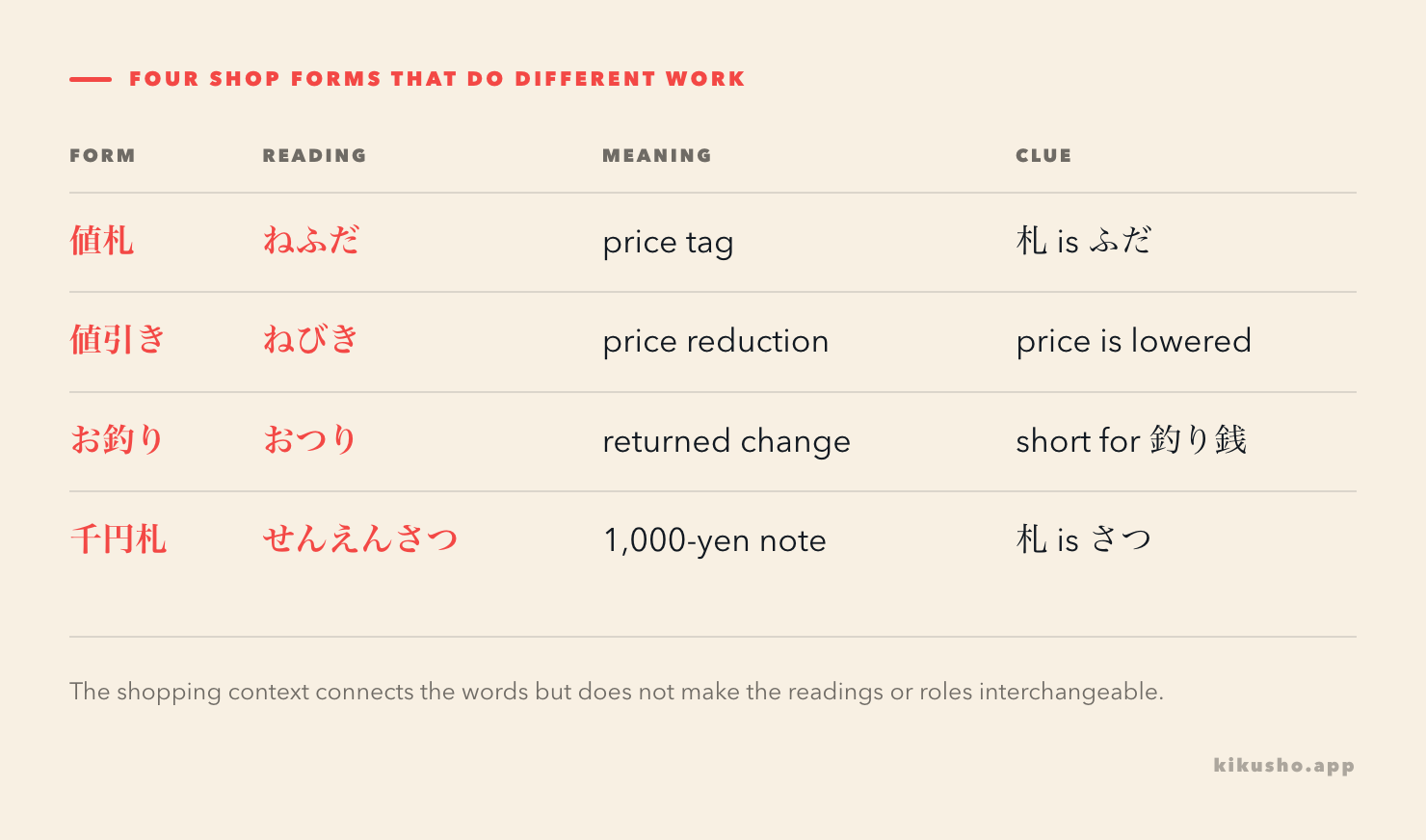
| 釣り | つり, tsuri | noun; suru verb | fishing; also change as an abbreviation of 釣り銭 | お釣りを受け取る: receive change |
| 値引き | ねびき, nebiki | noun; suru verb | price reduction; markdown | 値引きを交渉する: negotiate a reduction |
| 札 | ふだ, fuda | noun | tag, label, card or talisman | 値札を付ける: attach a price tag |
| 返済 | へんさい, hensai | noun; suru verb | repayment | 借入金を返済する: repay borrowed funds |
| 報酬 | ほうしゅう, hōshū | noun | remuneration, fee or reward | 報酬を受け取る: receive compensation |
| 融資 | ゆうし, yūshi | noun; suru verb | financing or a loan provided | 融資を受ける: obtain financing |
| 預金 | よきん, yokin | noun; suru verb | bank deposit; money held on deposit | 銀行に預金する: deposit money at a bank |
| 利子 | りし, rishi | noun | interest on borrowed or deposited money | 利子が付く: earn or accrue interest |
| 利息 | りそく, risoku | noun | interest on borrowed or deposited money | 利息を払う: pay interest |
These are not fifteen names for cash. They describe a household result, stored assets, compensation, a loan relationship, the cost of borrowing, a retail adjustment and two written forms whose reading changes with context.
家計 moves between 赤字, 黒字 and 貯蓄
家計(かけい) treats a household as one financial unit. It appears in 家計簿, a household account book, 家計管理, household financial management, and the official 家計調査, Family Income and Expenditure Survey.
物価が上がり、家計の負担が増えています。
ぶっかがあがり、かけいのふたんがふえています。
Prices are rising, increasing the burden on household finances.
赤字(あかじ) means expenses exceed income or a loss remains. 黒字(くろじ) gives the opposite result. The dictionary account of 黒字 traces the pair to recording a surplus in black and a shortfall in red.
支出が収入を上回り、今月の家計は赤字になりました。
ししゅつがしゅうにゅうをうわまわり、こんげつのかけいはあかじになりました。
Spending exceeded income, so the household ran a deficit this month.
固定費を見直した結果、家計は黒字に転じました。
こていひをみなおしたけっか、かけいはくろじにてんじました。
After reviewing fixed expenses, the household moved into surplus.
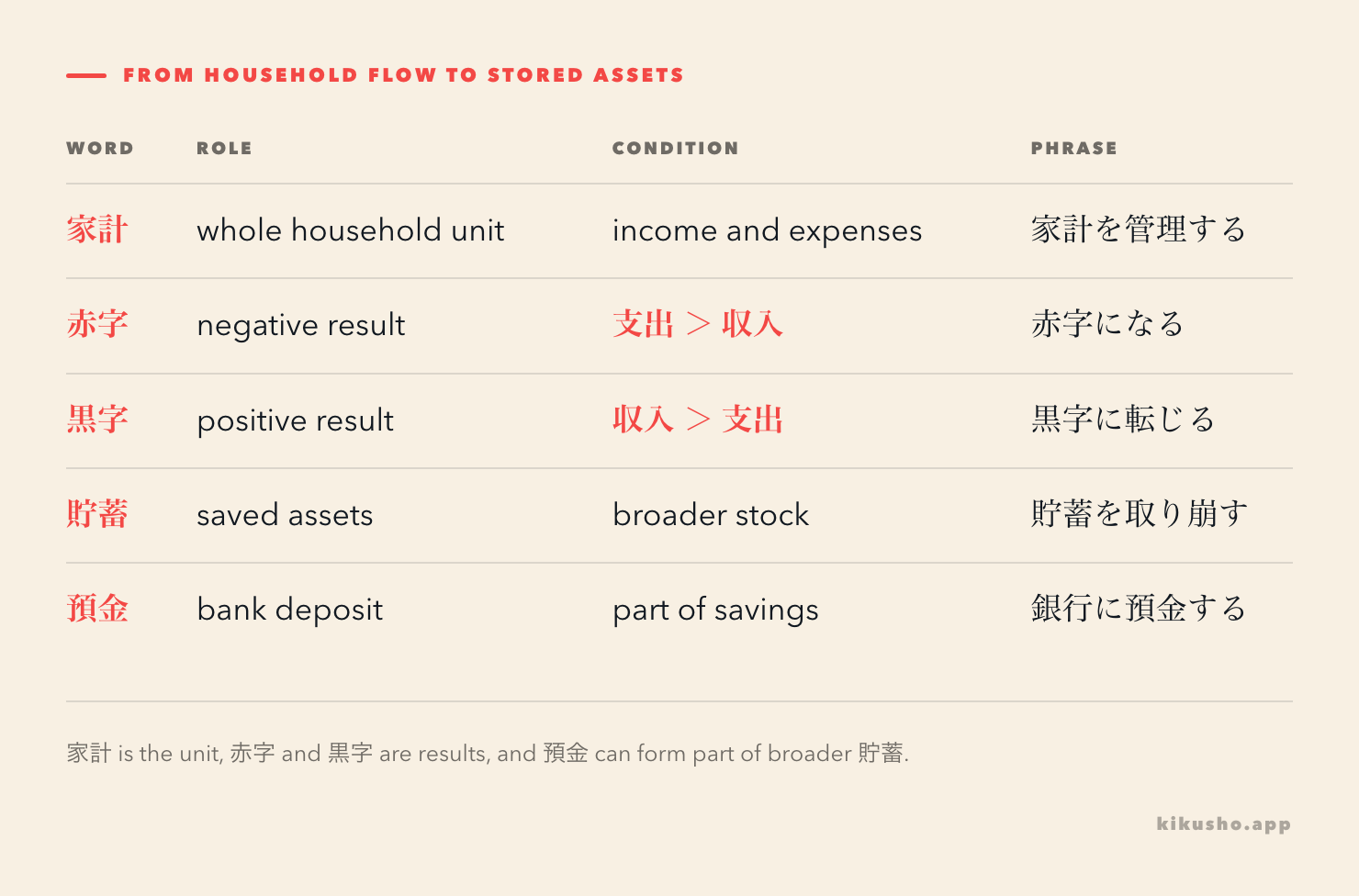
貯蓄(ちょちく) is broader than money in one bank account. The Statistics Bureau's definition used for household surveys includes deposits, securities, paid life-insurance amounts and some savings outside financial institutions.
収入が減ったため、貯蓄を取り崩して生活費に充てました。
しゅうにゅうがへったため、ちょちくをとりくずしてせいかつひにあてました。
Because income fell, we drew down savings to cover living expenses.
預金(よきん) is narrower: money placed with a bank, or the resulting deposit. A household's 預金 can therefore be one component of its 貯蓄. The Financial Services Agency's deposit-insurance page uses compounds such as 普通預金 and 定期預金 and discusses the principal and interest protected for a depositor.
賃金 is employment pay; 報酬 reaches further
賃金(ちんぎん) is the formal employment category for what an employer pays a worker in return for labour. The Labour Standards Act explanation says the name does not decide the category: salary, allowances and specified bonuses can all count as 賃金 when they are paid as consideration for labour.
会社は毎月決まった日に賃金を支払います。
かいしゃはまいげつきまったひにちんぎんをしはらいます。
The company pays wages on a fixed day each month.
報酬(ほうしゅう) is wider. Digital Daijisen covers money or goods given in return for labour or the use of something. It can describe a professional fee, compensation for a task, or a reward offered for useful information.
翻訳の仕事に対する報酬を受け取りました。
ほんやくのしごとにたいするほうしゅうをうけとりました。
I received compensation for the translation work.
A freelancer's fee is naturally 報酬, while employment law asks whether a payment is 賃金. In ordinary company language, the N2 lesson on 給与 adds the payroll and administrative term. The categories can overlap in real life, but they answer different questions: what kind of relationship produced the payment, and how is the payment being classified?
融資 begins the credit relationship; 返済 closes it
From the lender's side, 融資(ゆうし) is the provision of funds. A bank 融資する; a business or household 融資を受ける.
銀行から事業資金の融資を受けました。
ぎんこうからじぎょうしきんのゆうしをうけました。
We obtained business financing from a bank.
From the borrower's side, 返済(へんさい) is paying back what was borrowed:
借入金は五年かけて返済する予定です。
かりいれきんはごねんかけてへんさいするよていです。
We plan to repay the borrowed funds over five years.
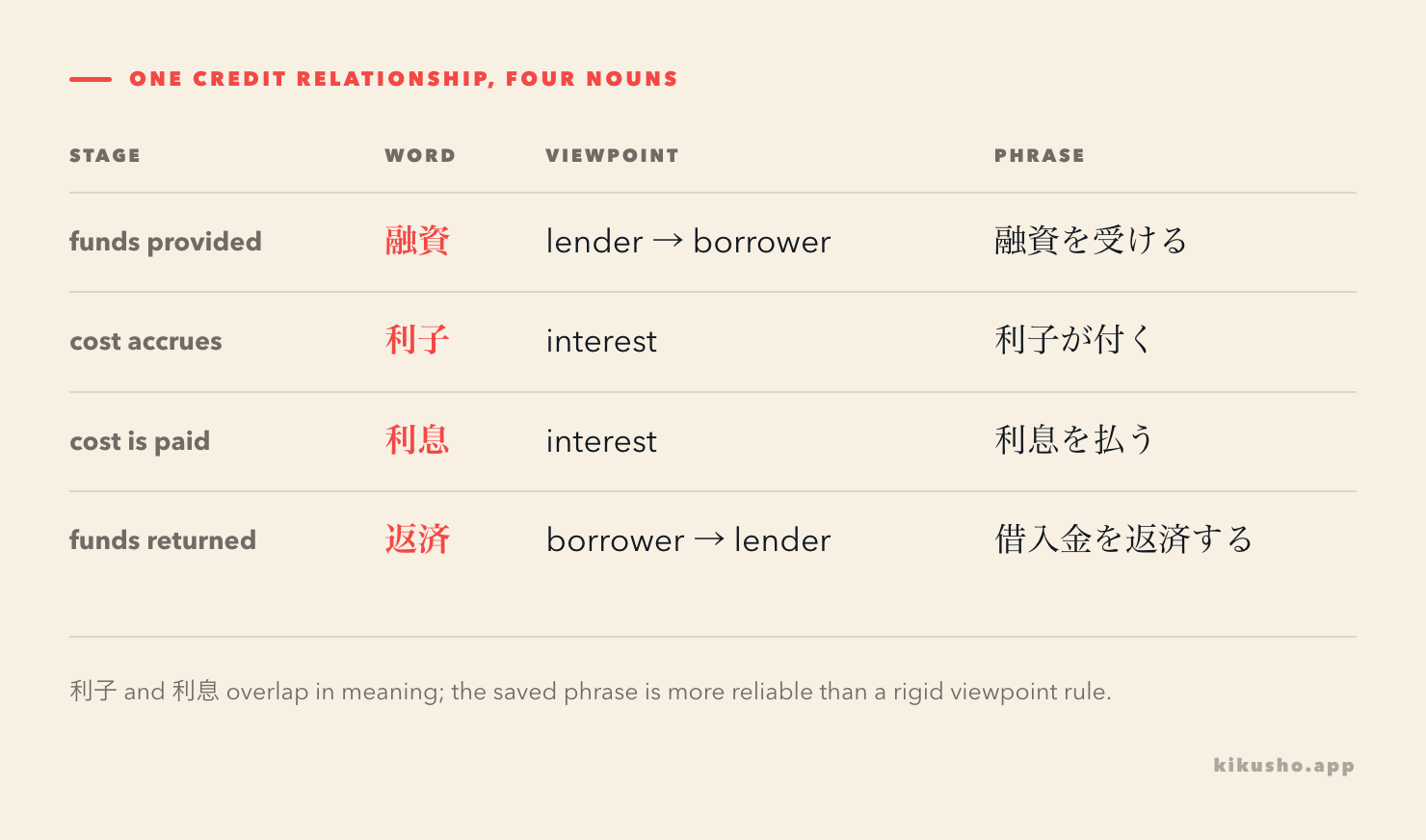
利子(りし) and 利息(りそく) both name interest. A tempting learner rule says one belongs to the receiver and the other to the payer, but Digital Daijisen's usage note says there is no semantic difference in ordinary examples such as paying interest on borrowed money or interest accruing on lent money.
Use the collocation an institution or document gives you:
- 預金に利子が付く: interest accrues on a deposit
- 借入金の利息を払う: pay interest on borrowed money
- 利息を含めて返済する: repay including interest
- 無利子融資: interest-free financing
金利(きんり) is the rate or interest-rate condition, while 利子 and 利息 can name the money calculated from it. This distinction matters more reliably than assigning the two synonyms to opposite sides of every transaction.
貨幣 changes scope in economic and legal writing
貨幣(かへい) can mean money or currency in economic discussion. It appears in 貨幣価値, monetary value, and 貨幣制度, monetary system.
インフレが進むと、貨幣価値が下がることがあります。
インフレがすすむと、かへいかちがさがることがあります。
As inflation advances, the value of money may fall.
Japanese legal and central-bank writing uses a narrower contrast. The Bank of Japan's payment-means guide explains that 銀行券(お札) and 貨幣(硬貨) are both payment means, and together form 現金通貨. Its historical operations guide notes that ordinary usage can call notes and coins 貨幣 collectively, while current Japanese legal terminology uses 貨幣 specifically for coins.
That makes context decisive. 貨幣価値 is not “the value of coins” alone. In 銀行券・貨幣, however, the second noun is deliberately the coin side of the contrast.
値引き changes a price, while 釣り and 札 change sense
値引き(ねびき) means making a price lower than the listed or standard price. The dictionary definition also records negotiation over the reduction.
展示品だったので、店員が五千円値引きしてくれました。
てんじひんだったので、てんいんがごせんえんねびきしてくれました。
Because it was a display item, the clerk reduced the price by ¥5,000.
The N2 word 割引 often builds a rate or eligibility rule such as 二割引 or 学生割引. 値引き readily describes lowering this particular item's price or negotiating the amount. They overlap, so context and the seller's wording decide; neither requires a completely different arithmetic system.
釣り(つり) first means fishing in the assigned source record:
休日は川へ釣りに行きます。
きゅうじつはかわへつりにいきます。
On days off, I go fishing at the river.
The same noun can abbreviate 釣り銭, the change returned after payment. In a transaction, the polite お釣り is the form to expect:
一万円札で払って、お釣りを受け取りました。
いちまんえんさつではらって、おつりをうけとりました。
I paid with a 10,000-yen note and received change.
札(ふだ) is the other reading trap. As ふだ it means a tag, label, card or talisman, and it appears in 値札(ねふだ), price tag. The banknote reading in 一万円札 is さつ.
値札を確認してから、値引きをお願いしました。
ねふだをかくにんしてから、ねびきをおねがいしました。
After checking the price tag, I asked for a reduction.
This page therefore keeps the exact assigned 釣り and 札 entries visible instead of silently rewriting them as only お釣り and 札(さつ) to fit the theme.
The N1 label describes a study sequence
Kikusho's September 2026 inventory places all 15 spelling-and-reading records here and reports no retained level disagreement. Its two core files reuse the same Waller/Tanos lineage, so that matching label is one family observation. JapaneseTest4You separately indexes several headwords at N1, while current advanced lists from J-Compass, Benri Japan and other teaching sites overlap with the financial terms.
The JLPT does not publish a complete current vocabulary list. N1 is therefore an editorial placement for this reference set, not a claim that every word is rare or guaranteed to appear. Some forms, including お釣り and 値札, can be encountered much earlier; the N1 work here lies in keeping technical scope, register and near-synonyms straight inside dense financial prose.
Ten attempts before the explanations
Complete every question before opening the answer block.
Question 1 — readings. Give the readings of 赤字 and 黒字 in order.
Question 2 — reading. Which reading matches 貯蓄?
- ア. ちょちく
- イ. ちょじく
- ウ. ちょうちく
- エ. じょちく
Question 3 — context. Complete the sentence: 収入と支出を見直して、( )を管理する。
- ア. 報酬
- イ. 家計
- ウ. 貨幣
- エ. 利息
Question 4 — scope. Which statement is accurate?
- ア. 預金 is always broader than 貯蓄.
- イ. 貯蓄 can include bank deposits and other saved financial assets.
- ウ. 貯蓄 means only cash kept at home.
- エ. 預金 means a household deficit.
Question 5 — roles. Complete with two different words: 銀行から事業資金の(甲)を受け、毎月少しずつ(乙)している。
Question 6 — synonyms. Which statement best describes 利子 and 利息?
- ア. 利子 is always received; 利息 is always paid.
- イ. 利子 applies only to coins; 利息 applies only to banknotes.
- ウ. Both can mean interest, and fixed collocations or institutional wording guide the choice.
- エ. One means principal and the other means repayment.
Question 7 — register and scope. A freelance designer receives money for one completed project. Which noun most directly names that compensation without asserting an employer-worker legal category?
- ア. 賃金
- イ. 報酬
- ウ. 預金
- エ. 貨幣
Question 8 — usage. Which sentence is natural?
- ア. 銀行が借り手から融資を受けた。
- イ. 借入金を五年で返済する。
- ウ. 家計を一万円札に転じる。
- エ. 利息を値札に預金する。
Question 9 — readings in a shop. Give the readings of the bold words: 値札を見て、一万円札で払った。
Question 10 — connected text. Read the passage and choose the accurate account.
賃金が上がらない一方で支出が増え、家計は二か月連続で赤字になった。そこで預金の一部を生活費に回し、不要な買い物を減らした結果、今月はわずかながら黒字に戻った。
- ア. Wages rose, deposits increased and the household stayed in deficit.
- イ. Spending fell immediately because the household obtained business financing.
- ウ. The household used part of its bank deposits and reduced unnecessary purchases before returning to a small surplus.
- エ. The household paid interest with a price tag and received change.
Answers and explanations
Answer 1. あかじ, then くろじ. Both end in じ. The colours identify opposite balance results in this context.
Answer 2. ア, ちょちく. 貯蓄 keeps the small ょ in ちょ and reads 蓄 as ちく. The other choices lengthen or voice sounds that do not change in this compound.
Answer 3. イ, 家計. Income and expenses are the two sides of household finances, so 家計 is what the speaker manages. The other nouns name compensation, currency or interest rather than the household unit.
Answer 4. イ. 貯蓄 is the broader category and can include 預金 as well as securities, insurance-related assets and other saved holdings. A bank deposit is neither a deficit nor limited to cash stored at home.
Answer 5. 甲=融資、乙=返済. The business receives financing from the bank, then repays the borrowed funds over time. Reversing the nouns would reverse the lender and borrower stages.
Answer 6. ウ. Standard dictionary guidance treats 利子 and 利息 as semantically interchangeable in ordinary interest sentences. Real documents establish preferences through compounds and institutional wording; a universal payer-versus-recipient rule fails.
Answer 7. イ, 報酬. 報酬 covers compensation or a fee for completed work without requiring an employment relationship. 賃金 specifically foregrounds payment from an employer to a worker as consideration for labour.
Answer 8. イ. 借入金を返済する is the ordinary repayment frame. A borrower receives 融資 from a bank, 家計 can turn 赤字 or 黒字 rather than into a banknote, and interest cannot be deposited into a price tag.
Answer 9. 値札 is ねふだ; 一万円札 ends in さつ. The same character uses its native reading in the tag compound and its on-reading in the banknote compound.
Answer 10. ウ. The text says wages did not rise while expenses did, producing two deficit months. The household then redirected part of its deposits and cut unnecessary purchases, after which it returned to a small surplus.
For review, rebuild the four chains rather than reciting fifteen translations: 家計から赤字・黒字・貯蓄へ、賃金から報酬との区別へ、融資から利子・利息・返済へ、値札から値引き・お釣りへ. Each chain preserves the relationship that makes the individual word retrievable.
Common questions
What is the difference between 利子 and 利息?
Both mean interest paid for the use of money, and standard dictionaries say they can replace each other in ordinary loan and deposit sentences. Fixed institutional phrases may prefer one, so learn the phrase rather than a rigid borrower-versus-lender rule.
What is the difference between 貯蓄 and 預金?
貯蓄 is the broader stock or act of saving and can include deposits, securities and insurance-related assets. 預金 is money deposited with a bank or a bank-deposit product, so a household's 預金 can form part of its 貯蓄.
How do 賃金 and 報酬 differ?
賃金 is payment from an employer to a worker in return for labour, including the legal employment category. 報酬 is wider compensation, remuneration, fee or reward for work, service, results or information.
Why is 札 read ふだ here but さつ in 千円札?
The assigned standalone reading ふだ means a tag, label, card or talisman and appears in 値札 and 名札. In banknote compounds such as 千円札, 札 is read さつ. The surrounding word fixes both reading and sense.