On this page
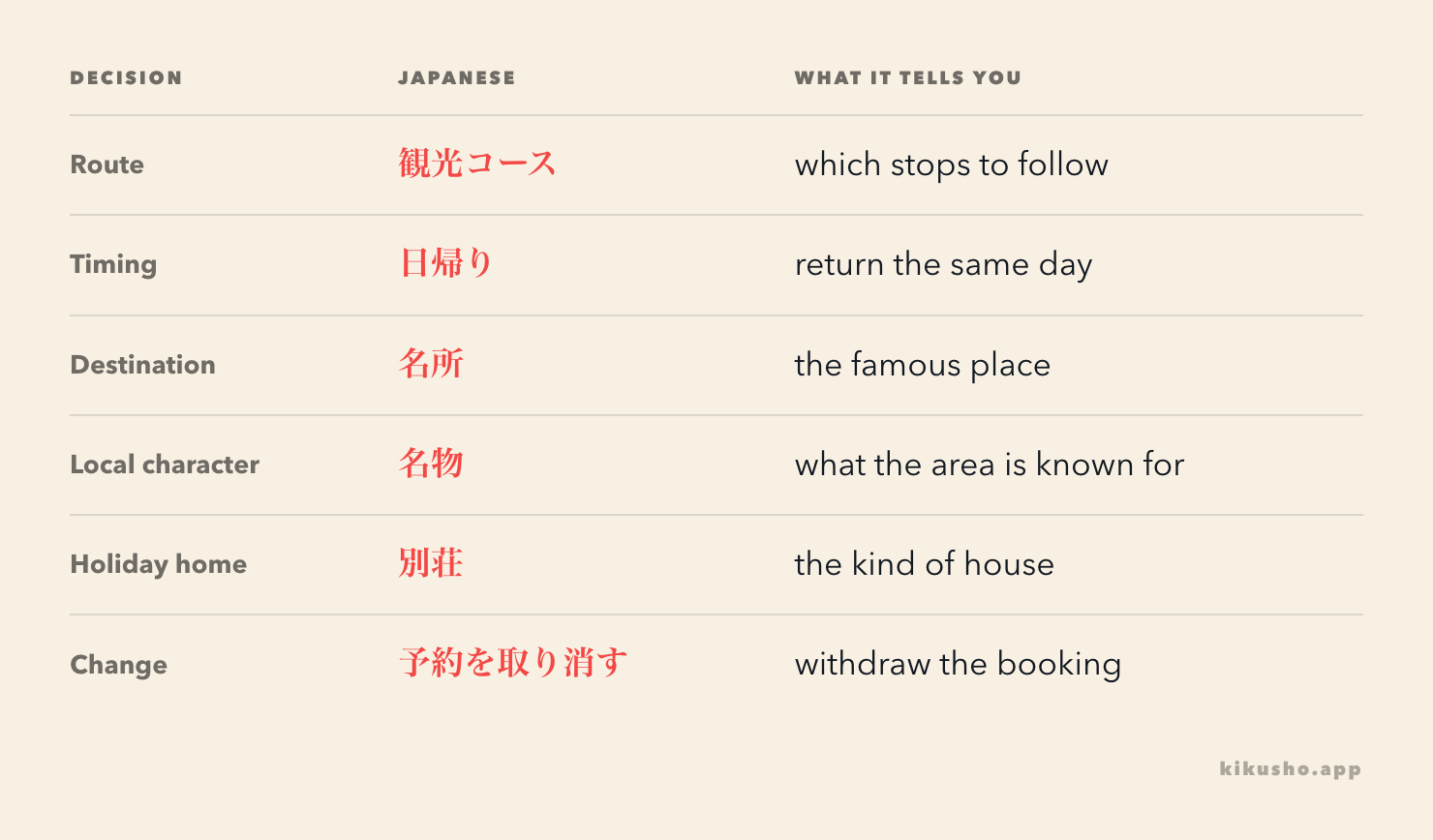
An N2 sightseeing plan separates the route, the cancellation, the length of the trip, the holiday home, the famous place and the local specialty. The six words are コース, 取り消す(とりけす), 日帰り(ひがえり), 別荘(べっそう), 名所(めいしょ) and 名物(めいぶつ).
English often compresses several of them into “trip,” “villa,” “attraction” or “cancel.” Japanese keeps the roles visible. A コース tells you how to go around; a 名所 is somewhere on that route; a 名物 is what the area is known for; and 日帰り decides whether you need accommodation at all.
Six words organise one sightseeing plan
| Headword | Part of speech and travel sense | Useful combination |
|---|---|---|
| コース | noun: a selected route, programme or sequence | 観光コース, sightseeing route |
| 取り消す(とりけす) | transitive godan verb: cancel, withdraw or revoke something decided | 予約を取り消す, cancel a reservation |
| 日帰り(ひがえり) | noun; する expression: a trip with a same-day return | 日帰りで行く, go and return that day |
| 別荘(べっそう) | noun: a second home used for holidays or seasonal stays | 海辺の別荘, a holiday home by the sea |
| 名所(めいしょ) | noun: a place famous for scenery, history or a local feature | 桜の名所, a famous cherry-blossom spot |
| 名物(めいぶつ) | noun: a well-known local product, food, person or phenomenon | 京都名物, a Kyoto specialty |
The words are easier to retain as decisions. First choose a コース. Decide whether the outing is 日帰り. Visit a 名所 and try a 名物. If the new plan no longer needs the 別荘, 予約を取り消す.
コース is the route or programme you choose
コース has many uses: a route, a course of study, a full-course meal, a race track or an organised programme. Travel context selects the route or itinerary sense. 観光コース is a sightseeing route, 散策コース a walking route and 半日コース a programme designed to fit half a day.
午前中は、城と庭園を回る観光コースに参加します。
ごぜんちゅうは、しろと ていえんを まわる かんこうコースに さんかします。
In the morning, I will join a sightseeing route that goes around the castle and garden.
The dictionary entry for コース includes a path taken toward a destination and an ordered programme. Official tourism material also uses 観光コース for a visitor route. The noun does not promise a guided tour by itself: 自分でコースを決める is to decide your own route.
The N2 maps and routes lesson handles the physical map vocabulary around that decision. Here コース is the selected sequence, not simply a road on the ground.
取り消す removes an existing decision
取り消す is a transitive godan verb. It takes the thing withdrawn or invalidated with を: 予約を取り消す, 注文を取り消す, 発言を取り消す. Its forms include 取り消します, 取り消して, 取り消した and 取り消さない.
日程を変えたので、貸別荘の予約を取り消しました。
にっていを かえたので、かしべっそうの よやくを とりけしました。
Because I changed the schedule, I cancelled the holiday-house reservation.
The 取り消す dictionary entry centres undoing a decision or announcement after it has been made. A hotel or ticket booking fits because it already exists. The noun is 取り消し, as in 予約の取り消し and 取り消し料.
キャンセルする is common for the same booking action and often sounds natural in customer service. 中止する has a different object. A company may ツアーを中止する because the tour will not take place; one traveller usually 予約を取り消す or 予約をキャンセルする. The difference is between stopping the organised event and withdrawing one existing booking.
日帰り rules out an overnight stay
日帰り means going somewhere and returning on the same day. It can name the plan in 日帰りにする, modify a noun in 日帰り旅行 and work adverbially with で in 日帰りで行く. The 日帰り definition explicitly excludes staying overnight.
東京から日帰りで行ける名所を探しています。
とうきょうから ひがえりで いける めいしょを さがしています。
I am looking for a famous place that I can visit as a day trip from Tokyo.
一泊二日(いっぱくふつか) is the compact contrast: one night and two days. A late return does not stop a journey from being 日帰り as long as the traveller returns without spending the night. Conversely, leaving in the evening and sleeping away from home creates an overnight stay even if little sightseeing happens.
Japan Foundation travel material uses 日帰り beside schedules, fees and lodging, and its Irodori material gives 東京から日帰り圏内, “within day-trip range of Tokyo.” These are useful cues for reading brochures: 日帰り changes the accommodation question before you inspect any hotel details.
別荘 is a second home, while 貸別荘 is rented
別荘 is a house separate from a person's main residence, used for rest, holidays or a season away. The dictionary definition focuses on that relationship to the usual home. English villa can suggest a building style or a luxury rental; Japanese 別荘 primarily describes the home's function.
祖父母は夏になると湖の近くの別荘で過ごします。
そふぼは なつに なると みずうみの ちかくの べっそうで すごします。
My grandparents spend time at their holiday home near the lake when summer comes.
Ownership is common but not grammatically built into the word. Someone may stay at a relative's 別荘. A 貸別荘(かしべっそう) is a holiday house offered for rent, so that compound is the safer choice when a booking site sells a private house by the night. Neither word is a synonym for ホテル.
The N3 hotel and stay lesson distinguishes 宿, 宿泊 and 滞在. Those words describe lodging, the overnight act and time spent in a place. 別荘 instead names one kind of house that can be used for a stay.
名所 is the place; 名物 is what represents it
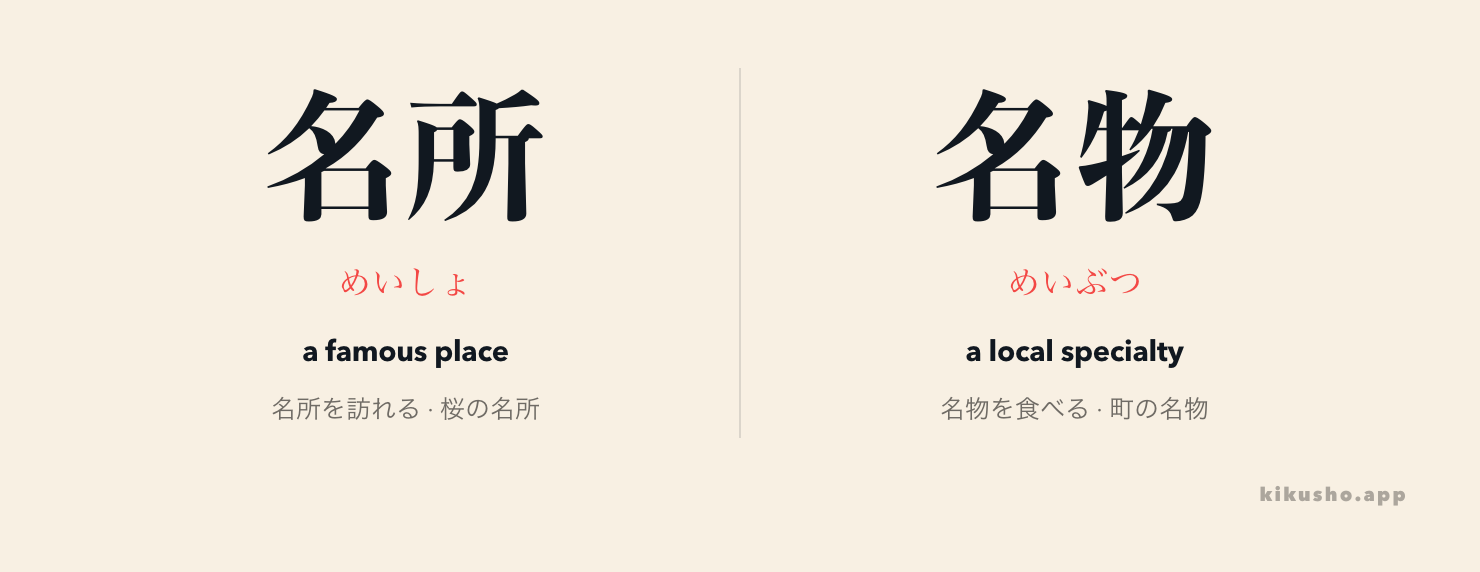
The shared first character does not make these words interchangeable. 名所 is a site known for scenery, historic associations or a distinctive local feature. 名物 is a product, food, person or phenomenon that has become characteristic of a place or community.
この寺は紅葉の名所です。
この てらは こうようの めいしょです。
This temple is a famous place for autumn leaves.
この町の名物は、栗を使った菓子です。
この まちの めいぶつは、くりを つかった かしです。
This town's specialty is a sweet made with chestnuts.
The 名所 entry describes a place famous for scenery, historic remains or characteristic features. 観光名所 is therefore a tourist sight, and 桜の名所 is a place famous for cherry blossoms. The visitor goes to it: 名所を訪れる, 名所を巡る.
The 名物 entry begins with a locally renowned product and extends to distinctive things or well-known people. Food is common in travel, but the word is broader: fog can be a city's 名物, and a memorable teacher can be a school's 名物教師. 名産 stays closer to a notable product of a region; 名物 can cover the larger local character.
The reliable travel test is grammatical as well as semantic. You can 名所を訪れる and 名物を食べる. A market can be both a 観光名所 and the place where you buy a 名物, but the two nouns still point to different things.
One changed plan uses all six words
朝は桜の名所を回る観光コースに参加し、昼は町の名物を食べます。今回は日帰りに変更したので、予約していた貸別荘の予約を取り消しました。夏には親戚の別荘に泊まる予定です。
あさは さくらの めいしょを まわる かんこうコースに さんかし、ひるは まちの めいぶつを たべます。こんかいは ひがえりに へんこうしたので、よやくしていた かしべっそうの よやくを とりけしました。なつには しんせきの べっそうに とまる よていです。
In the morning, I will join a sightseeing route that visits famous cherry-blossom spots, and at lunch I will eat the town's specialty. Because I changed this trip to a day trip, I cancelled the holiday-house reservation. I plan to stay at a relative's holiday home in summer.
The passage does not treat “travel vocabulary” as one loose category. コース supplies the sequence, 名所 the destinations and 名物 the regional food. 日帰り removes the need to stay overnight. 取り消す acts on the reservation, while 別荘 remains the type of home involved.
Kikusho's two baseline files place all six spelling-and-reading records at N2, but both descend from the same Tanos/Waller source family. Bunpro independently marks 取り消す as N2, and other modern N2 lists include 別荘. Today's JLPT specifications describe ability bands instead of assigning every word to a level. Treat N2 here as guidance about when to study the set, with the meanings and combinations checked separately against Japanese dictionaries, Japan Foundation teaching material and current tourism usage.
When saving these words in Kikusho, keep the phrase that selects the sense: 観光コース, 予約を取り消す, 日帰りで行く, 海辺の別荘, 桜の名所, 町の名物. A bare English gloss cannot preserve those six roles.
Practice all six roles before revealing the answers
Question 1 · read the same-day plan
How is 日帰り read in 京都へ日帰りで行く?
ア. にちかえり
イ. ひかえり
ウ. ひがえり
エ. にちがえり
Question 2 · write the cancellation verb
Select the written form of とりけす, the verb for withdrawing an existing decision.
ア. 取リ消す
イ. 取り消す
ウ. 撮り消す
エ. 取り済す
Question 3 · build the route expression
Which compound naturally means “a sightseeing route”?
ア. 観光コース
イ. 観光別荘
ウ. 名物帰り
エ. 取消名所
Question 4 · identify the famous place
Which word best completes the sentence?
この公園は梅の__として知られています。
ア. 名物
イ. 別荘
ウ. 名所
エ. 取り消し
Question 5 · restate a trip without a night away
Which line restates 今回は泊まらず、その日のうちに帰ります without changing the schedule?
ア. 今回は日帰りにします。
イ. 今回は別荘を買います。
ウ. 今回は名所を中止します。
エ. 今回は一泊二日にします。
Question 6 · give 取り消す a natural object
Which sentence uses 取り消す naturally?
ア. 雨が降ったので、ホテルが祭りを取り消して歩きました。
イ. 日帰りなので、昨日取った宿の予約を取り消しました。
ウ. 有名な寺を取り消して、写真を撮りました。
エ. 名物の菓子を取り消す味がしました。
Question 7 · separate the destination from the food
Complete the destination and food slots: 午前は紅葉の__を訪れ、午後は町の__を食べました。
ア. 名物, then 名所
イ. 別荘, then コース
ウ. 名所, then 名物
エ. 日帰り, then 取り消し
Question 8 · follow the revised itinerary
What happened in this passage?
観光コースを調べましたが、台風のためツアーが中止になりました。そこで、貸別荘の予約を取り消し、近くの名所へ日帰りで行きました。帰りに、その町の名物を買いました。
ア. The traveller stayed at a holiday home and cancelled a local specialty.
イ. The tour was stopped, so the traveller cancelled the rental-house booking, made a day trip to a nearby sight and bought a local specialty.
ウ. The traveller bought a sightseeing route and spent one night at a famous place.
エ. The tour continued, and the traveller bought a second home near the route.
Answers and explanations
1. ひがえり(ウ). 日帰り means making the outward and return journey on the same day, without staying overnight.
2. 取り消す(イ). The spelling combines 取る and 消す, with り retained in kana. 撮る means to take a photo, while the other forms are not the target verb.
3. 観光コース(ア). This is a sightseeing route or programme. The other choices join nouns that do not form the required travel expression.
4. 名所(ウ). A park known for its plum blossoms is a 梅の名所. 名物 would name a characteristic product, person or phenomenon rather than the park as a destination.
5. 今回は日帰りにします(ア). This states the same decision to return that day without an overnight stay. 一泊二日 says the opposite because it includes one night away.
6. 日帰りなので、昨日取った宿の予約を取り消しました(イ). The existing hotel reservation is the object cancelled with を. In ア, an organiser could 祭りを中止する, but the rest of the sentence does not create a coherent use of 取り消す. ウ and エ attach the verb to objects that cannot be withdrawn in those meanings.
7. 名所, then 名物(ウ). The traveller visits a famous place and eats a local specialty. Reversing them would turn the food into a destination and the autumn-leaf site into something eaten.
8. The cancelled tour leads to the revised day trip(イ). The passage keeps 中止する for the tour that will not take place and 取り消す for the traveller's reservation. 日帰り rules out an overnight stay, 名所 names the destination, and 名物 names what the traveller buys.
Common questions
What is the difference between 日帰り and 一泊二日?
日帰り(ひがえり) means travelling somewhere and returning the same day, without an overnight stay. 一泊二日(いっぱくふつか) is a two-day trip with one night away. 日帰り can modify a noun, as in 日帰り旅行, or describe how someone travels, as in 日帰りで行く.
What is the difference between 名所 and 名物?
名所(めいしょ) is a place famous for scenery, history or a local feature, such as 桜の名所. 名物(めいぶつ) is a product, food, person or phenomenon strongly associated with a place or group. You visit a 名所 and may eat or buy a 名物 there.
How are 取り消す, キャンセルする and 中止する different?
取り消す(とりけす) withdraws or cancels something already decided, announced or ordered, including a reservation. キャンセルする is the common loanword used for bookings and orders. 中止する stops an event or activity from taking place or continuing; it does not normally describe one customer cancelling a hotel reservation.
Is a 別荘 a hotel or a rental villa?
別荘(べっそう) is a second home used for holidays or seasonal stays, not a generic hotel. A holiday house offered for rent is a 貸別荘(かしべっそう). Context must tell you whether the speaker owns, borrows or rents the house.