On this page
These five N1 rail records tell you what a journey costs, when its first service leaves, how its schedule is displayed, what kind of train is calling and who is aboard. The difficult part is precision: 始発 has two time-and-origin senses, 準急 is defined by each operator, and the assigned じょうかく reading of 乗客 is valid but far less usual than じょうきゃく.
The set is 運賃(うんちん), 始発(しはつ), 時刻表(じこくひょう), 準急(じゅんきゅう) and 乗客(じょうかく). Some appear well below advanced prose in daily life. Their N1 label comes from a study inventory, not from an official JLPT word list or a claim that a beginner cannot meet them.
Five records describe one service from price to passengers
| Headword | Reading | Grammar and selected sense | Pairing worth keeping |
|---|---|---|---|
| 運賃 | うんちん | noun: fare paid for carrying a passenger; also a freight charge | 運賃を支払う, pay the fare |
| 始発 | しはつ | noun: first departure of the day; a service's point of origin | 始発に乗る, take the first train; 東京始発, originating in Tokyo |
| 時刻表 | じこくひょう | noun: timetable listing departure, arrival or passing times | 時刻表を確認する, check the timetable |
| 準急 | じゅんきゅう | noun: semi-express or local-express service category | 準急に乗る, take a semi-express |
| 乗客 | じょうかく | noun: passenger; uncommon alternative reading of usual じょうきゃく | 乗客を乗せる, carry passengers |
The five words do not form one grammatical pattern. They form a reading sequence. 運賃 answers the price question; 時刻表 and 始発 answer when and where a service begins; 準急 tells you which stopping pattern to inspect; 乗客 names the people travelling.
運賃 is the transport fare, while 料金 can be an added charge
運賃(うんちん) is the price paid for transport. In rail language, 普通運賃 is the ordinary passenger fare and 定期旅客運賃 is a commuter-pass fare. The word also extends to freight, which explains dictionary translations such as “freight rate.” The 運賃 dictionary entry defines payment for carrying passengers or goods.
東京までの普通運賃を調べました。
とうきょうまでの ふつううんちんを しらべました。
I checked the ordinary fare to Tokyo.
Railway Japanese often places 運賃 beside 料金, but they are not freely interchangeable. JR East's passenger rules list passenger fares separately from express, Green Car, sleeper and reserved-seat charges. A limited-express journey can therefore require 運賃+特急料金: the base transport fare plus the charge for the additional service.
The N3 rail lesson teaches 料金 in that wider charge role. Here 運賃改定 means a fare revision, and 運賃表 is a fare table. Neither phrase promises that every optional service charge is included.
始発 can mark the first departure or the service's origin
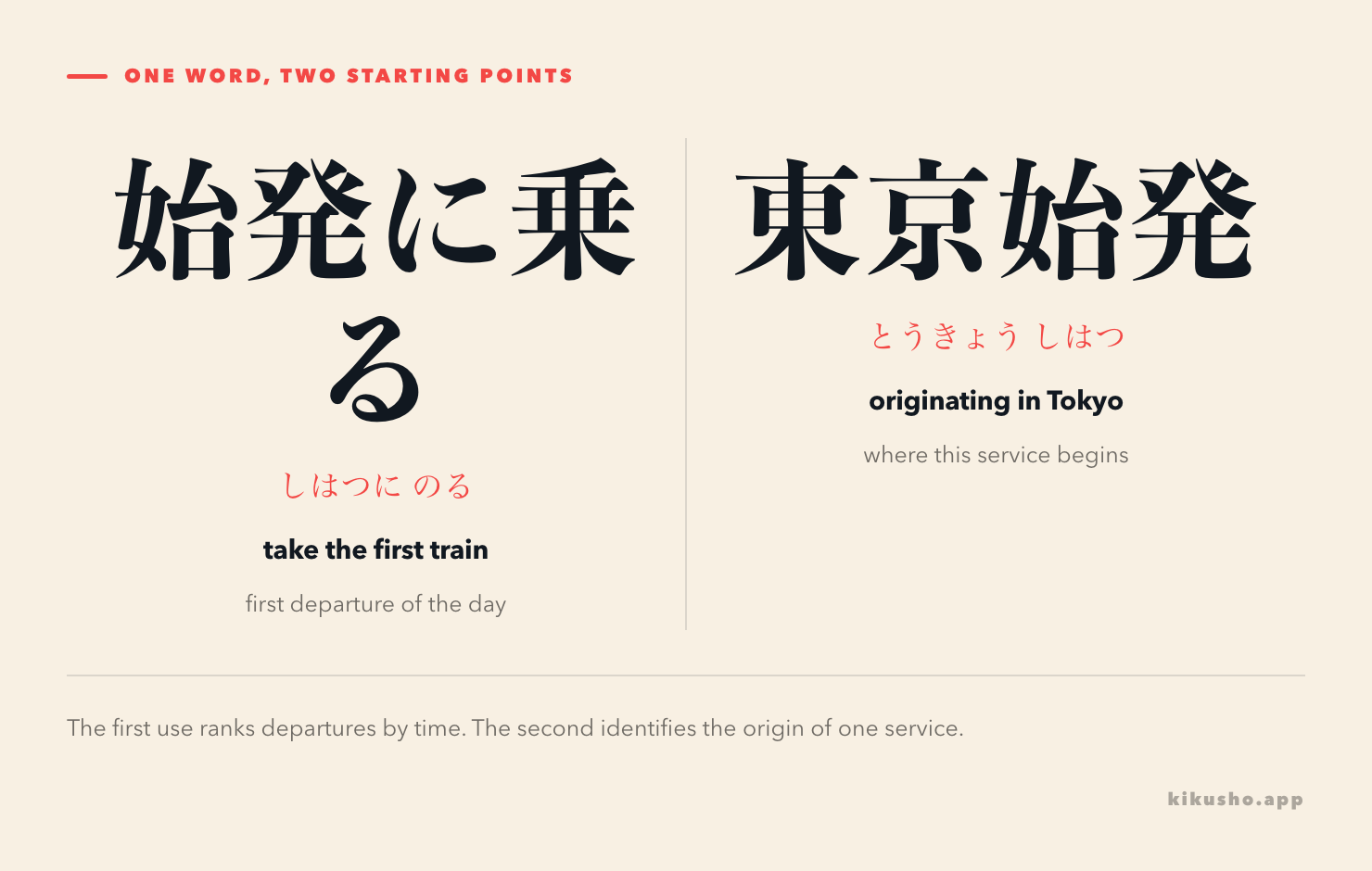
始発(しはつ) combines “begin” and “depart.” Its first use is the day's earliest scheduled departure, or the vehicle making it:
始発に乗るため、午前四時半に家を出ました。
しはつに のるため、ごぜん よじはんに いえを でました。
I left home at 4:30 a.m. to take the first train.
Its second use identifies where a particular service begins. 東京始発の列車 is a train originating at Tokyo Station. It may leave at noon; 始発 here describes its starting station, not its position as the first train of the day. The 始発 dictionary entry records both the first-service and point-of-origin uses.
Compare three labels:
- 始発列車: the first train, with context deciding the route and day
- 始発駅: the station where a service begins
- 終電: the last train of the day, an everyday counterpart to the first sense
This is why 始発は何時ですか asks for the earliest departure time, while この列車は東京始発です states an origin.
時刻表 displays times; ダイヤ describes the operating plan
時刻表(じこくひょう) is a table of times. The 時刻表 reference entry describes a display collecting departure, arrival and passing times for trains, buses, ships or aircraft. A station can have separate 平日時刻表 and 土休日時刻表 for weekdays and weekends or holidays.
駅の時刻表で始発の時刻を確認した。
えきの じこくひょうで しはつの じこくを かくにんした。
I checked the first departure time on the station timetable.
ダイヤ is related but operates at another scale. It can mean the railway operating diagram or schedule behind the service. A passenger reads a 時刻表; an operator revises the system through ダイヤ改正, and disruption produces ダイヤの乱れ. The distinction is one of viewpoint rather than two unrelated objects.
The characters also show the construction: 時刻, a point in time, plus 表, a table or chart. Do not read it じこくおもて. In the compound, 表 takes the Sino-Japanese reading ひょう.
準急 is a category, not a universal list of stops
準急(じゅんきゅう) abbreviates 準急行列車. The dictionary definition describes a train with somewhat more stops than an express. “Semi-express” or “local express” is useful as a translation, but the label is not a national promise about speed or stations.
Each operator defines the service pattern on its own network. A timetable change can alter it: an Odakyu timetable-revision notice explicitly adds 喜多見 and 和泉多摩川 as 準急 stops. The practical reading rule is therefore simple: recognise the category, then inspect the current stopping guide.
この準急は次の駅を通過します。
この じゅんきゅうは つぎの えきを つうかします。
This semi-express passes through the next station.
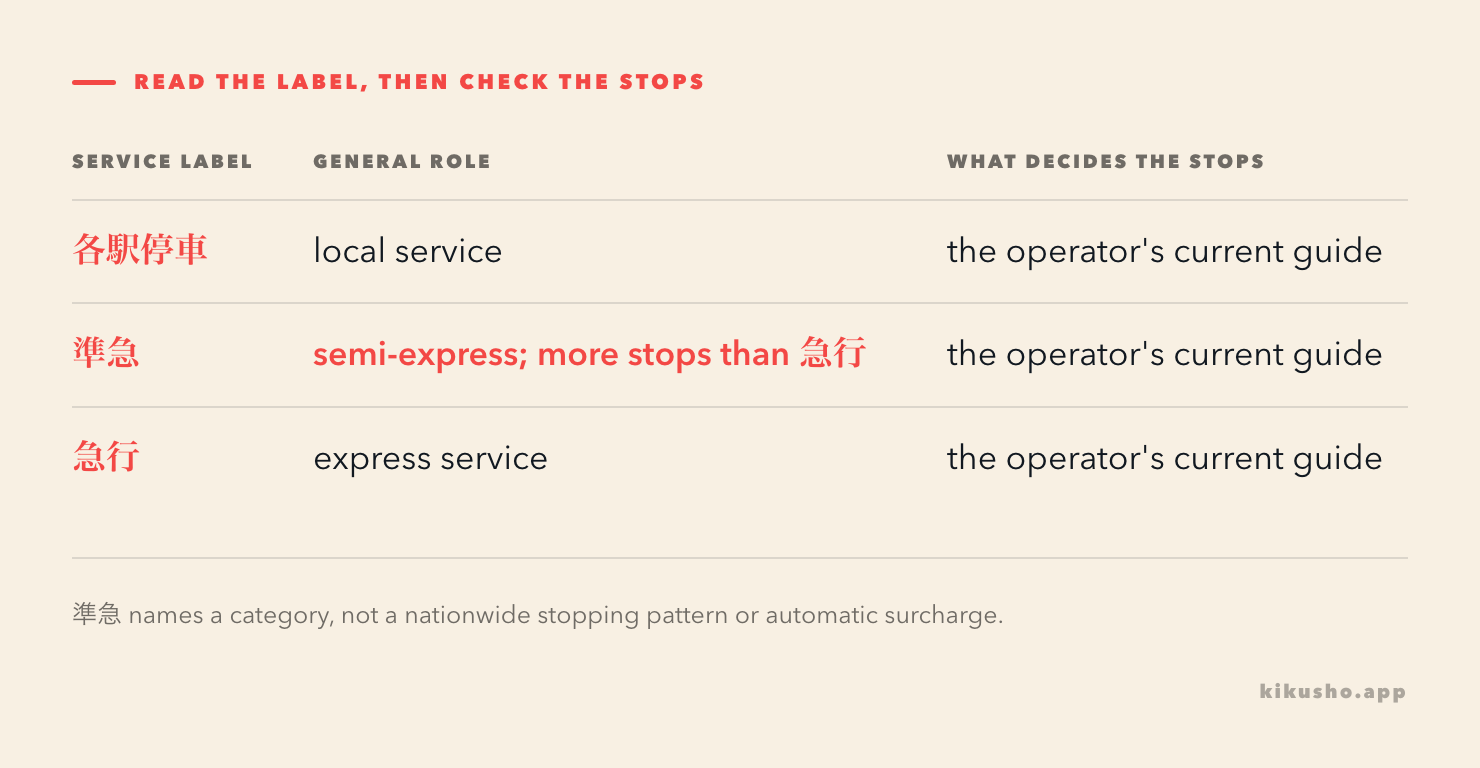
Do not infer that 準急 always costs extra. On many commuter railways it is simply a stopping category under the ordinary fare. A named service, reservation or special car may introduce a separate 料金, but the word 準急 alone does not establish one.
乗客 normally reads じょうきゃく; this record preserves じょうかく
乗客 means a passenger aboard a train, bus, ship or aircraft. Modern speech normally reads it じょうきゃく. The assigned record uses じょうかく, an uncommon alternative that dictionaries still recognise with the same meaning. Shogakukan's entry gives じょうきゃく as the main heading and redirects じょうかく to it.
This is a recognition distinction, not a pair of meanings. If you are speaking, use じょうきゃく unless a source or name specifically calls for the alternative. If a reading question supplies じょうかく, recognise that it can point to the same spelling and passenger sense.
列車には多くの乗客が乗っていた。
れっしゃには おおくの じょうきゃくが のっていた。
Many passengers were aboard the train.
The earlier N3 lesson teaches the ordinary 乗客(じょうきゃく) record. This N1 entry exists because the inventory distinguishes spelling-and-reading pairs. It should deepen recognition without replacing the pronunciation a learner will hear and use most often.
One timetable connects all five records
運賃改定後の時刻表を確認すると、最初の準急はこの駅を午前五時四十二分に出る始発列車だった。早朝にもかかわらず、ホームにはすでに多くの乗客が並んでいた。
うんちんかいていごの じこくひょうを かくにんすると、さいしょの じゅんきゅうは このえきを ごぜん ごじ よんじゅうにふんに でる しはつれっしゃだった。そうちょうにも かかわらず、ホームには すでに おおくの じょうきゃくが ならんでいた。
When I checked the timetable after the fare revision, the first semi-express was the first train from this station, departing at 5:42 a.m. Despite the early hour, many passengers were already lined up on the platform.
The surface 乗客 does not announce which accepted reading the writer has in mind. The supplied reading or ordinary usage resolves it. In the passage, じょうきゃく is the natural default; じょうかく remains the marked recognition target of the assigned inventory row.
The exact search results were led by broad train guides from Nihongo Navigator, JP YoKoSo, J-Compass, Slow Days in Japan and Migaku, plus Amiko's N1 travel list. They establish recurring demand for rail vocabulary, but none of the inspected pages joined these five records around the two senses of 始発, operator-defined 準急 and the alternative じょうかく reading.
Level labels are editorial. Both Kikusho baseline rows descend from the Tanos/Waller list, so together they still provide only one family of evidence. Bunpro places 始発 at N1, while its ordinary 乗客(じょうきゃく) entry is N3. That difference suits the actual learning burden: the rare alternative reading is advanced recognition, while the everyday passenger word is earlier vocabulary. The JLPT publishes no exhaustive current word list.
When you save a station notice in Kikusho, keep enough of the line to select the sense. 始発 alone cannot tell you whether it means earliest departure or point of origin, and 準急 alone cannot tell you its stops. A phrase such as 東京始発の準急 preserves both decisions for later review.
Read the service before revealing the explanations
1 — Read the fare word. How is 運賃 read?
- ア. うんひん
- イ. うんちん
- ウ. うんぎん
- エ. うんりん
2 — Resolve 始発 from context. What does 東京始発の列車 say?
- ア. The train is necessarily Tokyo's first train of the day.
- イ. The train originates in Tokyo.
- ウ. The train terminates in Tokyo.
- エ. The train passes through Tokyo without stopping.
3 — Choose the timetable. Which word completes the sentence?
駅の__で、午前中の発車時刻を調べました。
- ア. 運賃
- イ. 乗客
- ウ. 時刻表
- エ. 準急
4 — Interpret the service label. What can you safely conclude from 準急 alone?
- ア. It stops at exactly the same stations on every railway.
- イ. It always requires a reserved-seat charge.
- ウ. It is a train category whose current stops must be checked for that operator.
- エ. It is the last train of the day.
5 — Recognise the assigned alternative. Which reading of 乗客 is valid but uncommon and is assigned to this N1 record?
- ア. じょうかく
- イ. のりきゃく
- ウ. じょうけ
- エ. のりかく
6 — Separate fare from added charge. Which expression can describe a limited-express ticket total?
- ア. 運賃+特急料金
- イ. 始発+時刻表
- ウ. 乗客+準急
- エ. 時刻表+乗客
7 — Complete the route check. Choose the natural pair.
__で始発の時刻を確認し、最初の__の停車駅を調べた。
- ア. 乗客 / 運賃
- イ. 時刻表 / 準急
- ウ. 運賃 / 乗客
- エ. 準急 / 時刻表
8 — Read the whole notice. What does the sentence tell passengers?
運賃改定後も、平日の始発時刻と準急の停車駅に変更はありません。
- ア. The weekday first-departure time and semi-express stops remain unchanged after the fare revision.
- イ. Every weekday fare and timetable has been cancelled.
- ウ. The semi-express now originates at every station.
- エ. Passengers must pay a reserved-seat charge on the first train.
Answers and explanations
The clues move from a single reading to the logic of a complete service notice.
1. Choose イ, うんちん. 運賃 is the transport fare. 貨物運賃 extends the same word to freight charges.
2. Choose イ. 東京始発 identifies Tokyo as the service's origin. Only additional context can establish whether it is also the first departure of the day.
3. Choose ウ, 時刻表. A 時刻表 displays departure times. 運賃 is a fare, 乗客 a passenger and 準急 a service category.
4. Choose ウ. 準急 names a category, but operators choose its stopping pattern. The label alone does not guarantee identical stops or an added charge.
5. Choose ア, じょうかく. Dictionaries accept it as an alternative reading of 乗客. The normal modern reading is じょうきゃく, which should remain your speaking default.
6. Choose ア. 運賃 pays for the underlying transport, while 特急料金 pays for the additional limited-express service. JR ticket rules distinguish the two.
7. Choose イ: 時刻表, then 準急. You use a timetable to check the first departure time, then inspect where the semi-express stops.
8. Choose ア. The sentence says a fare revision occurred but explicitly denies changes to two service details: the weekday first-departure time and the semi-express stopping stations.
Common questions
What are the two meanings of 始発?
始発(しはつ) can mean the first train or bus of the day, as in 始発に乗る. It can also say where a particular service begins, as in 東京始発, a service originating in Tokyo. The second use does not necessarily mean the day's earliest train.
What is the difference between 時刻表 and ダイヤ?
時刻表(じこくひょう) is a timetable showing departure, arrival or passing times. Railway ダイヤ is the operating schedule or diagram behind the service and appears in ダイヤ改正 and ダイヤの乱れ. Everyday route displays may be called 時刻表 even though both reflect the same operation.
Does 準急 stop at the same stations on every railway?
No. 準急(じゅんきゅう) is a named train category, traditionally a service with more stops than an express, but each operator defines its own stopping pattern. Check that railway's current departure board or stopping guide.
Is 乗客 read じょうかく or じょうきゃく?
Dictionaries accept both, with the same meaning, passenger. じょうきゃく is the normal modern reading and the one learners should use by default. じょうかく is a valid but uncommon alternative preserved in this inventory record and is mainly useful for recognition.