On this page
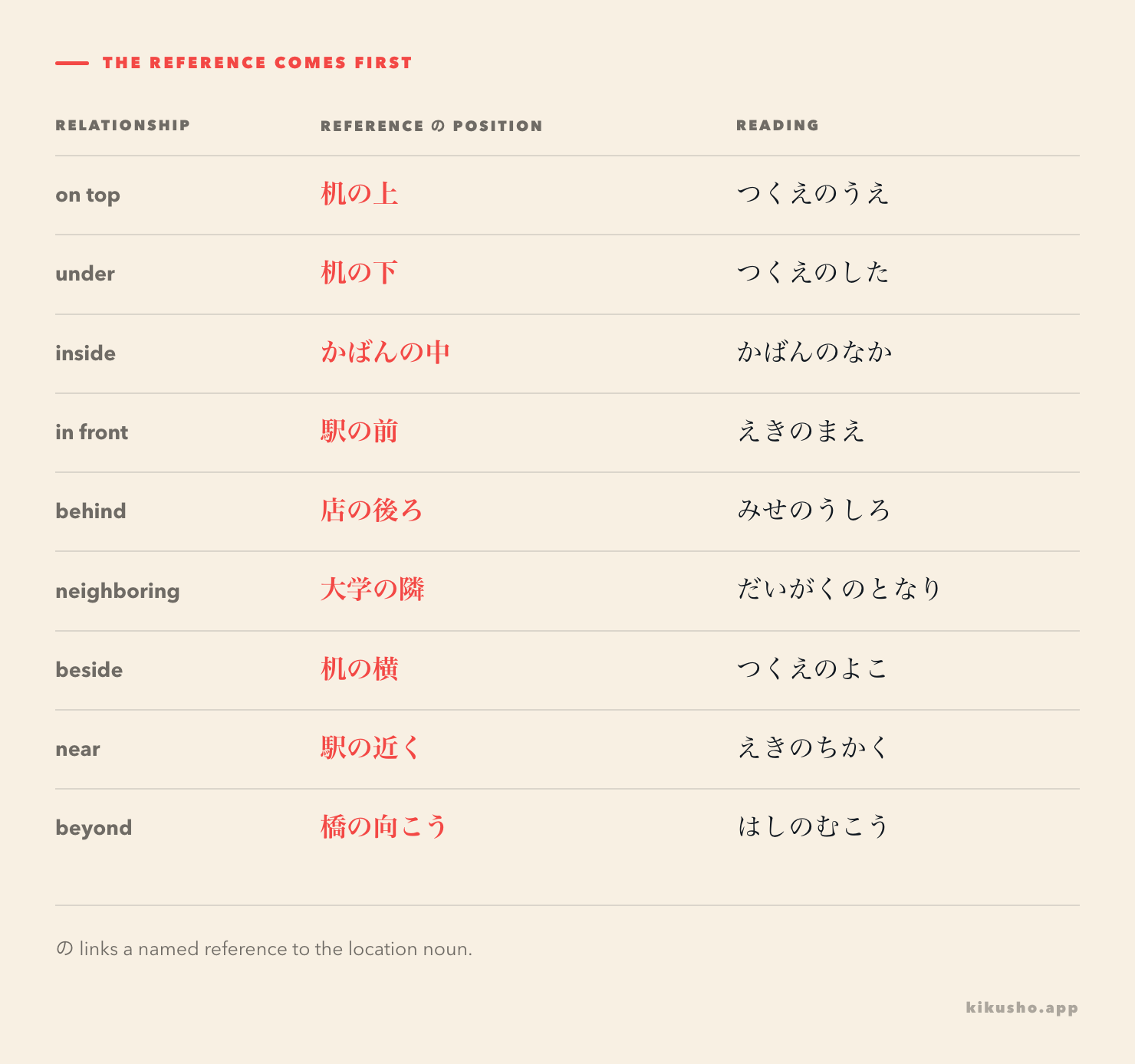
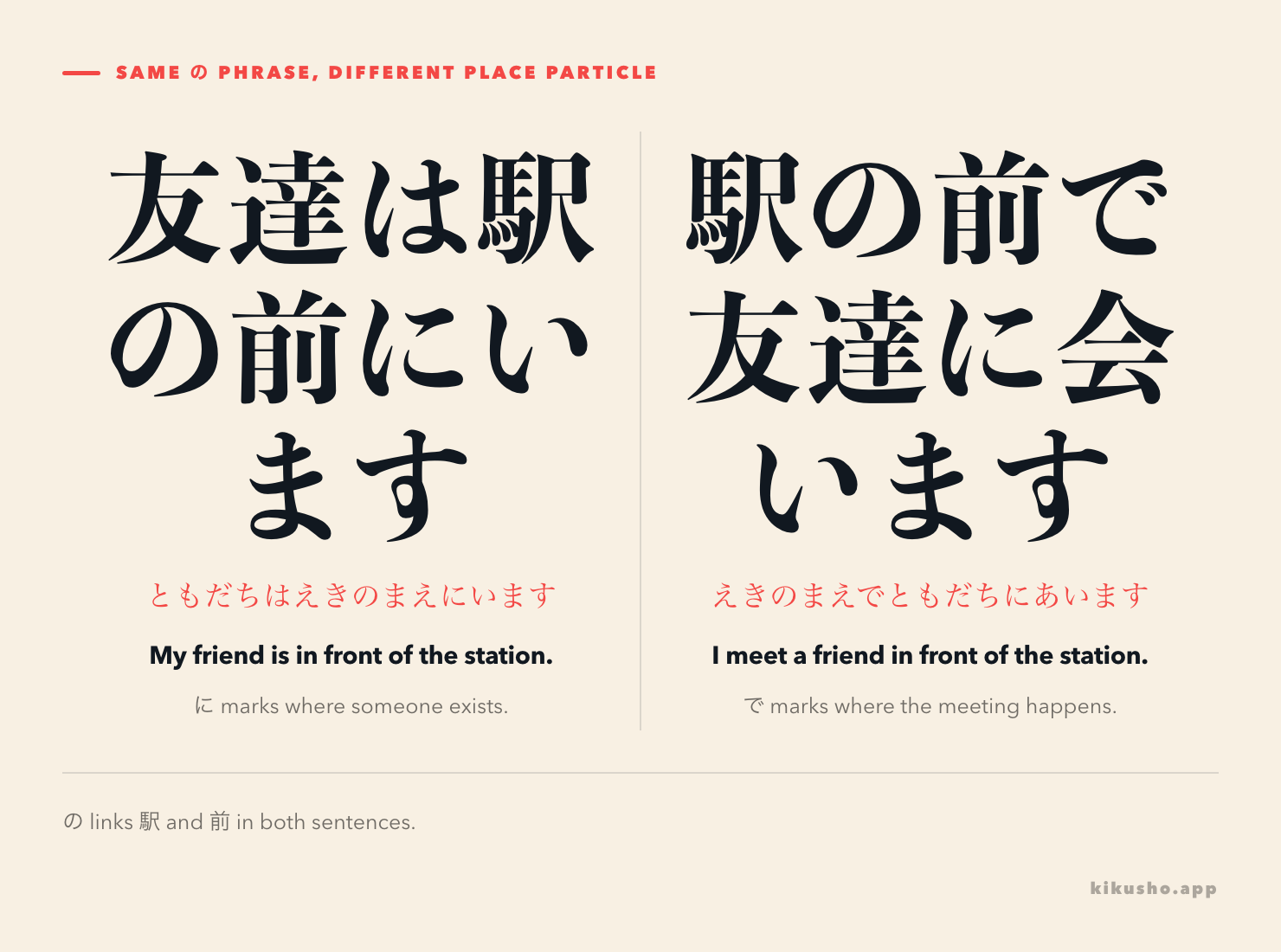
駅の前(えきのまえ) means “in front of the station.” 前(まえ) names a position, and の ties that position to the station. The same pattern gives 机の上 “on top of the desk,” かばんの中 “inside the bag,” and 橋の向こう “beyond the bridge.” These words act as location nouns when they take a reference point, even where English uses “on,” “in” or “behind.”
Why these words belong together
The seventeen assigned spelling-and-reading entries make a small map. Ten name a position relative to something: 上, 下, 中, 外(そと), 前, 後ろ, 隣, 横, 近く and 向こう. Six name a side or fixed direction: 右, 左, 北, 南, 東 and 西. The seventeenth is 外(ほか), a different reading for “elsewhere” or “other,” which prevents the map from becoming a false one-kanji-one-meaning rule.
Iori Hamada's university position-word lesson checks the core readings and the reference の position pattern. Emiko Konomi's independently authored university lesson gives the other-side, near, next-door and side words with readings. MLC Japanese Language School's original N5 direction guide independently checks right, left, behind and the compass directions. These are reference-list level estimates, not an official exhaustive JLPT vocabulary syllabus.
The set itself
| Assigned noun / reading | Relationship or direction taught | Short phrase |
|---|---|---|
| 上(うえ) | top; above | 机の上: on the desk |
| 下(した) | bottom; under | 机の下: under the desk |
| 中(なか) | inside; middle | かばんの中: inside the bag |
| 外(そと) | outside a boundary | 家の外: outside the house |
| 前(まえ) | front; in front of | 駅の前: in front of the station |
| 後ろ(うしろ) | back; behind | 店の後ろ: behind the shop |
| 隣(となり) | neighboring place; next door | 大学の隣: next to the university |
| 横(よこ) | side; beside | 机の横: beside the desk |
| 近く(ちかく) | vicinity; nearby | 駅の近く: near the station |
| 向こう(むこう) | far side; beyond | 橋の向こう: beyond the bridge |
| 右(みぎ) | right side | 右に曲がります: turn right |
| 左(ひだり) | left side | 左に曲がります: turn left |
| 北(きた) | north | 北口(きたぐち): north exit |
| 南(みなみ) | south | 南口(みなみぐち): south exit |
| 東(ひがし) | east | 東口(ひがしぐち): east exit |
| 西(にし) | west | 西口(にしぐち): west exit |
| 外(ほか) | another place; other things | ほかの店: another shop; usually written ほか or 他 |
All seventeen assigned rows are nouns with the readings shown, though 近く can also work adverbially and ほか has broader grammatical uses. The phrases are examples of one use, not every dictionary sense. The compass-exit readings are independently checked in Hamada's original direction-kanji chapter and MLC's beginner direction guide.
The pattern changes when you name a reference point
Take 前 alone and it can mean “front.” Name whose front and you need の: 駅の前. The reference noun comes first, then の, then the location noun. 前の駅 reverses the relationship and means a preceding station, so moving の is not a harmless rearrangement. The same noun-linking rule appears in the N5 lesson on の.
To say that something exists at that location, add に: 辞書は机の上にあります means “The dictionary is on the desk.” IMABI's original position lesson uses this exact sentence and distinguishes Xの上, Xの前, Xの隣, Xの近く and Xの向こう. Hamada's position chapter separately confirms Yのpositionに Xがあります/がいます for things or people. If an activity happens there, use で instead: 駅の前で友達に会います, “I meet a friend in front of the station.” Hamada's activity-location chapter checks that で pattern. の attaches the reference; に or で tells the verb how the resulting place is used.
The rule is conditional. 右に曲がります needs no の because no reference object was named. 北へ行きます can use a compass noun directly as a destination or direction. The headline's 駅の前 has の because it locates something relative to the station.
The words that break an easy translation
横 and 隣 can both be translated “next to.” 横 names the side of a reference point; 隣 names a neighboring position or place. 大学の隣 is natural for a café next door to a university in Hamada's lesson. The two can overlap: IMABI's original comparison gives the distinction without making “same kind of object” an absolute beginner rule. 近く is broader: something can be near a station without being its immediate neighbor.
向こう names what is on the far side of a reference point, such as 橋の向こう. 外(そと) names the outside of a boundary, such as 家の外. The Portland State university vocabulary lesson confirms 向こう as “opposite side, other side”; Kanji Pedia's original dictionary entry confirms 外(そと) as outside an enclosure or building. Neither is simply another word for あそこ “over there,” which the demonstrative lesson treats as a viewpoint word.
Then there is 外(ほか). Kanji Pedia lists this reading for “other,” “elsewhere” and “outside a range”; Shogakukan's bilingual dictionary gives examples such as ほかの人 and ほかに行く. In ordinary beginner prose ほか or 他 is easier to read than 外. The dated source inventory places this spelling-reading row at N5 from one Waller-derived list, while another Waller-derived N3 list places it at N3. The lesson teaches the reading and sense but does not call that boundary settled.
Which ones you will meet this month
At a station, 北口・南口・東口・西口 identify exits by fixed compass direction; 右・左 change with the way you face. In a room, 机の上, かばんの中, ドアの向こう and 店の近く are more useful than isolated “on,” “in,” “across” and “near.” Keep the reference noun when saving a phrase: 中 by itself cannot tell you which container is meant. In Kikusho, you can paste the whole phrase, inspect the reading on the drafted card and correct it before saving; the container survives alongside the position.
Check yourself
Question 1: word order. Write the Japanese phrase for “under the desk,” using 机 and the assigned location word.
Question 2: existence. A dictionary is on the desk. Complete 辞書は机の上__あります with the particle that marks its location.
- A. に
- B. で
- C. の
- D. を
Question 3: direction reading. An exit sign says 西口. What is the hiragana reading of 西 in this compound?
Question 4: other or outside. You want to say “another shop,” not “outside the shop.” Which reading of the assigned 外 row belongs to “other”: そと or ほか? Write the short Japanese phrase normally used for “another shop.”
Question 5: neighboring place. A café is next door to a university. Which assigned noun in カフェは大学の__です states next door rather than merely nearby?
- A. 近く
- B. 隣
- C. 中
- D. 外
Question 6: far side. A park is on the far side of a bridge. Which assigned location noun completes 橋の__に公園があります?
- A. 上
- B. 近く
- C. 向こう
- D. 横
Answers and explanations
Answer 1. 机の下(つくえのした). The desk is the reference noun, の connects it, and 下(した) is the location noun. 下の机 would identify a desk lower down rather than the space beneath a desk.
Answer 2. A, に: 辞書は机の上にあります. の links the desk to its top; に marks where the dictionary exists. で would mark the site of an activity.
Answer 3. にし: 西口(にしぐち) is the west exit. The compound adds 口(ぐち) to the direction noun 西(にし).
Answer 4. ほか, as in ほかの店. In this sense it means another shop; そと is outside a boundary, as in 店の外. The assigned row spells ほか with 外, but ordinary prose often uses kana or 他.
Answer 5. B, 隣: カフェは大学の隣です. The context says immediately next door. 近く would only establish nearness; 中 would put the café inside the university, and 外 would put it outside.
Answer 6. C, 向こう: 橋の向こうに公園があります. The park is beyond the bridge. 上 is on top, 近く is near, and 横 is to the side.
The next time English says “under” or “behind,” find the Japanese reference point first. It will tell you whether you need Xのposition, a standalone direction, or a different reading entirely.
Common questions
Why is there の in 駅の前?
前(まえ) is a location noun meaning front. の connects the station, the reference point, to that front: 駅の前 is in front of the station.
Does every position word always need の?
No. It needs の when you give a reference noun, as in 机の上. Standalone 上です and movement phrases such as 右に曲がります have no reference noun.
Are 外(そと) and 外(ほか) the same word?
No. そと points outside a boundary; ほか means another place or other things. ほか is commonly written in kana or 他, and N5/N3 reference lists disagree on the placement of the 外(ほか) reading.