On this page
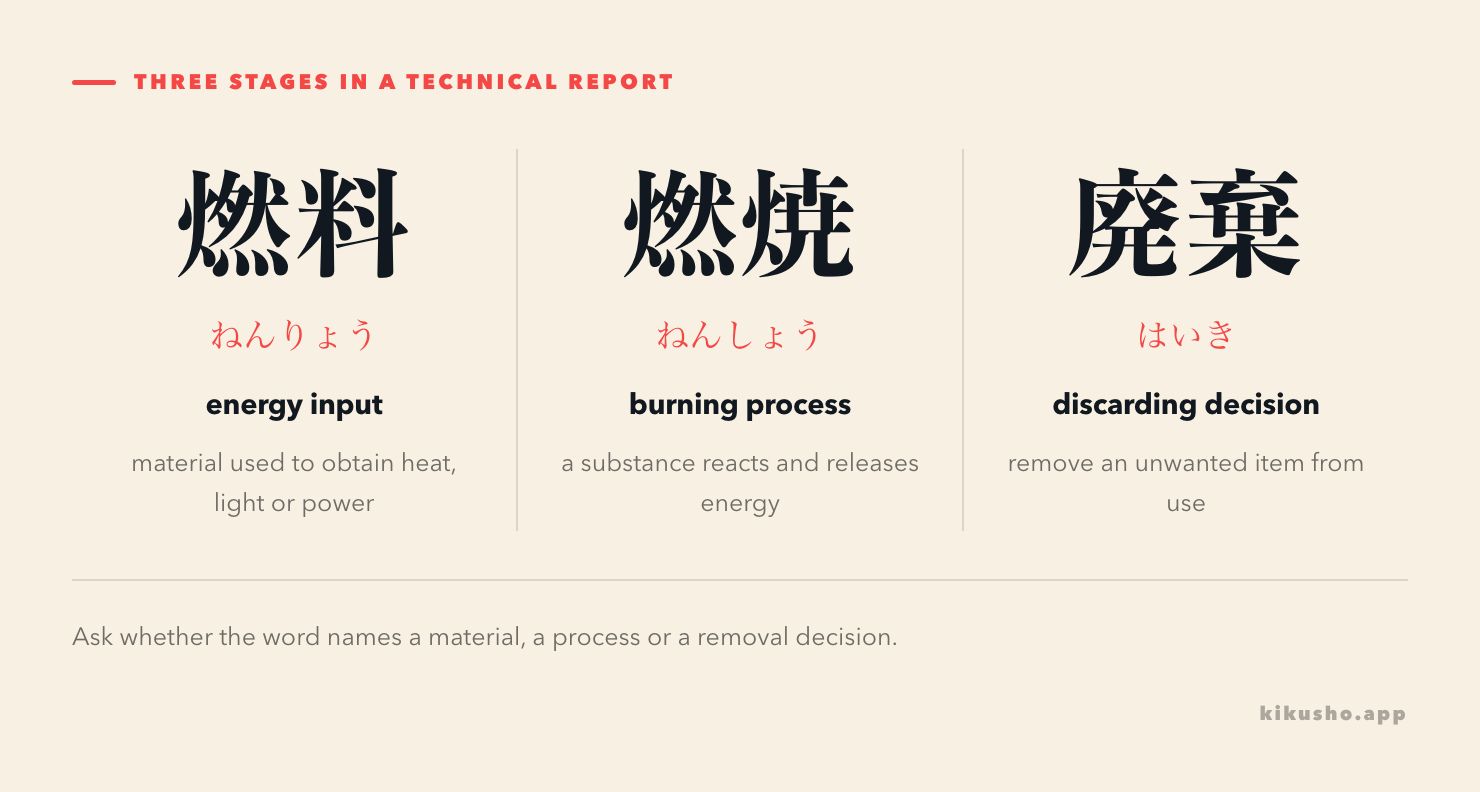
A report can say that discarded wood becomes 燃料, then undergoes 燃焼 instead of 廃棄. The three nouns mark different stages: what supplies the energy, what physical process occurs, and what decision removes an unwanted item from use.
This N1 set adds a second difficulty. 汚す and 汚れる can describe a stained reputation when read けがす and けがれる, and the inventory reading しょうこう for 消耗 is correct but uncommon in present-day speech. Recognising the spelling is not enough; you must choose the reading from the sentence.
Six records, including three reading traps
The meanings below are the senses selected for this lesson. Read the example combination with each headword.
| Entry | Pronunciation | Grammar | Selected N1 sense | Phrase to retain |
|---|---|---|---|---|
| 汚す | けがす | transitive godan verb | defile; disgrace; dishonour | 名誉を汚す: dishonour a reputation |
| 汚れる | けがれる | intransitive ichidan verb | become defiled or tainted | 名が汚れる: one's name is tarnished |
| 消耗 | しょうこう | noun; suru verb | use-induced loss, attrition or exhaustion | 人員の消耗を抑える: limit personnel exhaustion |
| 燃焼 | ねんしょう | noun; suru verb | burning; combustion | 燃料が燃焼する: fuel combusts |
| 燃料 | ねんりょう | noun | fuel | 燃料を補給する: replenish fuel |
| 廃棄 | はいき | noun; suru verb | discarding or disposal of something no longer used | 部品を廃棄する: discard a part |
This table does not assign every sense of 汚す or 廃棄 to environmental writing. It gives the exact spelling-and-reading records that the curriculum asks you to recognise, then connects the technical nouns in a report.
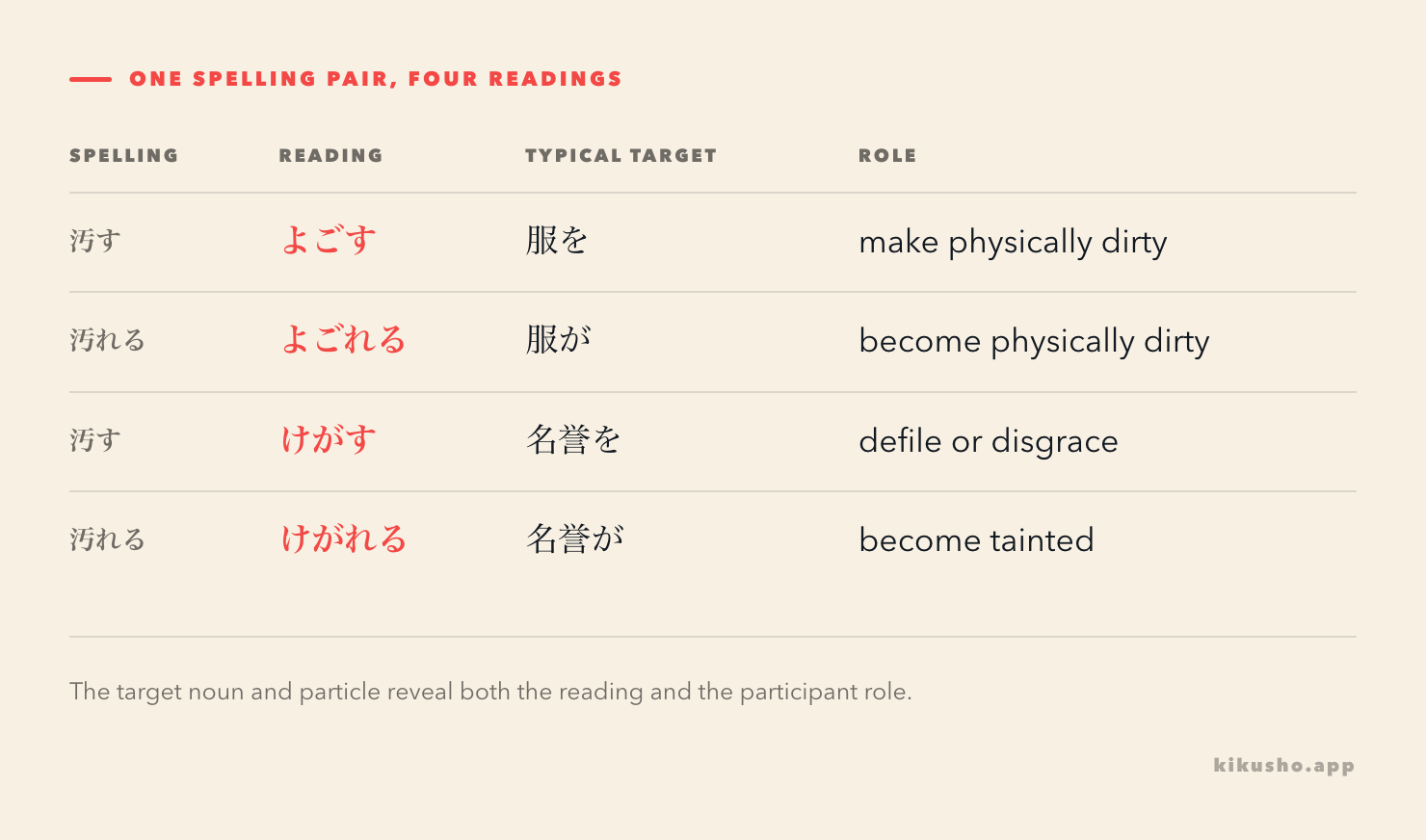
汚す and 汚れる change reading with the kind of stain
The spelling 汚す can represent both よごす and けがす. The spelling 汚れる can likewise represent よごれる and けがれる. The everyday よごす pair normally concerns physical dirt:
泥で作業服を汚した。
I got the work clothes dirty with mud.
排気ガスで窓が汚れた。
The window became dirty from exhaust fumes.
The けがす pair points more readily to moral, spiritual or reputational defilement. The dictionary entry for 汚す gives 名を汚す, to disgrace a name, and notes that けがす tends toward abstract or spiritual stains. 穢す and 穢れる are alternative spellings that make this sense more visible, but the assigned records use 汚.
不正な取引が会社の名誉を汚した。
The dishonest transaction disgraced the company's reputation.
一度の虚偽報告で、長年築いた信用が汚れた。
A single false report tainted the trust built over many years.
Read the final verbs けがした and けがれた. The same participant distinction seen in よごす and よごれる remains:
| Pattern | Role | Example |
|---|---|---|
| Nを汚す(けがす) | someone or something defiles N | 名誉を汚す |
| Nが汚れる(けがれる) | N becomes tainted | 名が汚れる |
The 汚れる dictionary comparison makes the contrast concrete: よごれた手 can have mud or oil on it, while けがれた手 suggests wrongdoing or contact with something treated as impure.
消耗(しょうこう)is correct, but recognition is the practical goal
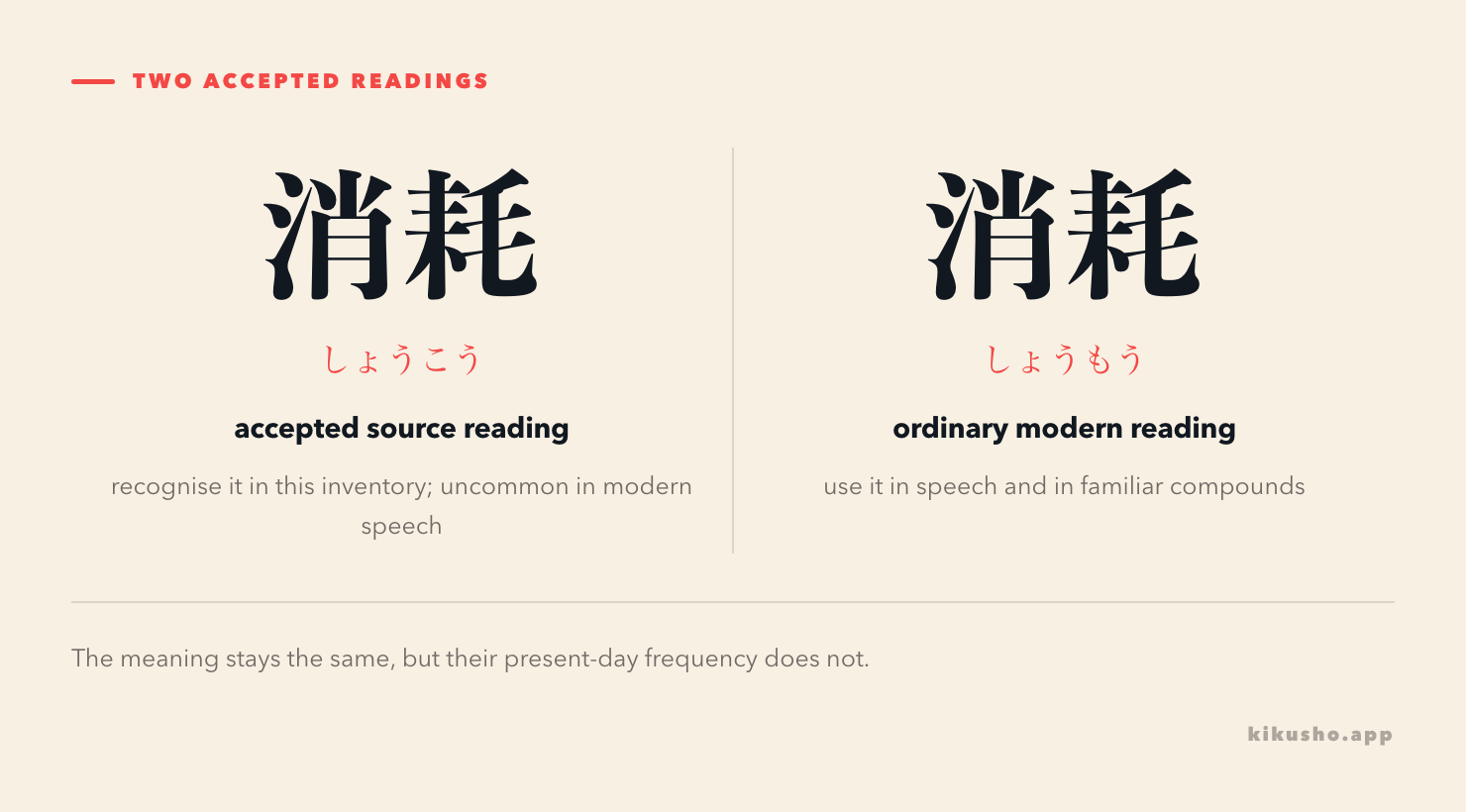
The previous N2 lesson taught 消耗(しょうもう), the ordinary modern reading. This N1 inventory contains the same word with しょうこう. The meaning does not change:
長期運転によって部品が消耗した。
The parts wore down through prolonged operation.
交渉が長引き、双方が資金と人員を消耗した。
The negotiations dragged on, depleting both sides' funds and personnel.
Why are there two readings? The dictionary account of 耗 records コウ as a regular on-reading and モウ as a conventional reading. The 消耗 entry describes しょうもう as a conventional reading of しょうこう. Both are accepted, but しょうもう became the normal form in speech and in compounds such as 消耗品 and 消耗戦.
For production, use しょうもう unless a source, annotation or specialised context explicitly supplies しょうこう. For an N1 reading question, however, do not reject しょうこう as impossible. It is a dictionary reading and the precise record assigned here.
燃料 is the input; 燃焼 is the process
燃料 is material used to obtain heat, light or power. The dictionary definition includes solid, liquid and gaseous fuels and also allows specialised extensions such as nuclear fuel.
この設備は木質燃料を使用している。
This facility uses woody biomass fuel.
燃焼 is the phenomenon or process of burning. In the common technical sense, a material reacts with an oxidiser and releases energy as heat or light. The 燃焼 entry also records a figurative sense of devoting all one's energy to an activity, but an emissions report normally means combustion.
燃料が完全に燃焼すると、発生する煙が少なくなる。
When the fuel burns completely, less smoke is produced.
技術者は燃焼効率を測定した。
The engineers measured combustion efficiency.
The grammatical frame changes with viewpoint. 燃料が燃焼する presents the fuel as undergoing combustion. 燃料を燃焼させる presents an operator or device causing it to burn. 燃料を燃焼する also occurs in technical prose, but the intransitive and causative frames make the participant roles especially clear for study.
| Report asks… | Choose | Typical phrase |
|---|---|---|
| What material supplies energy? | 燃料 | 燃料を補給する |
| What process releases energy? | 燃焼 | 燃料が燃焼する |
| How well does that process work? | 燃焼 | 燃焼効率を上げる |
廃棄 is a decision to discard, not a treatment method
廃棄する means to discard something as unnecessary or no longer usable. The dictionary entry for 廃棄 gives the concrete example of discarding old documents and also records legal uses such as terminating a treaty. This lesson selects the physical-disposal sense:
基準を満たさない製品は廃棄する。
Products that do not meet the standard are discarded.
Do not treat 廃棄, 処分 and 焼却 as interchangeable. 廃棄 focuses on taking an unwanted item out of use. 処分 is broader and can cover deciding, handling, selling or disposing according to context. 焼却 names incineration, one possible treatment method. A company may 廃棄を決める, decide to discard, and later 廃棄物を焼却する, incinerate the resulting waste.
The noun 廃棄物 is “waste,” not simply the completed act of throwing something away. Japan's Ministry of the Environment describes waste as an objectively unwanted solid or liquid material in its Waste Management Act guidance. A waste item can still be recycled or used for energy recovery under an applicable system.
Read all six words in one compliance report
The following factory report is invented for language practice:
工場は、従来廃棄していた木くずを燃料として利用し、その燃焼で生じる熱を回収する設備を導入した。これにより、化石燃料の消耗を抑える計画だ。しかし、環境への配慮を掲げながら排出基準に違反すれば、企業の名を汚し、長年築いた信用も汚れることになる。
The factory introduced equipment that uses wood scraps formerly discarded as fuel and recovers heat produced by their combustion. The plan is intended to curb depletion of fossil fuel. However, if the company violates emissions standards while claiming environmental responsibility, it will disgrace its name and tarnish the trust built over many years.
The report moves through three physical stages and one reputational consequence:
- 廃棄 is the former decision to discard the wood scraps.
- 燃料 is their new role as an energy input.
- 燃焼 is the process from which heat is recovered.
- 消耗 describes fossil fuel reserves being used down.
- 名を汚す(けがす) presents the company as causing disgrace.
- 信用が汚れる(けがれる) presents trust as becoming tainted.
The N2 environment and energy lesson supplies 原料, 公害, 森林, 電力 and 発電, as well as the ordinary しょうもう reading of 消耗. The N3 foundation owns the physical-pollution pair 汚染 and 汚す(よごす). Those links keep the readings and senses from competing for the same canonical explanation.
N1 labels the selected records, not every spelling match
The dated inventory assigns the six spelling-and-reading records to N1. Its two baseline lists descend from the same Waller family, so agreement between them is one line of evidence rather than two independent votes. NihongoDoya's broad N1 index independently includes 燃焼 and 燃料, Japanesetest4you labels 燃料 N1, and Tangorin labels 汚れる(けがれる) N1.
The apparent N4 conflict for 汚れる comes from a headword-only match: the linked N4 page teaches 汚れる(よごれる), not the assigned けがれる reading and abstract sense. Similarly, many lists place 消耗 at N2 with しょうもう; that does not independently confirm an N1 boundary for the uncommon しょうこう reading. The current JLPT publishes no exhaustive vocabulary list, so these are editorial study placements. The level note matters most where one spelling hides multiple readings.
On iPhone, share a sentence containing 名誉を汚す or 燃焼効率 directly to Kikusho. Save its noun and particle with the headword. That local evidence separates けがす from よごす and 燃焼 from 燃料 when the card returns.
Practice
Answer all eight questions before opening the explanations.
Question 1
How should 汚す be read in 不正な行為が組織の名誉を汚す?
A. よごす
B. けがす
C. けがれる
D. よごれる
名誉 points to reputational defilement, and を requires the transitive form.
Question 2
How do you read 燃焼, the combustion process?
A. ねんりょう
B. はいき
C. ねんしょう
D. しょうこう
Keep 焼(しょう)separate from 料(りょう).
Question 3
Which pair completes この設備では、木くずを( )として利用し、その( )で熱を得る?
A. 燃料 / 燃焼
B. 燃焼 / 燃料
C. 廃棄 / 消耗
D. 消耗 / 廃棄
First name what the wood scraps become, then the energy-releasing event.
Question 4
Which sentence correctly presents a reputation becoming tainted?
A. 信用をけがれる。
B. 信用がよごす。
C. 信用をけがす。
D. 信用が汚れる(けがれる)。
Choose both the intended reading and the intransitive frame.
Question 5
What does 使用済みの部品を廃棄した mean here?
A. The used parts generated heat.
B. The used parts were discarded.
C. The used parts became morally tainted.
D. The used parts replenished the fuel.
Keep the selected physical-disposal sense of 廃棄.
Question 6
Which statement about 消耗 is accurate?
A. Only しょうこう is accepted today.
B. The reading changes the word from depletion to combustion.
C. Both しょうこう and しょうもう are recorded, but しょうもう is ordinary today.
D. しょうもう is the reading of 燃焼.
Separate dictionary acceptance from present-day frequency.
Question 7
Choose the sentence that clearly distinguishes fuel from combustion.
A. 新しい燃料を補給し、燃焼効率を測定した。
B. 新しい燃焼を補給し、燃料効率を測定した。
C. 新しい廃棄を補給し、消耗効率を測定した。
D. 新しい消耗を補給し、廃棄効率を測定した。
Check what can be replenished and what can have an efficiency value.
Question 8
Read the report: 工場は廃棄していた木くずを燃料として利用し、その燃焼で生じる熱を回収する。 Which statement is supported?
A. The factory stains wood with exhaust gas.
B. The factory discards newly purchased fuel without using it.
C. The factory treats combustion as a moral stain.
D. The factory uses formerly discarded wood scraps as fuel and recovers combustion heat.
Follow the change in the wood scraps' role.
Answers and explanations
1 · Reputational stain — B. 名誉を汚す is read めいよをけがす when it means to disgrace or dishonour a reputation. よごす normally presents physical dirt, while けがれる and よごれる are intransitive forms.
2 · Combustion spelling — C. 燃焼 is ねんしょう, combustion. 燃料 is ねんりょう, fuel; 廃棄 is はいき, disposal; and 消耗 has the readings しょうこう and しょうもう.
3 · Input and process — A. The wood scraps have the role of 燃料, and 燃焼 is the process that produces the recovered heat. Reversing the nouns assigns a process as a material.
4 · Tainted reputation — D. 信用が汚れる(けがれる) presents trust as becoming tainted. The intransitive verb takes が. Option C is grammatical Japanese but means that someone or something actively tarnishes the trust, so it does not match “becoming.”
5 · Discarded part — B. 部品を廃棄する means to discard parts as unwanted or unusable. The sentence does not say how they are treated after that decision.
6 · Two accepted readings — C. Dictionaries record both readings for 消耗. しょうこう reflects the regular コウ reading of 耗, while the conventional しょうもう is the established ordinary pronunciation today. The depletion meaning stays the same.
7 · Fuel and efficiency — A. 燃料を補給する replenishes fuel, while 燃焼効率を測定する measures combustion efficiency. The other options put a process or an abstract change into the material slot.
8 · Reused wood scraps — D. 廃棄していた木くず identifies wood scraps formerly discarded, 燃料として利用する gives them a new fuel role, and 燃焼で生じる熱を回収する recovers heat from combustion.
Common questions
What is the difference between 汚れる(けがれる)and 汚れる(よごれる)?
けがれる usually describes moral, spiritual or reputational defilement, while よごれる normally describes something becoming physically dirty. Both readings can use the spelling 汚れる, so the surrounding noun decides.
Is 消耗 read しょうこう or しょうもう?
Both readings are recorded. しょうこう reflects the regular on-reading of 耗, but しょうもう is the established and overwhelmingly ordinary modern reading. Recognise しょうこう; normally say しょうもう.
What is the difference between 燃料 and 燃焼?
燃料 is fuel, the material used to obtain heat, light or power. 燃焼 is combustion, the process in which a substance burns and releases energy.