
On this page
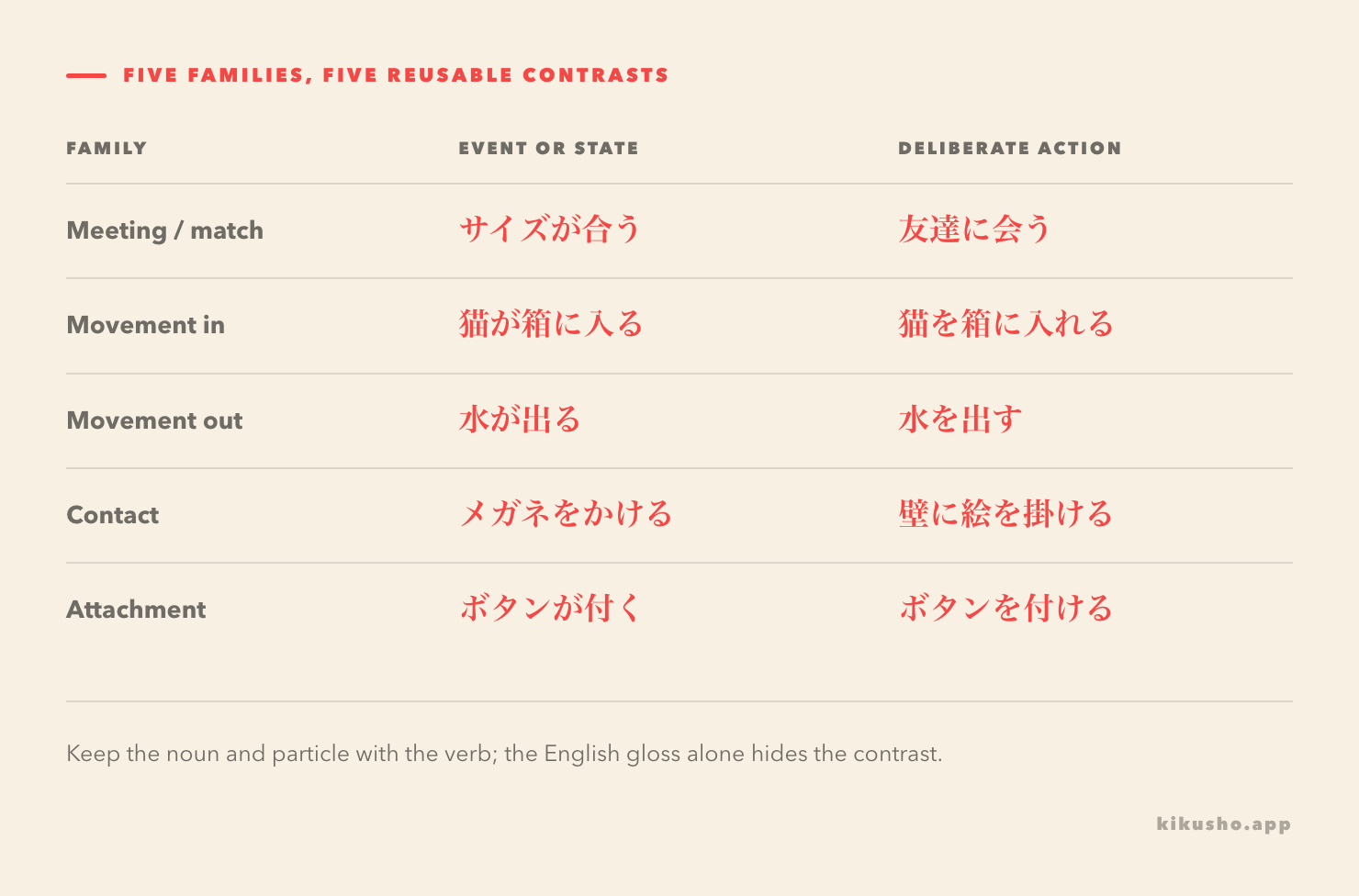
Japanese verbs make more sense when you learn the noun and particle beside them: 友達に会う, 箱に入る, 本を箱に入れる. The eleven entries below form five useful families, and each family shows why a particle belongs on the card with the verb.
Five families reveal more than eleven isolated glosses
Nine entries in this set are familiar N5 building blocks. The N4 work is to contrast them without collapsing different viewpoints into one English translation; 合う and 付く are the two entries tagged N4 in Kikusho's dated inventory. The JLPT does not publish an exhaustive vocabulary list, so those levels are editorial placements rather than official guarantees.
| Family | Kanji | Reading | Core idea | Keep this chunk |
|---|---|---|---|---|
| meeting and matching | 会う | あう | meet | 友達に会う |
| meeting and matching | 合う | あう | fit, match, agree | サイズが合う |
| movement in | 入る | はいる | enter, go in | 箱に入る |
| movement in | 入れる | いれる | put something in | 本を箱に入れる |
| placing and contacting | かける | かける | call; sit; put on | 友達に電話をかける |
| placing and contacting | 掛ける | かける | hang, place over | 壁に絵を掛ける |
| movement out | 出る | でる | go out, come out | 部屋を出る |
| movement out | 出す | だす | put out, submit | ごみを出す |
| causing a change | つける | つける | switch on | 電気をつける |
| causing a change | 付ける | つける | attach, add | 箱に名前を付ける |
| resulting state | 付く | つく | become attached | 箱に名前が付く |
The kana and kanji rows are not sealed compartments. Kanjipedia includes 電気を付ける, while everyday writing often uses 電気をつける. The spelling can hint at a sense, but the nouns and particles tell you more reliably what is happening.
入る and 入れる change the camera angle
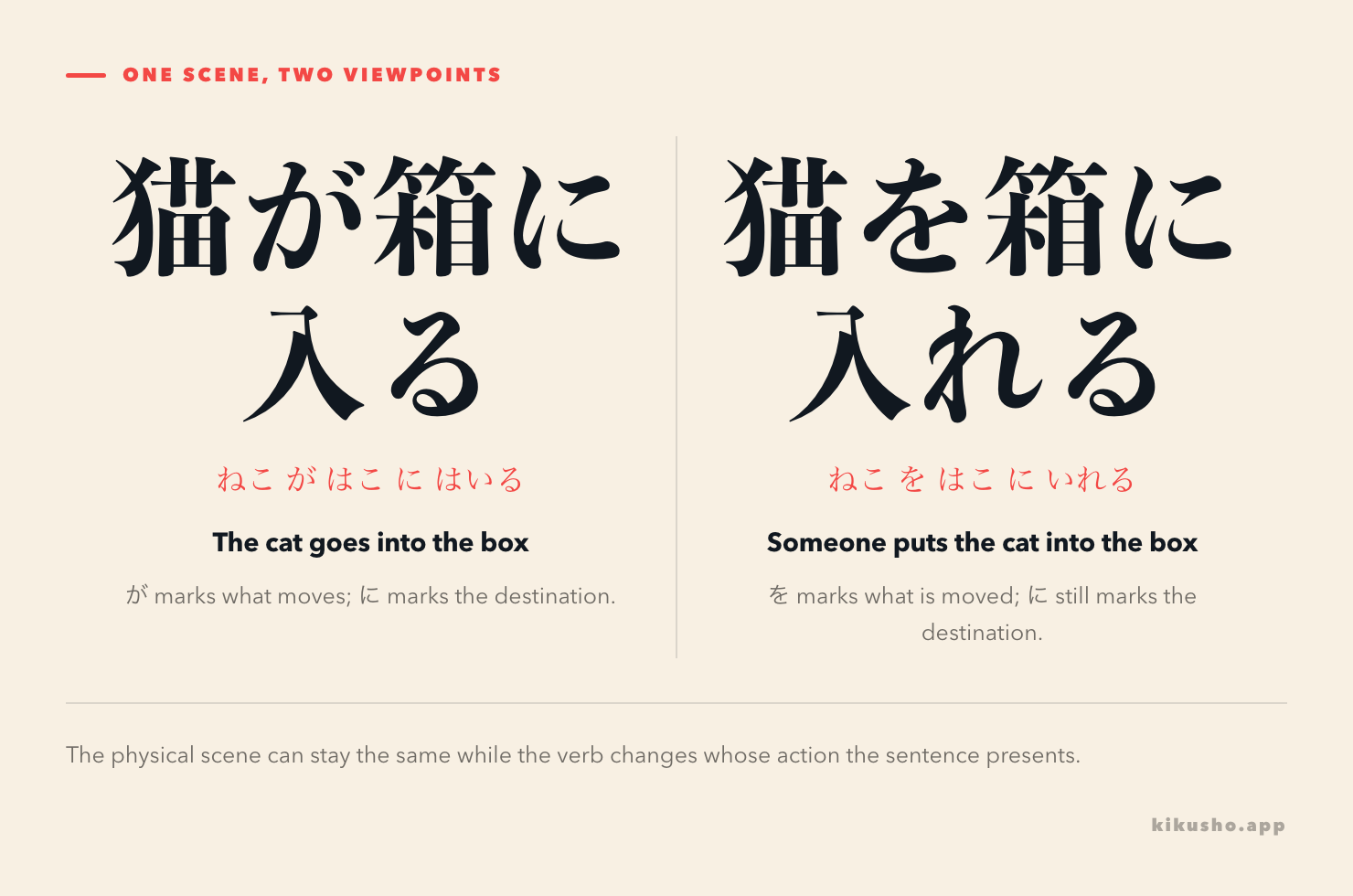
Compare one scene from two viewpoints:
猫が箱に入った。 The cat went into the box.
妹が猫を箱に入れた。 My younger sister put the cat into the box.
入る presents the thing that moves as the subject: 猫が. The destination is 箱に. 入れる presents someone causing the movement, so 猫 becomes the object marked by を, while the destination still takes に. The Japan Foundation's Irodori lesson teaches the same contrast with ingredients: something goes in, or a cook puts it in.
出る and 出す reverse the direction but preserve the choice of viewpoint:
水が出た。 Water came out.
冷蔵庫から水を出した。 I took water out of the refrigerator.
One detail stops this from becoming a mechanical rule: 部屋を出る is intransitive even though it contains を. Here を marks the place crossed or left, not a direct object receiving an action. As Tofugu's transitivity guide notes, particles help reveal a sentence's structure, but one particle by itself does not classify the verb.
会う and 合う share a reading, not a job
会う is the person verb:
駅で友達に会いました。 I met my friend at the station.
に points to the person encountered. と can present the meeting as mutual or arranged: 駅で友達と会いました. The dictionary entry for 会う records both meeting another person and coming together at an agreed place.
合う is the compatibility verb:
この靴はサイズが合います。 These shoes fit.
この色は部屋に合います。 This colour suits the room.
二人は意見が合いません。 The two do not agree.
The thing being judged commonly takes が; the person, purpose or standard it suits can take に. The two あう entries are therefore safer as 人に会う and サイズが合う than as two flashcards containing only the sound au. Individual vocabulary references also place 会う at N5 and 合う at N4, which matches the progression in this set.
かける keeps the act of placing or making contact
The English gloss changes sharply across these sentences:
母に電話をかけます。 I will call my mother.
椅子に腰をかけてください。 Please sit down on the chair.
壁に写真を掛けました。 I hung a photo on the wall.
メガネをかけています。 I am wearing glasses.
They are easier to keep together if かける evokes placing something onto a support or establishing contact. 母に is the person reached; 電話を is what you place. 壁に is the destination; 写真を is what you hang. Kanjipedia's 掛ける entry records the literal hanging sense and a wide range of extensions, which is why one English word cannot cover the family.
つける, 付ける and 付く separate action from result
Start with two deliberate actions:
電気をつけました。 I turned on the light.
荷物に名前を付けてください。 Please put a name on the luggage.
The action affects something marked by を: 電気 or 名前. With attachment, に marks what receives the added thing. Now remove the actor and report the resulting state:
シャツにボタンが付いています。 A button is attached to the shirt.
The button takes が because 付く describes what has become attached. Kanjipedia illustrates 付く with the same structure: paint が clothes に adheres. This action/result split also prepares you for the difference between 〜ている and 〜てある, where the verb you choose determines which resulting state you can describe.
A particle marks a noun's role, not an English translation
Tae Kim's particle guide describes particles as suffixes that define the grammatical role of the noun before them. That gives you a better question than “Which particle does this verb take?” Ask what each noun is doing in this sentence.
- Person encountered or reached: 友達に会う; 母に電話をかける.
- Destination or attachment point: 箱に入る; 壁に絵を掛ける.
- Thing deliberately moved or changed: 猫を箱に入れる; 電気をつける.
- Thing whose state or compatibility is described: サイズが合う; ボタンが付く.
- Place crossed or left: 部屋を出る.
This is why learning words inside sentences matters. A bare “出る = leave” loses the unusual 部屋を pattern; the full sentence preserves it.
Start with three contrasts
You do not need eleven isolated cards. Begin with 入る/入れる, 出る/出す, and 付ける/付く. Say both sides of one scene and make the particles audible: 猫が入る/猫を入れる, 水が出る/水を出す, ボタンが付く/ボタンを付ける.
When one of these verbs appears in something you are reading, capture the complete sentence in Kikusho. Check the generated reading, meaning and example before saving the card, especially when a kana spelling such as かける or つける could hide several senses.
Practice: answer all eight before scrolling further
Question 1. What is the reading of 合う?
a) はいる b) あう c) つく d) でる
Question 2. Which kanji means “meet” in 友達に__?
a) 合う b) 入る c) 会う d) 付く
Question 3. Choose the best completion: 本をかばんに__。(I put the book in the bag.)
a) 入りました b) 出ました c) 合いました d) 入れました
Question 4. Which sentence means “I left the room”?
a) 部屋を出ました。 b) 部屋を出しました。 c) 部屋に入れました。 d) 部屋が合いました。
Question 5. You pressed the switch. Which sentence reports your action?
a) 電気が付きました。 b) 電気をつけました。 c) 電気に入りました。 d) 電気を出ました。
Question 6. Choose the particles: 病院__電話__かけました。(I called the hospital.)
a) を / に b) で / が c) に / を d) が / で
Question 7. Which sentence describes a button already attached to a shirt?
a) シャツをボタンに付けています。 b) シャツがボタンを付いています。 c) シャツにボタンが付いています。 d) シャツにボタンを出ています。
Question 8. Which sentence means “I submitted the homework to the teacher”?
a) 宿題が先生に出ました。 b) 先生が宿題を出しました。 c) 宿題を先生が出ました。 d) 宿題を先生に出しました。
End of the questions. Record all eight choices before opening the explanations below.
Answers and explanations
Answer 1: b) あう. 合う and 会う share the reading あう. Their kanji, surrounding nouns and particles keep their meanings apart.
Answer 2: c) 会う. 人に会う means to meet a person. 合う is the matching or fitting verb, while 入る means enter and 付く means become attached.
Answer 3: d) 入れました. The book is deliberately moved, so it takes を and the transitive verb 入れる. 入りました would present the book itself as entering and would require 本が.
Answer 4: a) 部屋を出ました. With 出る, を marks the place left. 出しました is 出す, a transitive verb, and needs a thing that someone puts out.
Answer 5: b) 電気をつけました. This reports the actor's deliberate switch action. 電気が付きました can naturally report that the light came on, but it changes the viewpoint from your action to the resulting event.
Answer 6: c) に / を. 病院に is the party reached, and 電話を is what is placed: 病院に電話をかけました.
Answer 7: c) シャツにボタンが付いています. シャツに marks the attachment point; ボタンが marks the thing whose attached state is being described.
Answer 8: d) 宿題を先生に出しました. 出す can mean to hand in or submit something. 宿題 is the object marked by を, and 先生 is the recipient marked by に. Answer b instead makes the teacher the person who put out or assigned the homework.
Learn the family, keep the noun roles, and the particle stops being a guess made after the verb.
Common questions
Do Japanese verbs always determine one particle?
No. The particle marks the role of a noun in that particular sentence. A verb strongly predicts some patterns, but the scene can change the role: 出る takes を for a place being left, while 出す takes を for a thing being put out.
What is the difference between 会う and 合う?
Both are read あう. 会う means to meet a person and commonly marks that person with に or と. 合う means to fit, match or agree; the thing that fits is commonly marked with が, and the standard it matches with に.
Are 付ける and つける different verbs?
Spelling does not divide the senses perfectly. 付ける makes attachment or addition visible, while everyday senses such as turning on a light are often written in kana. Dictionaries also record 電気を付ける, so learn the sentence and meaning instead of treating the script as an absolute rule.