On this page
These twelve N1 words describe the point where an idea becomes organised work: a 構想 becomes a 企画, a 打ち合わせ fixes the 議題, duties are divided, and a 見積もり can lead through 交渉 and 合意 to an actual 取引. The difficult distinctions are about scale and status: routine 業務 versus one entrusted 任務, and a process merely 進行する versus a situation that has genuinely 進展する.
Twelve entries connect planning, responsibility and agreement
| Entry | Pronunciation | Grammatical role and meaning | Typical pattern |
|---|---|---|---|
| 打ち合わせ | うちあわせ, uchiawase | noun; する verb; working session held to align plans and practical details | 取引先と打ち合わせをする |
| 企画 | きかく, kikaku | noun; する verb; organised plan, project or planning | 新商品を企画する |
| 議題 | ぎだい, gidai | noun; matter placed before a meeting for discussion | 議題に取り上げる |
| 業務 | ぎょうむ, gyōmu | noun; の modifier; ongoing work, duties or business operations | 業務を遂行する |
| 交渉 | こうしょう, kōshō | noun; する verb; negotiation to adjust terms or interests | 価格を交渉する |
| 構想 | こうそう, kōsō | noun; する verb; conceived framework, vision or outline | 構想を練る |
| 合意 | ごうい, gōi | noun; する verb; agreement or alignment of intentions | 条件に合意する |
| 進展 | しんてん, shinten | noun; する verb; substantive progress or development | 交渉が進展する |
| 取引 | とりひき, torihiki | noun; する verb; transaction or business dealings | 取引を開始する |
| 任務 | にんむ, ninmu | noun; assigned duty, function or mission | 任務を果たす |
| 分担 | ぶんたん, buntan | noun; する verb; dividing and sharing work, cost or responsibility | 業務を分担する |
| 見積もり | みつもり, mitsumori | noun; estimate, valuation or quotation | 見積もりを依頼する |
Kikusho's source inventory assigns all twelve spelling-and-reading records to N1 and records no internal placement disagreement. The two baseline lists are descendants of the same Waller family, so they count as one source family. Current outside placements show why a level label should remain editorial: Bunpro labels 企画, 業務, 進展 and 見積もり N1, while its current pages place 打ち合わせ and 構想 earlier. The JLPT organisers publish no exhaustive vocabulary list.
The inventory also contains the compact spelling 打合せ in an earlier-level lesson. 打ち合わせ, 打ち合せ, 打合わせ and 打合せ are spelling variants of the same うちあわせ word, not four different meeting types. The N2 meetings lesson teaches the form in depth alongside dates, schedules, policy and countermeasures. Here it supplies the coordination stage in a more advanced project chain.
構想 sketches the frame; 企画 makes a project workable
構想 is the conceptual framework for something you intend to create. It can be broad, long-range and still open to revision. The common expression 構想を練る suggests working an idea into a coherent outline.
市は駅前を文化地区にする構想を発表しました。
しは えきまえを ぶんかちくに する こうそうを はっぴょうしました。
The city announced a vision for turning the area in front of the station into a cultural district.
企画 is the organised plan or project made to achieve a specific purpose. It appears in 企画案, a planning proposal; 企画書, a project proposal document; and 商品企画, product planning.
広報部は地域の店を紹介する動画を企画しています。
こうほうぶは ちいきの みせを しょうかいする どうがを きかくしています。
The public-relations department is planning a video introducing local shops.
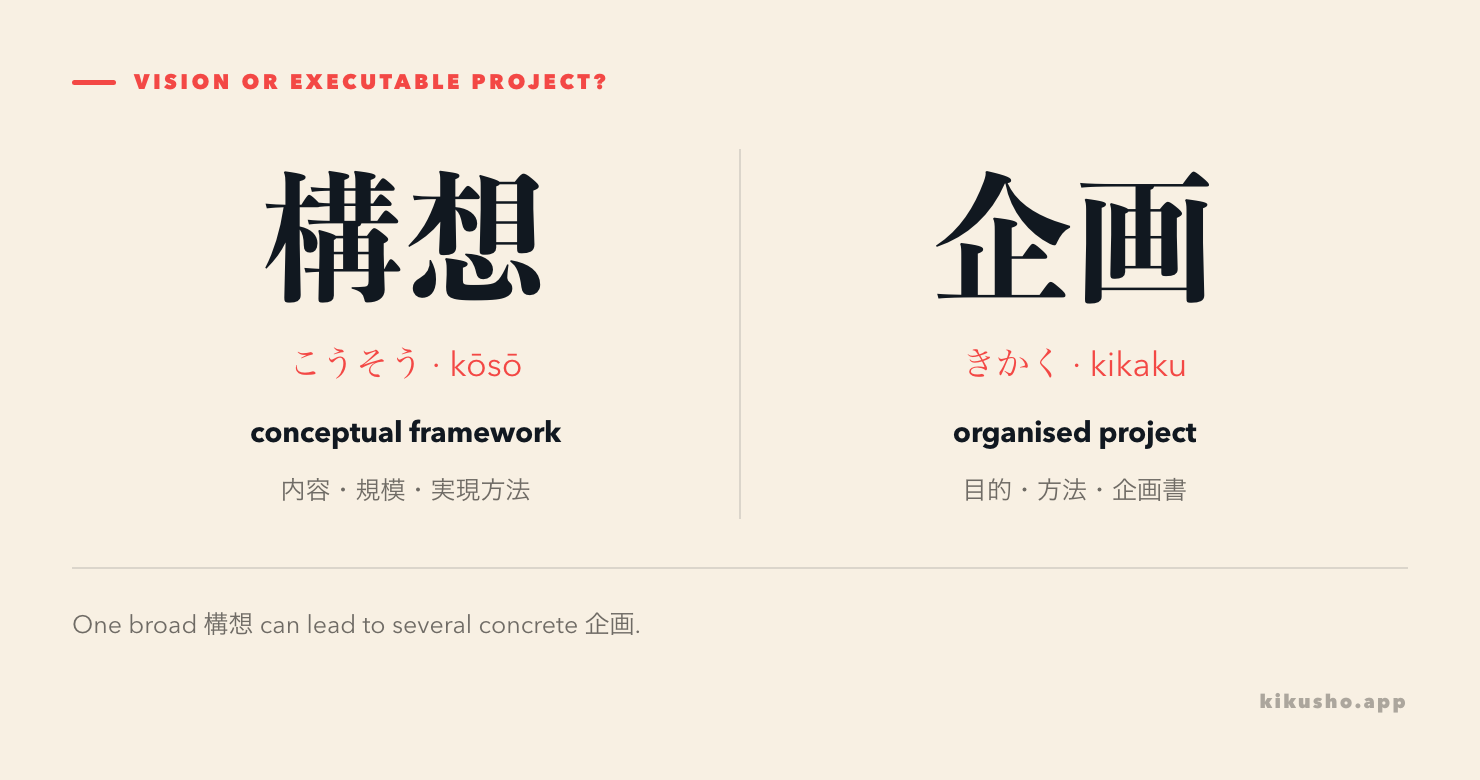
Daijisen defines 構想 as considering the content, scale and means of realisation and assembling the framework. Its 企画 entry focuses on making a plan in order to carry something out. They overlap, but a practical test helps: if you are still shaping the whole picture, 構想 is at home; if you are organising a project that can be proposed and run, 企画 is more likely.
打ち合わせ prepares the meeting; 議題 names what it must decide
A 打ち合わせ is advance coordination among the people who will carry out a task. It aligns details before an event, presentation, negotiation or larger meeting.
契約交渉の前に、営業部と打ち合わせをします。
けいやくこうしょうの まえに、えいぎょうぶと うちあわせを します。
Before the contract negotiations, we will coordinate with the sales department.
議題 is the specific matter submitted to a meeting for discussion. It is content, not the meeting itself and not its calendar.
本日の第一の議題は、開発費の分担です。
ほんじつの だいいちの ぎだいは、かいはつひの ぶんたんです。
Today's first agenda item is how to divide the development costs.
Useful combinations include 議題にする, make something an agenda item; 議題に取り上げる, take it up for discussion; and 議題から外す, remove it from the agenda. Daijisen defines 議題 as a problem submitted to a meeting for debate. English agenda can mean the complete programme, but Japanese 議題 points to the matter being discussed. A meeting's 日程 instead concerns its schedule.
業務 is ongoing work; 任務 is entrusted; 分担 assigns shares
業務 collects the work performed continuously as part of a profession, office or business. It often describes operations as a whole rather than one isolated task.
- 通常業務: normal operations
- 業務を遂行する: carry out one's work
- 業務を委託する: outsource operations or duties
- 業務を停止する: suspend operations
Goo's Daijisen entry centres 業務 on work performed continuously in relation to an occupation or enterprise.
任務 is a duty, function or mission entrusted to a person or group. It creates a clearer expected outcome or responsibility.
調査チームの任務は、事故の原因を明らかにすることです。
ちょうさチームの にんむは、じこの げんいんを あきらかに することです。
The investigation team's mission is to determine the cause of the accident.
Common verbs are 任務を果たす, fulfil a mission; 任務を遂行する, carry it out; and 任務に就く, take up an assignment. A person can perform many kinds of 業務 during the day while holding one urgent 任務.
分担 divides a larger body of work, responsibility or cost into shares.
設計と広報の業務を二つの部門で分担します。
せっけいと こうほうの ぎょうむを ふたつの ぶもんで ぶんたんします。
The two departments will divide the design and publicity work between them.
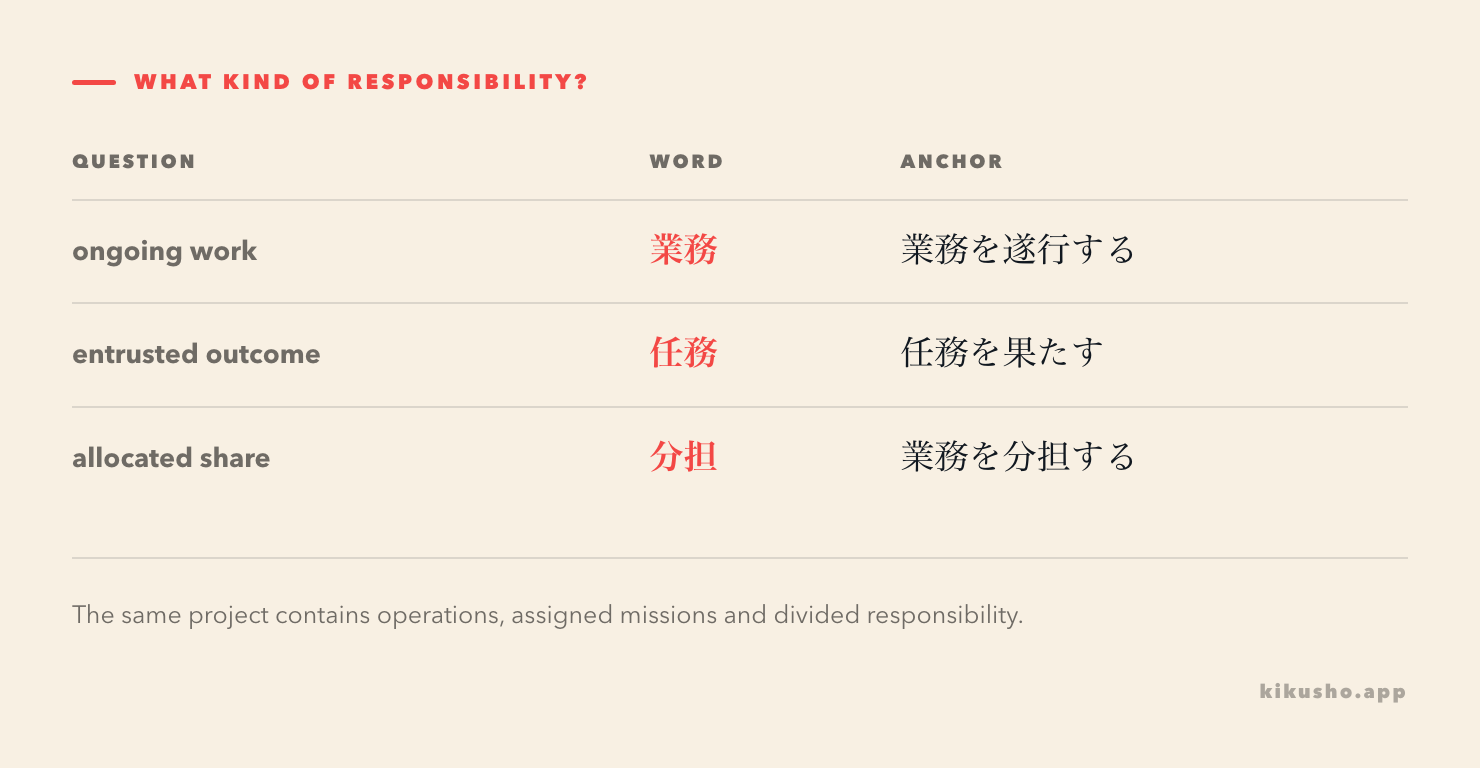
The Cabinet Secretariat's management guidance treats 業務分担 as a visible map of who does what and how much work each person carries. That is the relationship: 業務 names the operational work, and 分担 says how its parts are allocated. 分担 can also divide cost: 費用を三社で分担する.
見積もり begins a commercial chain before 取引 starts
A 見積もり is a calculation made in advance. In business, it is often a quotation of cost, time, quantity and conditions. 見積書 is the document recording it.
- 見積もりを依頼する: request a quotation
- 見積もりを取る: obtain an estimate
- 見積もりを出す: provide a quotation
- 見積もりを比較する: compare estimates
The Kotobank entry on 見積書 explains that a quotation calculates the necessary items before a sale or contracted job. The written estimate can be examined before the parties commit.
交渉 is the process of discussing conflicting or differing interests to adjust conditions and seek agreement.
納期と価格について取引先と交渉しています。
のうきと かかくについて とりひきさきと こうしょうしています。
We are negotiating the delivery date and price with the business partner.
Typical expressions are 価格交渉, price negotiation; 交渉に入る, enter negotiations; 交渉が難航する, negotiations encounter difficulty; and 交渉を打ち切る, break off negotiations. The Goo thesaurus characterises 交渉 as discussion aimed at an agreement.
合意 says that the parties' intentions align. The matter commonly takes に, and the result can be expressed with 合意に達する.
両社は新しい取引条件に合意しました。
りょうしゃは あたらしい とりひきじょうけんに ごういしました。
The two companies agreed to the new transaction terms.
取引 is the transaction or continuing commercial dealings themselves. It may involve goods, services, money or financial assets.
- 取引を開始する: begin doing business
- 取引を停止する: suspend transactions
- 取引条件: transaction terms
- 取引先: client, supplier or other business partner
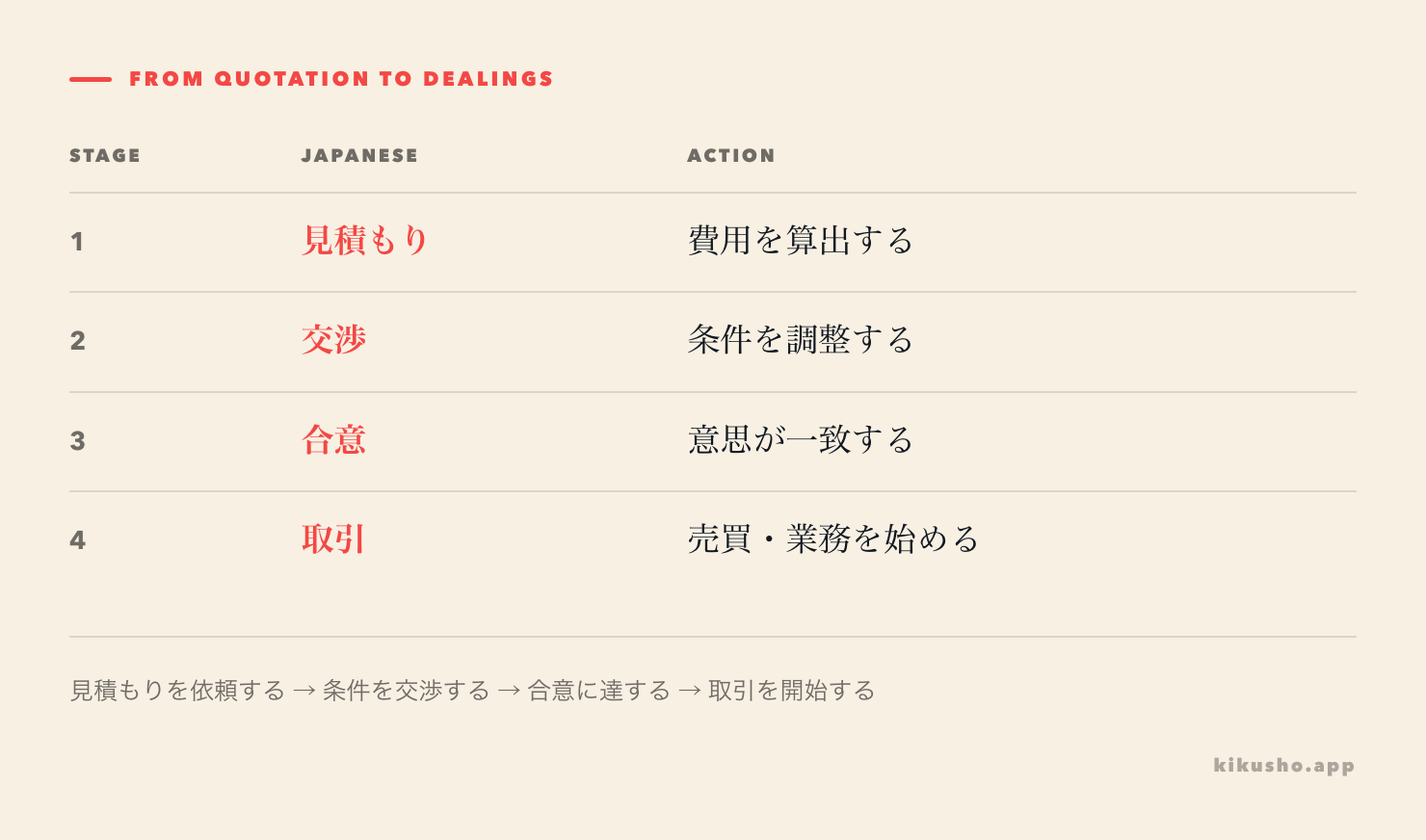
A useful sequence is 見積もりを依頼する → 条件を交渉する → 合意に達する → 取引を開始する. It is a reading map rather than a legal rule, but it matches the commercial flow described in the official INPIT guide from quotation request through condition negotiation, agreement and contract signing.
進行 tracks movement; 進展 reports a developed situation
The N3 word 進行 follows an event or process moving through stages. A moderator can 会議を進行する, and work can be 予定どおり進行する.
進展 says that the situation has opened out, developed or made substantive progress. It is especially natural with negotiation, investigation, research and relationships.
数回の交渉を重ねましたが、大きな進展はありません。
すうかいの こうしょうを かさねましたが、おおきな しんてんは ありません。
We have held several rounds of negotiation, but there has been no major progress.
新しい証拠によって、調査が急速に進展しました。
あたらしい しょうこによって、ちょうさが きゅうそくに しんてんしました。
New evidence caused the investigation to advance rapidly.
The meeting itself may 進行 smoothly while the negotiation produces no 進展. One word reports movement through the procedure; the other evaluates what changed as a result. The Shogakukan dictionary example specifically uses negotiations making rapid or little progress.
When you capture a project email in Kikusho, keep these nouns with the verbs that reveal their role: 議題に取り上げる, 任務を果たす, 合意に達する. A bare English gloss such as “work” or “progress” hides the distinction. The whole phrase preserves the case pattern and the situation you will need when reviewing the card.
A redevelopment memo puts the twelve words in one process
Read the internal memo:
駅前の再開発構想をもとに、地域交流施設の企画案を作成しました。明日の打ち合わせでは、建設費の見積もりと各社の業務分担を第一の議題とします。三社に見積もりを依頼しましたが、価格交渉にはまだ大きな進展がありません。条件に合意できれば、来月から正式な取引を開始します。運営業務は市と民間会社で分担し、安全確認を現場責任者の任務とします。
Based on the redevelopment vision for the station area, we prepared a proposal for a community exchange facility. At tomorrow's coordination meeting, the construction estimate and division of duties among the companies will be the first agenda item. We requested estimates from three companies, but the price negotiations have not yet made much progress. If we can agree on the conditions, formal business dealings will begin next month. The city and a private company will divide the operational work, while on-site safety checks will be the site manager's assigned mission.
Notice that the memo does not call every piece of work a 任務. Operations remain 業務, their allocation is 分担, and one outcome entrusted to a responsible person becomes a 任務. Likewise, the fact that negotiations are continuing does not prove 進展.
The N3 project lesson covers proposals, goals, contracts, implementation and completion. The N2 layer adds exact schedules, policy, countermeasures and agreement formation. Together the three lessons move from task execution to coordination and then to institutional planning and commercial decisions.
Practice
1 · Estimate reading. How is 見積もり read?
- A. みづもり
- B. みつもり
- C. けんせきもり
- D. みつまり
2 · Broad framework. The city is still shaping the overall content, scale and route to realisation of a twenty-year redevelopment vision. Which word fits?
- A. 議題
- B. 分担
- C. 構想
- D. 取引
3 · Organised project. Which expression names a concrete project proposal prepared for approval?
- A. 企画案
- B. 任務案
- C. 業務進展
- D. 取引議題
4 · Matter for debate. Which word names the issue formally placed before a meeting?
- A. 打ち合わせ
- B. 見積もり
- C. 構想
- D. 議題
5 · Continuing operations. Which sentence refers to the organisation's normal ongoing work?
- A. 通常任務を合意します。
- B. 通常業務を続けます。
- C. 通常取引を議題します。
- D. 通常分担が交渉します。
6 · Entrusted outcome. An investigation team has been specifically charged with finding the cause of an accident. Which noun best names that assignment?
- A. 見積もり
- B. 取引
- C. 任務
- D. 打ち合わせ
7 · Divided workload. Complete the sentence: 開発業務を三つの部門で( )します。
- A. 分担
- B. 進展
- C. 合意
- D. 交渉
8 · Commercial sequence. Which sentence uses both words naturally?
- A. 見積もりに任務して、議題を取引した。
- B. 合意を見積もって、分担に進展した。
- C. 取引を議題して、構想を任務した。
- D. 価格を交渉し、条件に合意した。
9 · Meaningful development. Negotiations are continuing, but nothing important has changed. Which statement fits?
- A. 交渉の任務を見積もった。
- B. 交渉が業務を分担した。
- C. 交渉に大きな進展はない。
- D. 交渉を議題に合意した。
10 · Project memo. Which statement agrees with the redevelopment memo?
- A. A contract has already been signed with one company.
- B. Operational duties will be shared, and safety checks are assigned to the site manager.
- C. Price negotiations have finished with substantial progress.
- D. The city abandoned the redevelopment vision before planning began.
Complete the whole set, then reveal the commentary beneath it.
Answers and explanations
Follow each noun's role in the project rather than matching one English gloss.
1 · B, みつもり. 見積もり is read みつもり. The spellings 見積り and 見積 are also used for the same reading.
2 · C, 構想. A long-range conceptual framework is a 構想. An executable project developed from it can become a 企画.
3 · A, 企画案. 企画案 is a project or planning proposal that can be submitted for consideration. The other compounds do not name that document or organised project.
4 · D, 議題. 議題 is the matter placed before a meeting for discussion. 打ち合わせ is the coordination meeting itself, and 見積もり is an estimate.
5 · B, 通常業務を続けます. 業務 names continuing occupational or organisational work. 任務 would foreground a particular entrusted mission.
6 · C, 任務. Determining the cause is the specific outcome entrusted to the investigation team. It can fulfil that mission with 任務を果たす.
7 · A, 分担. 業務を三つの部門で分担する divides the work among three organisational units. 分担 can also divide responsibility or cost.
8 · D. 価格を交渉する means negotiate the price, and 条件に合意する means agree to the conditions. The particles and commercial sequence are both natural.
9 · C, 交渉に大きな進展はない. The negotiations may still be in progress, but 進展 evaluates whether the situation has developed in a meaningful way.
10 · B. The memo says 運営業務は市と民間会社で分担し、安全確認を現場責任者の任務とします. Negotiations have not made much progress, and no signed contract or abandoned vision is reported.
Common questions
What is the difference between 構想 and 企画?
構想 is the conceived framework or vision for something not yet made, including its overall content, scale and route to realisation. 企画 is the organised plan or project designed to achieve a concrete purpose. A broad redevelopment 構想 can produce several executable 企画.
What is the difference between 業務 and 任務?
業務 means the ongoing work or operations carried out as part of a job or business. 任務 is a particular duty or mission entrusted to someone and expected to be fulfilled. Routine customer support can be 業務; completing one emergency inspection can be a 任務.
What is the difference between 進行 and 進展?
進行 says that an activity, event or process is moving through its course. 進展 says that the situation has developed or made substantive progress. A meeting can 進行 without negotiations making much 進展.
Is 見積もり the same as a final invoice?
No. 見積もり is an estimate or quotation prepared before an order or contract, often covering cost, time and conditions. A 見積書 records that estimate. A final invoice is a 請求書 and requests payment after the relevant goods or services have been supplied.