On this page
These nine N1 words describe an organisation from the personnel desk: who counts as 職員 or 人材, where people are 配置される, which 部門 they 勤務する, how they 昇進する, and how 辞職, 退職 and 履歴 record the end or course of a career. Their difficulty lies less in translation than in viewpoint: a person, a position, an organisational unit and a personnel record are not interchangeable.
Nine entries map people, posts, units and records
| Word | Reading | Word type and core sense | Anchor phrase |
|---|---|---|---|
| 勤務 | きんむ, kinmu | noun; する verb; serving or working for an organisation | 市役所に勤務する |
| 昇進 | しょうしん, shōshin | noun; する verb; promotion to a higher post | 課長に昇進する |
| 職員 | しょくいん, shokuin | noun; staff member of an institution or organisation | 大学の職員 |
| 辞職 | じしょく, jishoku | noun; する verb; voluntary resignation from a post | 議員を辞職する |
| 人材 | じんざい, jinzai | noun; capable people, talent or personnel | 人材を育成する |
| 退職 | たいしょく, taishoku | noun; する verb; leaving employment; retirement | 定年で退職する |
| 配置 | はいち, haichi | noun; する verb; assigning or arranging people or things | 職員を配置する |
| 部門 | ぶもん, bumon | noun; division, sector, category or branch of a whole | 営業部門 |
| 履歴 | りれき, rireki | noun; history, background or recorded log | 検索履歴 |
Kikusho's source inventory places all nine records at N1 and reports no disagreement among its retained observations. Current public pages are less tidy. Japanesetest4you labels 配置 and 辞職 N1, while its current 昇進 page presents the word as N2. Its 退職 page even has an N2 page title while the entry itself states N1. The JLPT organisers publish no exhaustive official vocabulary list, so this page keeps the assigned N1 study order and makes the inconsistent boundary visible.
The earlier N3 employment and workplace lesson teaches entering employment, hiring, transfers and assigned responsibility. This set moves into the language of personnel decisions and institutional records.
職員 is a member; 人材 is capability; 部門 is a unit
職員 identifies a person who belongs to an institution or organisation and carries out a role there. It works naturally for government offices, schools, hospitals, research institutes and other organisations:
図書館の職員に利用方法を尋ねました。
としょかんの しょくいんに りようほうほうを たずねました。
I asked a library staff member how to use the service.
社員 narrows the relationship to a company. 職員 is broader by institution type, though each organisation's own terminology may be more specific. Daijisen defines 職員 as someone registered with a government office, company, school or similar body and responsible for duties there.
人材 views a person through ability and usefulness in an activity or organisation. In recruitment and management language, English talent or personnel often fits better than the old gloss “man of talent.”
- 優秀な人材を採用する: recruit capable people
- 人材を育成する: develop personnel
- 人材を確保する: secure the people needed
- 人材不足: shortage of suitable personnel
The dictionary's 人材 entry centres on a capable person whose abilities are useful. Modern organisational compounds extend that viewpoint to groups and development programmes. 人材 does not identify the person's contractual status or prove that they already work for the organisation.
部門 is not a person at all. It is one division, sector or category produced by splitting a larger whole:
海外事業部門が新しい市場を調査しています。
かいがいじぎょうぶもんが あたらしい しじょうを ちょうさしています。
The overseas business division is researching a new market.
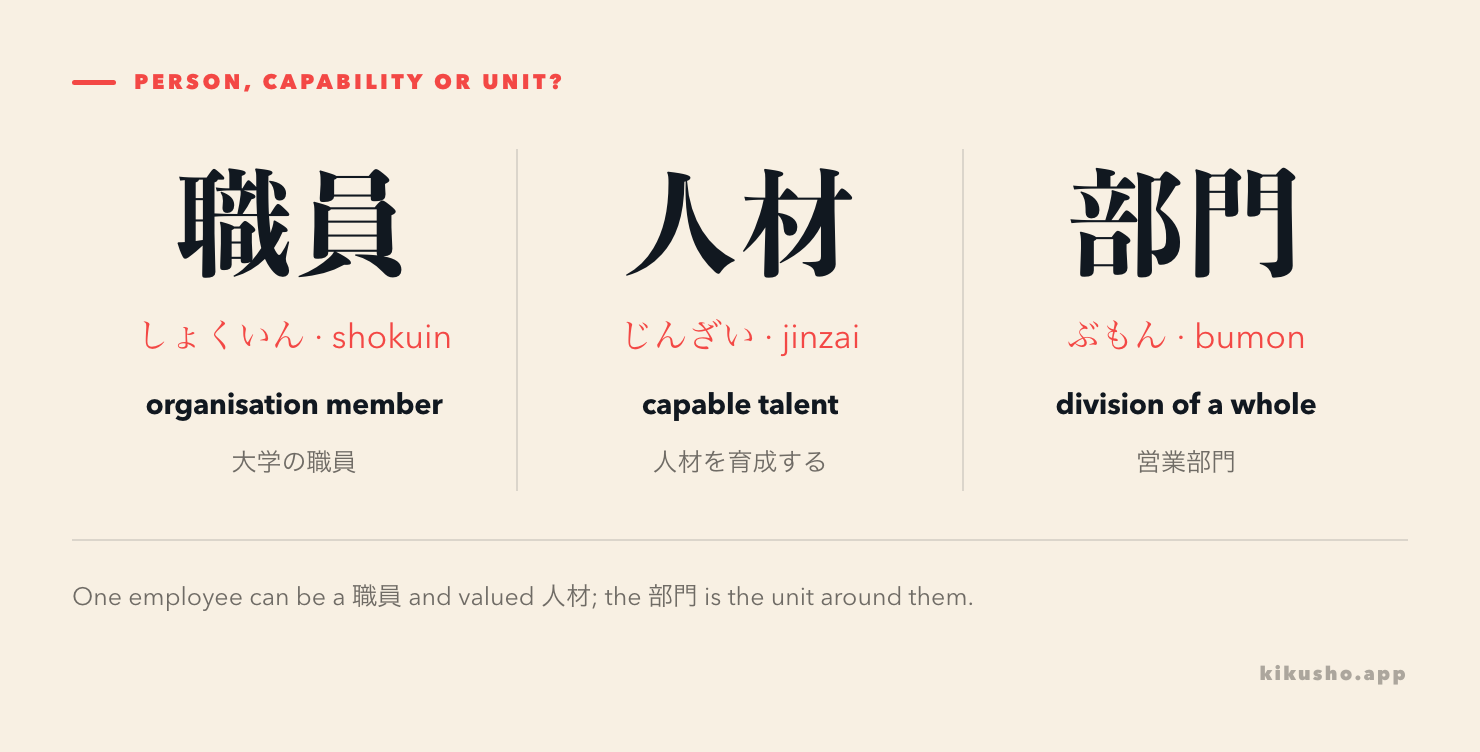
Daijisen defines 部門 as one part into which a whole has been divided. In a company, 営業部 may be the official name of a department, while 営業部門 can refer more broadly to the sales function or sector. Do not assume that every 部門 on an organisation chart has the formal suffix 部.
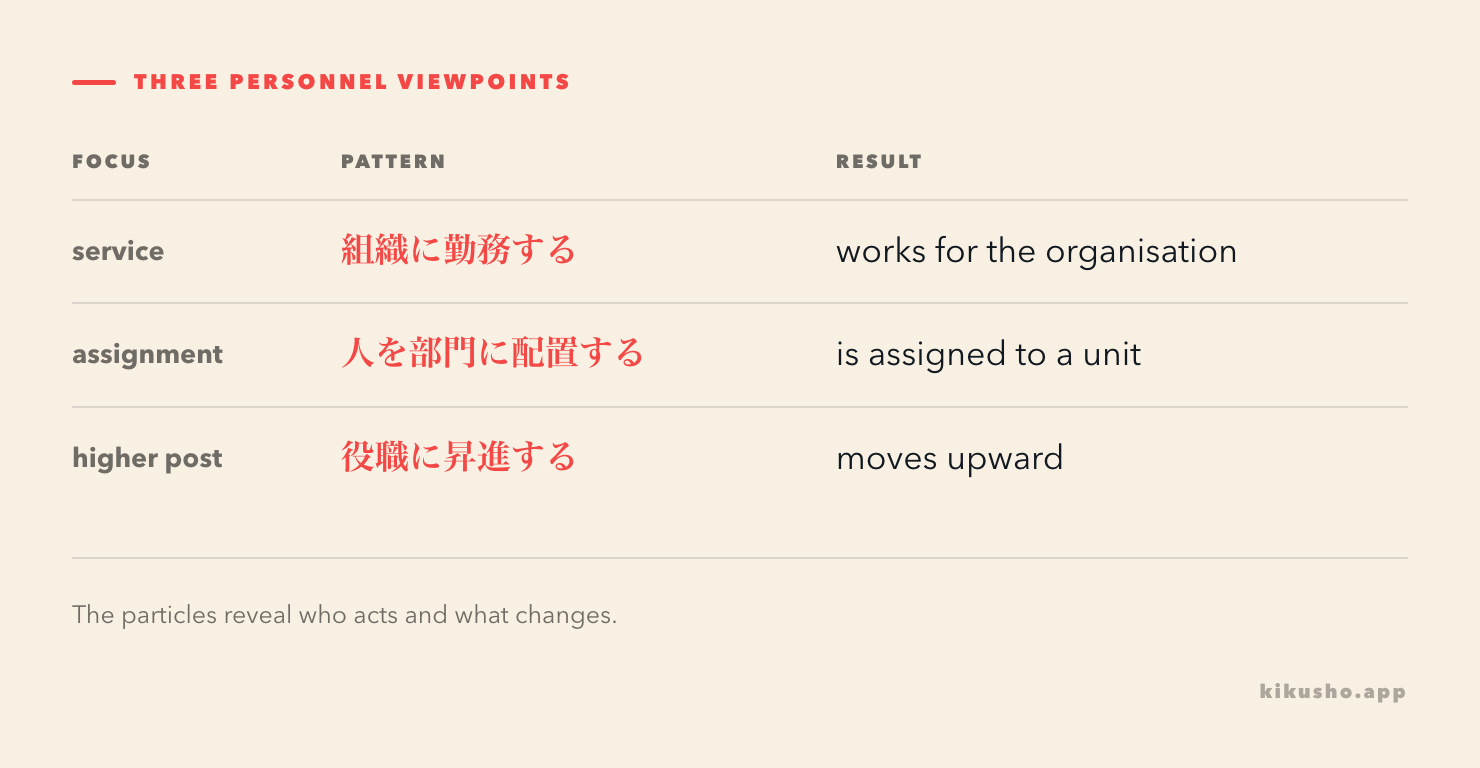
勤務, 配置 and 昇進 describe three different personnel actions
勤務する says that someone works in service of an organisation or at an assigned workplace. The organisation commonly takes に:
佐藤さんは十年間、市役所に勤務しています。
さとうさんは じゅうねんかん、しやくしょに きんむしています。
Sato has worked at city hall for ten years.
It also forms scheduling and location compounds: 勤務時間, working hours; 勤務先, place of employment; 在宅勤務, working from home. Daijisen defines the word as working for an organisation and the work performed there.
配置する is what the organisation does with people or resources: it assigns each to a position, station or place. The person or object takes を, and the destination commonly takes に.
経験のある職員を海外部門に配置しました。
けいけんの ある しょくいんを かいがいぶもんに はいちしました。
We assigned an experienced staff member to the overseas division.
The word is not restricted to personnel. You can arrange desks, equipment or buttons too. Its stable core is allocating people or things to their respective positions, as the dictionary definition states.
昇進する changes rank or post upward:
来月、彼女は支店長に昇進します。
らいげつ、かのじょは してんちょうに しょうしんします。
Next month, she will be promoted to branch manager.
The new position takes に. 昇進 differs from 昇給, a rise in pay, and often from 昇格, movement to a higher grade or qualification. An organisation may link these events, but the vocabulary records different changes.
| Focus | Pattern | What it says |
|---|---|---|
| affiliation or service | 組織に勤務する | the person works for the organisation |
| assignment | 人を部門に配置する | someone assigns the person to a unit |
| higher post | 役職に昇進する | the person moves to a higher position |
辞職 foregrounds resignation; 退職 covers leaving employment
Both words can describe a person leaving a job, but they frame the event differently.
辞職 explicitly presents the person as giving up a post by their own decision. It is frequent with public office, leadership and responsibility:
大臣は問題の責任を取り、辞職しました。
だいじんは もんだいの せきにんを とり、じしょくしました。
The minister took responsibility for the problem and resigned.
議員を辞職する意向を表明しました。
ぎいんを じしょくする いこうを ひょうめいしました。
They announced their intention to resign as a legislator.
退職 describes departure from employment more broadly. It covers a voluntary departure, retirement at a set age and other endings viewed from the employment relationship:
父は六十五歳で定年退職しました。
ちちは ろくじゅうごさいで ていねんたいしょくしました。
My father retired at the mandatory retirement age of sixty-five.
退職後も週に二日働いています。
たいしょくごも しゅうに ふつか はたらいています。
Even after retirement, they work two days a week.
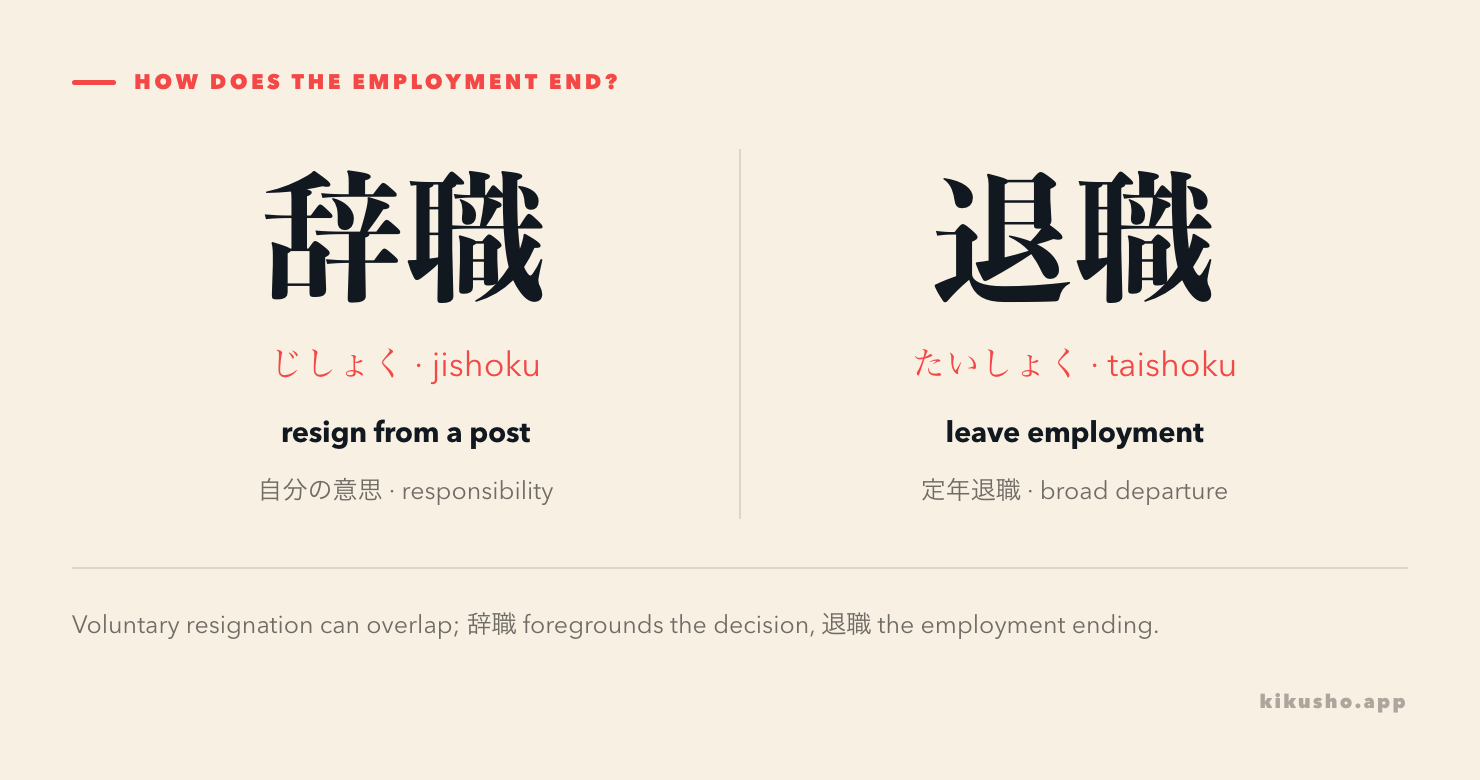
The Daijisen usage note makes the boundary explicit: 辞職 is leaving a post by one's own will, while 退職 can include voluntary departure, mandatory retirement and dismissal. The Ministry of Health, Labour and Welfare glossary likewise defines 退職 in its labour vocabulary as leaving a company.
The overlap is real. An employee who chooses to resign may describe the event as 退職, especially in routine company language. 辞職 adds a sharper focus on relinquishing the post. Neither word is the same as 退勤, leaving work at the end of the day.
履歴 is the trace left by a career or a system
履歴 is a record of what someone or something has gone through. Its older personal sense covers educational and professional background; digital Japanese extends the same idea to logged actions.
| Expression | Meaning |
|---|---|
| 履歴書 | résumé or curriculum vitae |
| 職歴 | employment history |
| 学歴 | educational history |
| 検索履歴 | search history |
| 更新履歴 | update or revision history |
| 通話履歴 | call history |
応募者の職歴と海外勤務歴を確認しました。
おうぼしゃの しょくれきと かいがいきんむれきを かくにんしました。
We checked the applicant's employment history and record of overseas work.
Daijisen records both the personal background sense and computer records such as communication history. 経歴 often presents the path or profile of positions and experience someone has accumulated. 履歴 readily names the stored record or trace, which is why it fits both a résumé and a browser history.
In a job application, 履歴書 is the document, while 職歴 is the employment-history section or information inside it. Saying 履歴 alone does not automatically mean the paper résumé.
A personnel announcement connects the nine words
Read the internal announcement:
来年度、海外事業部門を拡大します。新しい市場に詳しい人材を採用するとともに、現在本社に勤務している職員三人を海外拠点に配置します。営業部の佐藤さんは支店長に昇進します。一方、部門長は今回の問題の責任を取り、今月末で辞職する意向です。また、定年で退職する職員の後任を選ぶため、候補者の職歴と、社内の人事システムに残る勤務履歴を確認します。
Next fiscal year, we will expand the overseas business division. Along with recruiting people familiar with the new market, we will assign three staff members who currently work at headquarters to overseas locations. Sato from Sales will be promoted to branch manager. Meanwhile, the division head intends to resign at the end of this month to take responsibility for the recent problem. We will also review candidates' employment histories and the assignment histories retained in the internal personnel system in order to choose a successor for a staff member retiring at the mandatory age.
The announcement moves between four viewpoints. 人材 presents ability sought by the organisation; 職員 identifies current members. 部門 is the organisational unit, while 配置 and 昇進 describe management decisions affecting people. Finally, 辞職, 退職 and 履歴 distinguish a voluntary resignation, a retirement event and the records used to choose a successor.
Practice
1 · Placement reading. Which kana reproduce 配置?
- A. はいじ
- B. はいち
- C. ばいち
- D. はちい
2 · Orthography. Choose the spelling of しょうしん, “promotion to a higher post.”
- A. 昇進
- B. 上進
- C. 昇新
- D. 上新
3 · Case pattern. Complete the sentence: 佐藤さんは市役所( )勤務しています。
- A. を
- B. でだけ
- C. に
- D. へを
4 · Person or unit. Which word names a staff member rather than an organisational division?
- A. 部門
- B. 履歴
- C. 配置
- D. 職員
5 · Talent viewpoint. Which phrase means “develop personnel or talent”?
- A. 人材を育成する
- B. 人材を退職する
- C. 人材に履歴する
- D. 人材が部門する
6 · Assignment. Which sentence says that the organisation assigned experienced staff to the overseas division?
- A. 経験のある職員が海外部門を辞職した。
- B. 経験のある職員を海外部門に配置した。
- C. 経験のある部門を職員に勤務した。
- D. 海外部門の履歴が昇進した。
7 · Voluntary resignation. A minister gives up the post to take responsibility for a scandal. Which word best foregrounds that decision?
- A. 勤務
- B. 配置
- C. 辞職
- D. 部門
8 · Retirement. Complete the sentence: 父は六十五歳で定年( )しました。
- A. 退職
- B. 人材
- C. 職員
- D. 履歴
9 · Digital record. Which expression means “search history”?
- A. 検索職員
- B. 検索部門
- C. 検索勤務
- D. 検索履歴
10 · Personnel notice. What will happen under the plan described above?
- A. Every staff member will resign at the end of the month.
- B. Three headquarters staff members will be assigned overseas.
- C. Sato will retire instead of becoming branch manager.
- D. The overseas business division will be closed next year.
Return to the announcement once, then reveal the personnel review.
Answers and explanations
Match each noun to its viewpoint before judging the English gloss.
1 · B, はいち. 配置 is read はいち. The final character 置 contributes ち in this compound.
2 · A, 昇進. 昇進 is the standard spelling for promotion to a higher post. It is separate from 昇給, a pay rise.
3 · C, に. 勤務する commonly marks the organisation or workplace affiliation with に: 市役所に勤務する.
4 · D, 職員. 職員 identifies a person serving in an organisation. 部門 names a division; 履歴 a record; 配置 an arrangement or assignment.
5 · A, 人材を育成する. 人材を育成する means developing people's capabilities for the organisation. The other choices combine the noun with relationships it does not take.
6 · B. 職員を marks the people assigned, and 海外部門に marks their destination. This is the personnel sense of 配置する.
7 · C, 辞職. 辞職 foregrounds voluntarily relinquishing a post, especially one carrying public or organisational responsibility.
8 · A, 退職. 定年退職 is retirement at the prescribed age. 辞職 would focus on choosing to resign from a post rather than reaching the mandatory retirement point.
9 · D, 検索履歴. 履歴 extends from personal background to stored logs. 検索履歴 is the record of previous searches.
10 · B. The announcement says that three staff members currently working at headquarters will be assigned to overseas locations. The division will expand, Sato will be promoted, and only the division head intends to resign.
Common questions
What is the difference between 辞職 and 退職?
辞職 foregrounds a person's decision to resign from a post, often a public office or position carrying responsibility. 退職 is the broader term for leaving employment and includes voluntary departure, mandatory retirement and other ways employment ends. The words can overlap when someone chooses to leave a job.
What is the difference between 職員 and 人材?
職員 identifies a staff member who belongs to an organisation and performs a role there. 人材 evaluates or groups people as talent or personnel whose abilities an organisation seeks, develops or assigns. The same person can be both a 職員 and valuable 人材, but the viewpoint differs.
Does 昇進 mean receiving a pay rise?
昇進 means moving to a higher position or post, as in 課長に昇進する. A pay rise is 昇給. Promotion may bring higher pay, but 昇進 alone does not state that the salary changed.
Does 履歴 only refer to a résumé?
No. 履歴 is a record of what a person, system or object has gone through. It appears in 履歴書 for a résumé, 職歴 for employment history, and digital expressions such as 検索履歴 and 更新履歴.