On this page
These nine N1 words let you follow a product from 開発, development, through 規格, standards, and 加工, processing, to a 精密な machine powered by a 電源 and protected by a 特許. The central contrasts are practical: 規格 and 企画 share the reading きかく but not the same role, while 電源 supplies power and 回路 carries current or signals.
Nine entries describe a technical system and the people behind it
| Entry | Pronunciation | Grammatical role and meaning | Typical pattern |
|---|---|---|---|
| 開発 | かいはつ, kaihatsu | noun; する verb; development of a product, technology, system, land or resource | 新技術を開発する |
| 回路 | かいろ, kairo | noun; electrical or electronic circuit; path for current or signals | 回路を設計する |
| 加工 | かこう, kakō | noun; する verb; processing or treating a material, food, image or data | 金属を加工する |
| 規格 | きかく, kikaku | noun; standard or specification defining shared requirements | 規格に適合する |
| 効率 | こうりつ, kōritsu | noun; efficiency, the relationship between resources used and results | 生産効率を上げる |
| 精密 | せいみつ, seimitsu | noun; な adjective; precise, detailed or high-precision | 精密に測定する |
| 電源 | でんげん, dengen | noun; power source, power supply or a device's power control | 電源を入れる |
| 特許 | とっきょ, tokkyo | noun; patent; an exclusive legal right granted for an invention | 特許を取得する |
| 部 | ぶ, bu | noun; department, part or section; counter for copies | 開発部/資料を二部 |
The dated Kikusho inventory assigns N1 to every spelling-and-reading record in this set, with no recorded placement conflict. Its baseline evidence comes from two descendants of one Waller dataset, counted together as a single editorial lineage. Independent current pages provide useful checks rather than an official syllabus: Japanesetest4you labels 開発 and 効率 N1, while Bunpro currently places 加工 at N1. The JLPT organisers explain that no definitive vocabulary list is issued for the current test.
規格 is a specification; 企画 is a plan
規格 defines a shared requirement: dimensions, materials, performance, safety, test methods or quality. A component can 規格に適合する, conform to a standard, or 規格から外れる, fall outside it.
この部品は国際規格に適合しています。
この ぶひんは こくさいきかくに てきごうしています。
This component conforms to an international standard.
企画, taught in the N1 projects lesson, is an organised plan or project. The two words are exact homophones:
- 新製品を企画する: plan a new product
- 製品の規格を決める: determine the product specifications
- 企画書: project proposal
- 規格書: standards or specification document
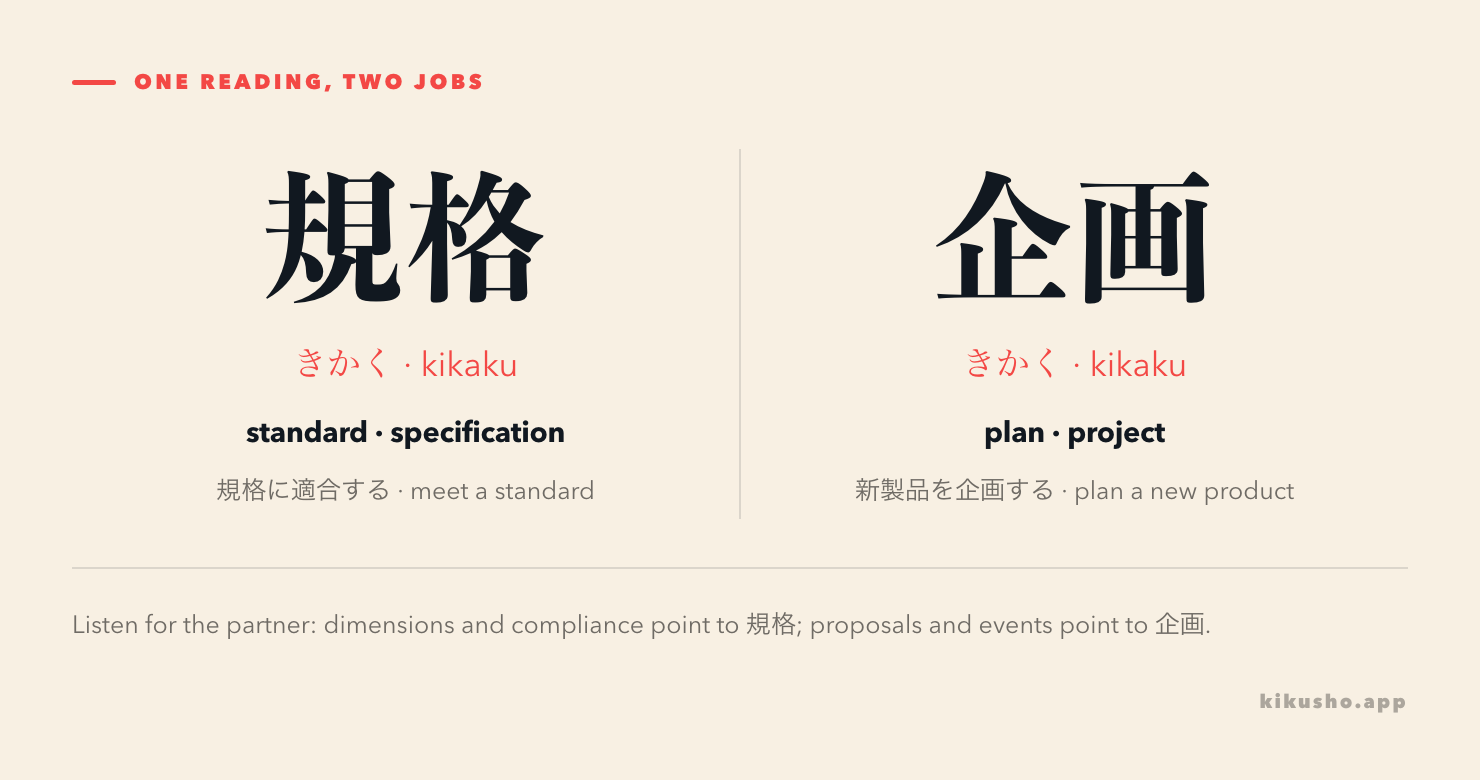
The official Japanese Industrial Standards Committee explains that standards support compatibility, production efficiency, quality, safety and information exchange. 規格 can therefore establish how something is made, measured or tested. In speech, surrounding words resolve the homophone: 適合する, 基準 and 寸法 point toward 規格; 提案する, イベント and 商品 often point toward 企画.
電源 supplies the energy; 回路 gives it a path
電源 can name a battery, mains supply or power-supply unit. In device instructions, it also appears where English uses “power.”
- 電源を入れる/切る: turn the power on/off
- 電源が入る/切れる: the power comes on/goes off
- 電源につなぐ: connect to a power source
- 予備電源: backup power supply
The transitive 電源を入れる tells us who operates the device. 電源が入る reports its state. 電源 is not a general replacement for 電気: 電気を使う means use electricity, while 電源を使う means use a particular source or supply.
回路 is the circuit that forms a path for current or signals. Engineers 回路を設計する, and a fault may cause 回路が切れる, the circuit to open or break. It appears in 集積回路, integrated circuit, and 電子回路, electronic circuit.
電源は入っていますが、制御回路が正常に動作しません。
でんげんは はいっていますが、せいぎょかいろが せいじょうに どうさしません。
The power is on, but the control circuit is not operating normally.
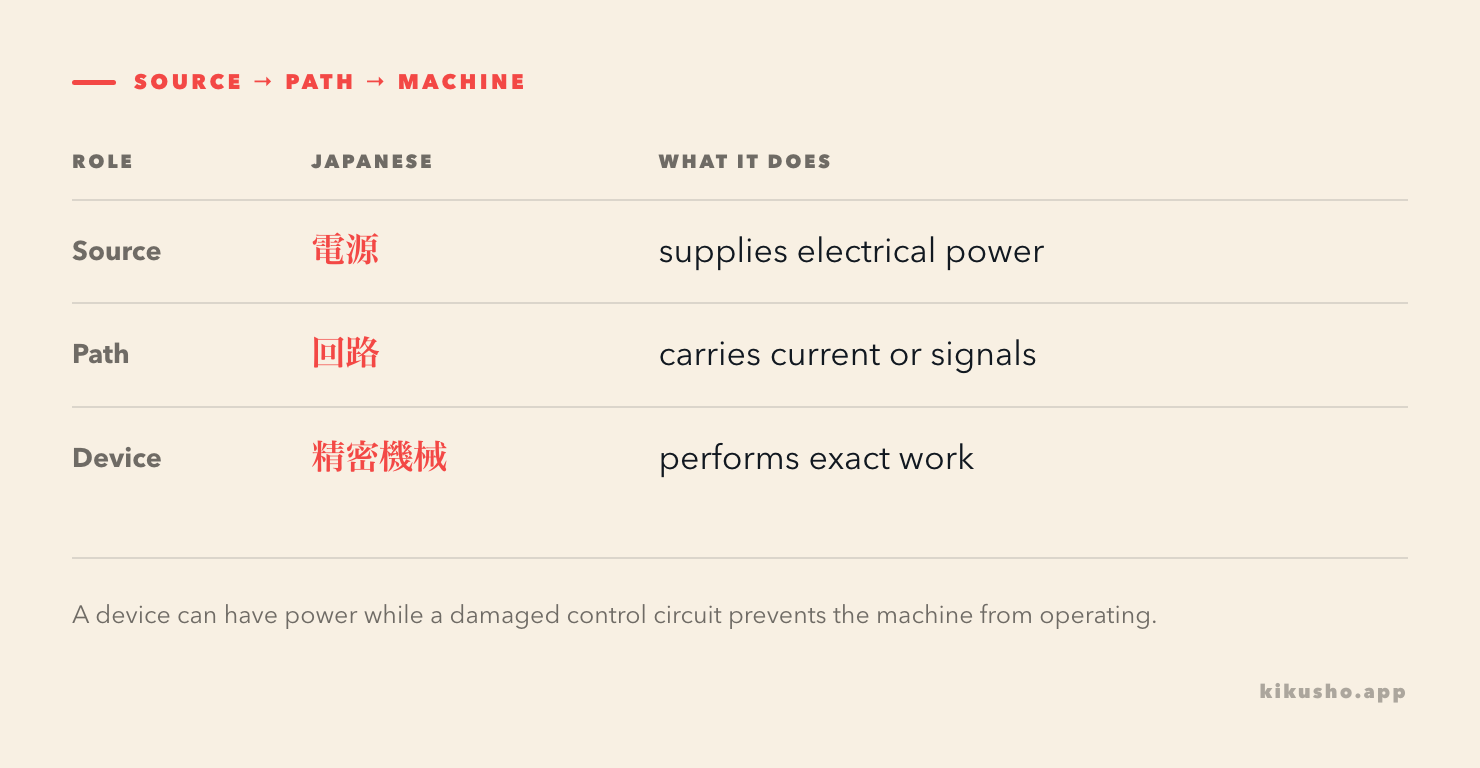
This sentence does not contradict itself. A machine may receive power while one of its circuits fails. In a fault report, confirm the 電源, inspect the 回路, then test the controlled device.
加工 changes a material or data; 精密 describes exact work
加工 means applying work or treatment so that an object's shape, properties, appearance or usability changes. In a factory, it often means machining or processing a material.
この工場では、金属を機械で精密に加工しています。
この こうじょうでは、きんぞくを きかいで せいみつに かこうしています。
At this factory, metal is machined precisely with machines.
The object marked by を shows what is processed:
- 木材を加工する: process or shape timber
- 食品を加工する: process food
- 画像を加工する: edit or manipulate an image
- データを加工する: transform or process data
加工 covers more than manufacturing. In an image context it may mean retouching; in data work it means transforming the input. It also differs from 製造, manufacturing: 製造 focuses on producing goods, while 加工 focuses on the operation performed on the material or information.
精密 describes work, instruments or measurements with very small errors and fine detail. As a な adjective it directly modifies a noun: 精密な機械. As an adverb it takes に: 精密に測定する. Frequent compounds include 精密機械, precision machinery; 精密検査, detailed examination; and 精密加工, precision machining.
Do not confuse precision with efficiency. A process may be 精密 yet slow and expensive. It may be 効率的 yet insufficiently accurate. Technical writing often evaluates both.
効率 evaluates output against time, energy or cost
効率 asks how effectively resources become useful results. The relevant resource may be time, labour, energy, material or money.
- 効率を上げる/高める: raise efficiency
- 効率がよい/悪い: be efficient/inefficient
- 効率的な方法: an efficient method
- 生産効率: production efficiency
- エネルギー効率: energy efficiency
作業の順序を見直して、生産効率を二割上げました。
さぎょうの じゅんじょを みなおして、せいさんこうりつを にわり あげました。
We reviewed the work sequence and increased production efficiency by twenty percent.
効率を上げる treats efficiency as something a person improves. 効率が上がる describes the resulting change. 効率的 characterises a method or system. The N1 environment and resources lesson supplies the wider context for energy sources, consumption and conservation.
特許 protects an invention only after the application process
特許 is a patent. The surrounding verb identifies the stage:
- 発明する: invent something
- 特許を出願する: file a patent application
- 審査を受ける: undergo examination
- 特許を取得する: obtain a patent
- 特許権を持つ: hold patent rights
当社は省電力回路について特許を出願しました。
とうしゃは しょうでんりょくかいろについて とっきょを しゅつがんしました。
Our company filed a patent application for a low-power circuit.
This reports an application, not a grant. The Japan Patent Office's overview separates filing and examination from the later decision to grant a patent. In news or business writing, 出願した must not be paraphrased as “patented” unless the right has actually been obtained.
部 can be a department, a part or a copy counter
The short word 部 changes meaning with its construction. At the end of an organisation name, it usually means a department:
- 開発部: development department
- 製造部: manufacturing department
- 技術部: engineering or technical department
As an independent noun or in compounds, it can indicate a part, section or category. An individual physical component is commonly a 部品, not simply 部. In publishing and office contexts, 部 also counts copies of printed documents.
開発部に、最新の規格書を二部送ってください。
かいはつぶに、さいしんの きかくしょを にぶ おくってください。
Please send two copies of the latest specification document to the development department.
The sentence uses 部 twice: first inside 開発部 for the receiving department, then as 二部 for the number of copies.
A factory report connects all nine words
開発部は、高効率の電源回路を使った精密機械を開発しています。試作品の金属部品は新しい方法で加工され、すべて社内規格に適合しました。この技術については特許を出願し、来月までに仕様書を三部作成する予定です。
The development department is developing a precision machine that uses a highly efficient power-supply circuit. The prototype's metal components were processed with a new method, and all conformed to the company's internal standards. The company has filed a patent application for this technology and plans to prepare three copies of the specification by next month.
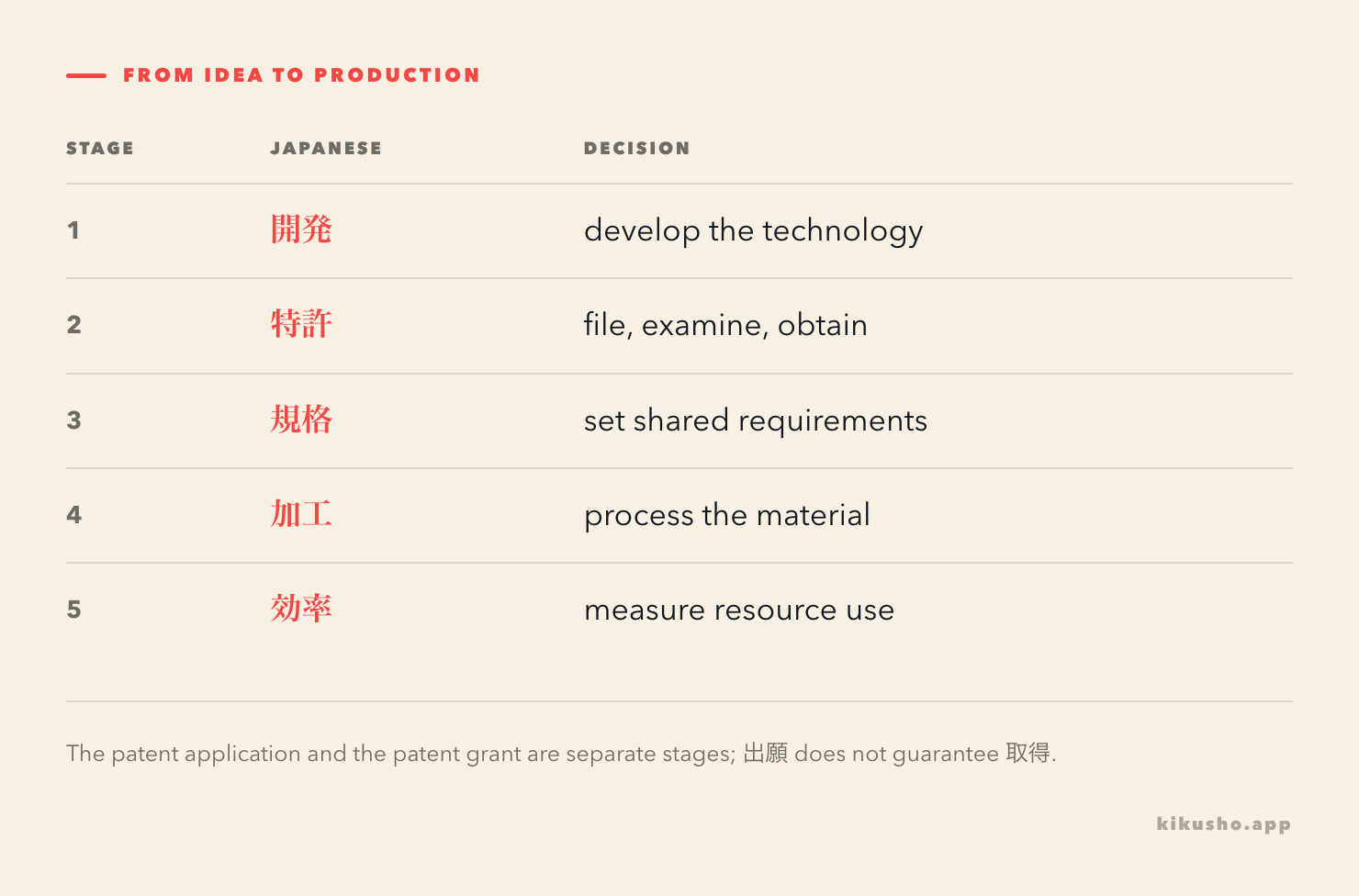
Each word carries a separate piece of information. 開発部 identifies the team, 開発 the work, 電源回路 the technical system, 精密機械 the product class, 加工 the operation, 規格 the requirement, 特許 the legal process and 三部 the document quantity. 高効率 evaluates the circuit's performance.
When you save these words in Kikusho, keep the revealing partner with the headword: 規格に適合する, 金属を加工する, 特許を出願する. A single English gloss cannot preserve the grammar and stage information needed to interpret a technical sentence. The N3 digital communication lesson helps with files, information and sending documents; this N1 set adds the factory and intellectual-property vocabulary found inside them.
Practice
1 · Technical reading. Choose the kana printed for 精密 in a dictionary entry.
- A. せいひつ
- B. しょうみつ
- C. せいみつ
- D. せんみつ
2 · Homophones. The team must determine the dimensions and test requirements that every component will follow. Which word fits?
- A. 企画
- B. 規格
- C. 効率
- D. 特許
3 · Power state. Which sentence naturally means “Please turn on the machine's power”?
- A. 機械の電源を入れてください。
- B. 機械の回路を企画してください。
- C. 機械の効率を切ってください。
- D. 機械の特許を入れてください。
4 · Circuit failure. The device receives power, but signals do not reach the motor because an internal path is damaged. What should be inspected?
- A. 部数
- B. 企画書
- C. 回路
- D. 特許権
5 · Processing. Complete: この工場では、金属を機械で( )しています。
- A. 加工
- B. 出願
- C. 適合
- D. 分担
6 · Precision. Which form correctly means “measure precisely”?
- A. 精密を測定する
- B. 精密で測定する
- C. 精密の測定する
- D. 精密に測定する
7 · Efficiency. Which sentence says that a change improved production efficiency?
- A. 生産効率を上げました。
- B. 生産効率を出願しました。
- C. 生産効率に適合しました。
- D. 生産効率を二部送りました。
8 · Patent stage. Which statement is accurate after a company has only filed its application?
- A. 特許権を必ず取得した。
- B. 特許を出願した。
- C. 規格を発明した。
- D. 回路を二部取得した。
9 · Department or copies. In 開発部に仕様書を二部送る, what do the two instances of 部 mean?
- A. Both mean a machine component.
- B. The first means efficiency; the second means a patent.
- C. The first means a department; the second counts copies.
- D. The first counts copies; the second means a department.
10 · Paraphrase. Which sentence best paraphrases 新製品は国際規格に適合している?
- A. The new product was planned by an international team.
- B. The new product meets the requirements of an international standard.
- C. The new product's patent application was rejected.
- D. The new product is manufactured in two departments.
Answers and explanations
- The dictionary reading is C, せいみつ.
- B. 規格 defines shared requirements; 企画 is a plan or project.
- A. 電源を入れる is the transitive expression for turning a device on.
- C. 回路 is the internal path for current or signals.
- A. 金属を加工する means to process or machine metal.
- D. The な adjective 精密 becomes the adverb 精密に before a verb.
- A. 効率を上げる means raise or improve efficiency.
- B. 出願 reports filing; it does not guarantee a patent has been granted.
- C. 開発部 is the department, while 二部 means two copies.
- B. 規格に適合する means conform to or meet a standard.
Common questions
What is the difference between 規格 and 企画?
Both are read きかく. 規格 is a standard or specification that defines shared requirements. 企画 is an organised plan or project.
What is the difference between 電源 and 回路?
電源 is the source or supply of electrical power. 回路 is the circuit through which current or signals travel.
Does 特許を出願する mean that a patent has been granted?
No. It means to file a patent application. 特許を取得する describes the later result of obtaining a patent.
What does 部 mean in a manufacturing text?
Context decides. 部 can name a department, a part or section, or count copies of documents. A physical machine component is commonly 部品.