On this page
These twelve N3 words let you follow a project from its first 目標 and 提案 through a 契約, the 作業 itself, and the decision to complete, postpone or cancel it. The useful pattern is a chain of roles: 共同 and 協力 organise the people, 進行 tracks movement, 実行 and 実施 turn plans into action, and 完了 marks an endpoint.
Twelve entries trace a project from intention to outcome
| Word | Reading | Word type and core sense | Anchor phrase |
|---|---|---|---|
| 延期 | えんき, enki | noun; する verb; postponement to a later time | 会議を延期する |
| 完了 | かんりょう, kanryō | noun; する verb; completion of a task or process | 作業が完了する |
| 共同 | きょうどう, kyōdō | noun; する verb; の modifier; joint participation or shared use | 共同で開発する |
| 協力 | きょうりょく, kyōryoku | noun; する verb; cooperation or active help | 調査に協力する |
| 契約 | けいやく, keiyaku | noun; する verb; contract or binding agreement | 契約を結ぶ |
| 作業 | さぎょう, sagyō | noun; する verb; task, operation or practical work | 作業を進める |
| 進行 | しんこう, shinkō | noun; する verb; forward movement or progress | 計画が進行する |
| 実行 | じっこう, jikkō | noun; する verb; putting a decision, plan or command into action | 計画を実行する |
| 実施 | じっし, jisshi | noun; する verb; carrying out a planned measure, test or event | 調査を実施する |
| 中止 | ちゅうし, chūshi | noun; する verb; stopping or cancelling an activity | イベントを中止する |
| 提案 | ていあん, teian | noun; する verb; proposal or suggestion presented for consideration | 改善案を提案する |
| 目標 | もくひょう, mokuhyō | noun; target or objective | 目標を達成する |
Kikusho's inventory assigns the set to N3. Eleven records have only N3 observations there; 進行 appears in both an N3 and an N1 source row. Current outside guides also disagree at the edges. Bunpro labels 共同, 契約 and 実施 N3, but places 協力 at N4 and 進行 at N1. These are study-list estimates. The JLPT organisers do not publish an exhaustive official vocabulary list.
The N2 lesson in this series adds 打ち合わせ, exact and wider schedules, policy, countermeasures and agreement formation. This N3 page supplies the practical nouns and actions that make that later coordination readable.
目標, 提案 and 契約 describe three different commitments
A 目標 is the result you aim for. You can 目標を立てる, set a goal; 目標に向かう, work toward it; and 目標を達成する, achieve it.
今月の目標は、試作品を三つ完成させることです。
こんげつの もくひょうは、しさくひんを みっつ かんせいさせることです。
This month's objective is to finish three prototypes.
A 提案 is an idea or course of action presented for someone to consider. The content can take を, while the recipient commonly takes に.
田中さんは会議で新しい方法を提案しました。
たなかさんは かいぎで あたらしい ほうほうを ていあんしました。
Tanaka proposed a new method at the meeting.
部長に計画の変更を提案します。
ぶちょうに けいかくの へんこうを ていあんします。
I will propose a change to the plan to the department head.
A 契約 is an agreement that establishes obligations or exchanges between parties. Common business combinations include 契約を結ぶ, enter into a contract; 契約を更新する, renew it; and 契約を解除する, terminate it. Daijisen's 契約 entry centres its legal sense on matching declarations of intent by two or more parties.
両社は一年間の契約を結びました。
りょうしゃは いちねんかんの けいやくを むすびました。
The two companies entered into a one-year contract.
A proposal is not yet a contract. A goal need not be contractual at all. The chain 目標を決める → 方法を提案する → 条件に合意して契約を結ぶ moves from desired outcome to candidate method to binding agreement.
共同 builds the joint frame; 協力 supplies effort inside it
共同 says that two or more parties do, own or use something together. It can modify a noun with の or appear adverbially with で:
- 共同開発: joint development
- 共同研究: joint research
- 共同の目標: a shared objective
- 二社が共同で運営する: two companies operate something jointly
協力 focuses on people combining effort or helping a purpose. The activity or cause often takes に; the partner can take と.
- 調査に協力する: cooperate with a survey
- 同僚と協力して作業する: work on a task in cooperation with colleagues
- 協力を求める: ask for cooperation
- 協力を得る: obtain support or cooperation
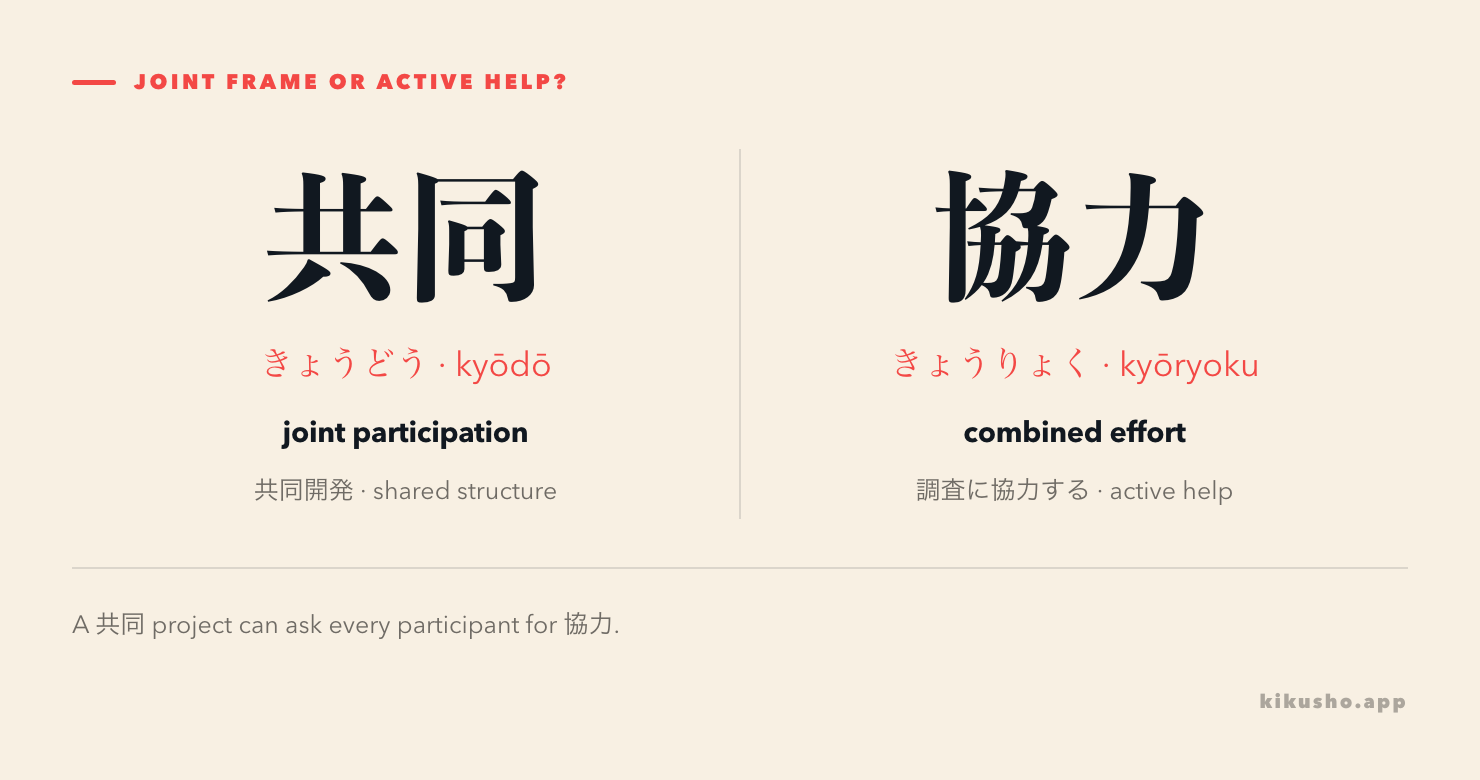
The distinction is about focus, not two exclusive situations. Two companies may begin 共同開発, a joint development project, and then ask several departments for 協力. The project structure is joint; the work succeeds because people contribute effort. The Goo thesaurus comparison similarly presents 共同 as joint involvement and 協力 as joining effort to tackle something.
作業 moves through 進行 and reaches 完了
作業 names practical work, a task or an operation. It is narrower than a person's whole job and need not be manual. Data entry, inspection and installation can all be 作業 when viewed as work to be performed.
午後からデータを確認する作業を始めます。
ごごから データを かくにんする さぎょうを はじめます。
We will begin the task of checking the data this afternoon.
進行 follows something as it moves forward. It can describe the progress of work or a project, the course of a meeting or ceremony, and literal forward movement.
開発は予定どおり進行しています。
かいはつは よていどおり しんこうしています。
Development is progressing according to schedule.
司会者が会議を進行します。
しかいしゃが かいぎを しんこうします。
The moderator will conduct the meeting.
The first sentence is intransitive: development progresses. The second is transitive: the moderator moves the meeting through its stages. 進行中 marks something in progress, but it does not say how much has been finished.
完了 marks the completion of an action, process or required task.
点検作業が完了しました。
てんけんさぎょうが かんりょうしました。
The inspection work has been completed.
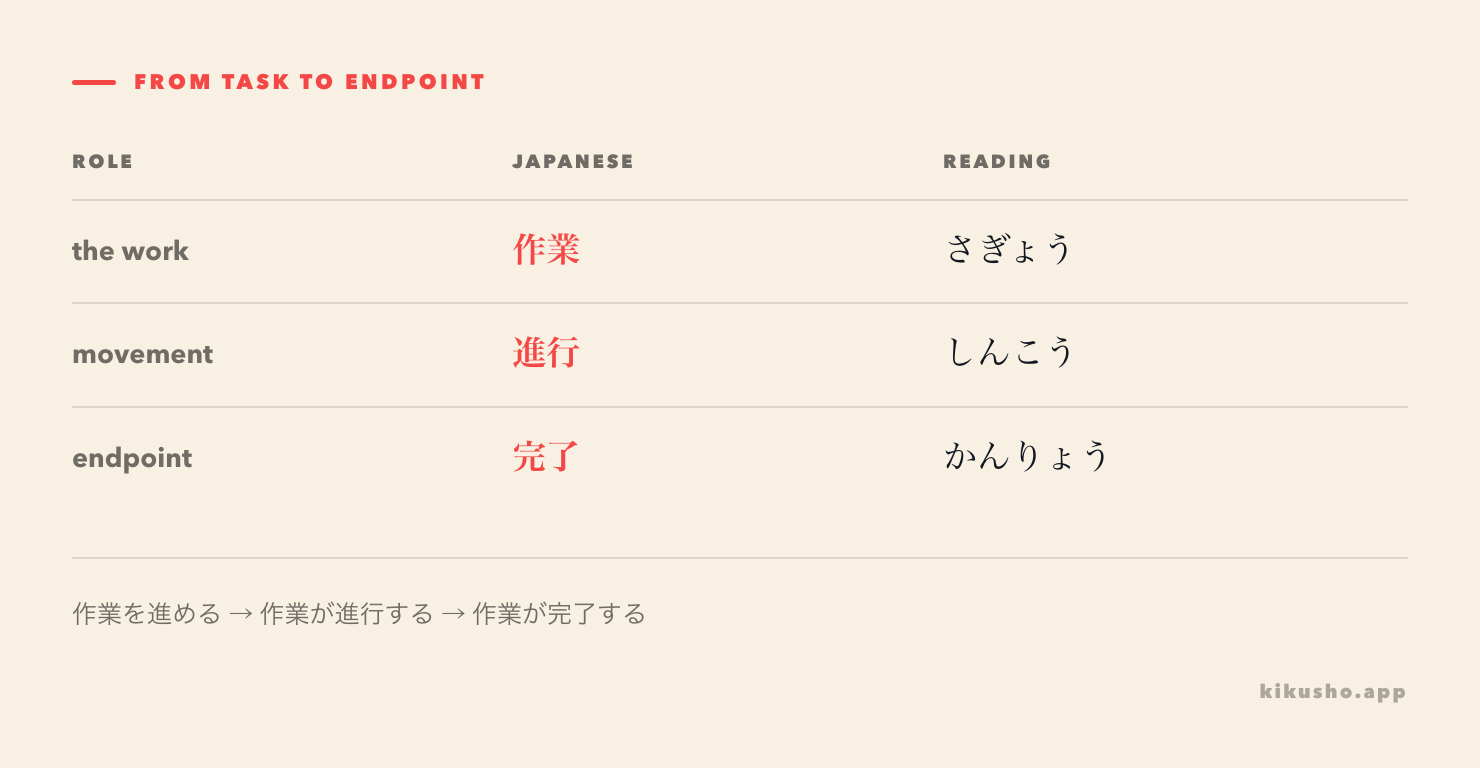
Do not replace 完了 with the N2 word 成立 whenever English offers “complete” or “conclude.” 作業が完了する says the work ends. 契約が成立する says a contract comes into existence as an agreement. One established contract may create months of 作業 that is still 進行中.
実行 puts a decision into action; 実施 carries out an organised plan
実行 has the wider action frame. A person turns an intention, decision or plan into action:
- 計画を実行する: execute a plan
- 決定を実行に移す: put a decision into effect
- 約束を実行する: carry out a promise
- プログラムを実行する: run a program
実施 commonly takes an organised activity or measure that was planned in advance:
- 試験を実施する: administer a test
- 調査を実施する: conduct a survey
- 訓練を実施する: conduct a drill
- 対策を実施する: implement measures
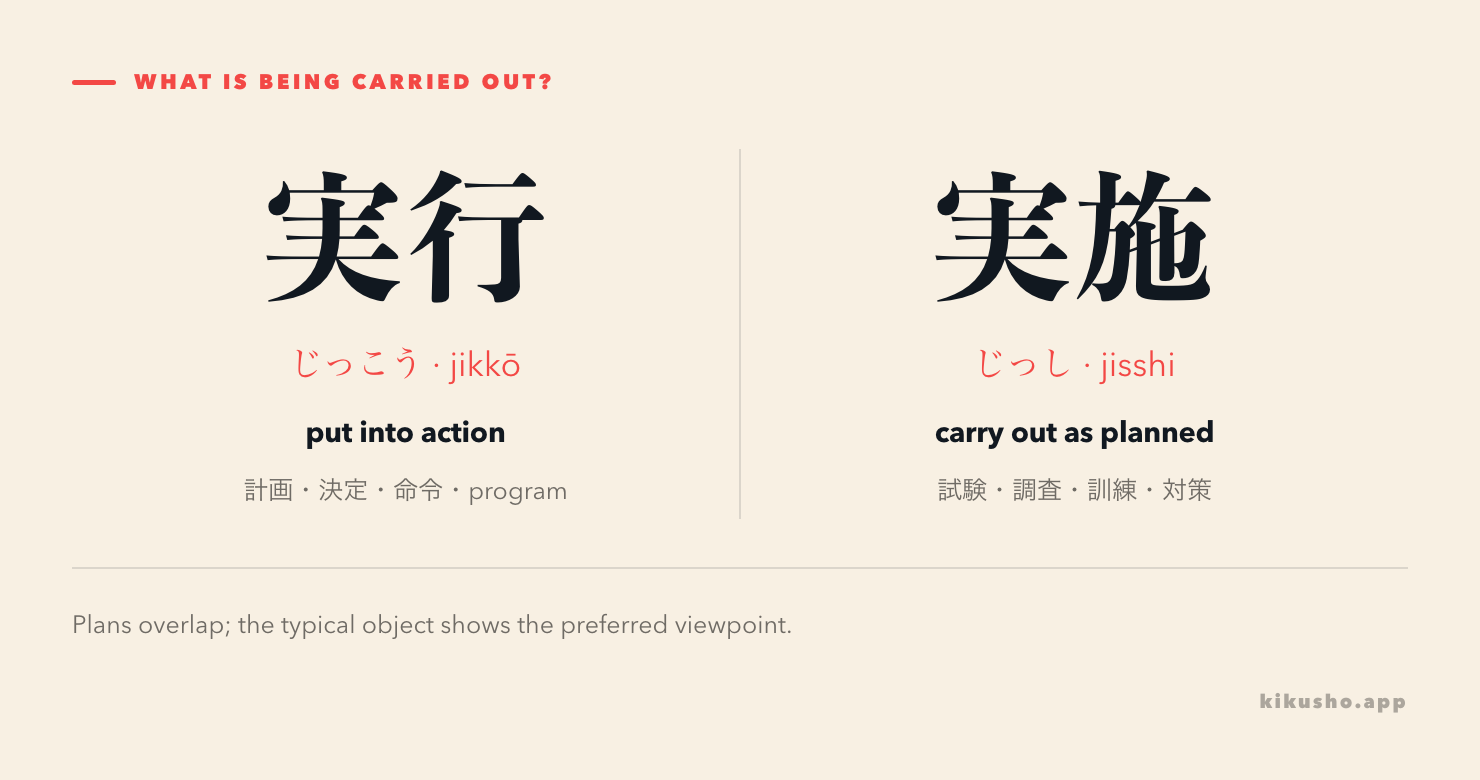
There is real overlap: 計画を実行する and 計画を実施する can both be natural. The first foregrounds taking action; the second presents the organised plan as being carried out. Some combinations are much less interchangeable. A computer command is normally 実行する, while a scheduled survey is conventionally 実施する. Daijisen specifically defines 実施 through actually carrying out a law or plan and gives 試験を実施する as an example.
When you save a project notice in Kikusho, keep the headword with its object. A card for 実施 alone leaves the choice abstract; 利用者調査を実施する preserves the organised activity that makes the word natural. Likewise, save 計画を実行に移す as a unit when the sentence describes the shift from decision to action.
延期 changes the date; 中止 removes the event or stops the activity
延期 moves something scheduled to a later point. The later date may be known or still undecided.
悪天候のため、説明会を来週に延期します。
あくてんこうの ため、せつめいかいを らいしゅうに えんきします。
Because of bad weather, we will postpone the information session until next week.
中止 stops an activity or cancels a plan. It can be used before an event starts or while an activity is under way.
安全を確認できないため、今日の作業を中止します。
あんぜんを かくにんできない ため、きょうの さぎょうを ちゅうしします。
Because we cannot confirm safety, we will stop today's work.
| What happens next? | Word | Example |
|---|---|---|
| The same meeting will be held later | 延期 | 会議を金曜日に延期する |
| The event will not be held | 中止 | イベントを中止する |
| Work stops now because it is unsafe | 中止 | 作業を直ちに中止する |
| The deadline moves one week later | 延期 | 提出期限を一週間延期する |
The practical test is whether the original activity remains scheduled for later. Goo's comparison of 延期 and neighbouring terms defines 延期 through moving a date or period forward. 中止 instead removes or stops the activity; it does not promise a replacement date.
One project update connects all twelve words
Read the internal update:
今月、A社から共同開発の提案がありました。両社の目標は、来年までに新しい予約システムを作ることです。契約を結ぶ前に、共同で利用者調査を実施し、各部門にも協力を求めます。調査結果を確認した後、計画を実行に移します。現在、準備作業は予定どおり進行しており、来週には完了する見込みです。ただし、担当者が出張するため、明日の会議は来週に延期します。プロジェクトを中止する予定はありません。
This month, Company A proposed a joint development project. The two companies aim to build a new reservation system by next year. Before signing a contract, they will jointly conduct a user survey and ask each department to cooperate. After reviewing the survey results, they will put the plan into action. Preparatory work is currently progressing on schedule and is expected to be complete next week. However, because the person responsible will be away on business, tomorrow's meeting will be postponed until next week. There is no plan to cancel the project.
The text separates three kinds of status. The 作業 is already 進行 and should reach 完了. The meeting is 延期, so it still has a future date. The project is explicitly not 中止. Reading those endings precisely matters more than translating every する noun as “do.”
For the staff roles around a project like this, the N3 employment and workplace lesson distinguishes assigned responsibility, personnel changes and management. The collocation lesson on goals and duties continues from 目標を達成する into other noun-and-verb partnerships.
Practice
1 · Implementation reading. How is 実施 read?
- A. じつし
- B. じっし
- C. じっじ
- D. じつじ
2 · Cooperation spelling. Choose the standard spelling of きょうりょく.
- A. 協力
- B. 共同
- C. 強力
- D. 合力
3 · Joint structure. Two universities run one research project as equal participants. Which expression fits the project itself?
- A. 中止研究
- B. 完了研究
- C. 共同研究
- D. 延期研究
4 · Active help. Which sentence naturally asks other departments to help with a survey?
- A. 各部門に調査を契約します。
- B. 各部門の調査が完了します。
- C. 各部門を共同します。
- D. 各部門に調査への協力を求めます。
5 · Binding agreement. Which collocation means “enter into a contract”?
- A. 契約を進行する
- B. 契約を結ぶ
- C. 契約を延期にする
- D. 契約が協力する
6 · Reached endpoint. The inspection task has finished. Complete the sentence: 点検作業が( )しました。
- A. 完了
- B. 目標
- C. 提案
- D. 共同
7 · Organised activity. Which sentence is the conventional way to say that the company conducted a user survey?
- A. 会社は利用者調査を進行しました。
- B. 会社は利用者調査を完了にしました。
- C. 会社は利用者調査を実施しました。
- D. 会社は利用者調査を共同しました。
8 · Later, not cancelled. The meeting will happen next Friday instead of today. Which word expresses that change?
- A. 中止
- B. 延期
- C. 完了
- D. 協力
9 · From decision to action. What does 計画を実行に移す mean here?
- A. Replace the project goal with a contract
- B. Report that every task is complete
- C. Stop the plan before work begins
- D. Put the plan into action
10 · Status report. Which statement matches the project update?
- A. The two companies have already cancelled the development project.
- B. The user survey will begin only after the contract is signed.
- C. Preparatory work is progressing, while the meeting has moved to next week.
- D. The system is complete and the contract has expired.
Choose all ten responses before revealing the review.
Answers and explanations
Check the noun paired with each action and the future status it creates.
1 · B, じっし. 実施 is read じっし, with a small っ. It commonly accompanies organised activities such as tests, surveys and training.
2 · A, 協力. 協力 is active cooperation or help. 共同 is read きょうどう, and 強力 is read きょうりょく but means powerful or strong.
3 · C, 共同研究. 共同 marks the research as a joint undertaking. 協力 may describe the effort people contribute inside it, but it is not the fixed project label requested here.
4 · D. 調査への協力を求める asks for cooperation directed toward the survey. The other choices give 契約, 完了 or 共同 an unnatural grammatical role.
5 · B, 契約を結ぶ. This established collocation means to enter into or conclude a contract. The parties can later 契約を更新する or 契約を解除する.
6 · A, 完了. 作業が完了する states that the task has reached its endpoint. 目標 and 提案 name an objective and a proposal; 共同 describes shared participation.
7 · C, 利用者調査を実施しました. A survey is a planned organised activity, so 実施する is conventional. 進行 can track the survey's progress, but 利用者調査を進行しました would instead present someone as directing its course and is not the intended report.
8 · B, 延期. The meeting remains planned and receives a later date. 中止 would say it is cancelled or stopped rather than moved.
9 · D. 実行に移す is the transition from deciding or planning to taking action. It does not itself state completion.
10 · C. The update says 準備作業は予定どおり進行しており and 明日の会議は来週に延期します. The project will not be cancelled, and the survey precedes the contract.
Common questions
What is the difference between 共同 and 協力?
共同 presents two or more people or organisations as joint participants or users, as in 共同開発 and 共同で使う. 協力 focuses on combining effort or giving help toward a purpose, as in 協力して作業する and 協力を求める. A joint project can therefore require each participant's active cooperation.
What is the difference between 実行 and 実施?
実行 is the broad act of putting a decision, plan or command into action; it is also the normal computing word for running a program. 実施 commonly presents a planned test, survey, event, policy or measure as being formally carried out. They overlap with plans, but their typical objects differ.
What is the difference between 延期 and 中止?
延期 moves a scheduled event or deadline to a later time, so the event is still expected to happen. 中止 stops or cancels an activity or plan. A meeting moved to next week is 延期; a meeting that will not be held is 中止.
Does 完了 mean the same thing as 成立?
No. 完了 marks the end of an action, process or task, as in 作業が完了する. 成立 says that an agreement, negotiation or other recognised whole comes into existence, as in 契約が成立する. A contract can be established while work required by it remains unfinished.