
On this page
浮かぶ, 運送, 運搬, 落ちる, 落とす, 沈める, 進出, 辿る and 転居 let you describe movement as a system rather than a single change of place. They distinguish a freight service from physical handling, an event from its cause, a route from its history and company expansion from a person's residential move.
Nine words organise one overseas launch
Imagine a precision-equipment company opening a testing centre abroad. A carrier ships its products, staff move heavy machines inside the building, engineers trace delivery records and a manager changes residence. During a water test, a sensor rises to the surface, a weight falls and a technician deliberately submerges the device.
| Project word | Reading | Role in the launch | Anchor phrase |
|---|---|---|---|
| 浮かぶ | うかぶ, ukabu | intransitive godan verb; float, emerge, come to mind | 水面にセンサーが浮かぶ, a sensor appears at the surface |
| 運送 | うんそう, unsō | noun; する verb; transport, freight, commercial carriage | 製品を海外へ運送する, ship products overseas |
| 運搬 | うんぱん, unpan | noun; する verb; carry or move goods and materials | 機械をクレーンで運搬する, move machinery by crane |
| 落ちる | おちる, ochiru | ichidan intransitive verb; fall, decline, come off, fail | 部品が床に落ちる, a part falls to the floor |
| 落とす | おとす, otosu | godan transitive verb; drop, lower, remove, lose, omit | 工具を落とす, drop a tool |
| 沈める | しずめる, shizumeru | ichidan transitive verb; sink or submerge something | 装置を水中に沈める, submerge a device |
| 進出 | しんしゅつ, shinshutsu | noun; する verb; enter or expand into a field or stage | 海外市場に進出する, enter an overseas market |
| 辿る | たどる, tadoru | godan transitive verb; follow or trace a route, clue or course | 輸送経路を辿る, trace a shipping route |
| 転居 | てんきょ, tenkyo | noun; する verb; formally change residence | 支店の近くへ転居する, move residence near the branch |
The useful question is not merely “Did something move?” Ask whether Japanese presents a service, physical handling, an uncontrolled result, an intentional cause, a route followed step by step or a new domain entered.
運送 frames delivery; 運搬 frames physical handling
The dictionary entry for 運送 defines carrying people or goods to a destination and also documents transport performed as a business. This makes 運送会社, transport company, 貨物運送, freight transport, and 運送料, shipping charge, natural combinations.
新製品は専門の会社が港から研究所まで運送します。
しんせいひんは せんもんの かいしゃが みなとから けんきゅうじょまで うんそうします。
A specialist company will transport the new products from the port to the laboratory.
精密機器なので、運送中の振動を記録してください。
せいみつききなので、うんそうちゅうの しんどうを きろくして ください。
Because this is precision equipment, record vibration during transport.
運搬 focuses easily on the act of carrying or moving an object, especially materials, machinery or loads within an operation. The dictionary entry gives moving goods from one place to another, so the two words overlap. Treat the contrast as a practical tendency, not a rule that forbids either word outside one domain.
重い実験装置はクレーンで二階へ運搬した。
おもい じっけんそうちは クレーンで にかいへ うんぱんした。
We moved the heavy experimental apparatus to the second floor by crane.
作業員は運搬経路から障害物を取り除いた。
さぎょういんは うんぱんけいろから しょうがいぶつを とりのぞいた。
The workers removed obstacles from the handling route.
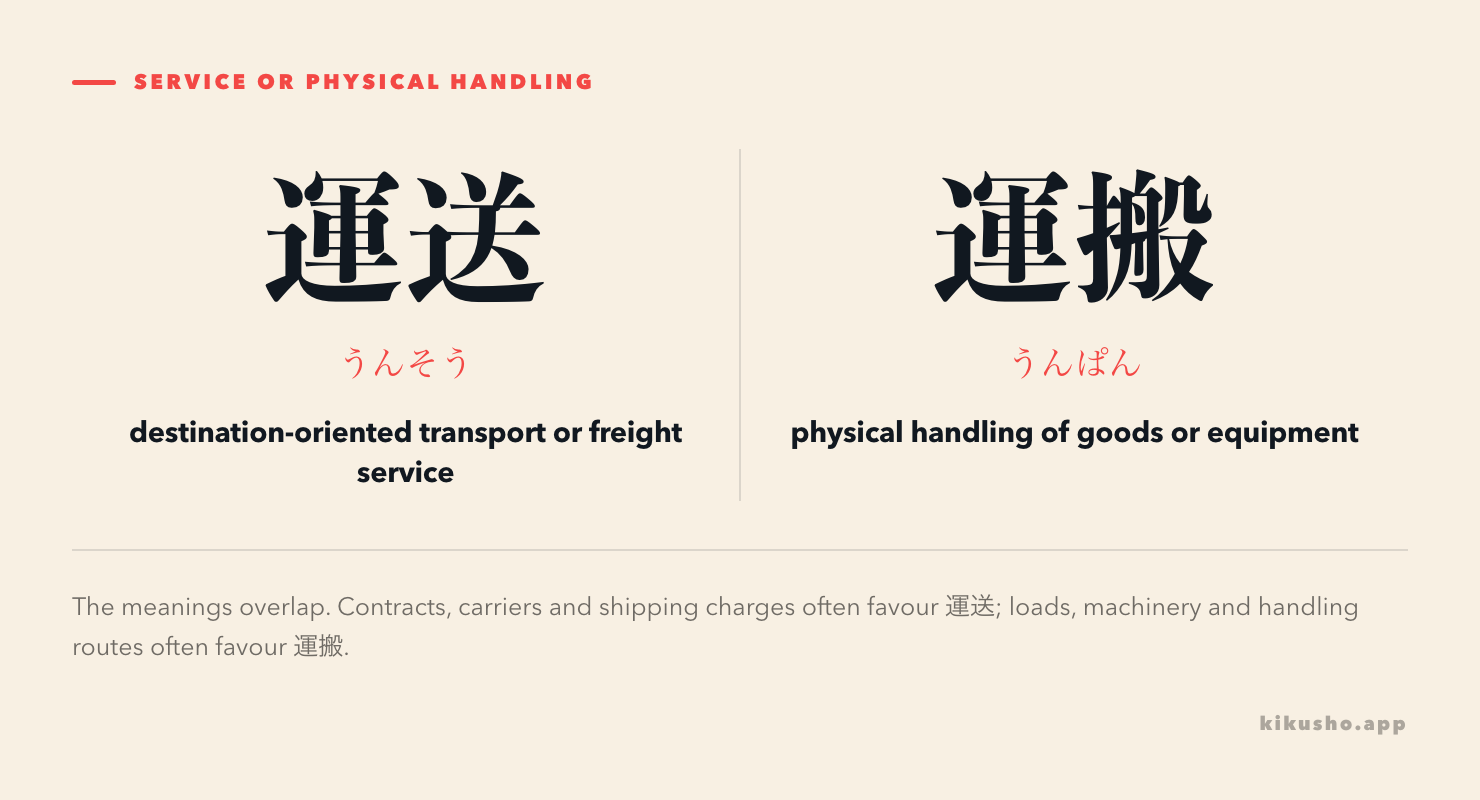
When the passage discusses contracts, carriers, freight charges or delivery between sites, expect 運送. When it discusses cranes, workers, loads, equipment and safe paths inside a site, 運搬 is often the sharper choice.
浮かぶ presents something emerging
浮かぶ(うかぶ) can describe a body floating, something becoming visible or a thought appearing in the mind. Its dictionary history covers physical emergence and things becoming distinct in view.
実験を始めると、センサーが水面に浮かんだ。
じっけんを はじめると、センサーが すいめんに うかんだ。
When the experiment began, the sensor rose to the surface.
輸送費を抑える名案が浮かんだ。
ゆそうひを おさえる めいあんが うかんだ。
A good idea for reducing shipping costs came to mind.
報告書を読むと、事故当時の光景が目に浮かぶ。
ほうこくしょを よむと、じことうじの こうけいが めに うかぶ。
Reading the report brings the scene of the accident vividly to mind.
The N2 lesson distinguishes 浮く and 浮かべる. 浮かぶ overlaps with 浮く in physical floating, but it is especially productive with 考え・疑問・名前・光景が浮かぶ. By contrast, 浮く covers separation from a base or group: 床が浮く, the flooring lifts, and 職場で浮く, stand out awkwardly at work.
落ちる gives the result; 落とす supplies the cause
落ちる(おちる) is intransitive. The changing item takes が, and the destination can take に or へ.
固定が緩み、金属部品が床に落ちた。
こていが ゆるみ、きんぞくぶひんが ゆかに おちた。
The fastening came loose, and a metal part fell to the floor.
At N1, the physical image supports several common extensions:
- 売上が落ちる: sales decline.
- 汚れが落ちる: dirt comes off.
- 試験に落ちる: fail an examination.
- 通信速度が落ちる: connection speed drops.
The dictionary entry records falling, detachment, decline and failure among many related senses.
落とす(おとす) is transitive. An agent acts on an object marked by を, whether intentionally or accidentally.
作業員が工具を水槽に落としてしまった。
さぎょういんが こうぐを すいそうに おとして しまった。
A worker accidentally dropped a tool into the tank.
確認表から重要な項目を落としてはいけない。
かくにんひょうから じゅうような こうもくを おとしては いけない。
You must not omit an important item from the checklist.
The dictionary entry for 落とす includes causing a fall, losing something, removing something and directing one's gaze. Learn fixed combinations such as 声を落とす, lower one's voice, 汚れを落とす, remove dirt, 視線を落とす, lower one's gaze, and 単位を落とす, fail to earn a course credit.
沈める deliberately puts something below
沈める(しずめる) is the transitive partner of 沈む(しずむ). The object that an agent submerges takes を; the medium or target often takes に.
技術者は重りを付けて装置を水中に沈めた。
ぎじゅつしゃは おもりを つけて そうちを すいちゅうに しずめた。
The technician attached a weight and submerged the device.
作業を終え、深い椅子に身を沈めた。
さぎょうを おえ、ふかい いすに みを しずめた。
After finishing the work, I sank into a deep chair.
The dictionary entry also records sinking an opponent or putting someone into an undesirable situation. Keep the spelling distinct from 静める, make quiet, and 鎮める, suppress or pacify pain, disorder or a spirit.
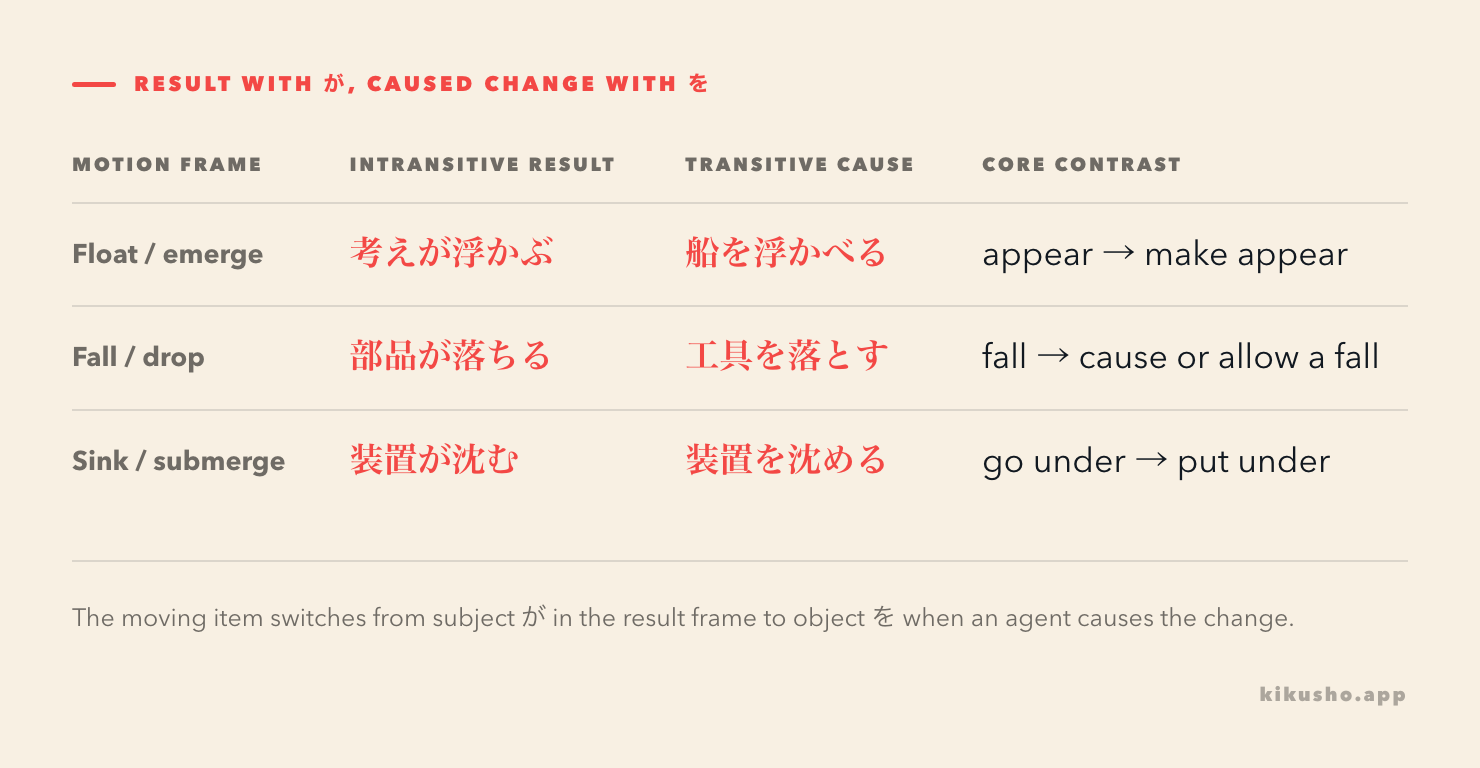
A compact particle test helps:
- 装置が沈む: the device sinks.
- 技術者が装置を沈める: the technician sinks the device.
- 部品が落ちる: the part falls.
- 作業員が部品を落とす: the worker drops the part.
進出 enters a domain, not just a place
進出(しんしゅつ) means moving into a new field or expanding the area of activity. Its dictionary entry also covers advancing to a later round of a competition.
その会社は来年、東南アジア市場に進出する。
その かいしゃは らいねん、とうなんアジアしじょうに しんしゅつする。
The company will enter the Southeast Asian market next year.
新製品は審査を通過し、最終選考に進出した。
しんせいひんは しんさを つうかし、さいしゅうせんこうに しんしゅつした。
The new product passed screening and advanced to the final selection.
Common frames are 市場に進出する, enter a market, 海外へ進出する, expand overseas, and 決勝に進出する, advance to the final. The subject expands its activity or earns access to a later stage; 進出 does not simply replace 行く for ordinary travel.
辿る follows evidence step by step
辿る(たどる) takes the path, clue, history or course with を. It can be physical, investigative, mental or predictive. The dictionary entry links moving along a route with pursuing clues and following the direction of a developing situation.
担当者は港から研究所までの輸送経路を辿った。
たんとうしゃは みなとから けんきゅうじょまでの ゆそうけいろを たどった。
The person in charge traced the shipping route from the port to the laboratory.
記録を辿ると、振動は積み替えの直後に始まっていた。
きろくを たどると、しんどうは つみかえの ちょくごに はじまって いた。
Tracing the records showed that the vibration began immediately after transshipment.
対策を取らなければ、事業は衰退の一途を辿るおそれがある。
たいさくを とらなければ、じぎょうは すいたいの いっとを たどる おそれが ある。
Without countermeasures, the business risks following a course of steady decline.
The verb implies continuity through ordered points. 道を辿る follows a path; 記憶を辿る retraces memory; 歴史を辿る follows a history; 経過を辿る tracks a process; 一途を辿る says a trend continues in one direction.
転居 formally identifies a residential move
転居(てんきょ) is a formal noun and する verb for changing residence. The dictionary entry gives changing one's dwelling and lists 引っ越し as a near synonym.
支店長は開業に合わせて研究所の近くへ転居した。
してんちょうは かいぎょうに あわせて けんきゅうじょの ちかくへ てんきょした。
The branch manager moved residence near the laboratory in time for the opening.
転居後は、住所変更の手続きを速やかに行ってください。
てんきょごは、じゅうしょへんこうの てつづきを すみやかに おこなって ください。
After moving residence, complete the address-change procedures promptly.
Use 転居届・転居通知・転居先・転居後 in administrative or formal writing. The N2 movement lesson separates 移転, formal relocation of an office, facility or right, from 引っ越し, the practical moving event. 転居 narrows the formal focus to the person's residence.
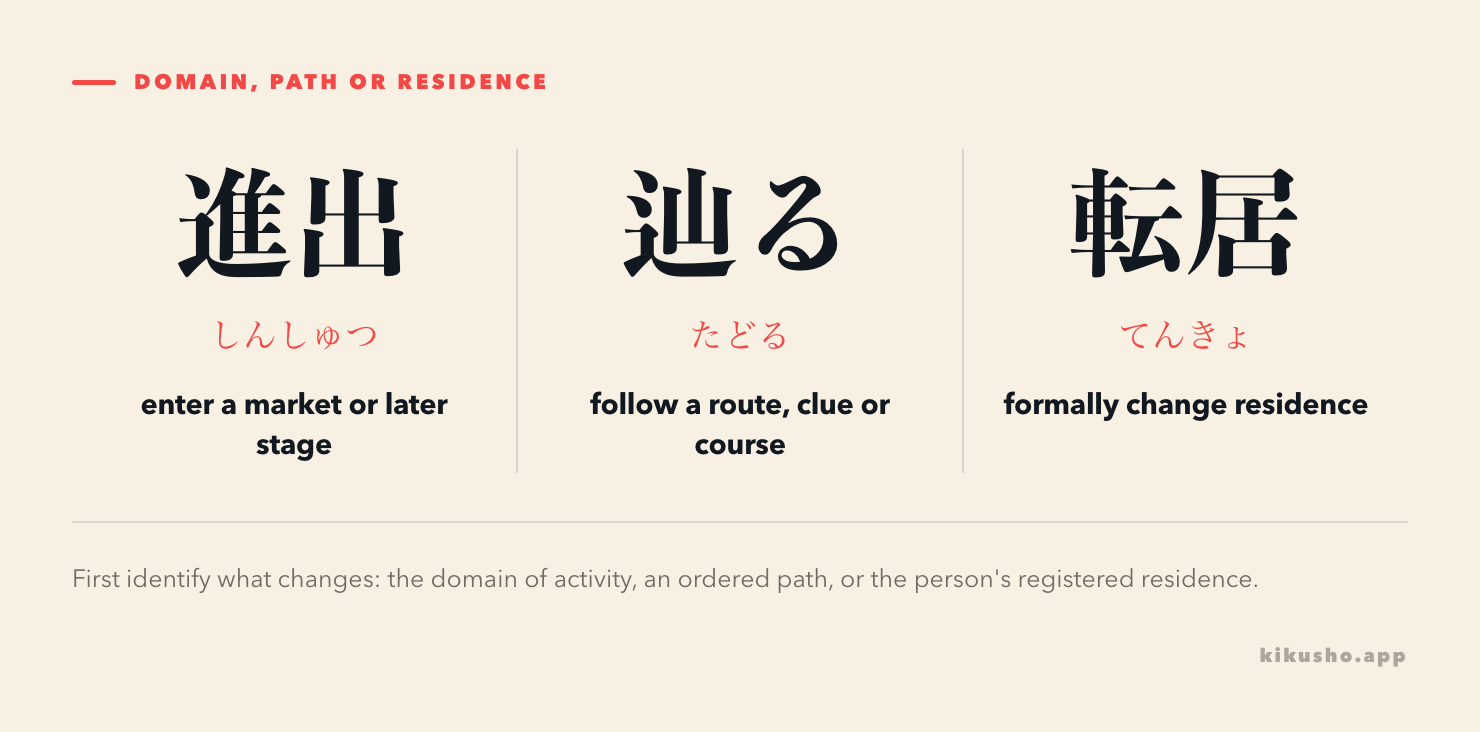
Read the launch report as one movement system
当社は海外市場への進出に伴い、新しい研究所を開設した。製品の運送は専門業者に委託し、所内での大型装置の運搬にはクレーンを使用した。水中試験では、センサーが浮かぶ位置を記録してから、重りで装置を沈めた。ところが、作業員が工具を落とし、一部の測定値が落ちた。記録を辿った結果、原因は運送中ではなく所内の作業にあると判明した。支店長は開業前に研究所の近くへ転居した。
とうしゃは かいがいしじょうへの しんしゅつに ともない、あたらしい けんきゅうじょを かいせつした。せいひんの うんそうは せんもんぎょうしゃに いたくし、しょないでの おおがたそうちの うんぱんには クレーンを しようした。すいちゅうしけんでは、センサーが うかぶ いちを きろくしてから、おもりで そうちを しずめた。ところが、さぎょういんが こうぐを おとし、いちぶの そくていちが おちた。きろくを たどった けっか、げんいんは うんそうちゅうではなく しょないの さぎょうに あると はんめいした。してんちょうは かいぎょうまえに けんきゅうじょの ちかくへ てんきょした。
As our company expanded into an overseas market, it opened a new laboratory. Product transport was entrusted to a specialist carrier, while cranes handled large equipment inside the facility. In an underwater test, staff recorded where the sensor surfaced and then submerged the device with a weight. However, a worker dropped a tool, and some readings fell. Tracing the records showed that the cause lay in on-site work rather than transport. The branch manager moved residence near the laboratory before it opened.
Notice how the same English word can hide different structures. “Transport” becomes 運送 or 運搬 according to the frame. “Fall” becomes 落ちる when the result is foregrounded and 落とす when an agent causes it. “Move” becomes 進出 for activity in a new domain and 転居 for a residence.
The N1 label is a study placement
Kikusho's September 2026 reference inventory assigns these nine spelling-reading records to N1. Independent resources draw different boundaries: Bunpro currently places 浮かぶ, 運送, 進出 and 辿る at N2, while its 沈める page places that verb at N1. Another current resource labels 落ちる at N4.
The current JLPT supplies no definitive word catalogue, as its official FAQ notes. Treat this grouping as an advanced contrast set: the value lies in choosing the right frame and extension under pressure, not in claiming that every provider draws the same level boundary.
Practice: track the actor, object and route
Answer all ten questions before opening the solution panel.
1 · Reading. How is 辿る read?
- ア. さどる
- イ. たどる
- ウ. てんる
- エ. めぐる
2 · Reading in context. How is 転居先 read in 転居先の住所を知らせる?
- ア. てんきょさき
- イ. てんこさき
- ウ. てんきょせん
- エ. てんいさき
3 · Logistics frame. A report focuses on a contracted carrier, freight charges and delivery from a port to a laboratory. Which word best fits?
- ア. 運搬
- イ. 浮かぶ
- ウ. 運送
- エ. 転居
4 · On-site handling. Complete the sentence: 大型装置の__には、専用のクレーンが必要だ。
- ア. 運搬
- イ. 進出
- ウ. 転居
- エ. 浮かぶ
5 · Result or cause? Complete the pair: 部品が床に__。作業員が工具を水槽に__。
- ア. 落とした / 落ちた
- イ. 落ちた / 落とした
- ウ. 沈めた / 浮かんだ
- エ. 辿った / 進出した
6 · Controlled submergence. Which sentence says that a technician deliberately submerged the device?
- ア. 技術者が装置を水中に沈めた。
- イ. 技術者が水中に浮かんだ。
- ウ. 装置が市場に進出した。
- エ. 装置が住所を転居した。
7 · Emerging thought. Which sentence means “A good solution came to mind”?
- ア. 良い解決策を落とした。
- イ. 良い解決策が浮かんだ。
- ウ. 良い解決策に転居した。
- エ. 良い解決策を運搬した。
8 · Expansion. Which sentence uses 進出 naturally?
- ア. 会社は来年、新しい市場に進出する。
- イ. 会社は工具を床に進出した。
- ウ. 会社は住所を進出した。
- エ. 会社は記憶を進出した。
9 · Trace the evidence. What does 記録を辿って原因を特定した mean?
- ア. They shipped the records and removed the cause.
- イ. They dropped the records and caused a failure.
- ウ. They followed the records step by step and identified the cause.
- エ. They changed residence after losing the records.
10 · Report comprehension. Which summary preserves the whole launch report?
- ア. The company abandoned expansion, moved every worker's home and found no relation between transport and the damaged readings.
- イ. A carrier handled overseas delivery, cranes handled equipment on site, a controlled water test was followed by an accidental drop, and tracing the records located the cause.
- ウ. The sensor entered a market, the laboratory fell into the sea and the carrier changed residence inside the facility.
- エ. Every movement word in the report means the same general action and can be exchanged freely.
Audit the launch: answers and explanations
イ, たどる. 辿る follows a physical route, a clue, a memory or the course of a situation step by step.
ア, てんきょさき. 転居 is read てんきょ; 転居先 is the new residence or destination after the move.
ウ, 運送. The carrier, freight charge and delivery between sites frame transport as a service. 運搬 would focus more readily on physical handling.
ア, 運搬. A crane physically moves the heavy apparatus inside the operation. The load-handling frame favours 運搬.
イ: 前 落ちた / 後 落とした. The part is the intransitive subject marked by が. The worker acts on the tool marked by を.
ア. 技術者 is the agent, 装置 is the object marked by を, and 水中 is the target environment marked by に.
イ. An idea or solution that appears in the mind takes が with 浮かぶ.
ア. 進出 naturally marks a company expanding into a market, field or later competition stage.
ウ. 辿る follows ordered evidence or a course. The investigators used the records to reconstruct what happened.
イ. The report distinguishes contracted 運送 from on-site 運搬, intentional 沈める from accidental 落とす and analytical 辿る from market 進出 and residential 転居.
Common questions
What is the difference between 運送 and 運搬?
Both can mean transporting people or goods. 運送 often frames transport to a destination or a commercial freight service, while 運搬 often focuses on the physical handling and movement of materials or equipment. This is a useful tendency rather than an absolute dictionary boundary.
What is the difference between 浮かぶ and 浮く?
Both can describe floating. 浮かぶ often presents something appearing at the surface, in view or in the mind, as in 名案が浮かぶ. 浮く also covers separation from a base or group, as in 床が浮く. The surrounding noun and result matter more than one English gloss.
What is the difference between 落ちる and 落とす?
落ちる is intransitive: something falls, declines, disappears or fails. 落とす is transitive: an agent drops, lowers, removes, loses or omits something. The changing item takes が with 落ちる and を with 落とす.
How is 転居 different from 移転 and 引っ越し?
転居 formally identifies a change of residence. 移転 is broader formal relocation for offices, facilities or rights, while 引っ越し is the practical everyday moving event.