On this page
移動, 動かす, 移す, 沈む, 倒す, 通過, 通行 and 通じる describe different movement frames. The key is to decide whether an agent moves an object, something sinks by itself, a traveller crosses a point, a road is used for passage or a physical or communicative connection succeeds.
Eight words divide movement by cause, path and connection
English often uses “move,” “pass” or “go through” where Japanese selects a word according to the relationship between participants. Learn the following phrases as small frames rather than as isolated translations.
| Assigned word | Reading | Word class and core sense | Anchor phrase |
|---|---|---|---|
| 移動 | いどう, idō | noun; する verb; movement or relocation | 会場へ移動する, move to the venue |
| 動かす | うごかす, ugokasu | godan transitive verb; make move, shift, operate | 椅子を動かす, move a chair |
| 移す | うつす, utsusu | godan transitive verb; transfer to another place or state | 荷物を別の部屋に移す, move luggage to another room |
| 沈む | しずむ, shizumu | godan intransitive verb; sink, set, become dejected | 船が沈む, a ship sinks |
| 倒す | たおす, taosu | godan transitive verb; knock down, defeat | 木を倒す, fell a tree |
| 通過 | つうか, tsūka | noun; する verb; pass through or clear a point | 駅を通過する, pass through a station |
| 通行 | つうこう, tsūkō | noun; する verb; travel or passage along a route | 道路を通行する, travel along a road |
| 通じる | つうじる, tsūjiru | ichidan intransitive verb; lead to, connect, be understood | 駅に通じる, lead to the station |
The first decision is agency. With 動かす, 移す and 倒す, a person or force acts on an object marked by を. 沈む presents the thing changing by itself with が. The second decision is path type: 通過 marks a point crossed, 通行 marks a route used and 通じる says that the connection works.
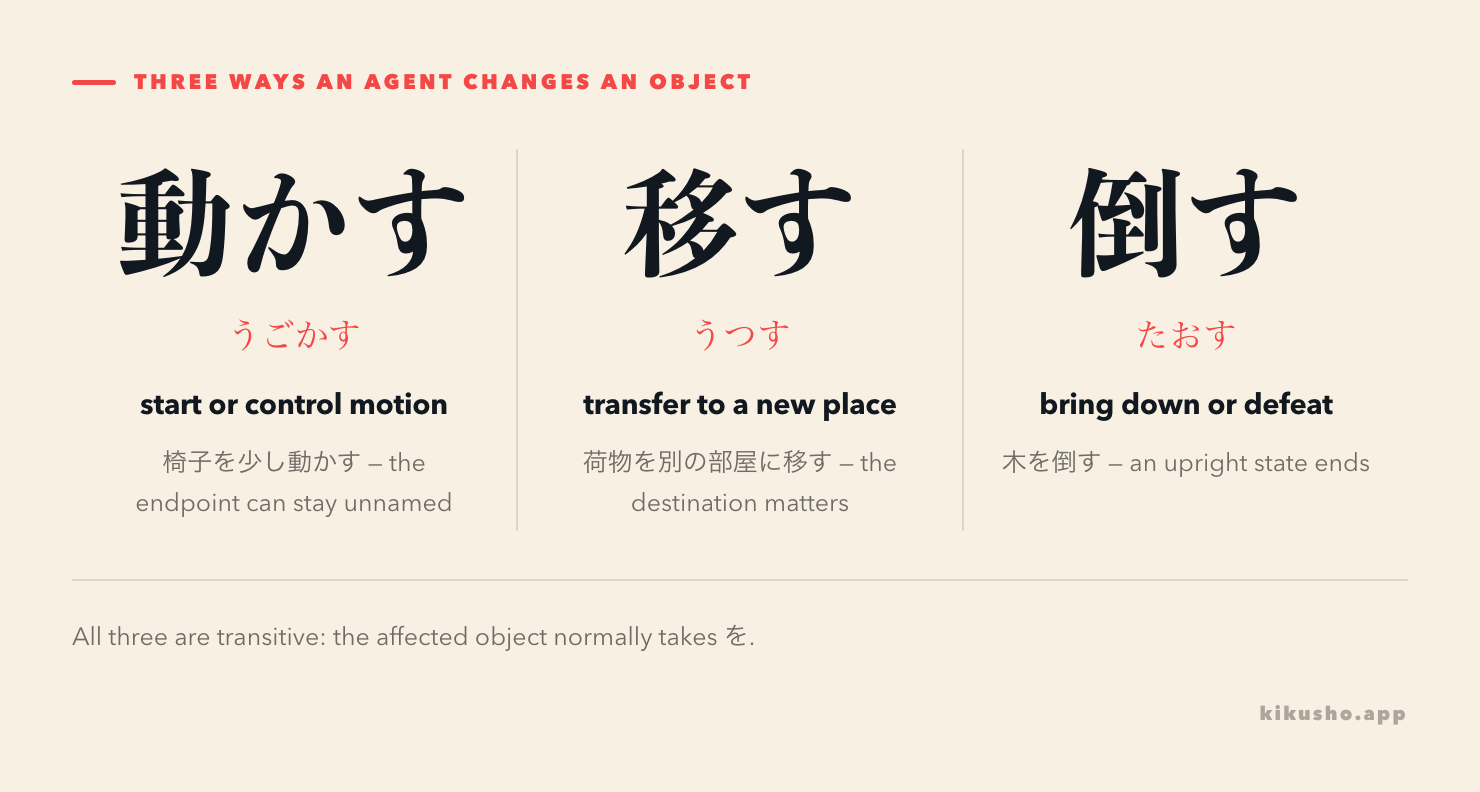
動かす, 移す and 倒す put the affected object in を
All three verbs are transitive, but their results differ.
動かす(うごかす) causes motion or operation. The dictionary entry covers changing position, moving a fixed part, operating machinery and influencing people or feelings. A destination is optional because the important fact can simply be that motion begins.
入口の前にある椅子を少し動かしてください。
いりぐちの まえに ある いすを すこし うごかして ください。
Please move the chair in front of the entrance a little.
このボタンを押すと、機械を動かすことができます。
この ボタンを おすと、きかいを うごかす ことが できます。
Pressing this button lets you operate the machine.
移す(うつす) presents a transfer. Something leaves one place, holder, state or stage and enters another. Its dictionary senses extend from physical relocation to transferring attention, a plan, a colour, a smell or an infection.
雨が降る前に、商品を倉庫の中へ移しました。
あめが ふる まえに、しょうひんを そうこの なかへ うつしました。
We moved the products into the warehouse before it rained.
来月から、計画を実行に移します。
らいげつから、けいかくを じっこうに うつします。
We will put the plan into action next month.
The pattern AからBに移す makes the transfer explicit: データを古い端末から新しい端末に移す, transfer the data from the old device to the new one. Compare that with 画面を少し動かす, move the screen slightly. 動かす supplies motion; 移す highlights the new place or stage.
倒す(たおす) causes something upright to lose that position or defeats an opponent. Its dictionary entry connects the physical and competitive senses through the idea of bringing something down.
強い風が庭の木を倒した。
つよい かぜが にわの きを たおした。
A strong wind knocked down the tree in the garden.
最後の試合で、彼は去年の優勝者を倒した。
さいごの しあいで、かれは きょねんの ゆうしょうしゃを たおした。
In the final match, he defeated last year's champion.
The N4 movement lesson teaches the corresponding event frames 動く, 移る and 倒れる. Compare 机が動く / 机を動かす, 荷物が別の部屋に移る / 荷物を別の部屋に移す, and 木が倒れる / 風が木を倒す.
移動 turns a change of location into an activity
移動(いどう) names movement from one place or position to another. It works as a noun in 移動時間, travel time, and with する in 別の会場へ移動する, move to another venue. The dictionary definition includes both a thing changing position and causing it to change position.
昼食の後、全員で次の会場へ移動します。
ちゅうしょくの あと、ぜんいんで つぎの かいじょうへ いどうします。
After lunch, everyone will move to the next venue.
駅からホテルまでの移動時間は約二十分です。
えきから ホテルまでの いどうじかんは やく にじゅっぷんです。
Travel time from the station to the hotel is about twenty minutes.
移動 presents the journey or relocation as a whole. 動かす focuses on what an agent does to a particular object; 移す stresses that object's transfer to a new place or state. Thus 机を動かす can mean shifting a desk a few centimetres, whereas 机を別の部屋に移す names its transfer to another room. 別の部屋へ移動する normally presents the person or group travelling there.
Do not confuse 移動 with the same-sounding 異動, an official change of duties, post or workplace. The N3 employment lesson contrasts 大阪支店へ移動する, physically travel to the Osaka branch, with 大阪支店へ異動する, be transferred there as a personnel assignment.
沈む reports downward movement without an external actor
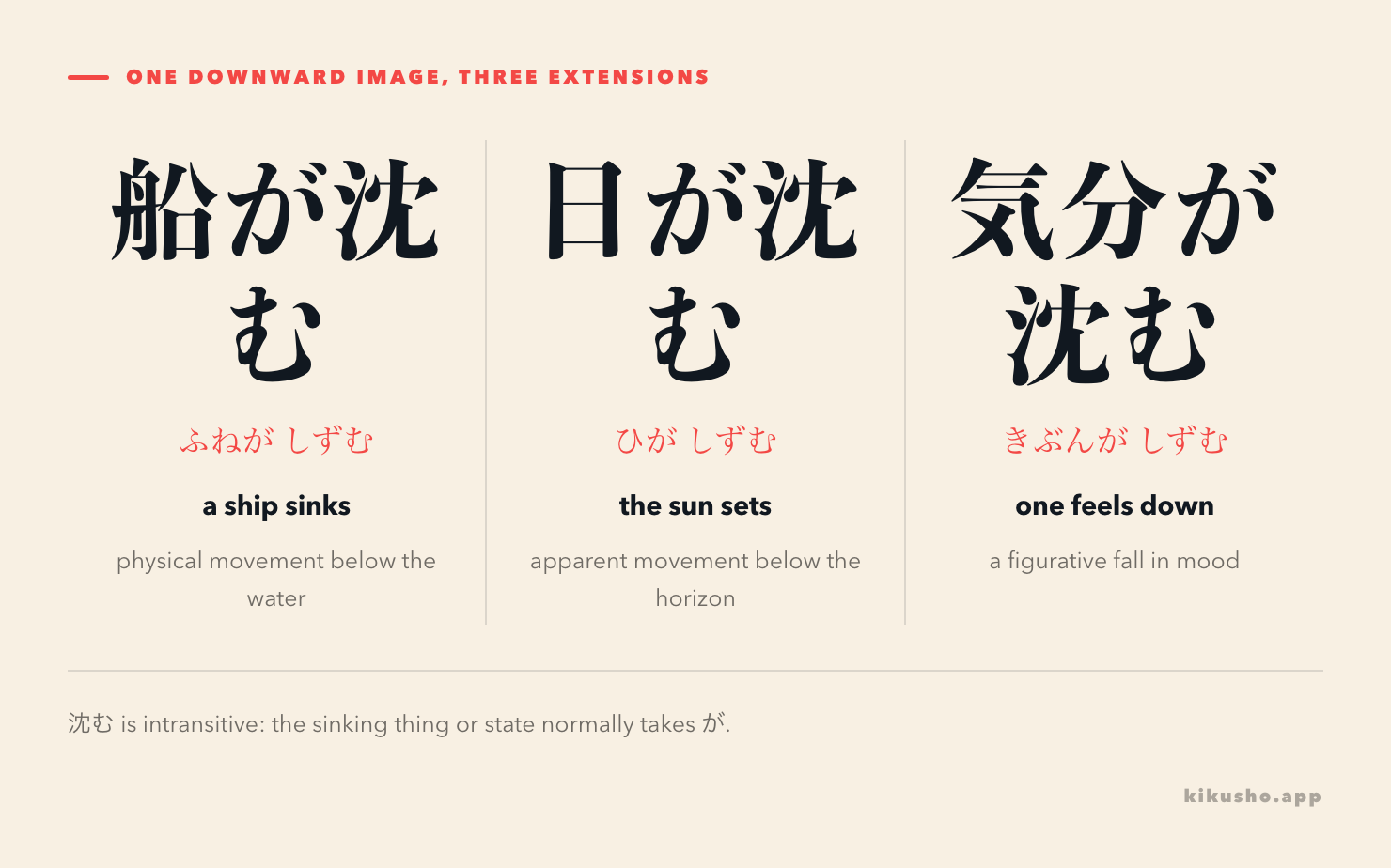
沈む(しずむ) is intransitive. The thing that goes below a surface, becomes lower or enters a subdued state normally takes が. The dictionary entry includes a vessel sinking, the sun setting and a person or atmosphere becoming depressed.
穴が開いて、水の中に船が沈んでいった。
あなが あいて、みずの なかに ふねが しずんで いった。
A hole opened, and the ship gradually sank into the water.
冬は日が沈むのが早い。
ふゆは ひが しずむのが はやい。
The sun sets early in winter.
試合に負けて、気分が沈んでいた。
しあいに まけて、きぶんが しずんで いた。
I felt down after losing the match.
These uses share a downward image, but only the first two describe physical position. 気分が沈む and 沈んだ声 extend that image to mood and tone. 沈む also differs from 倒れる: a ship can descend below the water with 沈む, while an upright tree loses its vertical position with 倒れる.
通過 crosses a point; 通行 uses a route
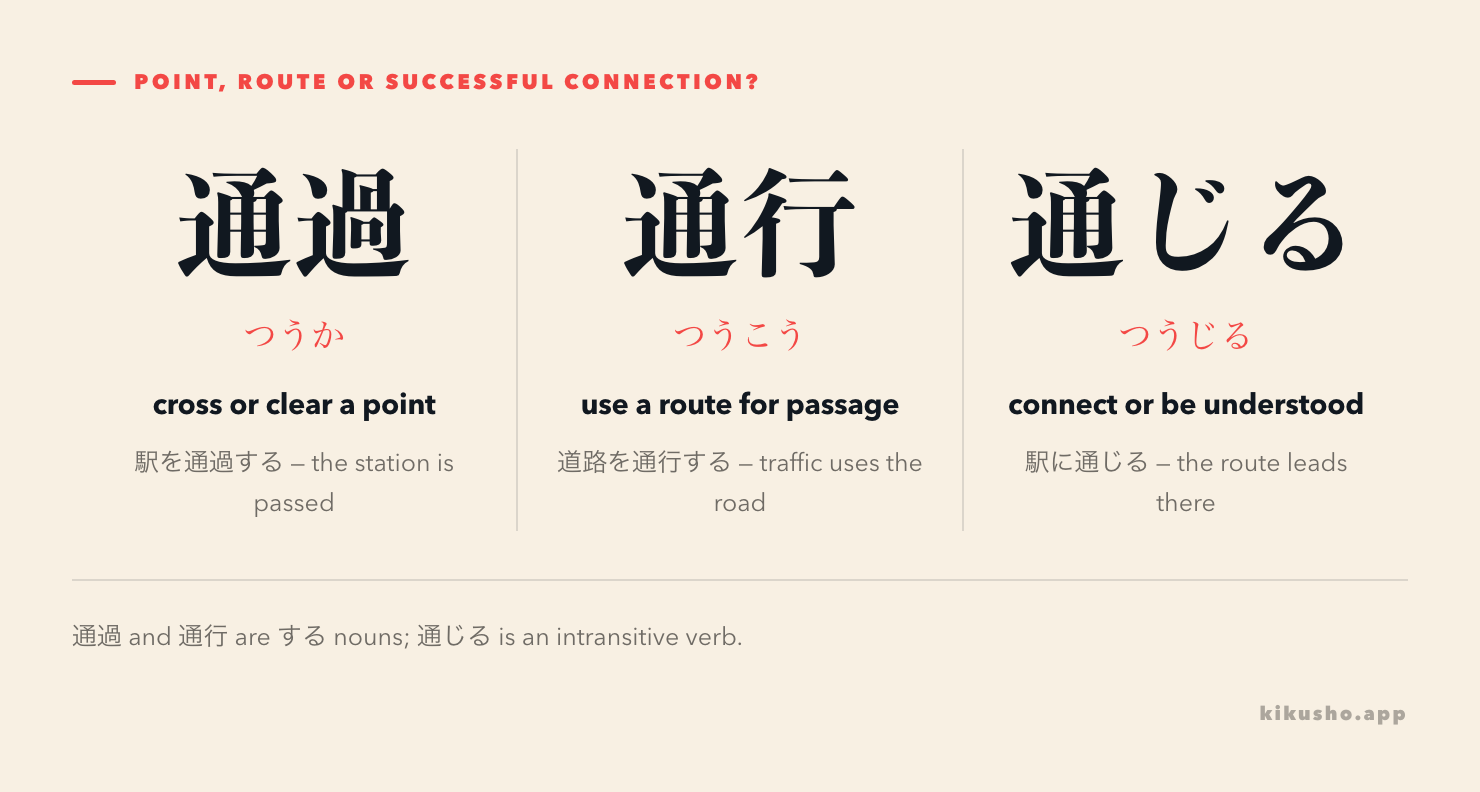
通過(つうか) presents a boundary, checkpoint or stage as crossed or cleared. The dictionary entry includes physically passing through and successfully clearing an examination, vote or screening.
この急行列車は小さい駅を通過します。
この きゅうこうれっしゃは ちいさい えきを つうかします。
This express train passes through the small station.
書類審査を通過した人に、面接の日程を送ります。
しょるいしんさを つうかした ひとに、めんせつの にっていを おくります。
We will send interview dates to the people who passed document screening.
The place or stage crossed commonly takes を. The station is not the train's destination in 駅を通過する; it is a point on the route.
通行(つうこう) focuses on passage along or through a road, path or controlled area. Its dictionary definition covers people and vehicles travelling through a place or in a direction.
この道路は工事中ですが、歩行者は通行できます。
この どうろは こうじちゅうですが、ほこうしゃは つうこうできます。
This road is under construction, but pedestrians can pass through.
大雨のため、橋は通行止めになりました。
おおあめの ため、はしは つうこうどめに なりました。
The bridge was closed to traffic because of heavy rain.
The compounds reveal the difference. 通過駅 is a station a train passes without stopping. 通行人 is a passer-by using the street, and 通行止め blocks road or pedestrian passage. When the question is “Did it clear that point?”, choose 通過. When the question is “Can people or vehicles use this route?”, choose 通行.
通じる says the connection succeeds
通じる(つうじる) does not merely describe a traveller moving along a route. It says that a route leads somewhere, a communication channel works, knowledge reaches another person or meaning is understood. The modern form 通じる appears under the broader 通ずる dictionary entry. The N2 continuation teaches the formal 通ずる form alongside relocation, floating, rolling and circular-route vocabulary.
この細い道は駅の南口に通じています。
この ほそい みちは えきの みなみぐちに つうじて います。
This narrow road leads to the station's south exit.
山の中では、携帯電話が通じませんでした。
やまの なかでは、けいたいでんわが つうじませんでした。
Mobile phones did not work in the mountains.
店員には英語が通じなかったので、日本語で説明した。
てんいんには えいごが つうじなかったので、にほんごで せつめいした。
The clerk did not understand English, so I explained in Japanese.
For a physical route, XはYに通じている means X leads or connects to Y. For communication, what gets through often takes が: 電話が通じる, the call connects, and 話が通じる, one's meaning gets through. 日本語が通じる says Japanese is understood in that situation; it does not by itself claim that every participant speaks Japanese fluently.
Follow one relocation through the whole set
A museum is preparing a travelling exhibition. Staff first 展示台を動かし, shift the display stands, then 作品を別の部屋に移します, transfer the works to another room. The group later 次の会場へ移動し, moves to the next venue. Drivers 検査所を通過します, pass a checkpoint, but cannot 古い橋を通行する, use the old bridge, because it is closed. A smaller road 町の中心に通じている, leads to the town centre. By the time 日が沈む, the sun sets, workers have secured the stands so that wind will not 展示台を倒す, knock them down.
係員は展示台を動かして、作品を別の部屋に移しました。その後、全員で次の会場へ移動しました。トラックは検査所を通過しましたが、古い橋は通行止めでした。運転手は町の中心に通じる道を選び、日が沈む前に到着しました。
かかりいんは てんじだいを うごかして、さくひんを べつの へやに うつしました。そのご、ぜんいんで つぎの かいじょうへ いどうしました。トラックは けんさじょを つうかしましたが、ふるい はしは つうこうどめでした。うんてんしゅは まちの ちゅうしんに つうじる みちを えらび、ひが しずむ まえに とうちゃくしました。
Staff moved the display stands and transferred the works to another room. The whole group then moved to the next venue. The truck passed the checkpoint, but the old bridge was closed to traffic. The driver chose a road leading to the town centre and arrived before sunset.
Keep the particle frame when making a study card: 作品を別の部屋に移す, 検査所を通過する, 橋を通行する, 町の中心に通じる. Those frames carry the distinction that a one-word English gloss loses.
The N3 label is a study placement, not an official boundary
Kikusho's September 2026 inventory assigns these eight records to N3. Current independent resources do not draw one identical boundary: Bunpro lists 通過 and 通行 at N3, but places 移動 at N4 and 通じる at N1. Its 沈む page currently uses a CEFR label rather than a JLPT level.
The official JLPT FAQ explains that the current test publishes no exhaustive vocabulary list. Treat N3 as a useful sequence for study and practise the actual contrasts, particles and contexts rather than memorising the level label alone.
Practice: choose the actor, path and connection
Complete the route analysis first; open the key only after Question 10.
1 · Reading. How is 通過 read?
- ア. つうか
- イ. つうこう
- ウ. とうか
- エ. とおか
2 · Spelling. Which word is read つうこう and means passage along a road or through an area?
- ア. 通じる
- イ. 通過
- ウ. 移動
- エ. 通行
3 · Transitivity. Complete the pair: 風でカーテンが動いた。係員がカーテンを__。
- ア. 動かした
- イ. 沈んだ
- ウ. 通じた
- エ. 移動した
4 · Motion or transfer? The box must go from the reception desk to a named storage room. Which phrase makes the transfer clearest?
- ア. 箱が受付で沈む
- イ. 箱を倉庫に移す
- ウ. 箱を少し動かす
- エ. 箱が駅に通じる
5 · Physical and figurative extension. Which sentence naturally uses 沈む?
- ア. 日が西の空に沈む。
- イ. 店員が椅子を沈む。
- ウ. 車が道路を通じる。
- エ. 選手が相手に通行する。
6 · Checkpoint or route use? Choose the correct pair.
急行は小さい駅を( 前 )。工事中、この道路を車で( 後 )ことはできない。
- ア. 前 通行する / 後 通過する
- イ. 前 通じる / 後 沈む
- ウ. 前 通過する / 後 通行する
- エ. 前 移動する / 後 倒す
7 · Physical connection. Complete: この道は港__通じています。
- ア. を
- イ. に
- ウ. が
- エ. で
8 · Communication. A traveller says ここでは英語が通じますか. What are they asking?
- ア. Does this road physically pass through England?
- イ. Is English understood here?
- ウ. May cars use this English road?
- エ. Will English sink here?
9 · Sentence building. Put the chunks into a natural sentence meaning “A strong wind knocked down the tree in front of the house.”
- 家の前の木を
- 強い風が
- 倒しました
10 · Paraphrase. Which summary preserves トラックは検査所を通過したが、橋が通行止めだったので、町に通じる別の道を選んだ?
- ア. The truck sank at the checkpoint and moved the bridge into town.
- イ. The truck cleared the checkpoint, but the bridge was closed, so the driver chose another road leading to town.
- ウ. The truck operated the checkpoint, defeated the bridge and transferred the town.
- エ. The truck used the bridge normally because no road connected to town.
Answers and explanations
ア, つうか. 通過 is read つうか. 通行 is つうこう, a useful pair to keep distinct in sound and meaning.
エ, 通行. 通行 names passage or traffic along a road, path or controlled area. 通過 focuses on crossing a point or clearing a stage.
ア, 動かした. 動く is intransitive in カーテンが動いた. The staff member deliberately acts on the curtain with transitive 動かす: 係員がカーテンを動かした.
イ, 箱を倉庫に移す. 移す marks the box as the transferred object and the warehouse as its destination. 動かす could express a small shift without establishing that endpoint.
ア. The sun is the intransitive subject of 沈む. The other choices combine an intransitive verb with a direct object or assign road and competitive roles to unsuitable verbs.
ウ: 前 通過する / 後 通行する. An express train crosses the small station as a point; a vehicle uses a road for passage. The road construction restricts 通行.
イ, に. A destination or connection endpoint takes に in 港に通じている, lead to the port.
イ. 英語が通じる means English gets through or is understood in that situation. It does not describe physical travel.
強い風が家の前の木を倒しました。 The causal force takes が, the affected tree takes を and 倒す states that the wind brought the upright tree down.
イ. 通過 says the truck cleared the checkpoint, 通行止め says traffic across the bridge was prohibited, and 町に通じる says the alternative road led to town.
Common questions
What is the difference between 動かす and 移す?
動かす makes something move, changes its position or operates it; the destination may be irrelevant. 移す transfers something from one place, state or stage to another, so a destination or resulting state is often central.
What is the difference between 通過 and 通行?
通過 focuses on crossing or clearing a point, zone or test. 通行 focuses on using a road, path or area for passage, especially by people and vehicles. A train can 駅を通過する, while a car 道路を通行する.
How do you use 通じる?
通じる says that a connection works: a road leads somewhere, a telephone connects, or words and meaning are understood. Use 駅に通じる for a route leading to the station and 日本語が通じる when Japanese is understood.
Is every word in this lesson officially JLPT N3?
Kikusho's dated inventory assigns all eight records to N3, but independent learner resources place several at other levels. The JLPT publishes no exhaustive official vocabulary list, so N3 is a transparent study placement rather than an official guarantee.