On this page
移転, 浮かべる, 浮く, 回転, 転がす, 転がる, 侵入, 持参, 通ずる, 引っ越し and 巡る describe more than simple movement. They distinguish formal relocation from an everyday move, caused motion from spontaneous motion, rotation from rolling, authorised routes from intrusive entry and a circuit from a connection.
Eleven words map what moves and how
Imagine a science museum relocating to a new building. Its official address changes, staff prepare the move, exhibits float or rotate, visitors follow a circuit and security prevents entry into restricted rooms. Each word below answers a different question inside that scene.
| Museum word | Reading | What it contributes to the scene | Example from the move |
|---|---|---|---|
| 移転 | いてん, iten | noun; する verb; formal relocation or transfer | 博物館が新館へ移転する, the museum relocates |
| 浮かべる | うかべる, ukaberu | ichidan transitive verb; make float, show, call to mind | 水に模型を浮かべる, float a model on water |
| 浮く | うく, uku | godan intransitive verb; float, lift, become detached | 模型が水に浮く, a model floats on water |
| 回転 | かいてん, kaiten | noun; する verb; rotate around an axis | 車輪が回転する, a wheel rotates |
| 転がす | ころがす, korogasu | godan transitive verb; roll or turn over something | ボールを転がす, roll a ball |
| 転がる | ころがる, korogaru | godan intransitive verb; roll, tumble, lie around | ボールが転がる, a ball rolls |
| 侵入 | しんにゅう, shinnyū | noun; する verb; forceful or unauthorised entry | 立入禁止区域に侵入する, enter a prohibited area |
| 持参 | じさん, jisan | noun; する verb; bring or take something along | 身分証を持参する, bring identification |
| 通ずる | つうずる, tsūzuru | irregular する-type verb; connect, communicate, know | 新館に通ずる道, a road leading to the new building |
| 引っ越し | ひっこし, hikkoshi | noun; する verb; moving home or workplace | 引っ越しの準備, preparations for a move |
| 巡る | めぐる, meguru | godan intransitive verb; go around, circulate, concern | 展示室を巡る, tour the exhibition rooms |
Do not force every word into a direction-verb template. 持参 identifies what accompanies a person, 侵入 evaluates how a boundary is crossed and 通ずる presents a working connection.
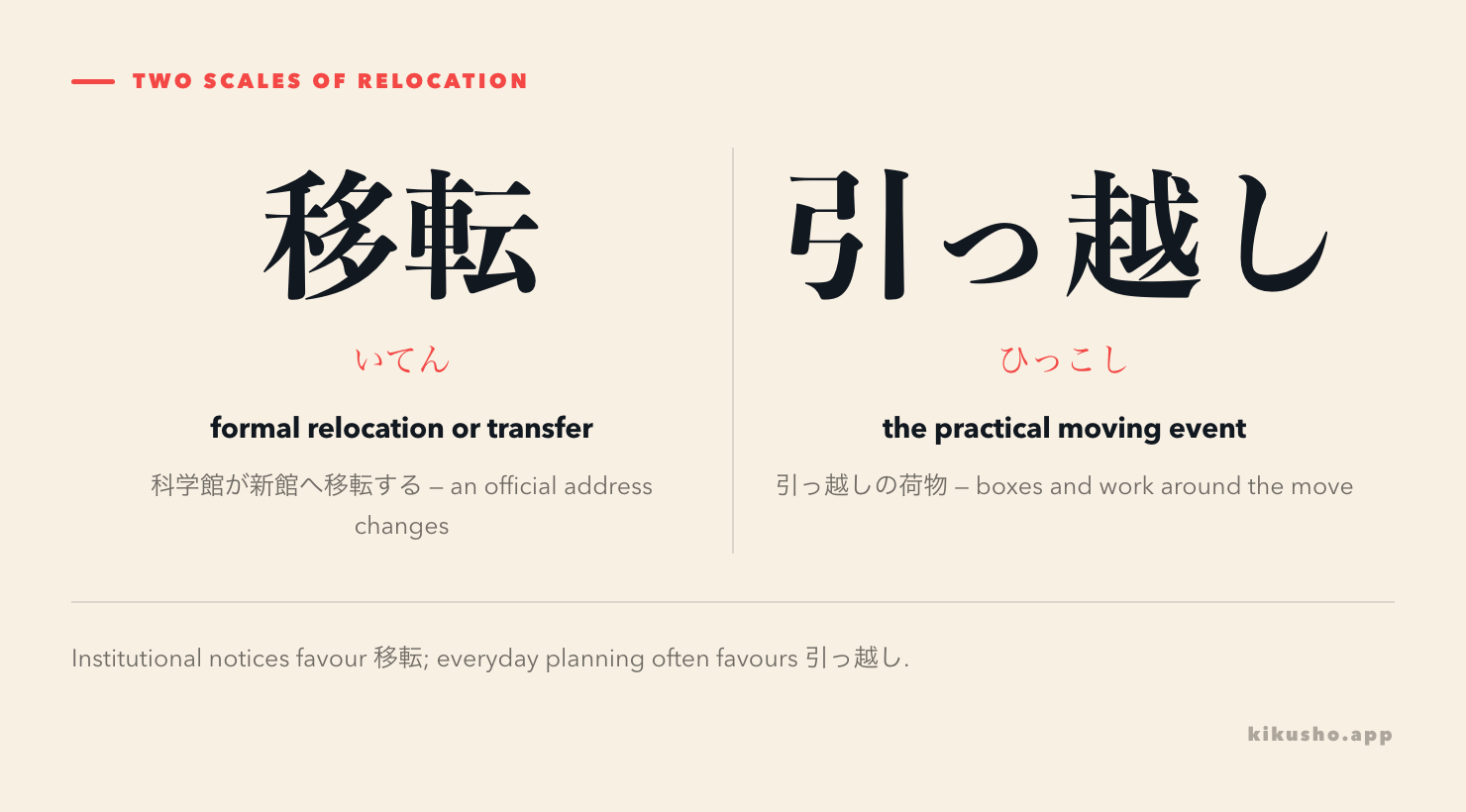
移転 is an official relocation; 引っ越し is the moving event
移転(いてん) is common in notices, institutional plans and legal language. The dictionary entry includes changing an office or address and transferring a legal right.
科学館は十月一日に駅前の新館へ移転します。
かがくかんは じゅうがつ ついたちに えきまえの しんかんへ いてんします。
The science museum will relocate to the new building by the station on October 1.
施設の移転に伴い、電話番号も変わります。
しせつの いてんに ともない、でんわばんごうも かわります。
The telephone number will also change with the facility's relocation.
引っ越し(ひっこし) names the practical move itself. Its dictionary entry defines it as the noun form of 引っ越す, covering a change of residence or workplace.
引っ越しの前に、不要な資料を処分しました。
ひっこしの まえに、ふような しりょうを しょぶんしました。
Before the move, we disposed of unnecessary materials.
A museum publishes 移転のお知らせ, a relocation notice. Staff can talk about 引っ越しの荷物, moving boxes. The N3 movement lesson provides the broader 移動 frame; this lesson narrows the register and event type.
浮く and 浮かべる reverse the participant roles
浮く(うく) is intransitive: the thing rises from a surface, remains buoyant or becomes detached. The dictionary explanation also extends it to a loose foundation, a person standing apart from a group and a cost being saved.
軽い模型なら、水に浮きます。
かるい もけいなら、みずに うきます。
A light model will float on the water.
床の一部が浮いているので、足元に注意してください。
ゆかの いちぶが ういて いるので、あしもとに ちゅういして ください。
Part of the flooring has lifted, so watch your step.
浮かべる(うかべる) is transitive. Its dictionary senses include setting something afloat, showing an emotion on one's face and bringing an image into consciousness.
係員が水槽に小さな船を浮かべました。
かかりいんが すいそうに ちいさな ふねを うかべました。
A staff member floated a small boat in the tank.
子どもたちは笑みを浮かべて実験を見ていた。
こどもたちは えみを うかべて じっけんを みて いた。
The children watched the experiment with smiles on their faces.
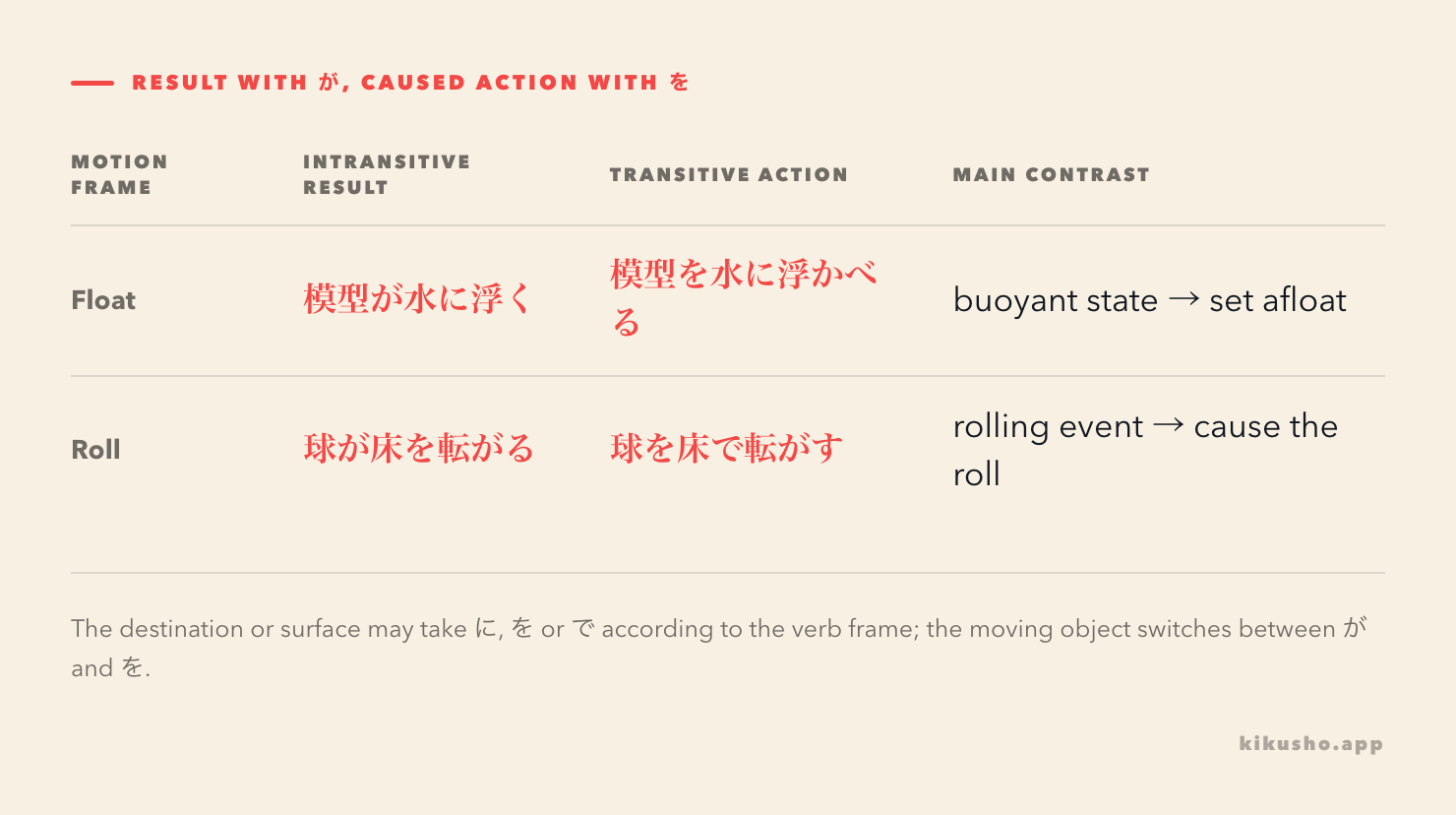
The contrast is direct: 船が水に浮く describes the resulting state; 船を水に浮かべる names the person-caused action.
回転 stays on an axis; 転がる changes position along a surface
回転(かいてん) focuses on rotation around a point or axis. The dictionary also extends it to mental processing and turnover, as in 頭の回転が速い and 客の回転.
スイッチを入れると、中央の円盤が回転します。
スイッチを いれると、ちゅうおうの えんばんが かいてんします。
When the switch is turned on, the central disc rotates.
転がる(ころがる) describes something rolling, tumbling, lying on its side or being scattered. 転がす(ころがす) supplies the agent that causes the roll. The dictionary entries preserve this intransitive/transitive relation for 転がる and 転がす.
ボールが斜面を転がっていった。
ボールが しゃめんを ころがって いった。
The ball rolled down the slope.
レバーを押して、金属の球をゆっくり転がしてください。
レバーを おして、きんぞくの たまを ゆっくり ころがして ください。
Press the lever and roll the metal ball slowly.
A disc can 回転する while remaining fixed in one place. A ball normally 転がる across a surface and changes location. If a visitor causes that motion, the ball takes を with 転がす.
侵入 crosses a protected boundary; 持参 carries a requirement
侵入(しんにゅう) is not neutral arrival. It presents entry into another's territory or a protected area as forceful, improper or unauthorised. Daijisen defines it as violating another domain and forcing one's way in.
閉館後、何者かが事務室に侵入しました。
へいかんご、なにものかが じむしつに しんにゅうしました。
After closing, someone entered the office without authorisation.
The destination commonly takes に. 無断侵入 and 不法侵入 make the lack of permission explicit. For an ordinary visitor entering the museum, 入る is enough; 侵入 adds the violated boundary.
持参(じさん) is a formal instruction to bring or take an item along. The dictionary entry explicitly covers both carrying something to a place and bringing it to the speaker's location, so it does not preserve the English bring/take distinction.
研修に参加する方は、身分証を持参してください。
けんしゅうに さんかする かたは、みぶんしょうを じさんして ください。
Participants in the training should bring identification.
The carried item takes を. 持ってくる is normal in conversation; 持参する suits notices, applications and event instructions.
通ずる connects an endpoint; 巡る traces a circuit
通ずる(つうずる) is a formal する-type form that overlaps with modern 通じる. Its dictionary entry covers roads leading somewhere, telephone or electricity getting through, meaning being understood and knowledge of a field.
この通路は新館の展示室に通じています。
この つうろは しんかんの てんじしつに つうじて います。
This passage leads to the new building's exhibition rooms.
その考え方は現代の環境問題にも通ずる。
その かんがえかたは げんだいの かんきょうもんだいにも つうずる。
That way of thinking also applies to modern environmental issues.
Notice the surface forms: dictionary form 通ずる, polite 通じます, negative 通じない and connective 通じて. The assigned record is 通ずる, but everyday Japanese often chooses 通じる.
巡る(めぐる) traces a route around places, a returning cycle or a topic surrounded by viewpoints. The dictionary includes touring several places, seasons returning, circulation and discussion centred on an issue.
ガイドと一緒に五つの展示室を巡りました。
ガイドと いっしょに いつつの てんじしつを めぐりました。
We toured five exhibition rooms with a guide.
新館の建設費を巡って、意見が分かれた。
しんかんの けんせつひを めぐって、いけんが わかれた。
Opinions were divided over the cost of the new building.
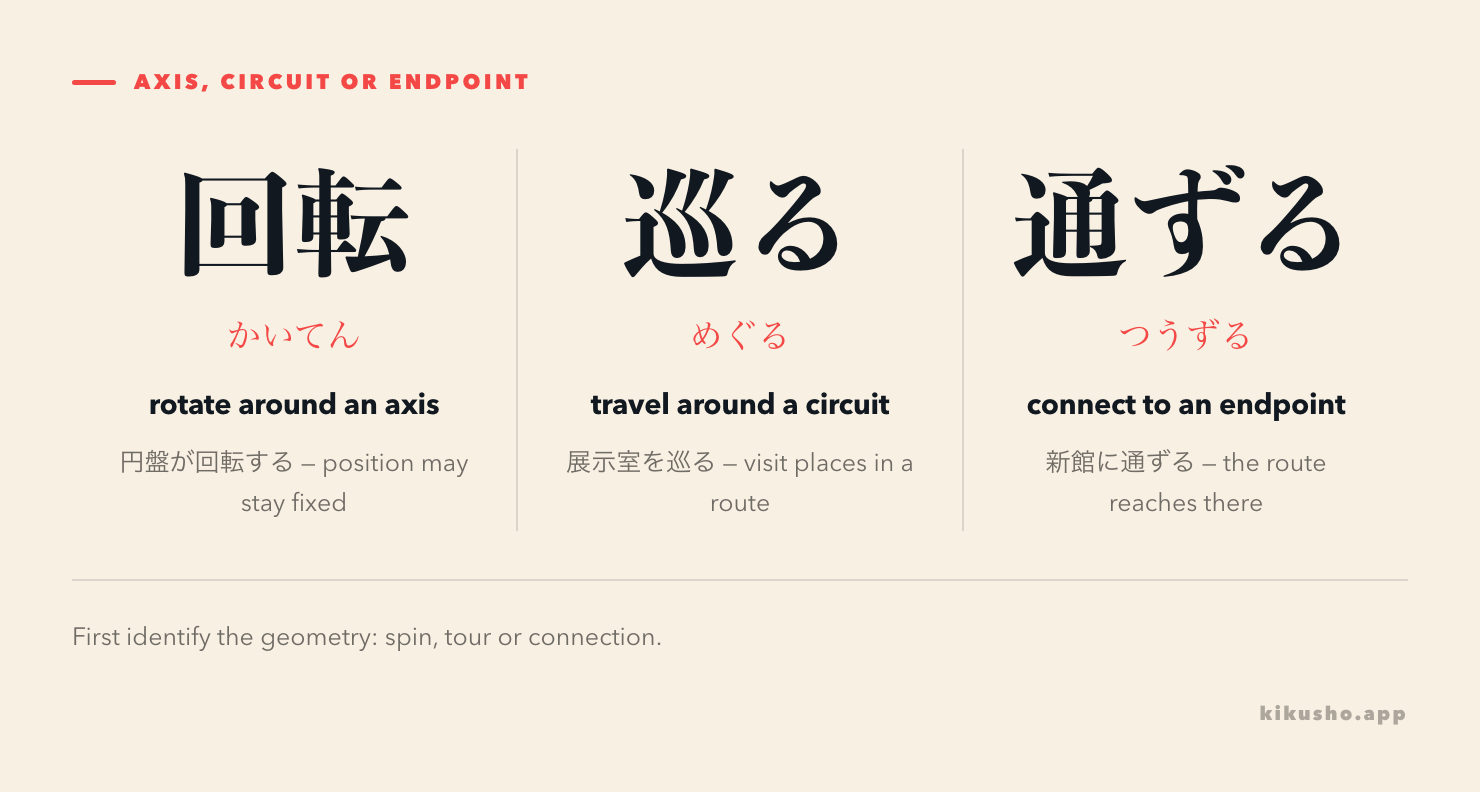
The を巡って lesson develops the formal debate pattern. Here the core contrast is spatial: 回転 stays around an axis, 巡る proceeds around a circuit or set of places and 通ずる reaches or connects to an endpoint.
Read the museum notice as one movement system
科学館は来月、新館へ移転します。引っ越し作業の間、関係者は身分証を持参してください。許可なく倉庫に侵入することは禁止されています。新館では、水に浮く模型や、係員が球を転がす実験を公開します。中央の装置はゆっくり回転します。入口から展示室に通ずる通路を進み、順番に各展示を巡ってください。
かがくかんは らいげつ、しんかんへ いてんします。ひっこしさぎょうの あいだ、かんけいしゃは みぶんしょうを じさんして ください。きょかなく そうこに しんにゅうする ことは きんしされて います。しんかんでは、みずに うく もけいや、かかりいんが たまを ころがす じっけんを こうかいします。ちゅうおうの そうちは ゆっくり かいてんします。いりぐちから てんじしつに つうずる つうろを すすみ、じゅんばんに かくてんじを めぐって ください。
The science museum will relocate to its new building next month. During the move, authorised personnel should bring identification. Entering the storage room without permission is prohibited. The new building will feature floating models and an experiment in which staff roll a ball. The central apparatus rotates slowly. Follow the passage connecting the entrance to the exhibition rooms and visit each exhibit in order.
The notice separates institutional change, carried requirements, protected boundaries and three kinds of movement. Preserve those frames in study cards: 新館へ移転する, 身分証を持参する, 倉庫に侵入する, 円盤が回転する, 球を転がす, 展示室に通ずる and 展示を巡る.
N2 is a documented study grouping
Kikusho's September 2026 inventory assigns all eleven records to N2. Independent current resources support much of that placement: Bunpro marks 浮かべる, 転がす, 転がる, 侵入 and 持参 at N2. It places 浮く, 回転 and 巡る at N3, however, and 引っ越し at N4. These differences reflect how learner resources distribute common words across stages.
The official JLPT FAQ publishes no exhaustive vocabulary list for the current exam. Study the readings, register, transitivity and collocations as an N2 review set without treating the label as an official exclusive boundary. The N1 continuation extends the system to freight, physical handling, caused descent, traced evidence and formal residential relocation.
Practice: restore the museum route
Keep the answer panel closed until every label, participant and boundary has been chosen.
1 · Reading. How is 移転 read in an official notice?
- ア. いどう
- イ. いてん
- ウ. いてい
- エ. いでん
2 · Orthography. Which spelling matches ころがる, “to roll or tumble”?
- ア. 転がる
- イ. 回がる
- ウ. 巡がる
- エ. 浮がる
3 · Word formation. Which compound naturally means “unauthorised entry”?
- ア. 無断回転
- イ. 無断持参
- ウ. 無断侵入
- エ. 無断移転
4 · Cause and result. Complete the pair: 模型が水に( 前 )。係員が模型を水に( 後 )。
- ア. 前 浮く / 後 浮かべる
- イ. 前 浮かべる / 後 浮く
- ウ. 前 転がす / 後 回転する
- エ. 前 巡る / 後 侵入する
5 · Rotation or rolling? A fixed disc spins around its central axis without travelling across the floor. Which verb fits?
- ア. 円盤が床を転がる
- イ. 円盤が回転する
- ウ. 円盤が新館へ移転する
- エ. 円盤が倉庫に侵入する
6 · Formal instruction. Complete: 参加者は身分証を__してください。
- ア. 持参
- イ. 侵入
- ウ. 回転
- エ. 移転
7 · Connection. Which sentence means “This passage leads to the exhibition room”?
- ア. この通路は展示室を転がしている。
- イ. この通路は展示室に通じている。
- ウ. この通路は展示室を持参している。
- エ. この通路は展示室へ侵入している。
8 · Circular route. What does 三つの寺を巡る旅行 describe?
- ア. A trip that formally relocates three temples
- イ. A trip that tours three temples
- ウ. A trip that rolls three temples downhill
- エ. A trip that enters three temples illegally
9 · Register. Which phrase best fits a company's formal change-of-address notice?
- ア. 本社移転のお知らせ
- イ. 本社が水に浮くお知らせ
- ウ. 本社無断侵入のお知らせ
- エ. 本社を転がすお知らせ
10 · Notice comprehension. Which summary matches the museum notice?
- ア. The museum remains at its old address and visitors may enter every room without identification.
- イ. The museum is relocating; authorised workers bring identification, restricted entry is prohibited and visitors follow a connected exhibition route.
- ウ. Every exhibit is transferred to a visitor's home and no apparatus moves.
- エ. The museum asks visitors to roll the building and float their identification cards.
Check the museum route: solutions and reasoning
イ, いてん. 移転 is the formal noun and する verb for relocation or transfer. 移動 is read いどう.
ア, 転がる. 転がる is the intransitive godan verb. 転がす is its transitive partner.
ウ, 無断侵入. 無断 means without permission, and 侵入 adds entry that violates a protected domain.
ア: 前 浮く / 後 浮かべる. The model takes が with intransitive 浮く. The staff member acts on the model marked by を with transitive 浮かべる.
イ, 円盤が回転する. 回転 describes spinning around an axis. 転がる would normally present movement along a surface or a fall onto one's side.
ア, 持参. A formal notice uses 身分証を持参してください, please bring identification. The object carried takes を.
イ. A route takes は and its endpoint takes に with 通じている. The other choices assign rolling, carrying or unauthorised entry to the passage.
イ. 巡る can trace a route through several places. The traveller visits the three temples as parts of one circuit.
ア, 本社移転のお知らせ. 移転 is the conventional formal word for an office or organisation changing address.
イ. The notice combines 移転 and 引っ越し with required 持参, prohibited 侵入, moving exhibits and a route that 通ずる and 巡る organise.
Common questions
What is the difference between 移転 and 引っ越し?
移転 is formal and often describes an organisation, office, facility or legal right moving to another place or owner. 引っ越し is the ordinary noun for moving one's home or workplace and the practical event around it.
What is the difference between 浮く and 浮かべる?
浮く is intransitive, so the thing floating takes が. 浮かべる is transitive, so the person causing something to float marks that object with を. 浮かべる also describes showing a smile or calling an image to mind.
What is the difference between 回転 and 転がる?
回転 focuses on rotation around an axis and can happen without a change of location. 転がる describes an object rolling along a surface, falling over or lying around. 転がす is the corresponding transitive action.
Is 通ずる different from 通じる?
They overlap heavily. 通ずる is a formal or literary する-type form, while 通じる is more common in modern speech. Both can express a route connecting, meaning getting through or knowledge of a field.