On this page
動く, 移る, 通う, 倒れる, 運ぶ and 引っ越す all involve movement, but they assign different roles to the moving person or thing. Use 動く for movement itself, 移る for a shift to another place or state, 通う for repeated travel, 倒れる for losing an upright position, 運ぶ for transporting something and 引っ越す for changing residence.
Six verbs divide movement by participant, route and repetition
The English verb “move” can hide who moves, whether there is a destination and whether another object is carried. Japanese makes those distinctions in the verb and the particles around it.
| Assigned verb | Reading | Word class and core sense | Phrase to keep |
|---|---|---|---|
| 動く | うごく, ugoku | godan intransitive verb; move, change position, operate | カーテンが動く, the curtain moves |
| 移る | うつる, utsuru | godan intransitive verb; shift or transfer to another place or state | 別の教室に移る, move to another classroom |
| 通う | かよう, kayou | godan intransitive verb; travel regularly between places | 学校に通う, attend or commute to school |
| 倒れる | たおれる, taoreru | ichidan intransitive verb; fall over or collapse | 木が倒れる, a tree falls |
| 運ぶ | はこぶ, hakobu | godan transitive verb; carry or transport | 荷物を二階に運ぶ, carry luggage upstairs |
| 引っ越す | ひっこす, hikkosu | godan intransitive verb; move residence or workplace | 大阪に引っ越す, move to Osaka |
This is a set of movement frames, not six translations of one word. Ask three questions when choosing: What changes position? Is there a destination? Does the movement repeat?
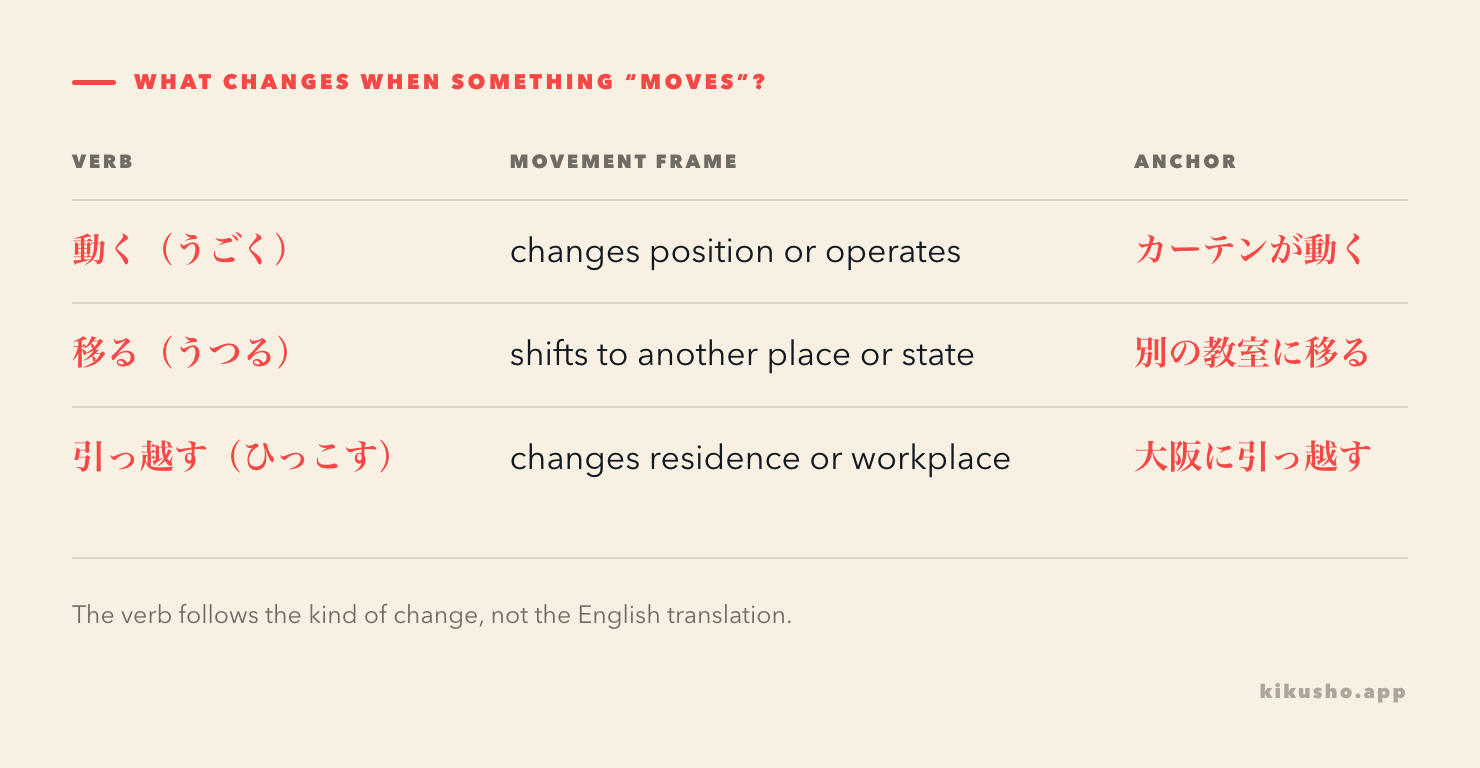
動く describes movement; 移る foregrounds a shift
動く(うごく) is the broad intransitive verb for something changing position or operating. Shogakukan's entry includes physical movement, changes of state and machinery working.
風でカーテンが動いている。
かぜで カーテンが うごいて いる。
The curtain is moving in the wind.
この時計はまだ動いている。
この とけいは まだ うごいて いる。
This clock is still running.
The moving thing takes が. Neither sentence needs an endpoint. To make something move, use the transitive partner 動かす: 机を動かす, move the desk.
移る(うつる) narrows the view to a transition. A person, meeting, topic or condition leaves one position and reaches another. Kanjipedia defines this spelling as moving to a different place and extends it to 移り変わり, change over time.
会議の後、別の教室に移りました。
かいぎの あと、べつの きょうしつに うつりました。
After the meeting, we moved to another classroom.
話題が旅行から仕事に移った。
わだいが りょこうから しごとに うつった。
The topic shifted from travel to work.
The pattern AからBに移る exposes the starting point and destination. That is why カーテンが動く merely reports motion, while カーテンが窓の右側に移る reports a change from one position to another. For deliberate movement of an object, the transitive partner is 移す: 机を窓の近くに移す, move the desk near the window. The N3 continuation develops 動かす, 移す and 倒す and then distinguishes 通過, 通行 and 通じる.
通う repeats a route; 引っ越す replaces the home base
通う(かよう) describes regular travel over the same interval. The dictionary definition explicitly includes repeated trips to school, work and a hospital.
毎日、電車で会社に通っています。
まいにち、でんしゃで かいしゃに かよって います。
I commute to work by train every day.
週に二回、病院に通っています。
しゅうに にかい、びょういんに かよって います。
I go to the hospital twice a week.
The regular destination takes に. The means of travel takes で, as in 電車で. A phrase such as 毎日 or 週に二回 often makes the repetition visible, but the verb already presents the trip as habitual.
引っ越す(ひっこす) changes the base itself. It normally names a change of residence and can also cover moving an office or workplace. AからBに引っ越す gives the old and new bases:
来月、東京から大阪に引っ越します。
らいげつ、とうきょうから おおさかに ひっこします。
Next month, I am moving from Tokyo to Osaka.
After that move, a person might say 大阪の会社に通っています. The first verb records the relocation; the second records the repeated commute that follows. Bunpro's 引っ越す entry likewise classifies it as an N4 intransitive verb for changing residence.
The earlier N4 route lesson teaches 進む, 戻る and 途中 for following one route. Here, 通う adds repetition and 引っ越す changes where that route begins.
運ぶ moves an object; 倒れる changes an upright position
運ぶ(はこぶ) is transitive in its core physical use. A person or vehicle takes something from one place to another. The National Institute for Japanese Language and Linguistics describes the verb as moving an object from one place to another and gives the basic frame person が + object を + destination に/へ + 運ぶ.
引っ越しの朝、箱をトラックまで運びました。
ひっこしの あさ、はこを トラックまで はこびました。
On moving day, I carried the boxes to the truck.
店員が新しい机を二階に運んだ。
てんいんが あたらしい つくえを にかいに はこんだ。
The employee carried the new desk upstairs.
The transported thing takes を. まで gives an endpoint, while に or へ gives a destination. Kanjipedia also records an abstract use, as in 会議が順調に運ぶ, a meeting proceeds smoothly. Learn the physical frame first because it makes the verb's transitivity unmistakable.
倒れる(たおれる) is intransitive. A standing person, tree or object loses support and ends up down:
強い風で庭の木が倒れた。
つよい かぜで にわの きが たおれた。
A tree in the garden fell in the strong wind.
駅で急に人が倒れた。
えきで きゅうに ひとが たおれた。
A person suddenly collapsed at the station.
The thing that falls takes が. Bunpro's N4 entry includes falling over, collapsing and becoming bedridden. Use 倒す when an agent knocks something down: 風が木を倒した, the wind knocked the tree down.
Do not replace 倒れる with 落ちる in every fall. 落ちる presents downward movement from a higher point, as when a wallet falls from a pocket. 倒れる presents the loss of an upright position. A tree can 倒れる without first being above the ground.
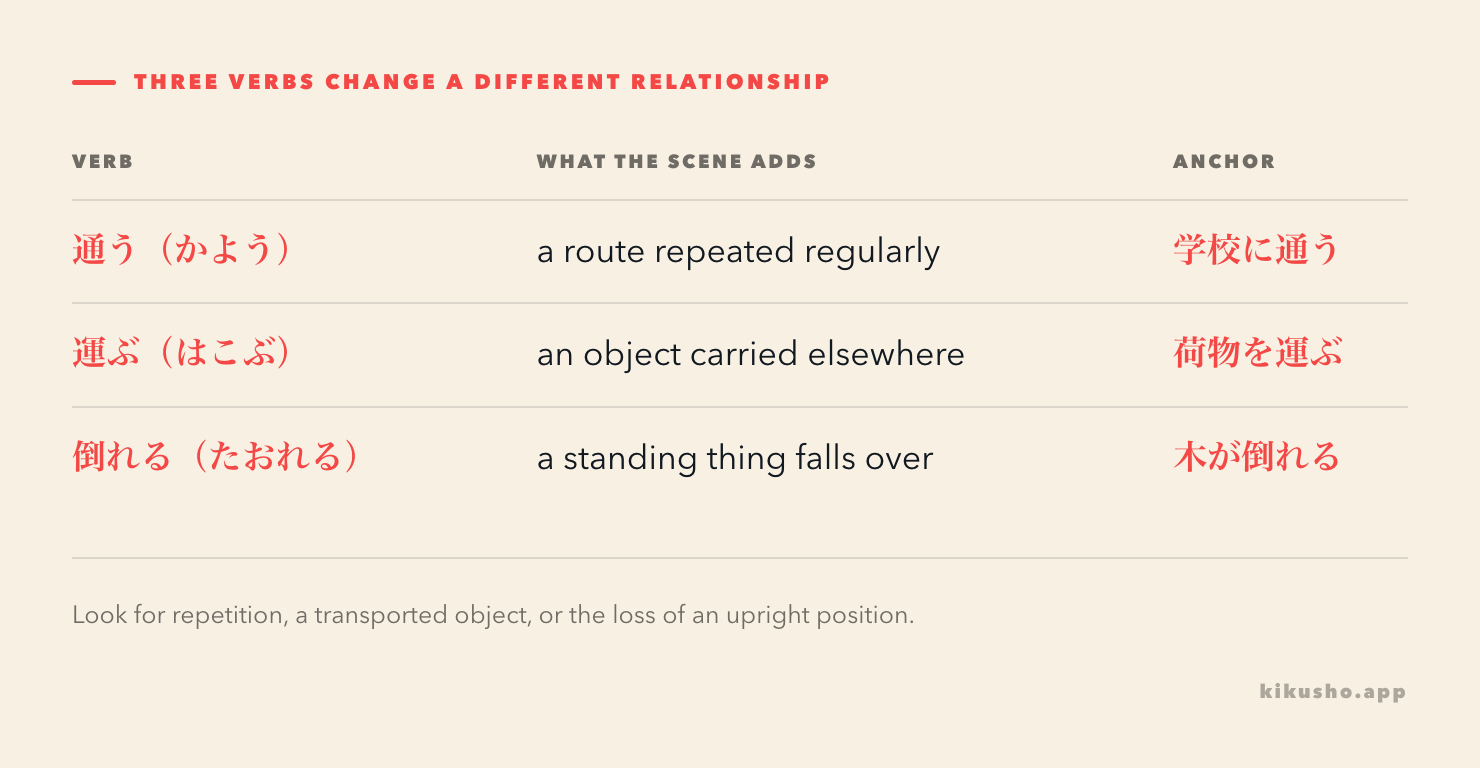
The particles reveal what each verb makes important
| Frame | Subject | Object or route | Destination or endpoint | Example |
|---|---|---|---|---|
| movement itself | thing が | optional route を | optional に/へ | 電車がゆっくり動く |
| shift | thing or person が | source から | new place に | 次の教室に移る |
| regular travel | person が | means で | regular place に | 自転車で学校に通う |
| collapse | person or thing が | cause で | direction can take に | 木が道に倒れる |
| transport | carrier が | carried thing を | に/へ/まで | 荷物を車まで運ぶ |
| relocation | person or group が | old base から | new base に/へ | 京都から東京に引っ越す |
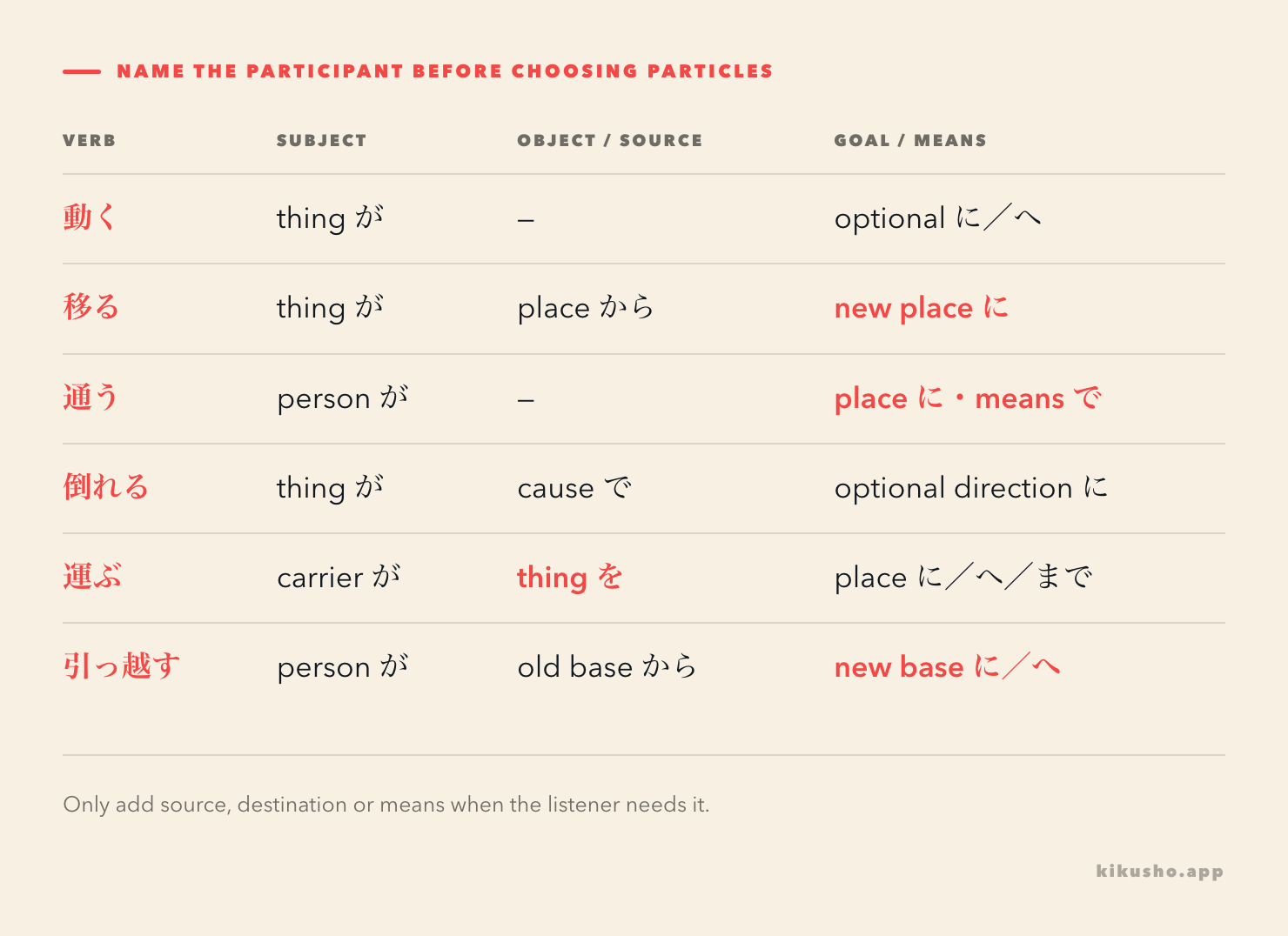
The table is a map, not a rule that every slot must appear. 来月引っ越します is complete when the destination is understood. 机が動いた is complete when the point is simply that the desk moved. Particles become easier when you first identify the moving participant and then add only the route details the listener needs.
One moving day gives all six verbs separate jobs
来月、家族で京都から東京に引っ越します。父は先に東京へ移り、今は新しい会社に通っています。引っ越しの日は、みんなで箱をトラックまで運びます。重い棚が急に動いたり、倒れたりしないように固定します。
らいげつ、かぞくで きょうとから とうきょうに ひっこします。ちちは さきに とうきょうへ うつり、いまは あたらしい かいしゃに かよって います。ひっこしの ひは、みんなで はこを トラックまで はこびます。おもい たなが きゅうに うごいたり、たおれたり しないように こていします。
Next month, our family is moving from Kyoto to Tokyo. My father transferred to Tokyo first and now commutes to his new company. On moving day, we will carry the boxes to the truck together. We will secure the heavy shelf so it does not move or fall over suddenly.
The same scene makes the roles visible. The family changes residence with 引っ越す. The father shifts location with 移る, then repeats a route with 通う. People transport boxes with 運ぶ. The shelf can move with 動く or lose its upright position with 倒れる.
A captured sentence is most useful when it keeps that frame intact. A Kikusho card for 会社に通う should preserve the destination; one for 荷物を運ぶ should preserve the object. Those small pieces of context stop six English “move” labels from collapsing back into one.
N4 is the teaching location, with a real boundary disagreement
Kikusho's dated reference inventory places all six assigned spelling-reading records at N4. The two baseline files share Waller/Tanos ancestry, so that agreement counts as one source family. Independent learner references support N4 for 通う, 運ぶ, 倒れる and 引っ越す.
The boundary is less tidy for 動く and 移る: Bunpro places 動く and 移る at N5. That does not change the readings or uses taught here. It means the words may be met earlier, while this N4 lesson asks you to distinguish their movement frames and related transitive forms.
The official JLPT FAQ explains that no exhaustive vocabulary specification is published. Treat the level as a study sequence and the six contrasts as the durable target.
Choose the movement frame before revealing the answers
Question 1 — reading. How is 引っ越す read?
ア. ひきこす
イ. ひっこす
ウ. ひっごす
エ. いんこす
Question 2 — orthography. Which kanji verb matches はこぶ, “carry or transport”?
ア. 運ぶ
イ. 動く
ウ. 通う
エ. 倒れる
Question 3 — movement versus shift. The curtain changes position in the wind, with no destination stated. Complete the sentence.
風でカーテンが__いる。
ア. 通って
イ. 運んで
ウ. 動いて
エ. 引っ越して
Question 4 — repeated travel. Which sentence naturally means “I commute to work by train every day”?
ア. 毎日、電車を会社で通っています。
イ. 毎日、電車で会社に通っています。
ウ. 毎日、会社を電車に運んでいます。
エ. 毎日、会社で電車が引っ越します。
Question 5 — relocation. You will change your residence from Tokyo to Osaka next month. Which verb fits?
来月、東京から大阪に__。
ア. 倒れます
イ. 動きます
ウ. 通います
エ. 引っ越します
Question 6 — transitivity. Choose the natural sentence for “The employee carried the desk upstairs.”
ア. 店員が机を二階に運びました。
イ. 店員を机が二階に運びました。
ウ. 店員が机に二階を運びました。
エ. 店員に机を二階が運びました。
Question 7 — type of fall. A standing tree loses support in strong wind. Which sentence best describes it?
ア. 強い風で木が通った。
イ. 強い風で木が引っ越した。
ウ. 強い風で木が倒れた。
エ. 強い風で木を移った。
Question 8 — build the transfer. Arrange these three chunks to say, “After the meeting, we moved to another classroom.”
別の教室に / 会議の後 / 移りました
Question 9 — paraphrase. Which sentence preserves the meaning of 父は週に三回、病院に通っています?
ア. My father moved house to the hospital three times.
イ. My father carries things to the hospital every week.
ウ. My father fell at the hospital three times.
エ. My father regularly goes to the hospital three times a week.
Answers and explanations
1. Choose イ, ひっこす. The small っ closes the first beat before こ. The verb is written 引っ越す and means to change residence or workplace.
2. Choose ア, 運ぶ. 運ぶ(はこぶ)takes the transported thing with を. 動く is うごく, 通う is かよう and 倒れる is たおれる.
3. Choose ウ, 動いて. 風でカーテンが動いている reports movement itself. No new place is presented, so 移る is unnecessary; the other options assign repetition, transport or relocation to a curtain.
4. Choose イ. 電車で marks the means of travel, 会社に marks the regular destination and 通う supplies repeated travel. The other choices reverse or misassign those roles.
5. Choose エ, 引っ越します. 東京から大阪に引っ越す changes the speaker's residential base from Tokyo to Osaka. 通う would describe repeated travel instead of relocation.
6. Choose ア. The carrier takes が, the transported desk takes を and the destination takes に: 店員が机を二階に運びました.
7. Choose ウ. 木が倒れた presents the tree as losing its upright position. The intransitive subject takes が. 木を移った is also ungrammatical for this frame because 移る does not take the shifted thing as a direct object.
8. 会議の後、別の教室に移りました。 The time phrase comes first, 別の教室に gives the destination, and 移りました reports the shift.
9. Choose エ. 週に三回 gives the frequency and 病院に通う means to travel regularly to the hospital. The sentence says nothing about relocating, carrying or falling.
Common questions
What is the difference between 動く and 移る?
動く(うごく)says that something moves, changes position or operates; it does not require a named destination. 移る(うつる)focuses on a shift from one place, state or topic to another, often with から and に.
What is the difference between 通う and 引っ越す?
通う(かよう)is repeated travel to a regular destination, such as school, work or a clinic. 引っ越す(ひっこす)is the one-time change of residence or workplace that makes another place your new base.
Is 運ぶ transitive in Japanese?
In its core physical sense, 運ぶ(はこぶ)is transitive: 荷物を二階に運ぶ means carry the luggage upstairs. The thing transported takes を and the destination can take に, へ or まで.
Is every word in this lesson officially JLPT N4?
Kikusho's dated inventory assigns the six records to N4, but independent learner lists disagree on 動く and 移る, sometimes placing them at N5. The JLPT publishes no exhaustive official vocabulary list, so the level is a practical study estimate rather than an official assignment.