On this page
Ten advanced Japanese records describe what happens when a system meets a problem: someone responds with 対処, selects a measure with 処置, removes or disposes of what cannot remain, restores what was lost and fills what is missing. Their English glosses overlap, but their objects and resulting states do not.
The crucial distinctions are 処置・処分・対処, concrete 取り除く versus forceful 排除, and the state changes expressed by 備わる・整える・付け加える・補充・取り戻す.
Ten records follow a problem from response to recovery
| Headword | Reading | Grammar | Core role | Anchor phrase |
|---|---|---|---|---|
| 処置 | しょち, shochi | noun; する verb | a measure or treatment applied to a case | 応急処置を施す |
| 処分 | しょぶん, shobun | noun; する verb | dispose of something; impose an official penalty | 不用品を処分する |
| 備わる | そなわる, sonawaru | intransitive godan verb | be equipped with; possess a quality | 設備が備わっている |
| 対処 | たいしょ, taisho | noun; する verb | respond appropriately to a situation | 緊急事態に対処する |
| 付け加える | つけくわえる, tsukekuwaeru | transitive ichidan verb | add something to what already exists | 説明を付け加える |
| 整える | ととのえる, totonoeru | transitive ichidan verb | put into an orderly, suitable or ready state | 体制を整える |
| 取り除く | とりのぞく, torinozoku | transitive godan verb | take away an unwanted thing or obstruction | 障害物を取り除く |
| 取り戻す | とりもどす, torimodosu | transitive godan verb | regain something or a state after losing it | 信頼を取り戻す |
| 排除 | はいじょ, haijo | noun; する verb | push out, exclude or eliminate | 危険要因を排除する |
| 補充 | ほじゅう, hojū | noun; する verb | replenish what is in short supply | 在庫を補充する |
The set contains actions, one resulting state and several institutional nouns. Memorising all ten as “handling” hides the grammar that makes them usable. Keep the particle and a typical object with every record.
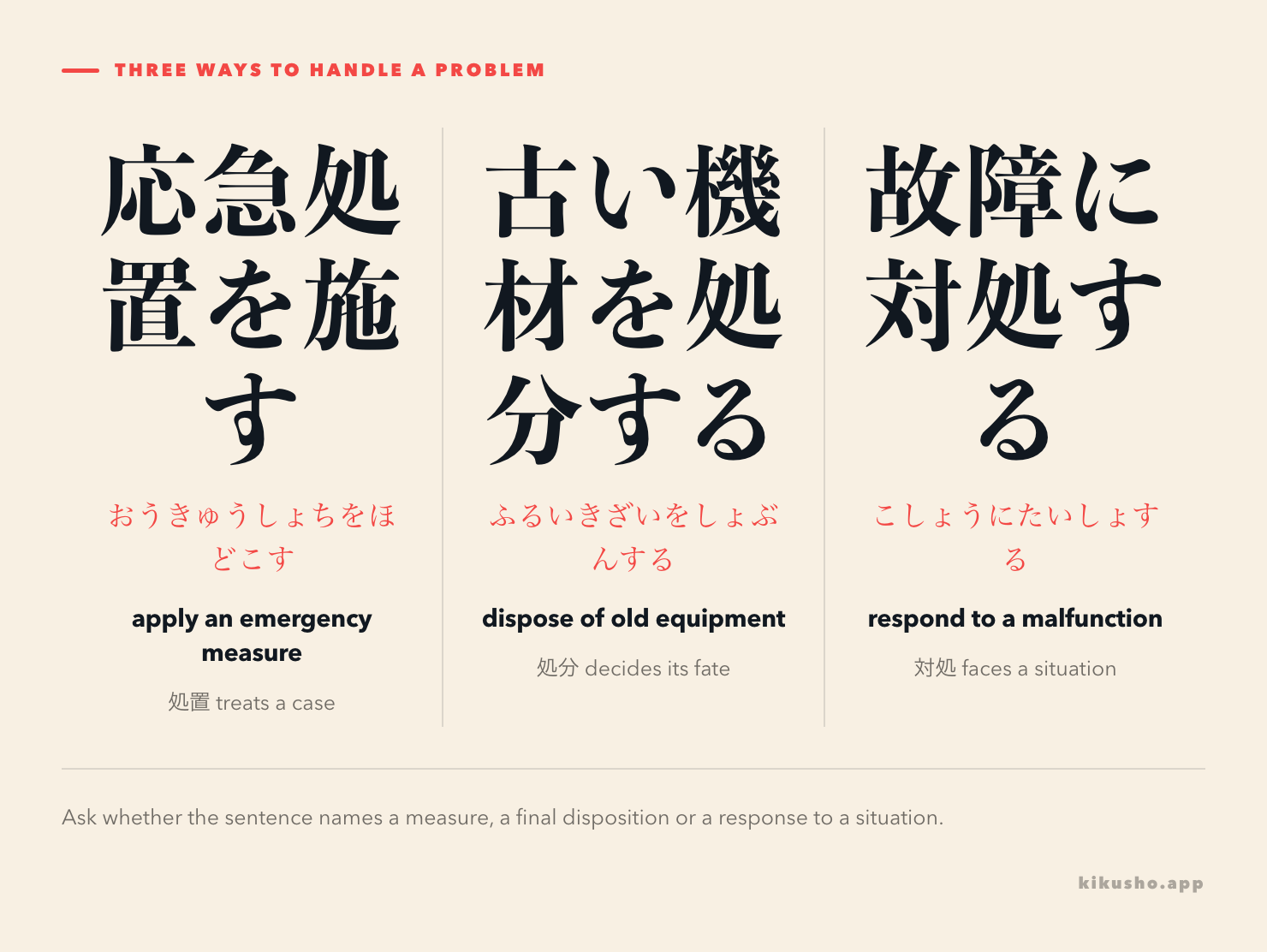
処置 treats a case, 処分 decides a fate, and 対処 faces a situation
The three words share 処, but they put attention in different places.
処置(しょち) names a concrete step chosen after judging a case. It is especially common for medical treatment and immediate measures: 傷を処置する, treat a wound; 応急処置を施す, administer first aid; 適切な処置を取る, take appropriate action. The object is the case being treated, or 処置 itself combines with する・施す・取る.
作業員は水漏れを止め、ぬれた資料に応急処置を施した。
さぎょういんは みずもれを とめ、ぬれた しりょうに おうきゅうしょちを ほどこした。
The workers stopped the leak and applied emergency treatment to the wet materials.
処分(しょぶん) decides what happens to something that cannot remain as it is. With objects, it often means discarding, selling or otherwise disposing of them: 古い機材を処分する. With a person under rules, it means an official penalty: 違反した職員を処分する or 懲戒処分を受ける. The word does not simply mean “deal with” whenever a problem appears.
再利用できない梱包材は、規則に従って処分した。
さいりようできない こんぽうざいは、きそくに したがって しょぶんした。
Packaging material that could not be reused was disposed of according to the rules.
対処(たいしょ)する describes responding to a situation with suitable action. The situation normally takes に: 事故に対処する, deal with an accident; 苦情に対処する, address a complaint; 変化に柔軟に対処する, respond flexibly to change. It can include several individual measures and does not promise that the underlying problem has been permanently solved.
担当者は状況を確認し、設備の故障に冷静に対処した。
たんとうしゃは じょうきょうを かくにんし、せつびの こしょうに れいせいに たいしょした。
The person in charge assessed the situation and dealt calmly with the equipment failure.
Shogakukan's usage note separates disposal and punishment under 処分 from the more immediate treatment of a person or case under 処置. Its 処置 entry includes both situational measures and medical care, while 対処 explicitly responds to changing circumstances.
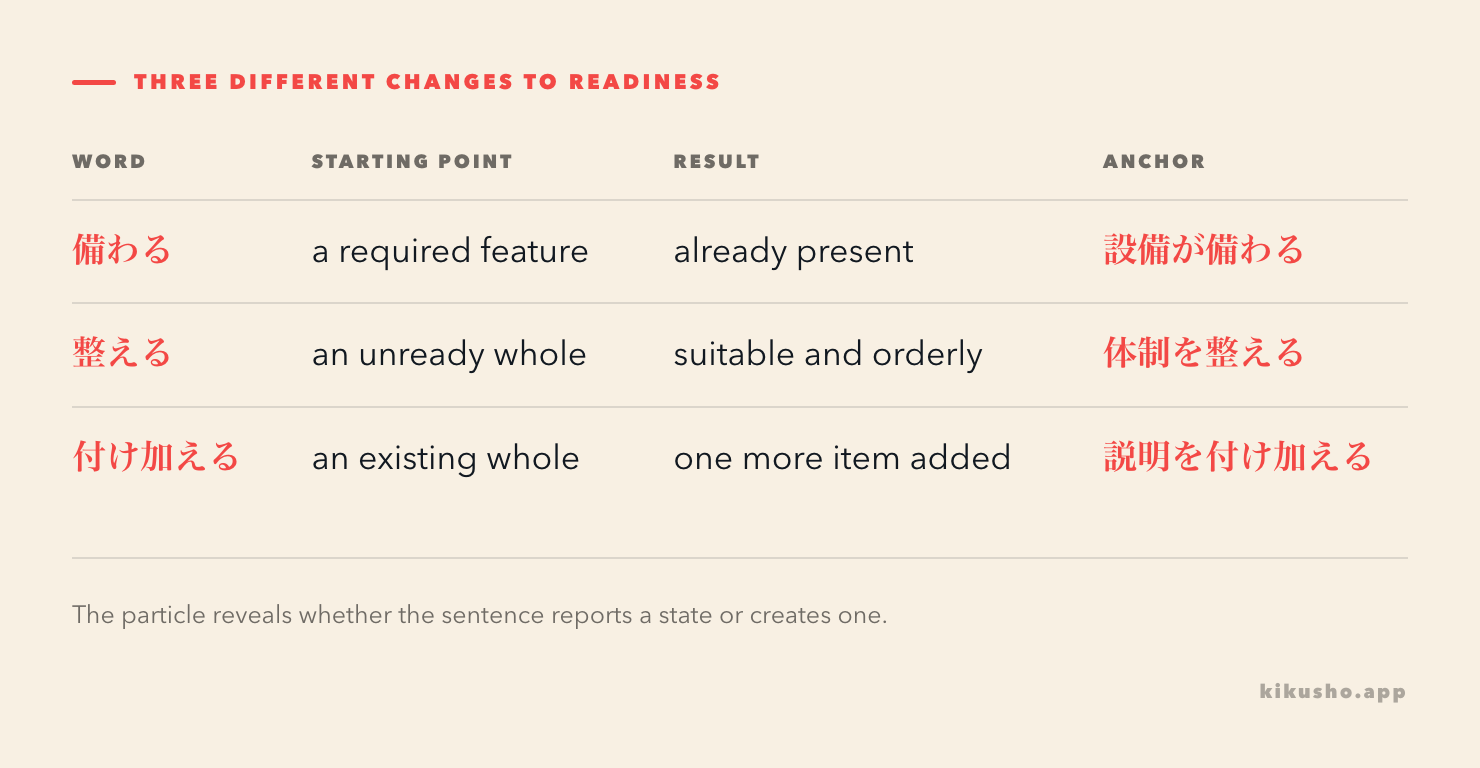
備わる reports readiness; 整える creates it
備わる(そなわる) is intransitive. Necessary equipment, conditions or qualities take が and are already present in a place or person.
- 会議室には通訳設備が備わっている: the meeting room is equipped with interpreting facilities
- 彼女には判断力が備わっている: she possesses sound judgement
- 必要な機能が備わった装置: a device furnished with the required functions
The subject is what exists, not the person who installed it. This is the result-side partner worth comparing with N3 備える, which can actively equip a place or prepare for a risk.
整える(ととのえる) is transitive. An agent brings an object into a suitable, orderly or ready condition: 体制を整える, establish a working structure; 環境を整える, prepare the environment; 呼吸を整える, steady one's breathing; 身なりを整える, make one's appearance neat. The verb does not necessarily add new material. It makes the whole fit its purpose.
非常用の設備は備わっていたが、職員は連絡体制を整える必要があった。
ひじょうようの せつびは そなわっていたが、しょくいんは れんらくたいせいを ととのえる ひつようが あった。
Emergency equipment was available, but the staff still had to put a communication system in place.
Shogakukan records both equipment being available and a quality being possessed under 備わる. Its 整える entry covers putting things in order, making preparations and adjusting something to a desirable state. The N3 preparation lesson teaches transitive 備える and the broader organisation verbs 整理する and まとめる.
付け加える adds after a whole already exists
付け加える(つけくわえる) presupposes something already present, then adds another item, condition, explanation or remark to it. Frequent objects include 説明・条件・注意・一言・意見.
責任者は手順を説明したあと、避難経路について注意を付け加えた。
せきにんしゃは てじゅんを せつめいした あと、ひなんけいろについて ちゅういを つけくわえた。
After explaining the procedure, the manager added a warning about the evacuation route.
Plain 加える has a wider range: it can add an ingredient, include a member, increase speed or inflict damage. 付け加える narrows the image to adding something further to an existing whole, particularly words or information. The dictionary definition centres on attaching another element to something that already exists.
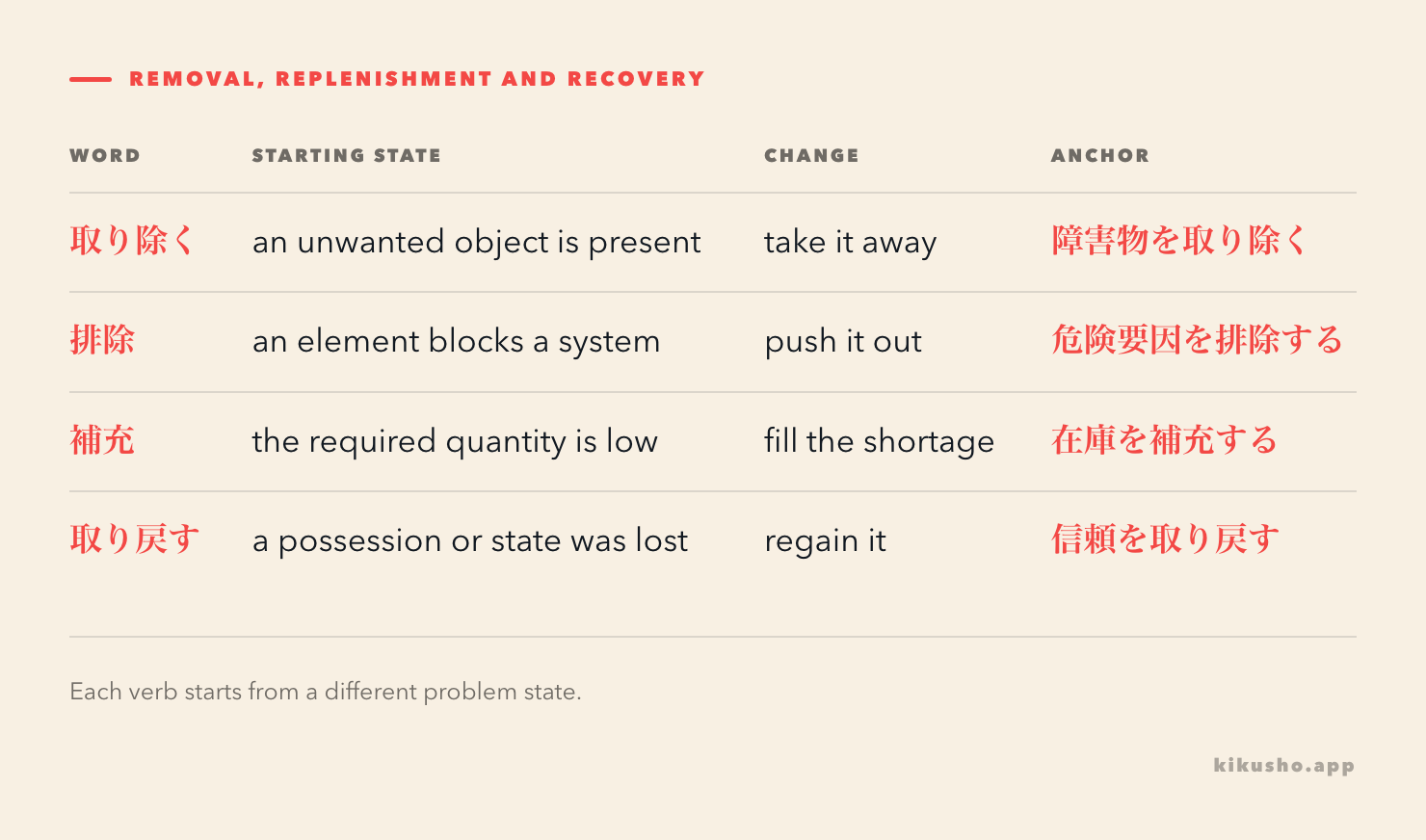
取り除く removes an obstacle; 排除 pushes something out
取り除く(とりのぞく) is the flexible transitive verb for taking away an unwanted thing. The object may be physical or abstract.
- 機械から異物を取り除く: remove foreign matter from a machine
- 通路の障害物を取り除く: remove an obstruction from a passage
- 不安を取り除く: relieve anxiety
- 誤解を取り除く: clear up a misunderstanding
排除(はいじょ)する presents an element as pushed out or excluded from a place, group, process or system. It is common in policy, safety and social discussion: 危険要因を排除する, eliminate risk factors; 不正を市場から排除する, drive misconduct out of the market; 少数派を排除する, exclude a minority.
技術者は配管から異物を取り除き、再発につながる危険要因も排除した。
ぎじゅつしゃは はいかんから いぶつを とりのぞき、さいはつに つながる きけんよういんも はいじょした。
The technician removed foreign matter from the pipe and eliminated the risk factors that could cause a recurrence.
The actions can describe the same event from different angles. バリケードを取り除く pictures taking the obstruction away. バリケードを排除する presents it as a blocking force that is cleared. With people, 排除 can carry a strong social or political implication because membership or participation is denied. Shogakukan defines 排除 as pushing something aside until it is no longer there.
補充 fills a shortage; 取り戻す reverses a loss
補充(ほじゅう)する begins with a quantity below the required level and fills the gap. Natural objects include 在庫, stock; 燃料, fuel; 人員, personnel; 水分, fluids; and 用紙, paper.
使用した救急用品と飲料水をその日のうちに補充した。
しようした きゅうきゅうようひんと いんりょうすいを そのひの うちに ほじゅうした。
The used first-aid supplies and drinking water were replenished that same day.
取り戻す(とりもどす) starts with something previously possessed or a prior state, then marks its recovery. The object can be concrete, but advanced writing often uses abstract combinations: 意識を取り戻す, regain consciousness; 落ち着きを取り戻す, regain composure; 信頼を取り戻す, regain trust; 主導権を取り戻す, regain the initiative.
施設は原因と改善策を公表し、利用者の信頼を取り戻そうとした。
しせつは げんいんと かいぜんさくを こうひょうし、りようしゃの しんらいを とりもどそうとした。
The facility disclosed the cause and corrective measures and tried to regain users' trust.
補充 restores a required amount by adding replacements. 取り戻す recovers the thing or state that was lost. Buying more paper is 用紙を補充する; recovering public confidence is 信頼を取り戻す. The dictionary entries define 補充 through filling a shortage and 取り戻す through regaining something or returning to a former state.
One archive emergency uses all ten records
公文書館には非常用の排水設備が備わっていた。漏水が発生すると、職員は状況に対処し、ぬれた資料に応急処置を施した。通路から障害物を取り除き、再発の危険を排除してから、保管環境と連絡体制を整えた。再利用できない資材は処分し、不足した救急用品を補充した。責任者は報告書に再発防止策を付け加え、利用者の信頼を取り戻すために調査結果を公表した。
The archive already has equipment, so 備わる reports an existing state. Staff 対処する the leak and apply an immediate 処置 to the documents. They 取り除く physical obstacles and 排除する a continuing risk. They 整える the environment and procedure, 処分する unusable material, 補充する depleted supplies, 付け加える information to the report and try to 取り戻す trust.
In Kikusho, save the noun and particle with each term. A card for “deal with” should retain 故障に対処する; a card for “equipped” should retain 設備が備わっている. The participant structure separates words that an English gloss collapses.
N1 is a study placement with substantial N2 overlap
For these ten spelling-and-reading records, Kikusho follows the N1 position retained in its September 2026 snapshot. The two licensed input files descend from the same Waller/Tanos lineage, so agreement between them is one historical judgement rather than two independent confirmations. JapaneseTest4You also indexes several headwords under N1, although the origin of its complete list has not been established.
Current Bunpro pages agree on N1 for 処分・付け加える・整える, but place 処置・備わる・取り除く・取り戻す・排除・補充 at N2. 対処 has no corresponding classified Bunpro headword page in the pages reviewed. These placements do not change the ten-record curriculum scope; they show that several words are reasonable N2 prerequisites whose formal contrasts remain useful in an N1 set.
The exam owners explain in the official JLPT FAQ that they chose not to issue fixed vocabulary, kanji and grammar catalogues for the redesigned test. Treat N1 here as the inventory location, then learn the participant roles and collocations that an actual usage question can test.
Practice: decide what changes
Answer all ten questions before opening the explanations.
1 · First-column kanji. Select the pronunciation of 処置.
- イ. しょち
- ロ. しょじ
- ハ. しょうち
- ニ. そち
2 · Situation and particle. Complete: 担当者は予期しない故障__冷静に対処した。
- イ. を
- ロ. が
- ハ. に
- ニ. で
3 · Immediate treatment. A conservator stabilises a wet document before full restoration. Which phrase best describes that first step?
- イ. 応急処置を施す
- ロ. 資料を処分する
- ハ. 信頼を取り戻す
- ニ. 人員を補充する
4 · Disposal or punishment. Which sentence naturally means “The employee received disciplinary action”?
- イ. 職員が設備を備わった。
- ロ. 職員が懲戒処分を受けた。
- ハ. 職員が説明に取り戻した。
- ニ. 職員が在庫を排除した。
5 · Existing equipment. Choose the grammatically natural sentence.
- イ. 会議室が通訳設備を備わっている。
- ロ. 会議室には通訳設備が備わっている。
- ハ. 会議室に通訳設備を備わっている。
- ニ. 会議室の通訳設備に備わっている。
6 · Ready state. A company establishes a support structure before launching a service. Which phrase fits?
- イ. 支援体制を整える
- ロ. 支援体制を取り戻す
- ハ. 支援体制に処分する
- ニ. 支援体制が付け加える
7 · Later addition. The report is complete, but the author adds one cautionary note. Which verb is most precise?
- イ. 備わる
- ロ. 付け加える
- ハ. 排除する
- ニ. 取り戻す
8 · Removal or exclusion. Which pairing best preserves the two viewpoints?
- イ. 配管から異物を取り除く / 組織から反対者を排除する
- ロ. 配管に異物を取り戻す / 組織を反対者に補充する
- ハ. 配管が異物を備わる / 組織から反対者を整える
- ニ. 配管を異物に対処する / 組織が反対者を付け加える
9 · Fill the shortage. Printer paper has run low. Which action directly restores the required quantity?
- イ. 用紙を処分する
- ロ. 用紙を補充する
- ハ. 用紙に対処する
- ニ. 用紙が備わる
10 · Restore a lost state. Complete: 事故のあと、会社は顧客の信頼を__ために情報を公開した。
- イ. 取り除く
- ロ. 処分する
- ハ. 取り戻す
- ニ. 補充する
Answers and explanations
Use the starting state and the participant marked by each particle to check the key.
イ, しょち. 処 is read しょ and 置 is read ち in this compound.
ハ, に. 対処する normally marks the situation being faced with に: 故障に対処する.
イ, 応急処置を施す. This is an immediate measure that protects the material before full treatment. 処分 would decide its disposal.
ロ. 懲戒処分 is disciplinary action, and the person subjected to it can 処分を受ける.
ロ. 備わる is intransitive. The available equipment takes が, while the location is framed with には.
イ, 支援体制を整える. An agent puts the system into a suitable state. The object therefore takes を.
ロ, 付け加える. The note is attached after an existing whole already exists.
イ. 取り除く takes an unwanted object away from a location. 排除 presents a person or element as excluded from a group or system.
ロ, 用紙を補充する. 補充 fills a measurable shortage with replacement stock.
ハ, 取り戻す. The company once had the trust, lost it after the accident and now seeks to regain it.
Common questions
What is the difference between 処置, 処分 and 対処?
処置 is a concrete measure or treatment chosen for a case, especially an immediate or medical one. 処分 decides the fate of an unwanted object or imposes an official penalty. 対処 means responding appropriately to a situation and normally marks that situation with に.
What is the difference between 取り除く and 排除?
取り除く describes taking an unwanted thing away from where it is, whether it is dust, an obstruction or anxiety. 排除 presents something or someone as being pushed out of a place, group or system and often sounds more forceful or institutional.
How are 備わる and 整える different?
備わる is intransitive and reports that equipment, conditions or qualities are already present: 設備が備わっている. 整える is transitive and says that an agent puts something into a suitable, orderly or ready state: 体制を整える.
Why do some of these N1 words appear on N2 lists?
The JLPT publishes no exhaustive current vocabulary list. Kikusho retains these ten records in its N1 inventory, while current Bunpro pages place several at N2. The lesson states that disagreement so N1 is understood as a study placement rather than an official boundary.