On this page
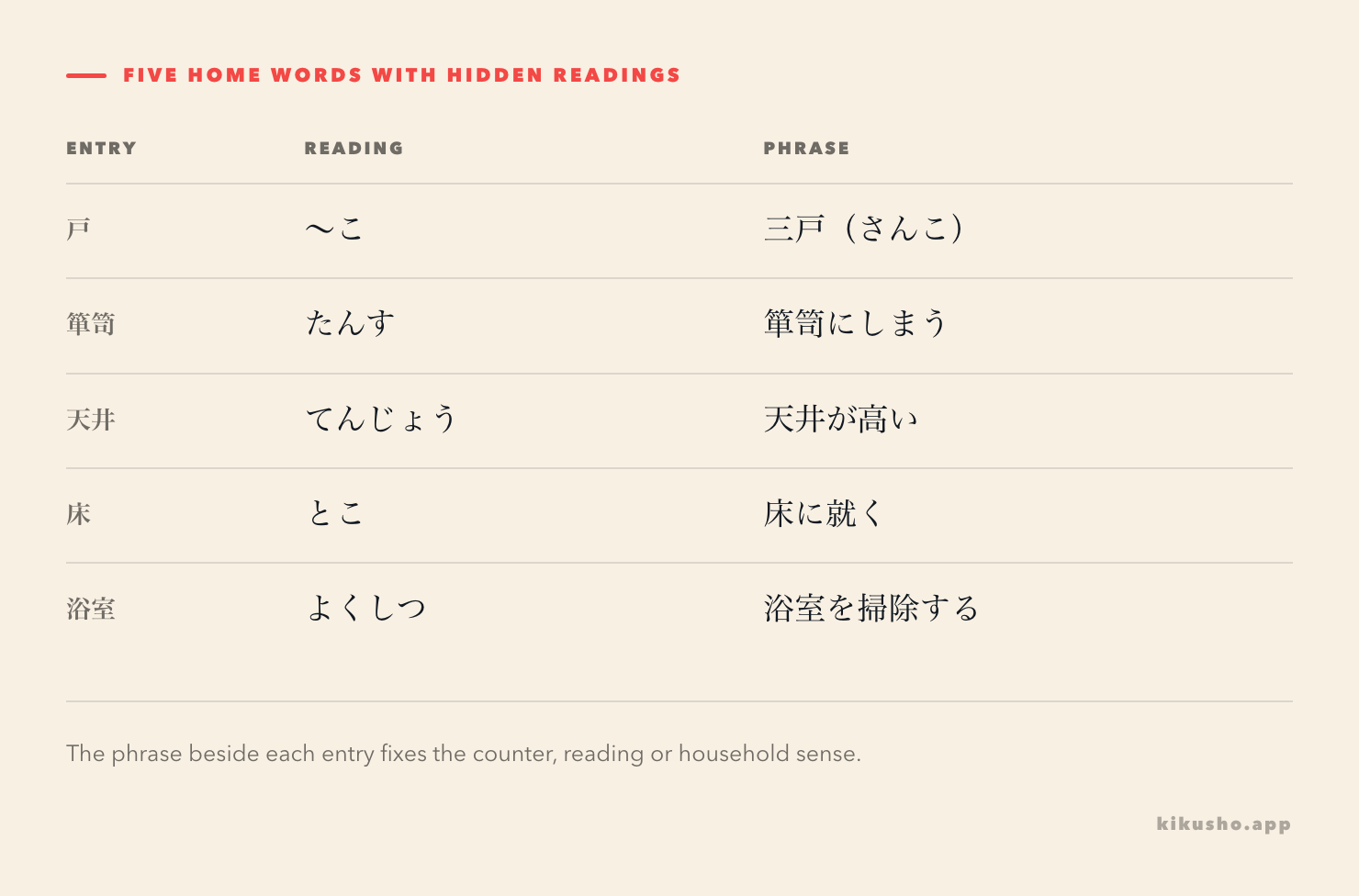
A property notice counts homes with 戸(こ), while a room description may mention a 箪笥(たんす), 天井(てんじょう), 床(とこ) or 浴室(よくしつ). These five entries look domestic, but their real difficulty lies in bound readings, overlapping household nouns and meanings that extend beyond the room.
The N2 household lesson supplies 家屋, 住居, 雨戸, 絨毯, 扇風機, 戸棚 and 枕. The N3 lesson owns 床(ゆか), the floor underfoot. Here 戸 is a counter, 床 is read とこ, and the other three entries add storage, the upper surface of a room and the room used for bathing.
Five entries connect listings, rooms and routines
| Entry | Reading | Grammar | Sense taught here | Phrase to retain |
|---|---|---|---|---|
| 戸 | ~こ | counter suffix | homes, households or housing units | 三戸(さんこ), three homes or units |
| 箪笥 | たんす | noun | chest of drawers, dresser or storage cabinet | 箪笥に衣類をしまう, store clothes in a chest |
| 天井 | てんじょう | noun | ceiling; figurative upper limit | 天井が高い, have a high ceiling |
| 床 | とこ | noun | bedding, bed or sleeping place; alcove in compounds | 床に就く, go to bed |
| 浴室 | よくしつ | noun | room used for bathing | 浴室を掃除する, clean the bathroom |
Each item answers a different question. 戸 states how many dwellings a report covers. 箪笥 identifies storage furniture. 天井 closes the room above, 床(とこ) establishes a place to sleep, and 浴室 names the bathing room rather than the tub inside it.
戸 is a housing counter when it is read こ
The assigned 戸(こ) does not independently mean “door.” It is a suffix attached to a number to count houses, households and individual units in an apartment building. It appears frequently in property descriptions, population statistics, utility notices and disaster reports.
このマンションには全部で三十戸あります。
This apartment building has thirty units in total.
大雨の影響で、約五百戸が停電しました。
About five hundred homes lost power because of the heavy rain.
The Japan Foundation's teaching material on counters gives 家一軒・一戸 and reads 一戸 as いっこ. The pattern follows the familiar こ sound changes:
| Quantity | Reading | Example use |
|---|---|---|
| 一戸 | いっこ | 一戸建て, detached house |
| 三戸 | さんこ | 三戸を所有する, own three units |
| 六戸 | ろっこ | 六戸の住宅, six homes |
| 八戸 | はっこ | 八戸に配布する, distribute to eight homes |
| 何戸 | なんこ | 何戸ありますか, how many units are there? |
Other counters frame buildings differently. 軒(けん) often counts separate houses, shops or buildings, while 棟(とう) counts whole structures. In a ten-storey building, 一棟 is the building and 三十戸 can be the thirty dwellings inside it.
The kanji also has the native reading と in words such as 雨戸(あまど) and 戸棚(とだな). A number immediately before 戸 and a housing quantity immediately after it are strong signals for こ.
箪笥 stores clothing behind drawers or doors
箪笥(たんす) is a chest, dresser or storage cabinet, traditionally wooden and used especially for clothes and personal items. Digital Daijisen describes furniture made with drawers or cabinet doors for storing clothing and accessories.
冬物の衣類は二階の箪笥にしまってあります。
The winter clothes have been stored in the chest upstairs.
Useful compounds narrow the furniture: 整理箪笥 is a chest of drawers, 洋服箪笥 is a wardrobe for hanging Western-style clothing, and 茶箪笥 stores tea utensils or tableware. 箪笥の引き出し identifies one drawer within the larger piece of furniture.
The N2 prerequisite 戸棚 is any cupboard or cabinet defined by shelves and front doors. 箪笥 more strongly evokes storage furniture for clothing or organised possessions and may combine drawers with doors. The border is not fixed by one English word, so attend to what is stored and how the furniture is built.
The spelling is a recognition problem of its own. Both kanji are uncommon, and たんす or タンス is ordinary in modern writing. Kanjipedia verifies the reading and defines the word as box-shaped furniture with drawers or hinged doors.
天井 is the surface above you and an upper limit
天井(てんじょう) first names the ceiling, the upper boundary of an interior space.
この部屋は天井が高く、昼間はとても明るい。
This room has a high ceiling and is very bright during the day.
Natural combinations include 天井を見上げる, look up at the ceiling; 天井に届く, reach the ceiling; and 天井から水が漏れる, water leaks from the ceiling. It is not 屋根(やね), the exterior roof that covers the building.
The physical position produces a figurative sense: the highest point, maximum or ceiling of a price or market. Kanjipedia's 天井 entry records both the room surface and the highest value of prices or a market.
株価は天井知らずの勢いで上がり続けた。
The share price kept rising as if there were no ceiling.
天井知らず means that no upper limit seems visible. The surrounding nouns decide whether 天井 is architectural or figurative: 部屋, 照明 and 水漏れ select the room; 株価, 相場 and 価格 select an upper limit.
床 changes from ゆか underfoot to とこ at bedtime
The character 床 has two household readings that cannot be recovered from the kanji alone. The familiar 床(ゆか) is a floor surface: 床を拭く, wipe the floor. The assigned entry 床(とこ) names bedding, a bed or a place prepared for sleep.
熱があったので、早めに床に就きました。
I had a fever, so I went to bed early.
床に就く(とこにつく) is more formal or literary than the everyday 寝る, but it remains useful in prose. 床を敷く means to lay out bedding, and 床を取る means to prepare or go to bed depending on context. Kanjipedia's 床(とこ) entry records bedding or a sleeping place and also the tatami core, a riverbed, a seedbed and the shortened architectural sense behind 床の間.
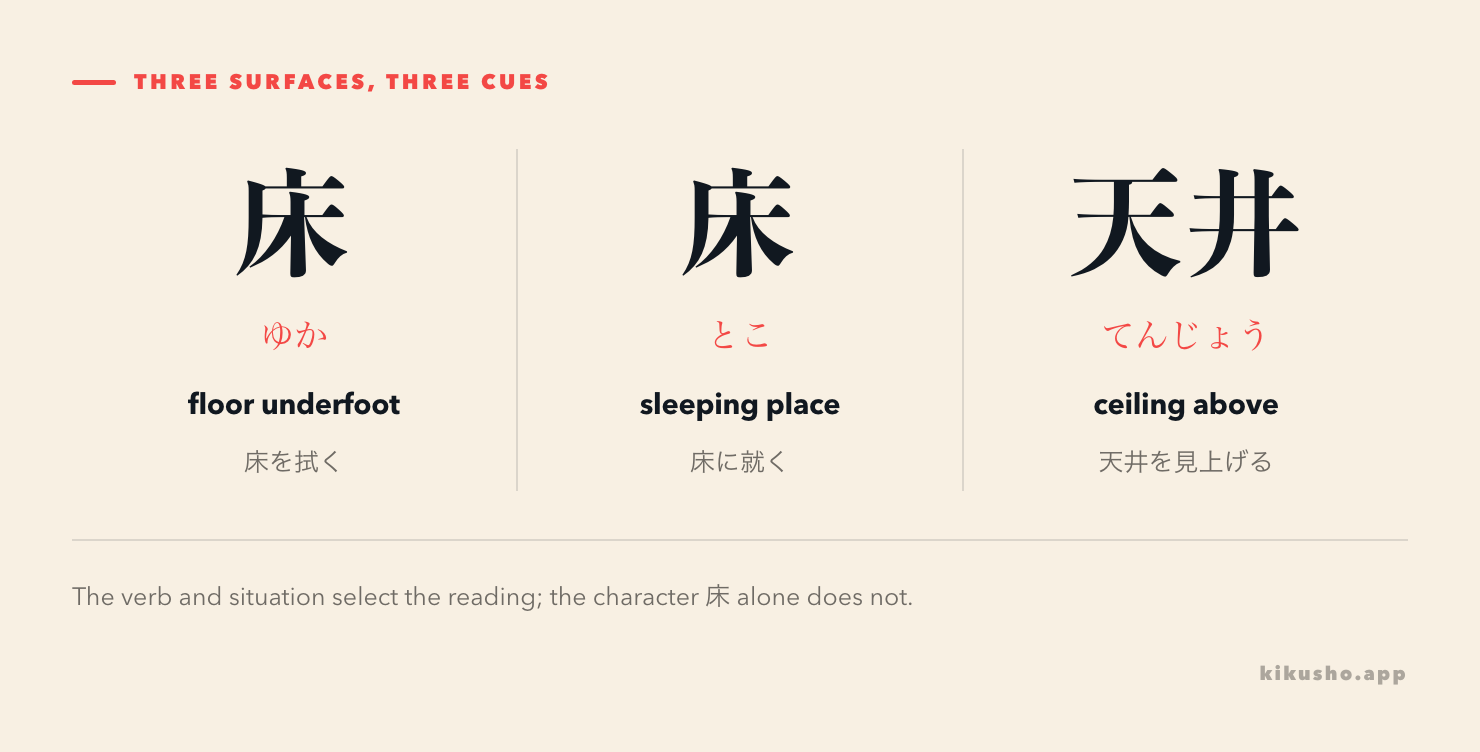
The contrast is visible in verbs:
- 床(ゆか)を掃除する: clean the floor
- 床(とこ)に就く: go to bed
- 寝床(ねどこ)にもぐる: crawl into bed
- 床の間(とこのま)に花を飾る: display flowers in the alcove
The inventory's comparison source lists 床(ゆか) at N3, while the N1 record is 床(とこ). That headword-only overlap is not evidence that one reading has two firm official levels. It is evidence that the reading and sense must remain attached to the record.
浴室 is the bathing room, not the tub
浴室(よくしつ) is a room used for bathing, normally the room containing the bath. The Japanese encyclopedia entry defines it as 入浴に使われる室 and gives 風呂場 and 湯殿 as related names.
浴室の床が滑りやすいので、気をつけてください。
The bathroom floor is slippery, so please be careful.
The room is 浴室; the tub is 浴槽(よくそう). You can therefore 浴室を掃除する, clean the bathing room, but 浴槽に湯を張る, fill the bathtub with hot water. Everyday speech often uses お風呂 for the bath, bathing or the bathing area, while 浴室 precisely identifies the room in property information, facility notices and equipment names such as 浴室乾燥機.
Do not map English “bathroom” directly to a toilet. In many Japanese homes, 浴室 and トイレ are separate rooms. The intended facility has to be named.
The N1 label has visible disagreements
Kikusho's reference inventory assigns these five spelling-reading records to N1 through a Waller-derived study list. The independent dictionary sources above verify the language, but dictionaries do not set JLPT boundaries. Bunpro currently places 床(とこ) at N1 while placing 戸(こ) and 箪笥 at N2. That disagreement fits the words themselves: several are ordinary household terms whose difficult spellings or less common readings do not form a clean proficiency boundary.
The official JLPT FAQ explains why the current test no longer publishes fixed specifications listing vocabulary, kanji and grammar items. Use N1 as the curriculum location for this five-item review, not as a claim that each word is exclusive to advanced Japanese.
A housing listing gives Kikusho enough context to keep 三十戸 separate from a door, while a sentence such as 床に就く preserves the とこ reading. Check the editable draft before saving, then let the full phrase return during offline review. For this set, the surrounding words are part of what you are learning.
Test the five entries without reading hints
Answer all eight questions before moving to the shared explanation block.
Question 1: read the furniture noun
How is 箪笥 read?
- ア. たんす
- イ. とだな
- ウ. だんし
- エ. たなす
Question 2: write the upper surface
Choose the standard spelling for てんじょう, “ceiling.”
- ア. 天状
- イ. 点上
- ウ. 天井
- エ. 転場
Question 3: read the housing count
How is 三戸 read when it means “three housing units”?
- ア. みと
- イ. さんど
- ウ. さんこ
- エ. みっけん
Question 4: identify the sleeping expression
What does 疲れていたので、早く床に就いた mean?
- ア. I was tired, so I repaired the floor early.
- イ. I was tired, so I went to bed early.
- ウ. I was tired, so I cleaned the bathroom early.
- エ. I was tired, so I looked at the ceiling early.
Question 5: choose the reading from context
How should 床 be read in 台所の床を拭いた?
- ア. しょう
- イ. とこ
- ウ. ゆか
- エ. どこ
Question 6: separate room from tub
Which sentence specifically says “I filled the bathtub with hot water”?
- ア. 浴室に湯を見上げた。
- イ. 浴槽に湯を張った。
- ウ. 天井に衣類をしまった。
- エ. 箪笥を入浴した。
Question 7: interpret the figurative ceiling
What does 株価が天井知らずの勢いで上がっている say?
- ア. The share price is rising with no apparent upper limit.
- イ. The ceiling of the exchange building is being raised.
- ウ. Three homes have lost power.
- エ. Furniture prices have been stored in a chest.
Question 8: choose the natural listing
A real-estate description says that one building contains forty housing units. Which sentence fits?
- ア. 一棟に四十戸あります。
- イ. 一戸に四十天井あります。
- ウ. 一浴室に四十棟あります。
- エ. 一箪笥に四十床あります。
Answers and explanations
Answer 1
ア, たんす. 箪笥 is the assigned spelling for a chest, dresser or storage cabinet. とだな is 戸棚, a cupboard; the other readings do not identify this word.
Answer 2
ウ, 天井. 天井 is read てんじょう and names a ceiling or figurative upper limit. The other choices imitate parts of the sound but are not the requested word.
Answer 3
ウ, さんこ. 戸 is the housing counter こ after the number. 軒 can also count houses, but 三軒 would be さんげん and is not the written expression shown.
Answer 4
イ. 床に就く reads とこにつく and means to go to bed. The adjective 疲れていた supplies a natural reason for sleeping; nothing in the sentence describes repair or cleaning.
Answer 5
ウ, ゆか. The kitchen surface is wiped, so 床 is the floor underfoot. The reading とこ belongs to bedding or a sleeping place in expressions such as 床に就く.
Answer 6
イ, 浴槽に湯を張った. 浴槽 is the bathtub, and 湯を張る means to fill it with hot water. 浴室 names the room and does not take 見上げる in this meaning.
Answer 7
ア. 天井知らず presents a rise whose upper limit cannot be seen. 株価 and 上がる select the market sense rather than the architectural ceiling.
Answer 8
ア, 一棟に四十戸あります. 棟 counts the one building, while 戸 counts the forty housing units inside it. The other choices count ceilings, buildings or sleeping places with nouns that do not fit the real-estate description.
Common questions
What does 戸 mean when it is read こ?
戸(こ) is a counter suffix for homes, households and individual housing units. 一戸 is いっこ, 三戸 is さんこ and 何戸 is なんこ. This bound counter is different from 戸(と), a door or sliding panel.
What is the difference between 床(とこ) and 床(ゆか)?
床(ゆか) is the floor surface underfoot. 床(とこ) can mean bedding or a sleeping place and appears in expressions such as 床に就く, go to bed. とこ also survives in words such as 寝床 and 床の間.
Is 箪笥 usually written in kanji?
箪笥 is read たんす and names a chest, dresser or storage cabinet, traditionally made of wood. The kanji are difficult and the word is also commonly written たんす or タンス.
Are all five entries officially JLPT N1 vocabulary?
No exhaustive official JLPT vocabulary list exists. Kikusho's Waller-based inventory places these five spelling-reading records at N1, while Bunpro places 戸(こ) and 箪笥 at N2 and 床(とこ) at N1. Treat the labels as study estimates and learn the readings and contexts themselves.