On this page
畳, 艘, 通, 滴 and 泊 specify the unit behind a quantity: tatami area, boats, written correspondence, liquid drops and overnight stays. To read them reliably, learn a useful noun phrase and its complete number reading together.
This is a bounded lesson in our N1 vocabulary sequence, revisiting five records placed at N2 by the Waller-derived inventory. The level tells you where a list filed them, not when your life will require them. A hotel booking can make 泊 useful before advanced study. The JLPT offers no official exhaustive vocabulary syllabus, and these five are neither exclusively N1 nor the final counters everyone needs.
These five identify a unit that the number cannot supply
Two letters, two sheets and two nights all contain “two”, but they describe different quantities. A generic object count loses the distinction you need in a booking or a written instruction. The specialist part is the field where the unit matters; it does not mean every word is obscure.
If number-plus-counter expressions are new to you, start with the general counter guide. For ordinary objects and the first irregular readings, continue with the twelve-noun counter lesson. Here the additional task is deciding what the quantity measures.
Each member needs a reading, a sense and a phrase
All five are counter suffixes in the uses below: they attach to a number. 畳 also has the standalone noun reading たたみ, meaning “tatami”; that is not the reading of this suffix. A kanji's other words do not determine its counter reading.
| Suffix | Base reading | Unit in this lesson | Phrase to retain |
|---|---|---|---|
| ~畳 | ~じょう | Tatami mats; room area expressed in tatami units | 六畳の和室(ろくじょうのわしつ): a six-tatami Japanese-style room |
| ~艘 | ~そう | Boats, especially small vessels | 一艘のボート(いっそうのボート): one boat |
| ~通 | ~つう | Letters, messages and written documents counted individually | メールを二通送る(メールをにつうおくる): send two emails |
| ~滴 | ~てき | Individual drops of liquid | しょうゆを三滴(しょうゆをさんてき): three drops of soy sauce |
| ~泊 | ~はく | Nights spent staying somewhere | 宿に二泊する(やどににはくする): stay two nights at an inn |
Mami Suzuki's Tofugu counter reference covers these five domains. Its “common” group includes 通 and 泊, which is a useful corrective to treating the whole set as rare technical vocabulary. For concrete applications, the Japanese counting dictionary verifies tatami and 一畳, rubber boats and 一艘, and soy sauce measured in drops.
Read each suffix in a complete sentence:
- この和室は六畳です。
このわしつはろくじょうです。
This Japanese-style room is six tatami units in area. - 湖でボートを一艘借りました。
みずうみでボートをいっそうかりました。
I rented one boat at the lake. - 返事のメールが二通届いた。
へんじのメールがにつうとどいた。
Two reply emails arrived. - 小皿にしょうゆを三滴落とした。
こざらにしょうゆをさんてきおとした。
I let three drops of soy sauce fall into a small dish. - 週末はこの宿に二泊します。
しゅうまつはこのやどににはくします。
I will stay at this inn for two nights over the weekend.
The first sentence describes area, rather than the number of rooms. The last describes the duration of one stay, rather than the number of accommodation buildings.
Read the number and suffix as one spoken chunk
The base reading is a starting point. 一 does not keep いち in every combination, and 泊 does not always begin with は. The small っ in いっそう, いっつう and いってき represents a consonant closure; it is not another syllable to pronounce as tsu.
| Unit | One | Two | Three |
|---|---|---|---|
| 畳 | 一畳(いちじょう) | 二畳(にじょう) | 三畳(さんじょう) |
| 艘 | 一艘(いっそう) | 二艘(にそう) | 三艘(さんそう) |
| 通 | 一通(いっつう) | 二通(につう) | 三通(さんつう) |
| 滴 | 一滴(いってき) | 二滴(にてき) | 三滴(さんてき) |
| 泊 | 一泊(いっぱく) | 二泊(にはく) | 三泊(さんぱく) |
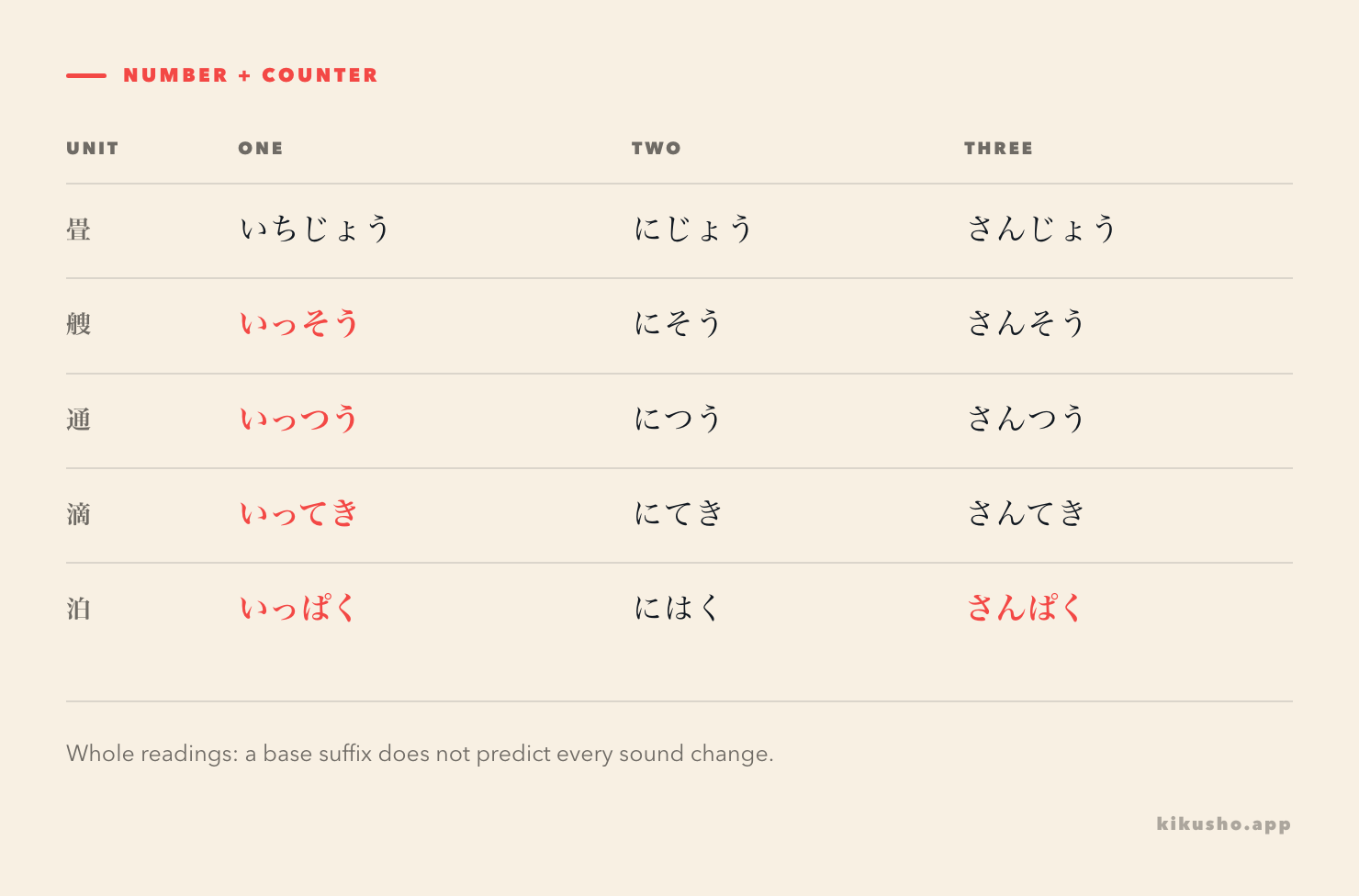
The University of Texas JOSHU charts, by Naoko Suito, verify the 通 and 泊 sequences. Independently, IMABI's second Sino-Japanese counter lesson gives those readings and documents variants for some larger numbers. Its intermediate counter lesson supplies the 滴 series. The Japanese pronunciation reference corroborates the 畳 and 艘 rows.
The table selects ordinary readings rather than cataloguing every variant. Do not extend a sound change from one counter to every suffix beginning with the same letter. In particular, retain 三泊 as さんぱく; remembering 三本 as さんぼん does not give you the vowel or consonant for a different word.
The main traps change what you are counting
Tatami area is different from counting rooms
六畳の和室 says how large the room is in tatami units. It does not mean there are six Japanese-style rooms. When talking about the mats themselves, the Japanese counting dictionary also gives 枚: 畳を一枚 means one tatami mat. The noun is たたみ; the counter in 一畳 is じょう.
An area label is useful for comparing room descriptions. If you need exact dimensions, read the measurements supplied for that particular room; this lesson does not convert the label into square metres.
A written message is different from its sheets
A letter with several pages remains one letter. 通 follows the correspondence unit, while 枚 follows the paper. The distinction also explains why an email can take 通 without having a physical sheet at all. Both IMABI and Tofugu include email in this counter's uses.
A written document can have a 通 count too. This does not make 通 a universal counter for every text: a book counted as a bound volume still belongs to the basic 冊 lesson. Choose the object being quantified, rather than merely noticing writing somewhere on it.
Overnight stays are different from trip days
一泊二日(いっぱくふつか)describes one overnight stay over two days. 二泊三日(にはくみっか)describes two nights over three days. The first quantity counts the nights away; the second names the days included in that itinerary.
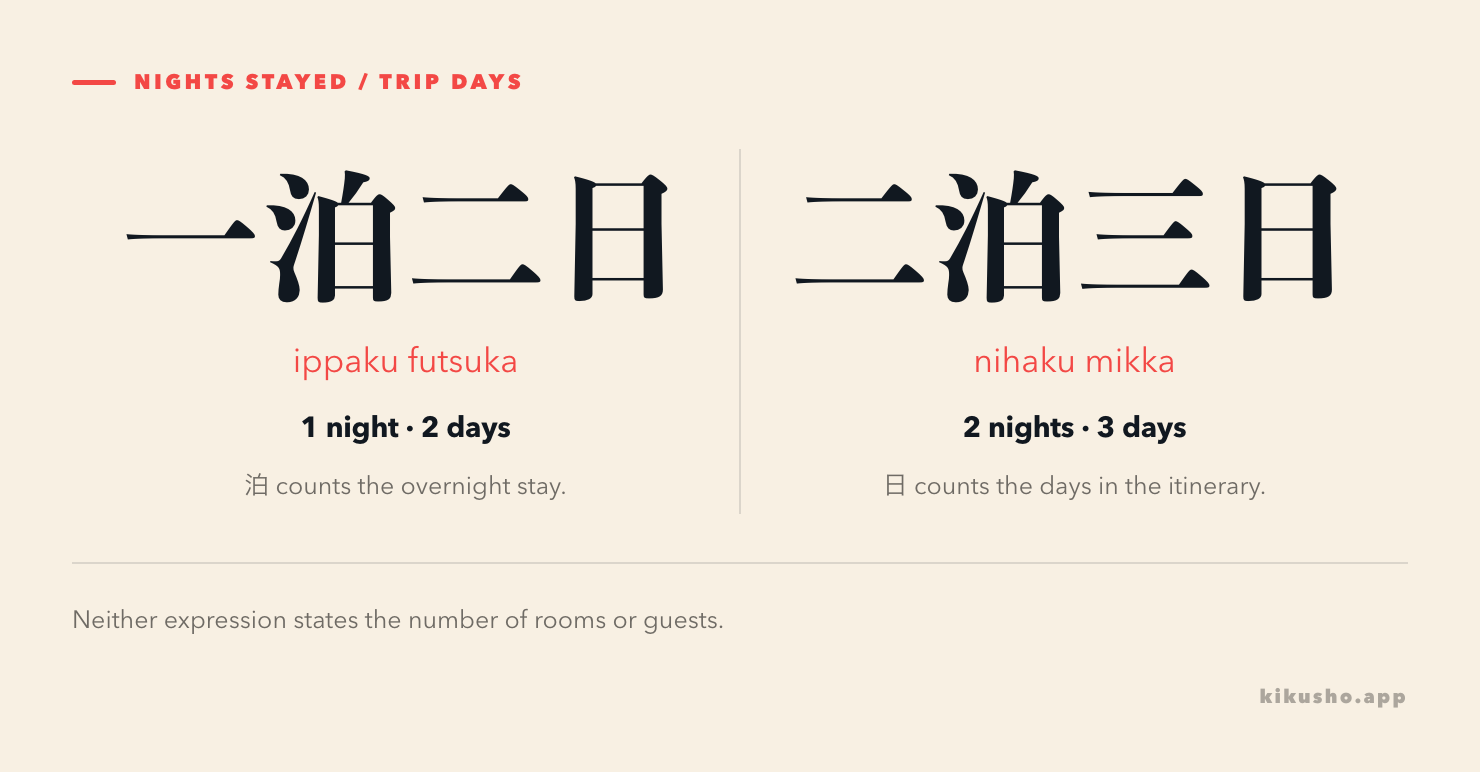
A room, a night and a guest are separate quantities. 二泊 alone does not tell you how many rooms were reserved or how many people travelled.
The other two distinctions are smaller but worth keeping precise. 艘 is a natural choice for the small boats used here; 隻 is also a vessel counter, especially familiar with larger ships. The counting dictionary allows both for sailboats, so size is a useful tendency rather than an absolute prohibition. 滴 names a droplet; it does not name the bottle containing the liquid. Count the unit requested by the instruction.
Your next encounter decides which phrase deserves review
A room description gives you 畳; an overnight reservation gives you 泊; correspondence gives you 通. Keep 艘 with the boat activity and 滴 with the liquid quantity. None needs to wait for a particular examination level before becoming useful.
For a counter you encounter in an email or listing, Kikusho's text capture can turn that phrase into a card with a reading and an example. Retain the noun and quantity together in your example, so the next review asks about the unit rather than an isolated character. The N1 collocation lesson develops the same habit of studying words with the verbs they take.
Practice questions
These six exercises are original. Attempt the full group before scrolling to the shared answer section. The tasks practise kanji reading, meaning in context, paraphrase and usage; a short group cannot establish exam readiness.
Question 1
Read the underlined quantity: 湖でボートを一艘借りた。
A. いちそう
B. いっそう
C. いっつう
D. いちじょう
Question 2
Which reading belongs to 三泊 in a hotel itinerary?
A. さんつう
B. さんてき
C. さんぱく
D. さんじょう
Question 3
Complete the room description with the counter that expresses its area:
この和室の広さは六( )です。
A. 泊
B. 通
C. 艘
D. 畳
Question 4
Choose the statement that preserves the quantities in this sentence. 便箋(べんせん)means writing paper.
三枚の便箋を使って、手紙を一通書いた。
A. 手紙は一通で、使った便箋は三枚だった。
B. 手紙は三通で、使った便箋は一枚だった。
C. 手紙は一通で、使った便箋は一枚だった。
D. 手紙は三通で、使った便箋は三枚だった。
Question 5
Which sentence uses 滴 for a literal droplet of liquid?
A. 旅館に一滴泊まった。
B. 皿にしょうゆを一滴落とした。
C. 湖でボートを一滴借りた。
D. 友人から一滴の手紙が届いた。
Question 6
A travel plan is labelled 二泊三日. Which description matches that label?
A. Three nights away, covering two trip days.
B. Two accommodation buildings, visited over three days.
C. Two nights away, covering three trip days.
D. Three rooms reserved for a two-day journey.
Answers and explanations
Answer 1
B: いっそう. 一艘 combines the number with the boat counter as one chunk, including small っ. A keeps an uncontracted いち where this expression contracts. C is 一通, while D is 一畳; neither reading belongs to 艘.
Answer 2
C: さんぱく. 三泊 counts three nights of a stay. The other readings belong to 三通, 三滴 and 三畳 respectively. The はく base form does not mean every numbered expression preserves は.
Answer 3
D: 畳. The sentence explicitly asks about 和室の広さ, the room's area. 六畳 is read ろくじょう. 泊 would count overnight stays, 通 written correspondence, and 艘 boats. Those are different units even though each can follow a number.
Answer 4
A. The writer used three sheets to write one letter. 通 identifies the letter; 枚 identifies the paper. B reverses both quantities, C reduces the paper count, and D increases the letter count. Several sheets do not automatically become several letters.
Answer 5
B. しょうゆ is a liquid and 一滴(いってき)counts one drop. The dish is where that drop lands. A needs a quantity of overnight stays, C a boat quantity, and D a letter quantity. Those alternatives do not use 滴 in the requested literal sense.
Answer 6
C. Read 二泊三日 as にはくみっか: two nights staying away, with three days included in the trip. A swaps nights and days. B makes 泊 count buildings, and D introduces a room count absent from the label. When you annotate your next booking, write the night count and day count on separate lines; that preserves the information the two suffixes supplied.
Common questions
Are these five Japanese counters exclusive to N1?
No. This lesson sits in our N1 vocabulary study sequence, but the Waller-derived reference inventory places all five at N2. They can be useful much earlier when you book accommodation or read room descriptions. There is no official exhaustive JLPT vocabulary syllabus.
Can a room be described with 畳 even when I am not counting loose mats?
Yes. 畳, read じょう after a number, expresses room area in tatami units as well as counting tatami. The standalone word 畳 is read たたみ. For exact dimensions, use the measurements supplied for the particular room.
Does 通 count the pages in a letter?
通 counts letters or written messages as units. 枚 counts their individual sheets of paper. A letter can therefore be one 通 even when it contains several 枚. Both quantities can appear in the same description.