On this page
家屋(かおく) and 住居(じゅうきょ) describe a home at different levels: one foregrounds the physical building, while the other foregrounds the place where someone lives. Five concrete nouns complete this N2 home set: 雨戸(あまど), 絨毯(じゅうたん), 扇風機(せんぷうき), 戸棚(とだな) and 枕(まくら).
The N4 household lesson supplies words such as 壁, 棚, 布団, 冷房 and 暖房. The N3 lesson then adds 住宅, 屋根, 床, 家具 and 毛布. Those words remain prerequisites here. This lesson concentrates on the seven assigned N2 entries and the distinctions that make them useful in property notices, weather preparation and ordinary routines at home.
The N1 continuation adds the housing counter 戸(こ), 箪笥, 天井, 床(とこ) and 浴室. It also separates the とこ reading of 床 from the prerequisite ゆか reading taught at N3.
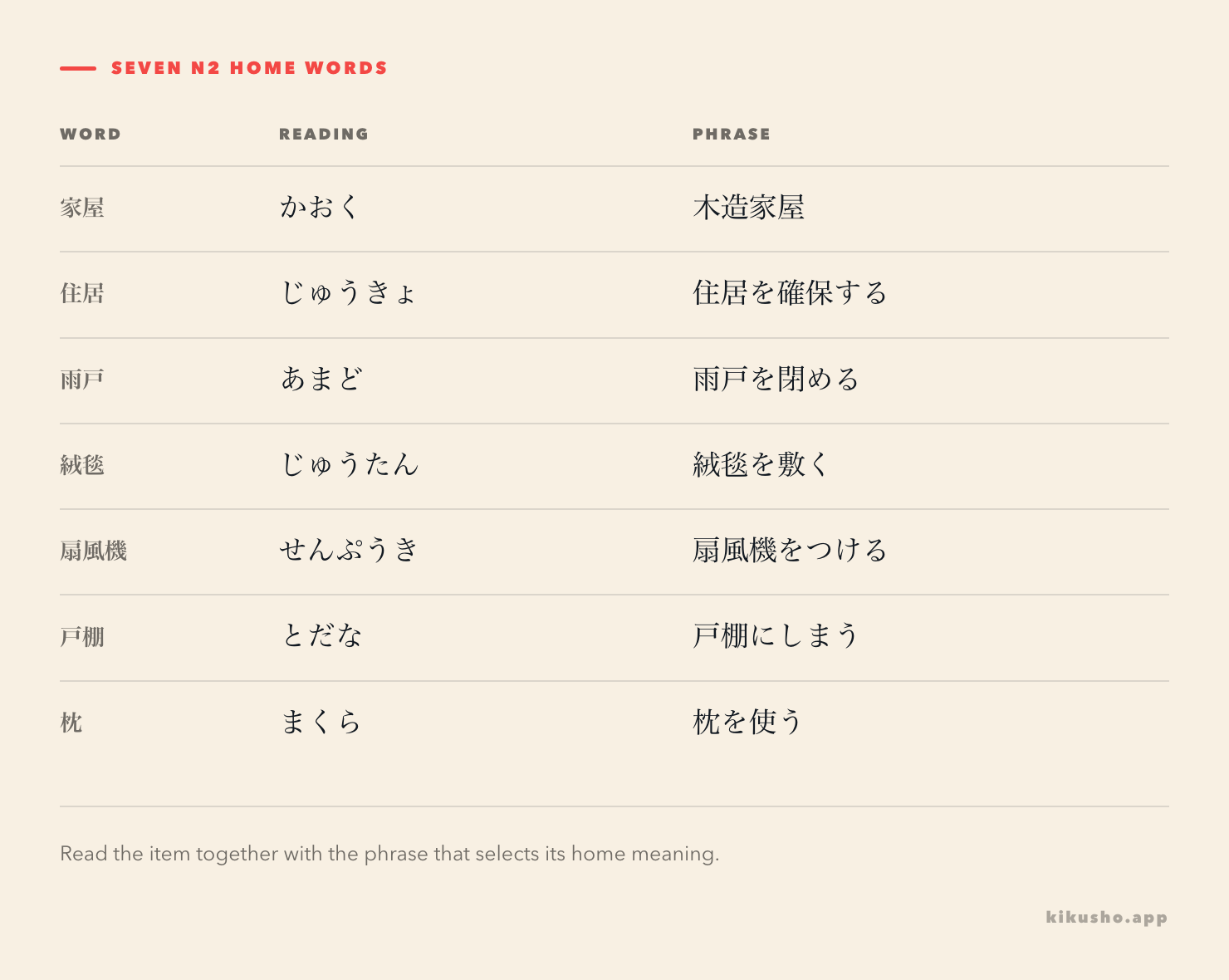
Seven words move from the building to daily comfort
| Scale | Word | Reading | Sense taught here | Useful combination |
|---|---|---|---|---|
| Physical building | 家屋 | かおく | house or building, viewed as a structure | 木造家屋, wooden house or building |
| Living place | 住居 | じゅうきょ | dwelling, residence, place where one lives | 住居を確保する, secure housing |
| Exterior opening | 雨戸 | あまど | exterior storm shutter | 雨戸を閉める, close the shutters |
| Floor covering | 絨毯 | じゅうたん | carpet or rug | 絨毯を敷く, lay a carpet |
| Air-moving appliance | 扇風機 | せんぷうき | electric fan | 扇風機をつける, turn on a fan |
| Enclosed storage | 戸棚 | とだな | cupboard or cabinet with doors | 戸棚にしまう, put away in a cupboard |
| Head support | 枕 | まくら | pillow | 枕を使う, use a pillow |
The sequence gives each item a place. 家屋 and 住居 name the whole setting. 雨戸 protects an opening from outside. 絨毯, 扇風機 and 戸棚 shape the room inside, and 枕 is the personal object used when resting.
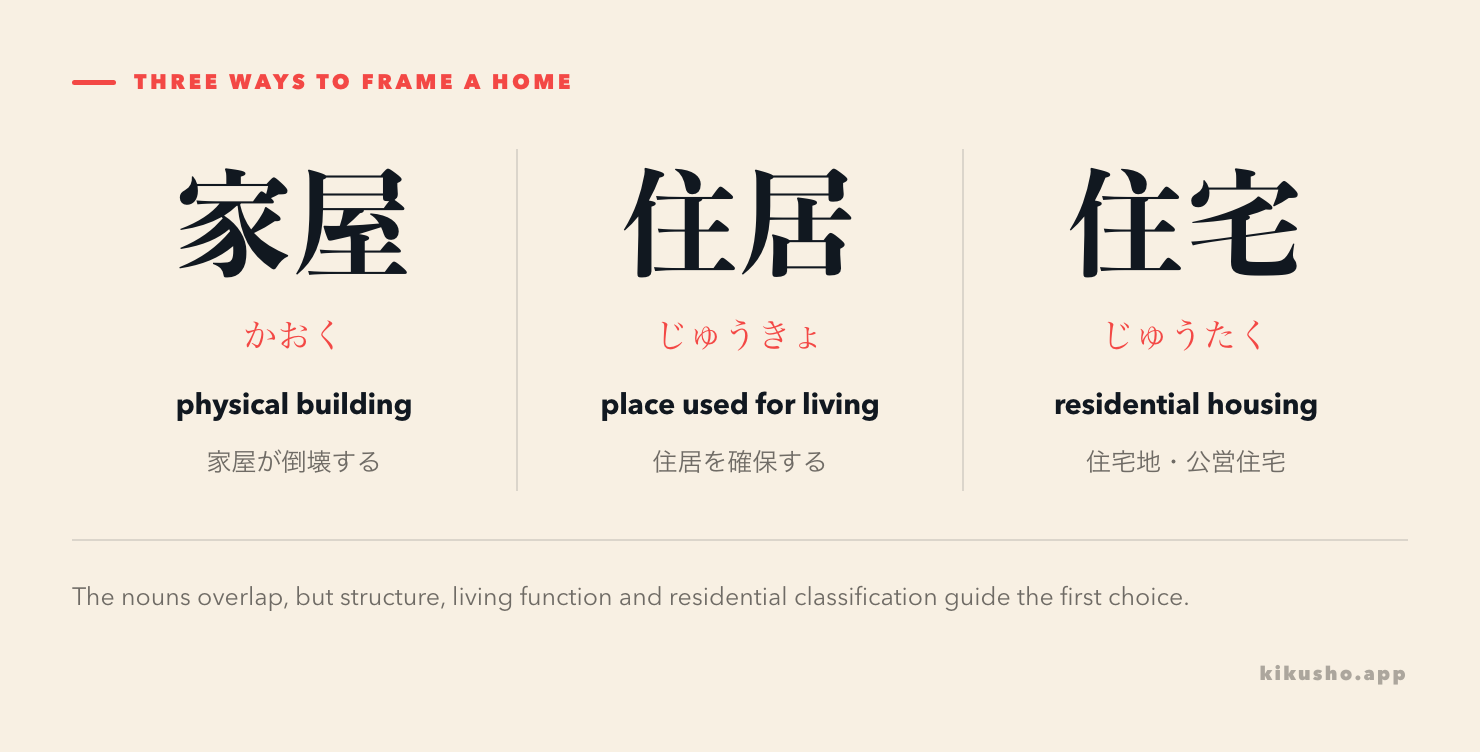
家屋 is the structure; 住居 is the place for living
家屋(かおく) directs attention to a building as a physical object. It is common in formal or written settings such as insurance documents, property surveys and reports of storm or earthquake damage.
強い地震で多くの家屋が倒壊しました。
Many houses collapsed in the strong earthquake.
木造家屋 classifies a building by its construction, and 家屋を調査する treats the building as something to inspect. The word is broader in legal and dictionary use than the English “home”: Goo Dictionary's 家屋 entry notes that it can cover buildings such as shops, factories and warehouses. In this assigned vocabulary record, “house; building” is the relevant core.
住居(じゅうきょ) instead names a place used for human life, or a person's place of residence. Its focus is functional: someone lives there.
転勤する社員のために、会社が住居を用意しました。
The company arranged housing for the employee who was being transferred.
Natural combinations include 住居を構える, establish a residence, 住居を移す, move one's residence, and 住居を確保する, secure housing. Digital Daijisen's 住居 entry explicitly distinguishes the living-space function from the building alone.
The prerequisite 住宅(じゅうたく) overlaps with both. It commonly classifies a house or housing intended for residential use, as in 住宅地 and 公営住宅. A useful first choice is therefore:
- report on damage to a physical building: 家屋
- talk about someone's dwelling or place to live: 住居
- classify residential housing or a housing type: 住宅
These are tendencies rather than three sealed boxes. Context and established compounds still decide the natural word.
雨戸 protects an opening from outside
雨戸(あまど) is an exterior shutter fitted outside a window, veranda opening or similar part of a house. It can be closed against severe weather and for security.
台風が近づいていたので、寝る前に雨戸を閉めました。
A typhoon was approaching, so I closed the storm shutters before going to bed.
The basic pair is 雨戸を開ける/閉める. The Japan Sash Manufacturers Association describes 雨戸 as panels outside an opening that are moved out from storage when used; Digital Daijisen also records protection from wind and rain and prevention of intrusion.
Do not translate the characters mechanically as a door used only when it rains. In a sentence about a typhoon, a window opening and closing panels, “storm shutters” is usually more informative than “rain door.” A normal entrance door remains ドア or 戸, depending on context.
絨毯 covers the floor; 枕 supports the head
絨毯(じゅうたん) is a thick woven floor covering: a carpet or rug. The most useful action is 絨毯を敷く, to lay a carpet.
居間に新しい絨毯を敷きました。
We laid a new carpet in the living room.
Other natural phrases include 絨毯の上に座る and 絨毯を掃除する. Digital Daijisen's 絨毯 entry defines it as a thick textile used as a floor covering and gives カーペット as a related word. The two kanji are visually demanding, so じゅうたん in hiragana and カーペット are also forms you may meet. For recognition practice, connect the spelling to the full phrase 絨毯を敷く.
枕(まくら) is the support placed under the head for sleep or rest.
この枕は少し高すぎて、よく眠れません。
This pillow is a little too high, so I cannot sleep well.
You can 枕を使う, use a pillow, put something 枕の下に, under the pillow, or leave something at 枕元(まくらもと), by the bedside. The Kotobank 枕 entry verifies the reading and head-support sense.
The prerequisite 毛布 is a blanket and 布団 is padded bedding; neither names a pillow. In a bedroom instruction, the location or action separates them: 枕に頭をのせる, rest one's head on a pillow; 毛布を掛ける, put on a blanket; 布団を敷く, lay out a futon.
扇風機 moves air; it does not name air conditioning
扇風機(せんぷうき) is an electric fan. Its blades move air, either toward a person or around a room.
暑いけれど、冷房をつけずに扇風機を回しています。
It is hot, but I am running the fan without turning on the air conditioning.
Common verbs include 扇風機をつける, turn on the fan, 止める, stop it, and 回す, run or rotate it. 扇風機に当たる means to sit or stand in its breeze. Kotobank's Japanese–English entry records these combinations, while its encyclopedic entry describes an electric motor driving blades to create airflow.
The N4 prerequisite 冷房(れいぼう) is cooling or air conditioning. A room can use both, but the nouns do not substitute for each other: 冷房をつける starts the cooling system, while 扇風機をつける starts the fan.
戸棚 is enclosed storage, not just a shelf
戸棚(とだな) is a cupboard or cabinet with shelves inside and doors in front. Its construction is helpful: 戸 points to the door and 棚 to the shelving.
洗った食器を戸棚にしまってください。
Please put the washed dishes away in the cupboard.
The prerequisite 棚(たな) can be an open shelf or a set of shelves. 戸棚 adds the enclosure. Digital Daijisen's 戸棚 entry defines furniture closed by boards on its sides, with shelves inside and doors at the front. Useful actions include 戸棚を開ける, open the cupboard, and 戸棚から皿を出す, take a plate from the cupboard.
Because English “cabinet,” “cupboard” and “closet” divide storage differently across regions, learn the Japanese object from its form and use. Dishes placed behind doors on interior shelves make 戸棚 a strong choice.
The N2 label is a study placement
Kikusho cross-checks the seven assigned entries against two dated exports. Both exports trace back to the Waller/Tanos list, so matching N2 labels represent a single historical study tradition rather than independent decisions. None of the seven records shows a conflict inside this inventory.
The official JLPT test-item outline confirms that N2 vocabulary questions test kanji reading, orthography, contextual meaning, paraphrase and usage. The official FAQ explains why the fixed Test Content Specifications listing vocabulary, kanji and grammar are no longer published for the current test. The dictionary and specialist sources above verify readings, meanings and collocations; they do not turn an editorial study placement into an official syllabus.
When a property notice, appliance label or sentence gives you one of these words, Kikusho can draft an editable card from the line. Keep the phrase that resolved the meaning: 家屋が倒壊する, 住居を確保する, 雨戸を閉める, 絨毯を敷く, 扇風機を回す, 戸棚にしまう or 枕を使う. The saved context makes later review more precise than an isolated English gloss.
Check the seven words in context
Complete all eight questions before opening the answer section below.
Question 1: pronounce the shutter
How is 雨戸 read?
- ア. あめど
- イ. あまど
- ウ. あまと
- エ. うど
Question 2: write the floor covering
Choose the standard kanji spelling for じゅうたん, “carpet.”
- ア. 住端
- イ. 重段
- ウ. 絨毯
- エ. 柔壇
Question 3: distinguish the whole home
A formal report focuses on physical buildings damaged by an earthquake. Which noun best completes the sentence?
地震で多くの( )が倒壊した。
- ア. 住居
- イ. 家屋
- ウ. 枕
- エ. 戸棚
Question 4: choose the living-place noun
Which phrase most naturally means “secure housing” for people who need a place to live?
- ア. 家屋を回す
- イ. 住居を確保する
- ウ. 雨戸を敷く
- エ. 絨毯を構える
Question 5: store the dishes
Choose the most natural completion.
食器を( )にしまいました。
- ア. 扇風機
- イ. 枕
- ウ. 戸棚
- エ. 雨戸
Question 6: select the appliance
Which sentence means “I turned on the fan because it was hot”?
- ア. 暑かったので、扇風機をつけました。
- イ. 暑かったので、絨毯を閉めました。
- ウ. 暑かったので、枕を回しました。
- エ. 暑かったので、家屋を敷きました。
Question 7: interpret the weather preparation
What does 台風の前に雨戸を全部閉めた mean?
- ア. I closed all the storm shutters before the typhoon.
- イ. I put every pillow away before the typhoon.
- ウ. I laid all the carpets before the typhoon.
- エ. I inspected every residence before the typhoon.
Question 8: complete the bedroom scene
Choose the pair that completes the sentence naturally.
床に( ① )を敷き、ベッドには新しい( ② )を置いた。
- ア. ① 絨毯 / ② 枕
- イ. ① 枕 / ② 家屋
- ウ. ① 戸棚 / ② 雨戸
- エ. ① 住居 / ② 扇風機
Answers and explanations
Answer 1
イ, あまど. 雨 is read あま in this compound, and 戸 is ど. The word names exterior shutters, not an ordinary entrance door.
Answer 2
ウ, 絨毯. Both characters are uncommon enough that the hiragana spelling じゅうたん is also useful to recognize. The full phrase 絨毯を敷く means to lay a carpet.
Answer 3
イ, 家屋. A damage report treats the houses as physical structures that collapsed. 住居 can identify a place to live, but 家屋 fits the report's structural focus most directly.
Answer 4
イ, 住居を確保する. 住居 names a dwelling or place of residence, and 確保する means secure or obtain. The other options combine objects and actions that do not match.
Answer 5
ウ, 戸棚. Dishes are naturally put away on shelves behind the doors of a cupboard or cabinet. 雨戸 is an exterior shutter, while 扇風機 and 枕 are not storage furniture.
Answer 6
ア. 扇風機 is an electric fan, and 扇風機をつける means to turn it on. The other verbs do not form sensible combinations with the objects given.
Answer 7
ア. 台風の前に sets the preparation before the typhoon, 雨戸 names the exterior shutters, and 全部閉めた says that all of them were closed.
Answer 8
ア, ① 絨毯 / ② 枕. 絨毯を床に敷く is to lay a carpet on the floor, and 枕をベッドに置く is to put a pillow on the bed. The other pairs place buildings, shutters or appliances where the sentence expects a floor covering and a bedding item.
Common questions
What is the difference between 家屋 and 住居?
家屋(かおく) focuses on a physical building and often appears in formal descriptions, surveys and damage reports. 住居(じゅうきょ) focuses on the place used for living, so it can describe a dwelling as a human living space or place of residence.
What is the difference between 戸棚 and 棚?
棚(たな) is a shelf or set of shelves. 戸棚(とだな) is an enclosed cupboard or cabinet with shelves inside and doors at the front. 食器を戸棚に しまう therefore means to put dishes away in a cupboard.
How do you read 絨毯 and what does it mean?
絨毯 is read じゅうたん and means a carpet or rug, especially a thick floor covering. 絨毯を敷く means to lay a carpet. The word may also be written in hiragana as じゅうたん.
Are these seven words officially assigned to JLPT N2?
Two related Waller-derived study-list snapshots place all seven at N2, with no disagreement inside Kikusho's inventory. The current JLPT does not publish an exhaustive official vocabulary list, so N2 is a useful study placement rather than a guarantee about a particular test paper.